
Regulatory Competitor Insights: 5 Common Mistakes Key Account Managers Must Avoid
In today's complex regulatory landscape, key account managers who overlook competitors' regulatory activities are leaving revenue on the table. Monitoring regulatory filings, compliance updates, and enforcement actions against rivals isn't just about risk avoidance—it's a strategic growth lever. When competitors face regulatory scrutiny or compliance challenges, they create immediate opportunities for proactive account managers to strengthen client relationships.
Consider this: A competitor's product recall due to regulatory non-compliance creates a perfect opening to address your client's compliance concerns. By tracking these developments, you can position your solutions as the safer, more compliant alternative. This intelligence directly connects to client pain points around regulatory risk management and operational continuity.
Practical steps to get started:
✅ Set up alerts for competitors' regulatory filings with agencies like FDA, SEC, or industry-specific bodies
✅ Monitor enforcement actions and warning letters against rival companies
✅ Track changes in industry compliance standards that competitors might struggle to meet
✅ Document how competitors' regulatory challenges impact their service reliability
✅ Prepare talking points linking these insights to your clients' specific compliance needs
Regulatory competitor insights transform compliance from a cost center to a competitive advantage, enabling key account managers to anticipate client concerns before they become crises.
Mistake #1: Overlooking Regulatory Settlements as Competitive Weakness Indicators
Many key account managers focus on direct competitive moves but miss the strategic implications of regulatory settlements. These settlements often indicate deeper operational issues that can be leveraged for account growth. For instance, RivalSense tracked that Pratt & Whitney's Canada unit settled a lawsuit on December 30, 2025, accused of trying to block competition for sales of used regional aircraft engines and parts. This type of insight is valuable for business strategy because it reveals competitive practices that may be restricted, highlighting vulnerabilities and creating openings for alternative solutions.
Step 1: Settlement Analysis Checklist
🔍 Identify prohibited practices (e.g., antitrust violations)
📝 Note compliance requirements (monitoring, training, restrictions)
💡 Map resource allocation shifts (e.g., R&D impacts due to data limitations)
Step 2: Strategic Vulnerability Mapping
When competitors face regulatory pressure, they typically:
- Divert resources from growth to compliance
- Restrict competitive practices (e.g., pricing algorithm limitations)
- Create service gaps you can fill
Step 3: Account Expansion Timing
Monitor settlement patterns to predict when competitors will be most distracted. Target accounts during compliance implementation phases for maximum impact.
Practical Tip: Use settlement terms to identify restricted competitor capabilities. For example, prohibitions on using recent data can create openings for alternative pricing solutions. Track how settlement requirements force budget reallocation from innovation to compliance overhead.
Mistake #2: Ignoring Regulatory Approvals as Market Entry Signals
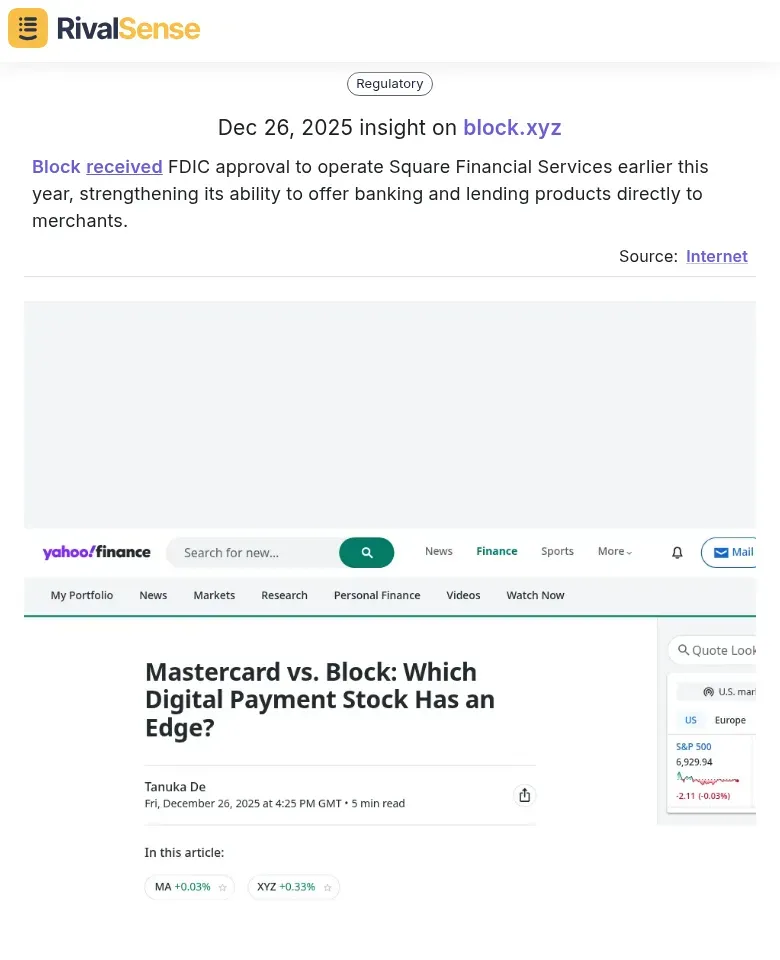
When competitors secure regulatory approvals, they're not just checking compliance boxes—they're signaling imminent market moves. Key account managers who ignore these signals risk being blindsided by new competitive offerings. For example, RivalSense highlighted that Block received FDIC approval to operate Square Financial Services earlier this year, strengthening its ability to offer banking and lending products directly to merchants. This insight is valuable for business strategy because it signals market expansion and new capabilities, allowing you to proactively address client concerns.
Proactive Tracking Methods:
📍 Regulatory databases (SEC EDGAR, FINRA BrokerCheck, state banking portals)
📰 Competitor press releases and investor presentations
🔔 Industry news alerts for regulatory announcements
Actionable Response Plan:
- Assess the threat – Will this enable faster onboarding, lower fees, or new features?
- Address client concerns preemptively – e.g., "We're aware Competitor X secured their lending license—here's how our platform already exceeds those capabilities."
- Create a tracking spreadsheet with columns for competitor, approval type, date, and potential impact.
Mistake #3: Missing Internal Regulatory Disputes as Organizational Stress Points
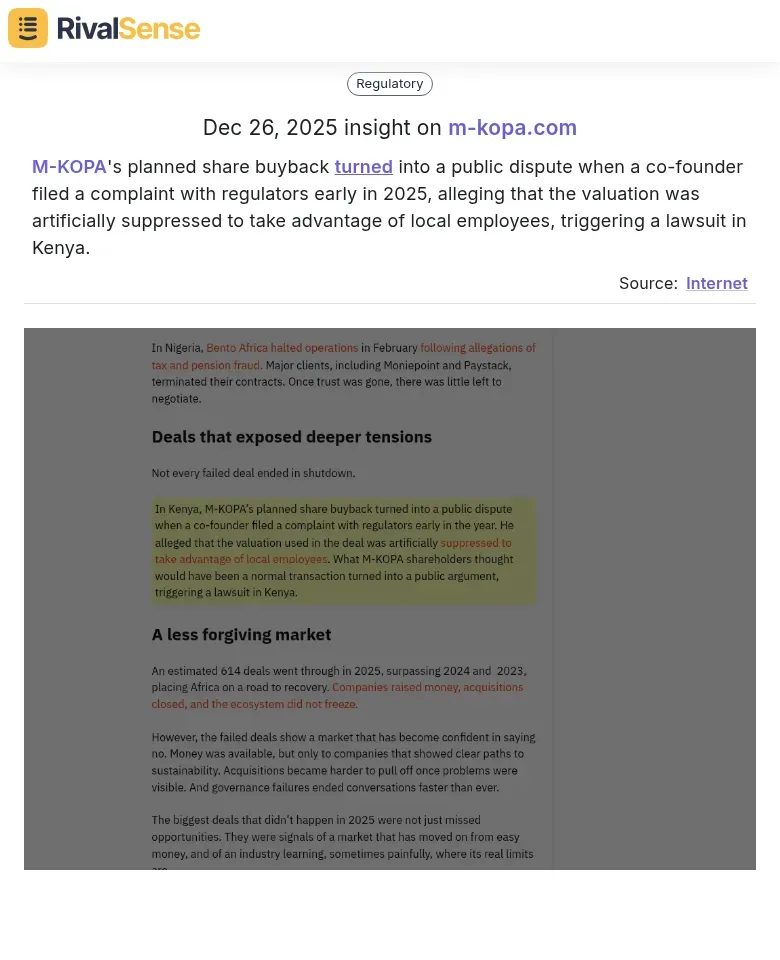
Internal regulatory disputes are often overlooked goldmines for competitive intelligence. When key account managers fail to monitor these organizational stress points, they miss critical indicators of competitor instability that directly impact client relationships. RivalSense captured that M-KOPA's planned share buyback turned into a public dispute when a co-founder filed a complaint with regulators early in 2025, alleging valuation suppression, triggering a lawsuit in Kenya. This insight is valuable for business strategy because it exposes internal fractures that can lead to service disruptions, helping you position your company as a stable alternative.
Practical Monitoring Strategy:
⚠️ Set up alerts for regulatory complaint filings against competitors
👔 Track executive departures following regulatory investigations
💬 Monitor employee reviews mentioning compliance issues
📊 Watch for sudden leadership changes during regulatory proceedings
Client Reassurance Playbook:
• Use documented regulatory disputes to demonstrate your company's compliance stability
• Frame competitor instability as a risk to client operations
• Position your proactive regulatory approach as a competitive advantage
• Share case studies showing how you've navigated similar challenges successfully
Key Insight: Internal regulatory conflicts often precede public service failures. By identifying these stress points early, you can proactively address client concerns before they escalate.
Mistake #4: Failing to Connect Regulatory Patterns to Client-Specific Risks
When competitors face regulatory scrutiny, most account managers simply note the violation. The strategic mistake is failing to connect these patterns to your client's specific compliance vulnerabilities. For example, if a competitor in financial services gets penalized for inadequate KYC procedures, map this directly to your client's customer onboarding workflows.
Practical steps to avoid this mistake:
- Create a regulatory pattern matrix – Track competitor violations by regulation type, fine amount, and affected business units.
- Conduct client vulnerability mapping – Cross-reference competitor issues with your client's similar processes.
- Develop proactive compliance solutions – Build tailored checklists addressing competitor weaknesses (e.g., "5 GDPR gaps our competitors missed").
Differentiate your value by creating regulatory risk assessments that quantify potential client exposure. Instead of generic advice, provide specific metrics: "Based on competitor X's $2M fine for data retention violations, your similar email archiving system creates a 40% higher compliance risk." This transforms regulatory intelligence from reactive monitoring to proactive risk management.
Mistake #5: Underestimating Global Regulatory Variations in Competitive Analysis
Many key account managers treat regulatory compliance as a uniform global checklist, failing to recognize how regional differences create competitive advantages. Regulatory variations aren't just compliance hurdles—they're strategic opportunities. Competitors who master local regulations can offer better pricing, faster implementation, or unique features that comply with regional requirements.
Practical Steps to Avoid This Mistake:
| Action | Description |
|---|---|
| Create jurisdiction-specific frameworks | Map requirements across target markets and track competitor adaptations. |
| Implement cross-border tracking | Use automated tools for monitoring regulatory changes in key markets. |
| Develop regional playbooks | Document regulatory advantages/disadvantages and train teams on nuances. |
Key Insight: Track how competitors leverage regulatory differences to gain market share in specific regions. Build this intelligence into your multinational account strategies to stay ahead.
Conclusion: Building a Proactive Regulatory Intelligence Framework
Building a proactive regulatory intelligence framework requires moving beyond reactive monitoring to systematic integration. Start by establishing a structured competitor regulatory monitoring process: assign dedicated team members, create a centralized repository, and set up automated alerts. Integrate these insights into your key account planning cycles by scheduling quarterly regulatory intelligence reviews before strategy sessions.
Measure impact with metrics:
📈 Regulatory intelligence contribution to account retention rates
💼 Influence on deal size during renewals affected by competitor regulatory changes
⏱️ Time-to-response for regulatory threats
Pro Tip: Combine automated monitoring with human analysis for the most effective framework. Tools like RivalSense can track competitors' product launches, pricing updates, event participations, partnerships, regulatory aspects, management changes, and media mentions across various sources, delivering insights in a weekly email report.
🚀 Ready to turn regulatory insights into competitive advantages? Try RivalSense for free at https://rivalsense.co/ and get your first competitor report today to start protecting and growing your key accounts!
📚 Read more
👉 Mastering Competitor Analysis: Insights from Hiring Trends
👉 The Ultimate Guide to Tracking Key Account History: Practical Strategies for Competitive Advantage
👉 Key Account Management Podcasts: Productivity Tips for Medical Equipment Distribution
👉 How Sensor Integration Exposed Competitors' Verification Gaps in Carbon Markets
👉 Twitter Competitor Insights Cheat Sheet for Key Account Tracking