
Real-World SEO Mystery Shopping: How Top Agencies Outperform Competitors
SEO mystery shopping transforms competitive intelligence from passive observation to active investigation. Unlike traditional analysis that relies on public data, this methodology involves anonymously evaluating competitors' services to uncover their actual strategies, pricing, and client experience. Top agencies use this approach to benchmark their performance against market leaders and identify gaps in their own offerings.
Practical implementation involves three key steps:
- Anonymous Setup: Create realistic client personas with specific business needs and budgets 🎭
- Service Evaluation: Engage competitors through consultations, proposals, and initial strategy discussions 💼
- Comparative Analysis: Document pricing structures, service inclusions, communication quality, and unique selling points 📊
Strategic advantages include discovering hidden pricing tiers, understanding actual service delivery (not just marketing claims), and identifying competitor weaknesses you can exploit. For example, you might find that a competitor's premium package lacks the technical audits they advertise, creating an opportunity to differentiate your offering.
Pro tip: Schedule mystery shopping quarterly to track competitor evolution and maintain your competitive edge. Document findings in a standardized template for consistent comparison across multiple agencies.
Case Study Analysis: How Leading Agencies Execute Mystery Shopping
Leading SEO agencies use mystery shopping to systematically evaluate competitors' strategies, turning insights into actionable improvements. For instance, one agency discovered a competitor's technical SEO gaps by simulating a client journey, identifying slow page load speeds (3.2+ seconds) and poor mobile optimization that were overlooked. Another agency quantified performance gaps by tracking competitor keyword rankings across 50+ commercial terms, revealing 35% lower conversion rates for competitors' top-ranking pages.
Methodology: Agencies simulate client experiences through structured audits:
- Technical assessment: Page speed, mobile responsiveness, Core Web Vitals ⚙️
- Content analysis: Keyword targeting, content depth, E-E-A-T signals 📝
- User journey mapping: Conversion path optimization, CTAs, lead capture 🗺️
- Backlink profiling: Competitor link acquisition strategies 🔗
Practical checklist for agency mystery shopping:
- [ ] Create 3-5 client personas with different search intents
- [ ] Track competitor ranking movements weekly using automated tools
- [ ] Document conversion friction points (forms, pricing pages, contact flows)
- [ ] Benchmark against 3-5 direct competitors simultaneously
- [ ] Quantify gaps: Calculate competitor's estimated traffic value vs. actual conversions
Top agencies outperform by identifying what competitors miss: technical debt accumulation, content gaps in emerging topics, and conversion optimization opportunities. They translate findings into actionable roadmaps, typically identifying 15-20% immediate improvement opportunities that competitors overlook.
Key Performance Indicators: What Top Agencies Measure
Top agencies measure what matters most in SEO mystery shopping to gain a competitive edge. For technical evaluation, they track Core Web Vitals (LCP, FID, CLS), crawl budget efficiency, and indexation ratios. They create checklists for mobile-friendliness, site speed, and structured data implementation. Practical tip: Use tools like PageSpeed Insights and Screaming Frog to benchmark technical performance against competitors.
Content strategy analysis goes beyond keyword density to uncover deeper insights. Top agencies evaluate topic clusters, content freshness, and E-E-A-T signals. They analyze competitor content gaps by mapping keyword intent and identifying underserved search queries. Actionable step: Create a content gap analysis spreadsheet comparing your topics vs. competitors' coverage.
Client communication effectiveness is a key differentiator that can make or break deals. Top agencies measure response times, proposal clarity, and onboarding transparency. They track how competitors explain complex SEO concepts to clients. Checklist item: Document competitor communication templates and adapt their best practices for explaining technical metrics in business terms.
These KPIs reveal not just what competitors do, but how they think about SEO success. The most valuable insights come from measuring the measurable while observing the intangible competitive advantages.
Strategic Insights: Turning Mystery Shopping Data into Competitive Advantage
Top SEO agencies transform mystery shopping data into competitive advantage through systematic analysis and strategic planning. First, they create a competitive intelligence dashboard tracking 5-10 key competitors across pricing, service offerings, and customer experience touchpoints. This reveals market gaps where competitors underdeliver—perhaps in technical SEO audits or local SEO services.
Practical steps to leverage insights:
- Map competitor service packages against pricing tiers 💰
- Identify underserved customer segments (e.g., mid-market businesses needing ongoing SEO) 🎯
- Analyze competitor content gaps using keyword difficulty vs. search volume analysis 📈
- Benchmark response times and proposal quality ⏱️
Agencies then optimize pricing by positioning between budget providers and premium agencies, while offering unique value in identified gaps. They develop targeted service packages addressing specific pain points competitors miss. For example, if competitors offer only monthly retainers, create project-based SEO audits as an entry point.
Key insight: The most successful agencies don't just match competitors—they identify where competitors are vulnerable and build superior offerings in those areas. This creates defensible market positions and higher-value client relationships.
Implementation Framework: Building Your Own Mystery Shopping Program
Building an effective SEO mystery shopping program requires a systematic approach to ensure consistency and actionable results. Here's a practical framework to get started:
Step 1: Define Your Competitive Landscape
- Identify 3-5 primary competitors and 5-7 secondary ones 🏢
- Create a spreadsheet tracking their domains, target keywords, and content strategies
- Document their service offerings, pricing tiers, and unique value propositions
Step 2: Establish Monitoring Infrastructure
- Set up automated tracking using tools like RivalSense for keyword rankings, backlink profiles, and content updates 🔔
- Configure Google Alerts for competitor mentions and news
- Use SEMrush or Ahrefs for technical SEO audits of competitor sites
- Implement social listening tools to track their engagement strategies
Step 3: Create Evaluation Criteria
- Develop a scoring system for: content quality, site speed, mobile optimization, conversion paths, and user experience 📋
- Include specific metrics like Core Web Vitals, keyword density, and internal linking structure
- Track response times for lead generation forms and customer service interactions
Step 4: Ethical Implementation Guidelines
- Never misrepresent your identity or intentions 🚫
- Avoid accessing proprietary information or trade secrets
- Focus on publicly available data only
- Document all findings objectively without bias
- Respect terms of service for all tools and platforms used
Pro Tips:
- Schedule quarterly deep-dive analyses and monthly performance reviews 📅
- Create competitor persona profiles to understand their strategic direction
- Use anonymous browsing tools to avoid detection
- Maintain a centralized knowledge base for team access
- Regularly update your evaluation criteria as SEO best practices evolve
Beyond SEO: Leveraging Broad Competitive Intelligence with RivalSense
While SEO mystery shopping focuses on digital strategies, comprehensive competitive intelligence requires tracking broader business movements. Insights from tools like RivalSense can reveal strategic shifts that impact market dynamics. For example, tracking product launches can uncover new revenue streams or partnerships that competitors are pursuing.
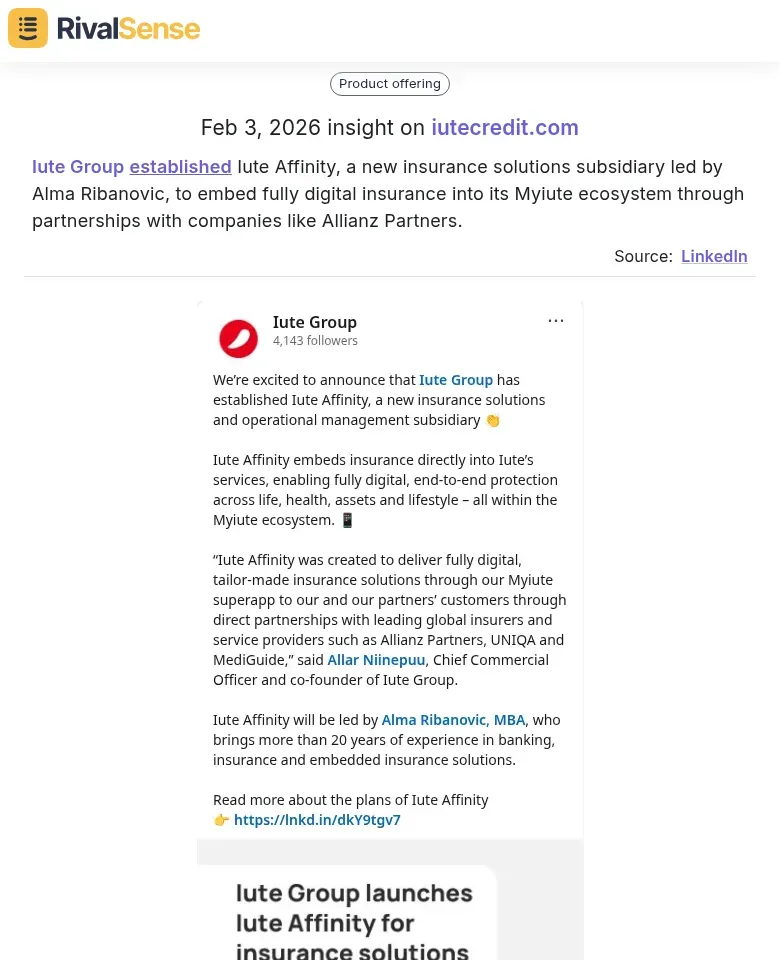
Why product launch insights are valuable: They help you anticipate market trends and adjust your offerings. For instance, RivalSense tracked that Iute Group established Iute Affinity, a new insurance solutions subsidiary led by Alma Ribanovic, to embed fully digital insurance into its Myiute ecosystem through partnerships with companies like Allianz Partners. This insight shows how competitors expand into adjacent markets, signaling opportunities or threats for your business.
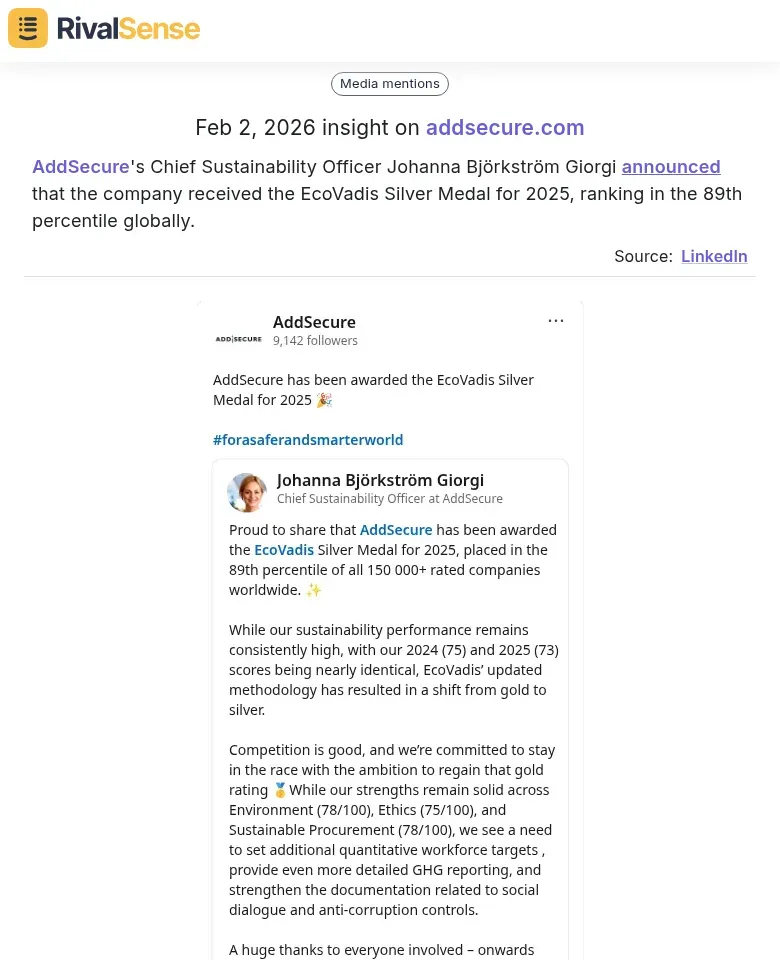
Why regulatory and award insights are valuable: They highlight competitor strengths in sustainability or compliance, which can influence client perceptions. RivalSense reported that AddSecure's Chief Sustainability Officer Johanna Björkström Giorgi announced that the company received the EcoVadis Silver Medal for 2025, ranking in the 89th percentile globally. Such accolades can enhance a competitor's brand reputation, prompting you to bolster your own sustainability narratives.
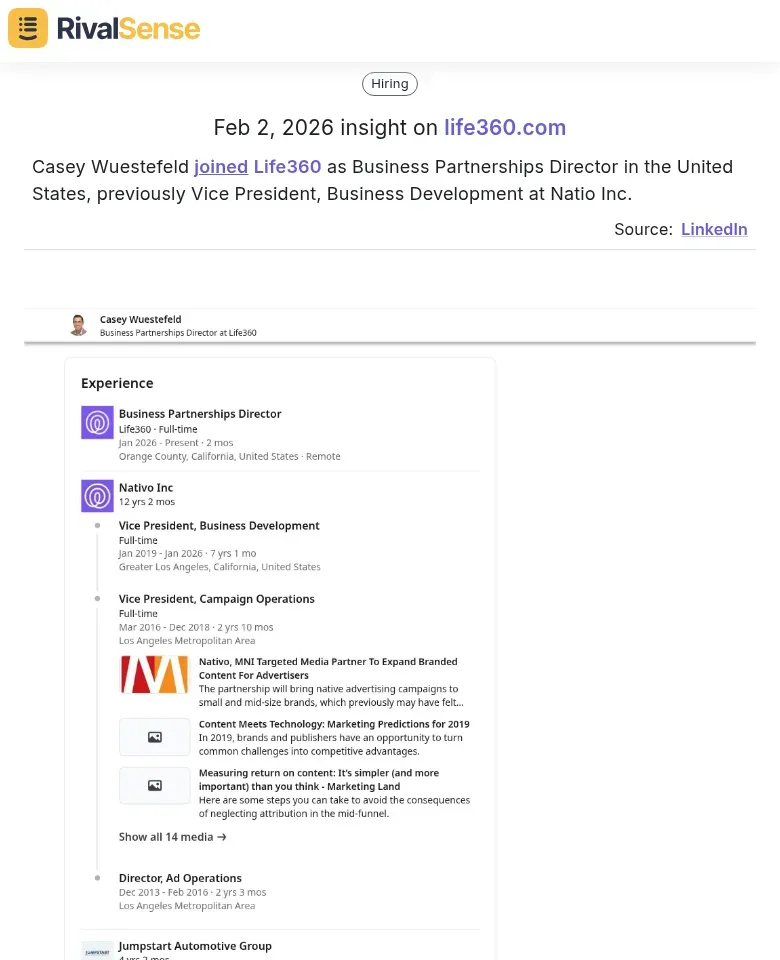
Why management change insights are valuable: They indicate strategic pivots or new focus areas. For example, RivalSense noted that Casey Wuestefeld joined Life360 as Business Partnerships Director in the United States, previously Vice President, Business Development at Natio Inc. This change might signal a push for stronger partnerships, urging you to review your own alliance strategies.
Integrating these insights with SEO mystery shopping creates a holistic view of competitor activities, from digital tactics to corporate strategy.
Conclusion: The Future of Competitive Intelligence in SEO
The future of competitive intelligence in SEO is being reshaped by AI and automation, transforming mystery shopping from manual audits to real-time monitoring systems. Top agencies now leverage AI to continuously track competitor strategies, pricing changes, and content gaps, moving beyond periodic audits to dynamic intelligence ecosystems.
For actionable implementation:
- Start with 3-5 key competitors—Track their pricing, service packages, and content strategies 🚀
- Automate monitoring—Use tools to track competitor website changes, pricing updates, and content publication
- Analyze gaps—Identify where competitors are weak and your agency can excel
- Test response times—Mystery shop your own team to ensure superior customer experience
Competitive intelligence is no longer optional—it's the foundation for differentiation. Agencies that master mystery shopping gain insights into market positioning, pricing strategies, and service delivery that competitors miss. The key is moving from reactive analysis to proactive intelligence gathering, using automated systems to stay ahead of market shifts.
Implement a quarterly mystery shopping program, document findings in competitive intelligence dashboards, and train your team to act on insights. The agencies that win tomorrow are those building competitive intelligence into their DNA today.
Ready to elevate your competitive intelligence? Try out RivalSense for free at https://rivalsense.co/ to track competitor product launches, pricing updates, event participations, and more—all delivered in a weekly email report. Get your first competitor report today and stay ahead of the curve! 📬
📚 Read more
👉 How Life360's No-Show Alert Insight Drove a Competitor's Proactive Safety Feature
👉 LinkedIn Competitor Intelligence Workflow: Cost-Effective Key Account Tracking for B2B Leaders
👉 Solving Visual Collaboration Gaps in Key Account Management Software
👉 Regulatory Competitor Insights: A Checklist for Key Account Growth
👉 Leveraging Personnel Changes for Competitor Analysis: A Real-World Example