
Quick Website Monitoring Hacks for Key Account Intelligence
In today's hyper-competitive B2B landscape, key account intelligence isn't just about quarterly reviews—it's about real-time awareness. Website monitoring transforms reactive tracking into proactive strategic intelligence by capturing the subtle signals that precede major market shifts. When you automate competitor website tracking, you move from playing catch-up to anticipating moves before they happen.
Consider this: a key competitor quietly adds a new case study page targeting your top client's industry. With manual monitoring, you might discover this weeks later. With automated tracking, you receive an alert within hours, giving you time to reinforce your value proposition before your client even sees their pitch. This isn't just monitoring—it's strategic foresight.
Practical steps to implement:
- Set up automated alerts for pricing page changes, new case studies, and team additions
- Monitor job postings for clues about competitor expansion plans
- Track blog content themes to identify shifting strategic priorities
- Watch for technology stack changes that signal new capabilities
Website changes are the digital footprints of strategic intent. By connecting these dots to your key account management, you transform website monitoring from an IT task into a competitive intelligence weapon that keeps you ahead of market shifts and competitor moves.
Hack #1: Decode Pricing Strategy Shifts from Competitor Website Updates 💰
Pricing changes are often the first sign of a competitor's strategic shift. By monitoring their website updates, you can decode these moves and protect your key accounts from price-based attacks. Here's how to turn pricing intelligence into actionable insights:
Step 1: Spot the Signals
- Monitor competitor pricing pages, product descriptions, and feature matrices weekly
- Look for tier restructuring (new/removed plans), value bundling (features repackaged), or price-per-unit adjustments
- Example: A competitor adding enterprise features to mid-tier plans signals upmarket targeting
Step 2: Analyze the Impact
- Calculate new price-to-value ratios using updated feature lists
- Compare old vs. new package structures to identify hidden price increases
- Track how changes affect your key accounts' perceived value
Step 3: Take Action
- Use insights to refine your own tiering or bundle high-value features
- Proactively address key account concerns before competitors pitch them
- Adjust your value proposition to highlight competitive advantages
Real-World Example:
RivalSense recently tracked that ProxyRack updated its private residential proxy offering from 5 ports at $26.38 per port to 15 ports at $19.99 per port, with the monthly price increasing from $131.90 to $299.99.
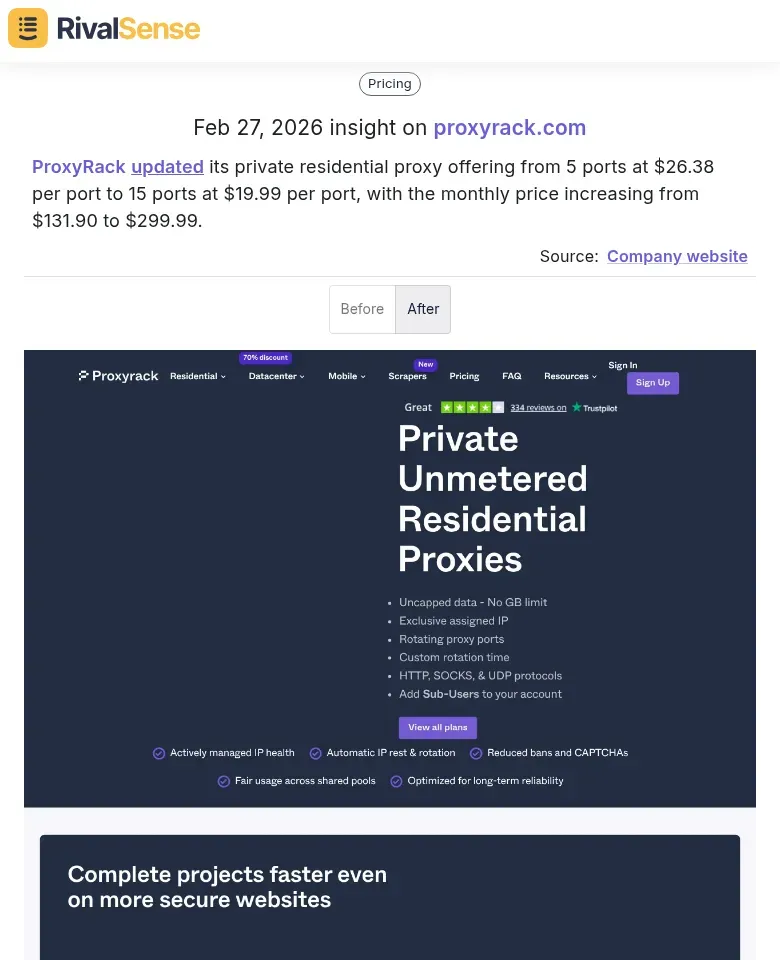
This type of pricing insight is valuable for business strategy because it reveals how competitors are adjusting their value propositions—in this case, shifting to a bulk pricing model that may appeal to larger enterprises. By catching such changes early, you can reassess your own pricing tiers and prepare counter-strategies for key accounts.
Quick Checklist:
✓ Document baseline pricing before changes
✓ Note feature migrations between tiers
✓ Calculate effective price changes for target accounts
✓ Update competitive battle cards with new intelligence
✓ Schedule key account check-ins to reinforce value
Pricing intelligence isn't just about matching numbers—it's about anticipating competitor moves and protecting your most valuable relationships through strategic positioning.
Hack #2: Track Brand Evolution and Product Rebranding for Market Positioning Insights 🏷️
Brand rebranding signals deeper strategic pivots that can impact market positioning. When competitors consolidate products or change names, they're often targeting new customer segments or unifying their platform. Monitoring these changes helps you anticipate shifts in their focus and resource allocation.
Practical Checklist:
- Set up alerts for competitor website changes, especially product pages and navigation menus
- Track naming convention patterns—look for prefixes like "AI-", "Smart-", or "Enterprise-" that signal positioning shifts
- Monitor feature integration patterns when products merge—which features get prioritized reveals their target market
- Analyze product hierarchy changes—when standalone products become features within larger platforms, it shows platform unification strategy
- Document timeline of rebranding initiatives to identify strategic cadence
Real-World Example:
Trimble Inc. has rebranded its core TMS solutions, renaming TruckMate to Trimble TruckMate and TMW.Suite to Trimble TMW.Suite, while introducing new features for Fuel Dispatch and Trimble TMS, including AI-powered modules and predictive forecasting.
Tracking such rebranding efforts is crucial for business strategy as it indicates a focus on integration and AI capabilities, helping you anticipate competitive moves in technology adoption and adjust your own market messaging.
Key Intelligence Signals:
- Brand consolidation = market focus narrowing
- Feature integration patterns = target customer segment prioritization
- Naming convention changes = competitive positioning shifts (e.g., from "Basic" to "Pro" indicates upmarket move)
- Product hierarchy restructuring = platform strategy evolution
Quick Tip: Use RivalSense to automatically track competitor website changes and receive alerts when rebranding initiatives occur, allowing you to analyze positioning shifts in real-time.
Hack #3: Monitor New Product Launches and Feature Expansions for Innovation Intelligence 🚀
New product launches and feature expansions are direct indicators of a competitor's innovation roadmap. By tracking these, you can identify emerging threats and opportunities for your key accounts. This intelligence allows you to stay ahead in the innovation race and protect your account base.
Track vertical market expansion by monitoring new industry-specific landing pages, case studies, and solution pages. Set up alerts for keywords like "for healthcare," "manufacturing edition," or "financial services module" to catch competitors entering new sectors.
Identify platform evolution patterns by watching for modular additions like API expansions, new integrations, or capability enhancements. Create a checklist: track new pricing tiers, feature announcements in changelogs, and developer documentation updates.
Analyze technology stack development by monitoring AI integration announcements, new tool partnerships, and ecosystem growth. Practical tip: Use RSS feeds for competitor blogs, GitHub repositories, and product announcement platforms.
Real-World Example:
Kore.ai introduced new AI applications for banking, healthcare, retail, IT, HR, and recruiting, along with platform modules for multi-agent orchestration, AI engineering tools, search and data AI, AI security and governance, and no-code and pro-code tools.
This insight into product expansion is valuable for strategy as it shows competitor focus on vertical markets and AI integration, allowing you to adjust your own innovation priorities and account defenses before your clients are approached.
Weekly Review Routine:
- Set up weekly reviews of competitor release notes
- Conduct quarterly analysis of their technology partnerships
- Map new features to your key accounts' pain points
- Update your product roadmap based on competitive gaps
Hack #4: Set Up Automated Alerts for Critical Website Changes That Impact Key Accounts 🔔
Automated alerts ensure you never miss critical competitor updates. By focusing on high-threat changes, you can respond swiftly to protect your key accounts. Not all website changes are created equal, so prioritize monitoring based on account vulnerability and competitor threat level.
Create a tiered system:
- Tier 1: Direct competitors for your top 5 accounts
- Tier 2: Emerging threats for secondary accounts
- Tier 3: Market disruptors with potential long-term impact
Configure intelligent alerts that filter out noise. Set up keyword triggers for pricing changes, feature announcements, case studies mentioning your clients, and leadership team updates. Use location-based monitoring for regional competitors targeting specific accounts.
Practical tip: Create alert rules that only trigger when multiple keywords appear together (e.g., "enterprise" + "pricing" + "your client's industry").
Establish response protocols for different change types:
| Change Type | Response Timeline | Team Responsible |
|---|---|---|
| Pricing changes | Immediate notification | Sales team with competitive positioning guidance |
| Feature launches | 24-hour analysis window | Product team to assess impact |
| Case studies | Account team review within 48 hours | Prepare counter-messaging |
| Leadership changes | Weekly digest | Strategic planning team |
Checklist for Implementation:
- Map competitors to specific key accounts
- Set up tiered monitoring priorities
- Configure keyword combinations for intelligent filtering
- Define response timelines for each change type
- Assign team responsibilities for each alert category
Conclusion: Building a Sustainable Website Monitoring System for Continuous Intelligence 📈
To build a sustainable website monitoring system for continuous intelligence, start by integrating insights into your weekly competitive intelligence workflow. Create a simple dashboard that tracks 3-5 key competitor metrics (pricing changes, feature launches, content updates) and review it every Monday morning. This ensures monitoring becomes a habit, not an afterthought.
Establish feedback loops by connecting monitoring data directly to account strategy sessions. When you spot competitor website changes, immediately ask: "How does this impact our key accounts?" and "What adjustments should we make?" Create a simple checklist:
- Identify affected accounts – Which clients are most vulnerable?
- Assess competitive threat level – Is this a minor update or a major shift?
- Update account playbooks – Adjust your approach based on new intelligence
- Schedule client conversations – Proactively address potential concerns
Measure ROI through concrete metrics: track account retention rates before and after implementing monitoring insights, and document competitive wins where monitoring provided the edge. Tip: Create a "monitoring impact log" to record specific instances where website intelligence influenced account decisions. This builds the business case for ongoing investment while ensuring your monitoring system evolves based on real-world results.
Ready to Implement These Hacks? 🛠️
Start by trying out RivalSense for free at https://rivalsense.co/ to get automated competitor insights delivered in a weekly email report. Sign up today and get your first competitor report to stay ahead of pricing shifts, rebranding moves, and product launches—transforming website monitoring into your strategic advantage for key account intelligence.
📚 Read more
👉 AI Agent Productivity: Analyzing Competitor UX for Enterprise Advantage
👉 Predictive Analysis: Forecast Competitor Churn via Media & Content Insights
👉 Decoding Competitor Moves: How Hiring Insights Reveal Strategic Shifts
👉 Mastering Competitor Trade Show Strategy for 2026 Business Growth
👉 A Step-by-Step Guide to Comparing Key Account Management Tools for Industrial Machinery Maintenance