
Quick Twitter Hacks: Competitor Intelligence for B2B Leaders
For B2B leaders, from founders to key account managers, Twitter offers unparalleled real-time insights into competitor activities. While traditional research methods are slow, Twitter reveals strategic moves as they happen, allowing you to stay ahead in the market. This speed advantage enables proactive decision-making and stronger account management.
Practical steps to start:
- Create private Twitter lists for each major competitor, including their official accounts, key executives, and product teams.
- Set up alerts for competitor mentions of your target accounts using Twitter’s advanced search operators.
- Monitor competitor responses to industry news and customer complaints to gauge their strategic priorities.
💡 Tip: Pay attention to engagement patterns—when competitors suddenly start interacting with a target account’s leadership team, it often signals upcoming sales activity. This real-time visibility transforms reactive approaches into proactive strategy, giving you the edge in high-stakes B2B relationships.
Three Core Twitter Monitoring Strategies for Competitive Advantage
Twitter monitoring can be broken down into three key areas that deliver strategic insights. By focusing on these, you can gather actionable intelligence to inform your business decisions and outmaneuver competitors.
1. Track Product Launches & Feature Updates
Monitoring competitor announcements helps you identify automation opportunities and efficiency gains. When competitors launch new features, analyze implementation timelines and customer reactions to adapt your own strategy.
Example from RivalSense: Google AI launched Gemma 4, an open model with reasoning capabilities for personal hardware, and Veo 3.1 Lite on April 3. 
Why it's valuable: Tracking such product launches allows you to anticipate market trends, assess competitive threats, and identify gaps in your own offerings. It helps in planning counter-features or marketing messages to stay competitive.
✅ Practical checklist:
- Set up Twitter alerts for “launch,” “update,” “feature” + competitor handles
- Document which automation features competitors adopt first
- Measure engagement metrics on launch announcements
- Test similar automation in your workflow within 30 days
2. Monitor Technology Partnerships & Research Publications
Analyzing partnership announcements reveals market expansion strategies and innovation pipelines. When competitors announce integrations or research collaborations, track adoption patterns to understand their ecosystem development.
Example from RivalSense: Anthropic’s research on cross-architecture model diffing with Crosscoders, led by Tom Jiralerspong and supervised by Trenton Bricken, was published on April 3. 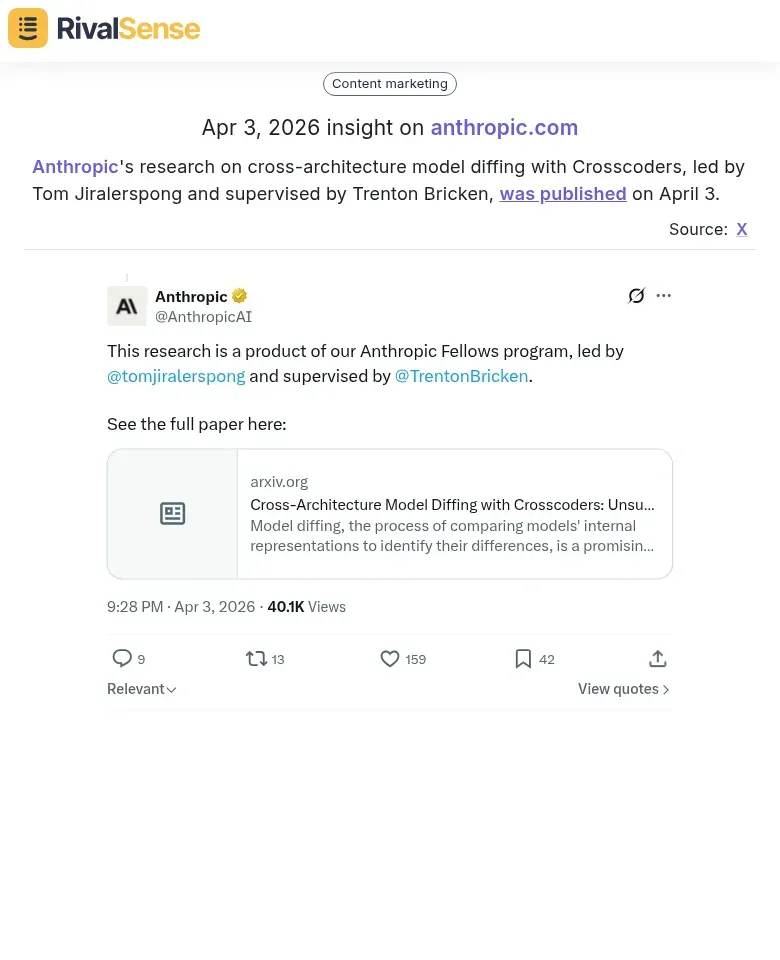
Why it's valuable: Insights into research publications signal upcoming product innovations and technical roadmaps. This helps you prepare for future market shifts and identify potential partnership opportunities to enhance your own offerings.
🚀 Actionable steps:
- Create tracking lists for partnership keywords (#partner, #collaboration, #research)
- Note which accounts competitors tag in partnership tweets
- Analyze ecosystem development trends quarterly
- Identify gaps where you can form similar alliances
3. Analyze Award Nominations & Industry Recognition
Tracking industry awards and recognition gauges market validation and brand positioning. Monitor how competitors leverage accolades in their messaging to refine your own strategy and highlight your strengths.
Example from RivalSense: Apple TV’s ‘Prehistoric Planet: Ice Age’ is now streaming and is a BAFTA TV Award nominee. 
Why it's valuable: Award nominations highlight areas where competitors are excelling and receiving market approval. This intelligence can guide your branding efforts and help you position your company as a leader in similar domains, boosting credibility.
🏆 Practical tips:
- Set up alerts for “award,” “recognition,” “top” + industry terms
- Document which awards competitors win most frequently
- Analyze how they incorporate recognition into customer communications
- Use this intelligence to refine your own positioning strategy
🔍 Pro tip: Use Twitter Lists to organize competitors by tier and track their interactions with shared target accounts. Look for patterns in who they engage with most frequently – these relationships indicate priority accounts worth monitoring closely.
Learning from Real-World Twitter Insights: Strategic Applications
Real-world Twitter insights transform raw data into strategic advantage. By applying these insights practically, you can stay ahead of competitors and better serve your key accounts with timely, informed actions.
Content Streaming Announcements: When competitors announce new content series or streaming events, analyze engagement patterns. Look beyond likes—track retweet ratios, reply sentiment, and follower growth spikes. For instance, if a rival’s webinar series generates 3x more quote tweets than usual, they’ve tapped into a high-value discussion topic.
Actionable tip: Create a weekly tracker spreadsheet with columns for content type, engagement metrics, and audience response themes to identify trends.
AI Research Publications: As seen with Anthropic’s research, monitoring AI publications signals upcoming innovations. Track which academic institutions competitors collaborate with and which problems they’re solving to anticipate market shifts and adapt your product roadmap.
Practical step: Set up Twitter alerts for competitor handles + keywords like “research,” “paper,” or “arXiv.” When you spot a trend, anticipate customer experience enhancements in 6-12 months and prepare your response.
Open Model Launches: Similar to Google AI’s Gemma 4 launch, analyzing open-source model releases reveals ecosystem strategies. Check who’s retweeting—developers, enterprise partners, or academics? This shows their differentiation approach and target audience.
📋 Quick checklist:
- Document launch timing relative to industry events
- Track third-party integrations mentioned in replies
- Monitor GitHub star growth correlations
🌟 Pro tip: Combine these insights—content patterns reveal messaging priorities, AI research indicates technical roadmap, and open models show partnership strategy. Cross-reference to build a complete competitive picture for informed decision-making.
Building Your Twitter Monitoring Framework for Key Accounts
Building an effective Twitter monitoring framework starts with organization and automation. By setting up structured lists and alerts, you can efficiently gather and analyze competitor intelligence without getting overwhelmed by noise.
Create three specialized Twitter Lists: 1) Competitors (direct and indirect), 2) Industry influencers and analysts, and 3) Your target key accounts. Use private lists to track competitors discreetly and avoid alerting them to your monitoring efforts.
Set up automated alerts using Boolean operators for precision tracking. For example, “(competitor_name OR @competitorhandle) AND (pricing OR discount OR deal) -RT” catches pricing discussions without retweets, focusing on original content.
Implement sentiment analysis by categorizing reactions into positive, negative, and neutral. Track trends over time to identify market validation opportunities or emerging issues that you can address proactively.
✅ Quick checklist:
- Create and maintain your three core Twitter Lists
- Set up 5-7 Boolean alerts for each competitor
- Review sentiment analysis weekly
- Document insights in your CRM or competitive intelligence platform
- Share findings with your sales team during weekly syncs
Turning Twitter Insights into Actionable Account Engagement Strategies
Twitter reveals gaps in competitor engagement that you can exploit to win key accounts. Start by analyzing their patterns: Which questions go unanswered? Which customer segments receive minimal interaction? This identifies underserved areas where you can position your company as a solution provider.
Develop targeted messaging that positions your company as the specialist for these gaps. Craft tweets, threads, and replies that address overlooked needs, using language that contrasts with competitors—if they focus on features, emphasize outcomes and benefits.
📋 Checklist for action:
- Map competitor engagement by topic
- Identify 2-3 underserved segments
- Draft 5-7 key messages per segment
- Build competitive battle cards with validated intelligence from Twitter, including screenshots and analysis
💬 Tip: Monitor Twitter daily for real-time adjustments—engagement patterns shift quickly, and staying agile allows you to capitalize on emerging opportunities.
Integrating Twitter Intelligence Across Your Organization for Maximum Impact
To maximize impact, integrate Twitter intelligence into your organizational processes. Establish shared dashboards that track competitor mentions, customer sentiment, and trends, enabling coordinated responses across sales, marketing, and product teams.
Develop quarterly review protocols where cross-functional teams analyze insights. Use standardized templates to document findings, such as competitor positioning shifts, customer pain points, and emerging market trends, and update competitive playbooks accordingly.
Measure ROI by correlating Twitter intelligence with business outcomes, such as account wins influenced by insights or deal velocity improvements. Implement a simple scoring system to track contributions and refine collection priorities over time.
🔄 Practical checklist:
- Set up automated alerts for competitor announcements
- Create shared dashboard accessible to sales, marketing, and product teams
- Schedule quarterly cross-functional review meetings
- Document insights in standardized competitive intelligence templates
- Track account wins influenced by Twitter intelligence
- Update competitive playbooks quarterly based on findings
Conclusion and Next Steps
Twitter is a powerful tool for real-time competitor intelligence, but manual monitoring can be time-consuming and prone to misses. To streamline this process and gain comprehensive insights, consider using specialized tools that automate data collection and analysis.
For example, RivalSense tracks competitor product launches, pricing updates, event participations, partnerships, regulatory aspects, management changes, and media mentions across company websites, social media, and various registries. It delivers all this in a weekly email report, saving you time and ensuring you never miss a key update.
Ready to enhance your competitor tracking? Try RivalSense for free at https://rivalsense.co/ and get your first competitor report today to start turning insights into actionable strategies for your business.
📚 Read more
👉 Advanced Financial Analysis for Video Editing Software Competitors: Turning Insights into Strategy
👉 Competitor Product Analysis Workflow: From Tracking to Strategic Insights
👉 Decoding Competitor Moves: What Vanta's New Storytelling Hire Reveals
👉 The Ultimate Key Account Tracking Workflow: A Practical Guide for 2026
👉 Data-Driven Aviation Fuel Competitor App Review Tracking Strategies