
Quick Tips: Uncover Competitor Partnerships to Win Key Accounts
When you're focused on feature-by-feature comparisons, you're missing the real threat: competitor partnerships that create bundled solutions your standalone offering can't match. These strategic alliances transform individual products into comprehensive ecosystems that directly threaten key account renewals. Imagine a client choosing your competitor's CRM because it's bundled with their partner's marketing automation tool at a 20% discount—suddenly, your superior standalone solution becomes irrelevant.
Key accounts don't just evaluate products; they evaluate solutions. When competitors partner, they create value propositions that address multiple pain points simultaneously, making renewal decisions about convenience and integration, not just functionality. Your best feature becomes meaningless when it's part of a less convenient package.
Practical steps to start today:
- Map your top 5 competitors' partnership pages and track changes monthly
- Monitor joint webinars, co-branded content, and shared case studies
- Set Google Alerts for "[competitor] partners with" and "[competitor] alliance"
- Analyze partnership announcements for bundled pricing models
- Document how partnerships affect your current key accounts' renewal criteria
Proactive partnership tracking isn't optional—it's how you identify threats before they cost you major renewals. Start by dedicating 30 minutes weekly to competitor alliance monitoring, and you'll spot bundled solutions before they become deal-breakers.
The Three Partnership Types That Threaten Your Key Accounts
Competitors often leverage three critical partnership types to threaten your key accounts. Understanding these can help you anticipate moves and protect your position. By categorizing partnerships, you can develop targeted counter-strategies.
-
Geographic Expansion Partnerships: When competitors partner with established local players, they gain instant market access and credibility. For example, a SaaS company partnering with a regional consulting firm can bypass years of market development. Tip: Monitor competitor press releases and LinkedIn for announcements about new market entries or local partnerships.
-
Technology Integration Alliances: These create comprehensive bundled offerings that solve multiple customer problems at once. A competitor's CRM integrating with a popular marketing automation tool creates a powerful ecosystem. Checklist: Regularly test competitor products for new integrations, and track their partner pages for technology alliances.
-
Distribution Channel Partnerships: These dramatically increase competitor reach and accessibility. A competitor partnering with a major reseller network can suddenly appear in dozens of new sales conversations. Practical Step: Identify which channels matter most to your key accounts, then monitor competitor presence through channel partner directories and industry events.
Actionable Insight: Create a partnership tracking matrix for each key competitor. Document their geographic, technology, and distribution partners, and assess how these alliances might impact your key accounts. This proactive approach helps you anticipate competitive threats before they materialize.
Learning from Real-World Partnership Examples
Learning from real-world partnership examples provides actionable insights into competitor strategies. By examining specific cases, you can understand how alliances impact market dynamics and customer decisions.
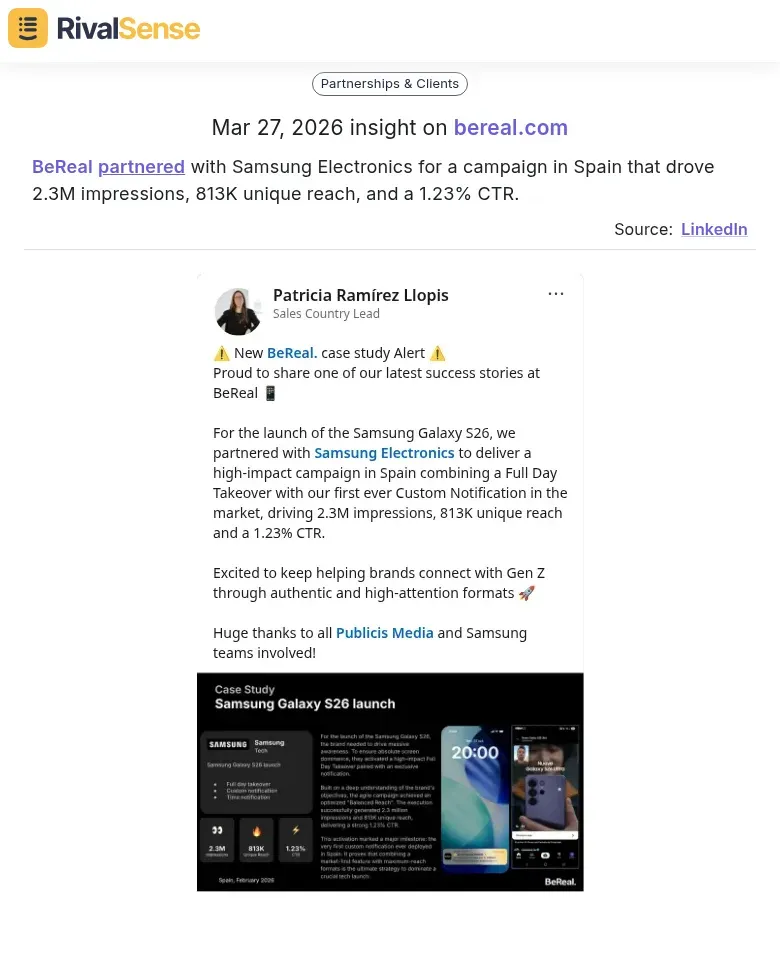
For instance, tracking campaign metrics like impressions, reach, and CTR reveals the effectiveness of co-marketing initiatives. Consider the partnership between BeReal and Samsung Electronics for a campaign in Spain that drove 2.3M impressions, 813K unique reach, and a 1.23% CTR. This type of insight is valuable for assessing the ROI of competitor partnerships and understanding their marketing reach.
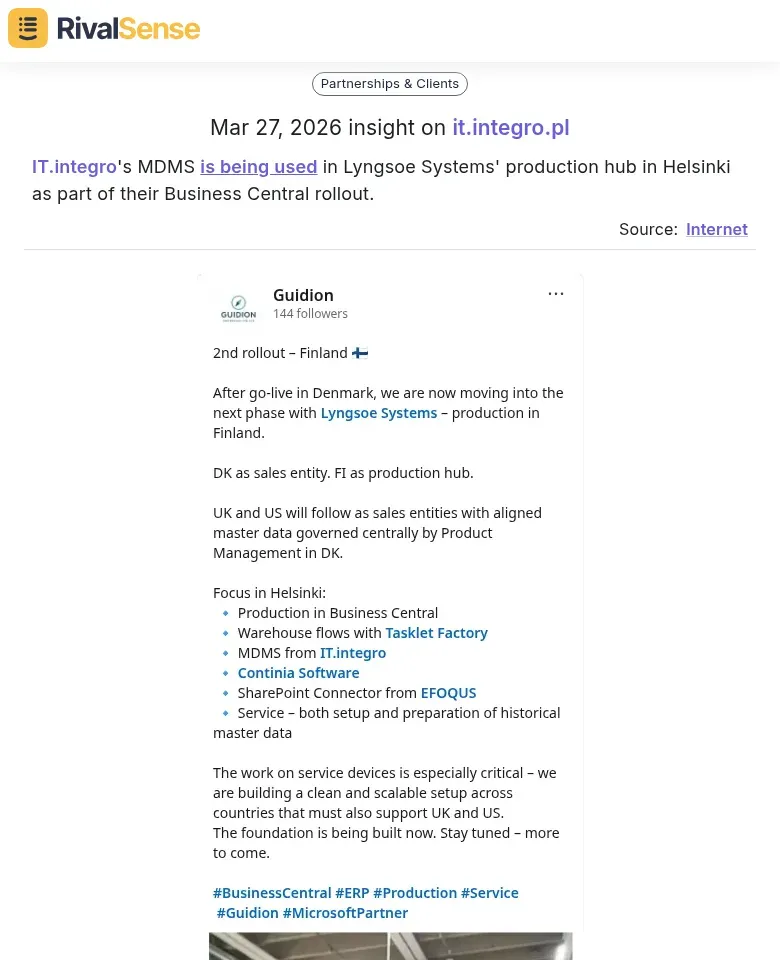
Similarly, technology integration partnerships show how competitors enhance their offerings. IT.integro's MDMS being used in Lyngsoe Systems' production hub in Helsinki as part of their Business Central rollout demonstrates a deep integration that adds value to both parties. Monitoring such integrations helps you anticipate how competitors are strengthening their ecosystems.
Strategic collaborations, like Flying Tiger Copenhagen's announcement of a collaboration with RuPaul's Drag Race on March 28, target specific demographics and boost brand visibility. This insight is valuable for identifying how competitors are expanding into new markets or engaging with niche audiences.

Practical tip: Use tools like RivalSense to automate the tracking of such partnerships and receive alerts when competitors announce new alliances. This ensures you never miss strategic shifts that could impact your market position.
Building Your Partnership Intelligence Framework
To systematically monitor competitor partnerships, you need a robust intelligence framework. This involves setting up tracking systems and analyzing data to anticipate threats. A well-structured framework ensures you stay ahead of competitive moves.
Create a partnership tracking dashboard with these key metrics: partnership announcement frequency, integration depth (API vs. co-marketing), revenue impact scoring (1-10 scale), and customer overlap percentage. Use tools like RivalSense to automate monitoring across 80+ sources including press releases, social media, and regulatory filings.
Set up automated monitoring systems with real-time alerts for: competitor joint announcements, co-branded webinars, shared booth appearances at major conferences, and API integration updates. Practical tip: Configure alerts for competitor mentions alongside major cloud providers (AWS, Azure, Google Cloud) to detect emerging alliances before they impact your market position.
Develop partnership impact matrices for each key account using a 2x2 grid: vertical axis measures partnership strength (weak to strong), horizontal axis assesses your vulnerability (low to high). For each account, plot competitor partnerships to identify high-risk scenarios where strong competitor alliances intersect with your high vulnerability.
Checklist:
- Map all competitor partnerships per account
- Score partnership strength (1-5)
- Assess your vulnerability (1-5)
- Prioritize accounts in the high-risk quadrant for immediate action
- Update quarterly as new partnerships emerge
Mapping Partnership Intelligence to Your Renewal Timeline
Integrating partnership intelligence into your renewal timeline is crucial for proactive account management. By aligning monitoring with key dates, you can anticipate and counter competitor moves effectively.
Create a 12-month monitoring framework starting 6-12 months before renewal dates. Begin by identifying key accounts and their renewal windows, then set up automated alerts for competitor partnership announcements, joint marketing campaigns, and co-selling initiatives. Use tools like RivalSense to track competitor movements systematically.
Practical Checklist:
- 📅 Map all key account renewal dates 12 months out
- 🔔 Set automated alerts for competitor partnership filings
- 📊 Create a dashboard tracking competitor co-marketing activities
- 👥 Assign team members to monitor specific competitor relationships
At 9 months before renewal: Conduct your first strategic check-in. Review competitor partnership patterns and assess potential threats. Are competitors forming alliances with your clients' preferred vendors? Are they launching joint solutions that could displace your offering?
At 6 months before renewal: Conduct your second check-in. Analyze partnership intelligence for emerging trends. Look for patterns in competitor integration announcements, API partnerships, or channel expansions. Adjust your value proposition based on these insights.
At 3 months before renewal: Conduct your final pre-renewal assessment. Identify specific partnership threats that could impact your renewal negotiations.
60-90 days before renewal windows: Develop targeted counter-strategies. If competitors have formed partnerships with complementary vendors, create your own alliance strategy. Prepare value-added bundles, enhanced integration options, or exclusive partnership benefits to counter competitor moves. Document specific talking points addressing partnership advantages you offer.
Tip: Competitor partnership filings often precede market launches by 30-90 days, giving you crucial lead time to adjust your renewal strategy. Use this window to strengthen client relationships and demonstrate superior partnership value.
Actionable Strategies to Counter Competitor Partnerships
To counter competitor partnerships effectively, you need proactive strategies that leverage your unique strengths. Developing response playbooks and timing your moves strategically can protect your key accounts.
Develop 'partnership-proof' value propositions that emphasize your unique advantages competitors can't replicate through alliances. For example, highlight proprietary technology, superior customer support, or exclusive data insights.
Create response playbooks for different scenarios:
- Feature gaps: Develop quick-win solutions or emphasize your platform's superior integration capabilities
- Channel expansion: Strengthen relationships with existing partners or offer better commission structures
- Technology integration: Showcase your native functionality versus their 'bolted-on' solutions
Time your strategic moves carefully. Monitor competitor partnership announcements and map them against your key accounts' renewal cycles. Launch your own partnerships or feature enhancements 60-90 days before major renewal dates to demonstrate proactive innovation.
Use this checklist:
- Track competitor partnership announcements in real-time
- Identify affected accounts immediately
- Assess partnership impact on your value proposition
- Prepare tailored response messaging
- Schedule counter-moves before renewal windows
Pro tip: Create 'partnership vulnerability assessments' for your top 20 accounts to anticipate where competitors might gain traction through alliances.
Staying ahead of competitor partnerships requires continuous monitoring and strategic insight. To streamline this process, try out RivalSense for free at https://rivalsense.co/ and get your first competitor report today. RivalSense tracks competitor product launches, pricing updates, event participations, partnerships, and more, delivering all in a weekly email report to help you protect your key accounts.
📚 Read more
👉 Strategic Competitor Analysis in 2026: Mastering Media Mentions and Content Marketing Trends
👉 Competitor Analysis in Action: Decoding Web Scraper's Marketplace Expansion
👉 Key Account Tracking Permissions: The Complete Guide for B2B Leaders in 2026
👉 Renewable Energy SEO Benchmarking: Outperform Competitors Strategically
👉 How Genspark's Voice Launch Prompted a Rival's AI Workspace Acceleration