
Quick Market Entry Hacks: Competitor Insights for Startup Key Accounts
Entering a new market is like navigating uncharted territory—competitor insights are your GPS. They accelerate market entry by revealing untapped opportunities that established players have overlooked. For startups targeting key accounts, this intelligence is non-negotiable: you can't win high-value clients without understanding how competitors are positioned and where they're falling short. Think of it as learning from others' expensive mistakes and successes without paying the tuition.
Practical Hack: Start with a 3-step competitive positioning audit:
- Map competitors' key account offerings on a matrix (price vs. features)
- Analyze customer reviews for recurring complaints about current solutions
- Identify service gaps where competitors consistently underdeliver
This reveals where you can differentiate—perhaps through superior onboarding, flexible pricing, or features that address specific pain points competitors ignore. Remember: key accounts choose solutions that solve their unique problems, not just match existing offerings. Your competitive intelligence should focus on uncovering those unmet needs that become your entry wedge.
Hiring Patterns as Expansion Signals: Decoding Competitor Growth Strategies
Hiring announcements are one of the earliest and most reliable signals of competitor expansion. When a rival suddenly posts multiple roles in a new region or for a specific function, they're revealing their strategic priorities months before public announcements. For founders and CEOs, decoding these signals can provide a critical edge in timing your own market entry and resource allocation.
Practical Analysis Framework:
- Monitor 3-5 key competitors across LinkedIn, company career pages, and job boards
- Track role patterns - look for clusters of sales, implementation, or customer success roles in specific regions
- Analyze organizational structure - reporting lines reveal which functions are prioritized (e.g., "Reports to VP of EMEA Expansion")
- Note technology requirements - specific tools or platforms mentioned indicate product direction
Key Signals to Watch:
- Regional hiring spikes in new markets signal geographic expansion
- Multiple senior leadership roles indicate market entry team formation
- Implementation specialist clusters suggest enterprise focus
- Local language requirements confirm market commitment
💡 RivalSense Insight Example:
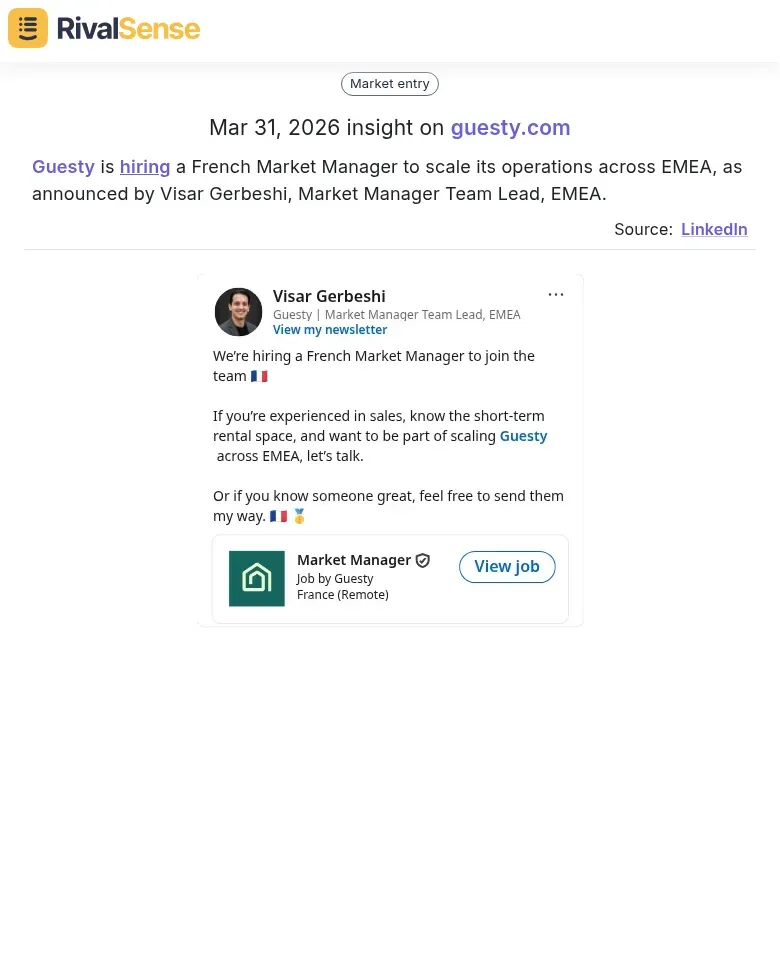
Guesty is hiring a French Market Manager to scale its operations across EMEA, as announced by Visar Gerbeshi, Market Manager Team Lead, EMEA. This type of insight is valuable because it signals deliberate expansion into new regions, allowing you to anticipate competitor moves and adjust your strategy—like accelerating your own hiring or strengthening client relationships in that market.
Benchmarking Checklist:
✓ Compare competitor team composition to your planned structure
✓ Analyze their regional hiring timeline to anticipate market entry speed
✓ Note which functions they prioritize first (sales vs. support)
✓ Track how quickly they scale from initial hires to full teams
Pro Tip: Use automated tools to monitor competitor hiring. When you see a competitor hiring 5+ sales roles in a new region within 30 days, they're likely launching there within 3-6 months. Adjust your own market entry timing and resource allocation accordingly.
Physical Presence and Brand Activation: Learning from Competitor Launch Strategies
When entering new markets, analyzing competitor physical presence strategies can accelerate your own launch. Physical expansions, such as store openings or flagship launches, reveal confidence in specific markets and target demographics. By studying these moves, you can optimize your timing, location choices, and brand activation efforts to gain a competitive advantage.
Practical Checklist:
- Track competitor flagship store openings in target cities
- Monitor brand partnerships and celebrity endorsements (these signal market commitment and target demographics)
- Analyze launch event timing relative to local holidays or industry events
- Note location choices - are they in premium retail districts or emerging neighborhoods?
💡 RivalSense Insight Example:
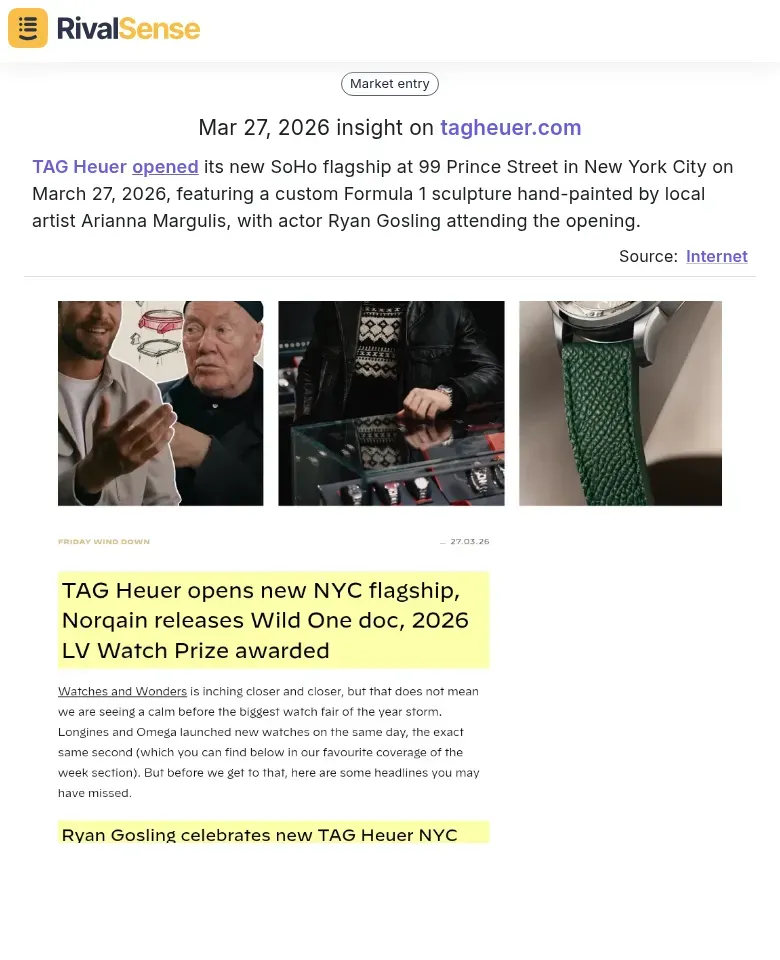
TAG Heuer opened its new SoHo flagship at 99 Prince Street in New York City on March 27, 2026, featuring a custom Formula 1 sculpture hand-painted by local artist Arianna Margulis, with actor Ryan Gosling attending the opening. Insights like this are valuable for business strategy as they highlight brand activation and market commitment, helping you understand competitor priorities and refine your own launch events or location selections.
For example, if a competitor consistently opens pop-ups before permanent stores, they're likely testing market viability. If they partner with local influencers before physical entry, they're building brand awareness. Use these insights to refine your own timing: launch during industry events when media attention is high, or avoid periods when multiple competitors are launching simultaneously.
Key Insight: Competitor physical expansion patterns reveal their confidence in specific markets. A cluster of openings in a region indicates strategic focus, while isolated stores suggest experimental testing. Adjust your market entry strategy accordingly—either challenge their strongholds or target underserved areas they've overlooked.
Talent Development and Leadership Programs: Understanding Competitor Culture Investments
Competitor training and leadership programs offer invaluable insights into their long-term market commitment and organizational maturity. For B2B leaders, understanding these investments helps in benchmarking talent strategies and attracting key hires. By analyzing how competitors develop their teams, you can identify gaps in your own approach and tailor your market entry to showcase superior culture and growth opportunities.
Practical steps for analysis:
- Monitor competitor job postings for training coordinator, L&D specialist, or leadership development roles
- Review their career pages for mentions of mentorship programs, leadership tracks, or certification support
- Analyze employee reviews on Glassdoor for mentions of training opportunities and career growth
- Check if they publish thought leadership content from internal experts, indicating knowledge sharing culture
💡 RivalSense Insight Example:
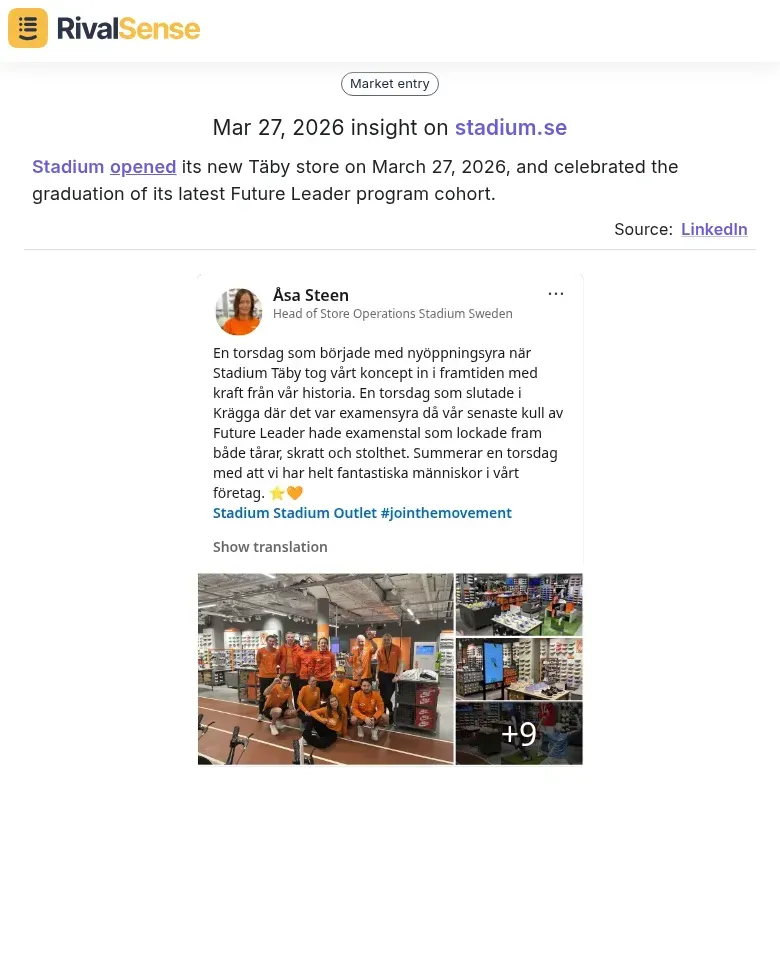
Stadium opened its new Täby store on March 27, 2026, and celebrated the graduation of its latest Future Leader program cohort. This insight is valuable because it combines physical expansion with talent development, signaling a holistic growth strategy. Understanding such investments can help you emphasize your own culture and development programs when competing for talent and key accounts.
Benchmark your talent strategy against these findings. If competitors invest in technical certification programs, consider similar investments to compete for specialized talent. Their culture investments (wellness programs, DEI initiatives) signal workplace priorities that may attract your target talent pool. Use these insights to tailor your market entry approach—matching or exceeding competitor talent investments can help you attract key hires and demonstrate commitment to the market.
Actionable Intelligence Framework: Turning Insights into Market Entry Advantages
To transform competitor insights into market entry advantages, you need a structured framework. This involves systematic data collection, real-time analysis, and pre-planned responses. For entrepreneurs and business owners, implementing such a framework ensures that competitor moves are turned into opportunities rather than threats.
Here’s a practical Actionable Intelligence Framework:
-
Systematic Data Collection: Create a competitor tracking matrix with key metrics: pricing changes, feature launches, customer reviews, and marketing campaigns. Use automation tools to gather data from websites, social media, and review platforms. Example: Track how competitors adjust pricing for enterprise clients in your target region.
-
Real-Time Analysis Protocol: Establish weekly review sessions to analyze competitor moves. Use SWOT analysis (Strengths, Weaknesses, Opportunities, Threats) to identify gaps. For instance, if a competitor lacks 24/7 support in your target market, position this as your advantage.
-
Competitive Response Playbook: Develop pre-planned strategies for common scenarios:
- If a competitor lowers prices: Highlight your superior value proposition
- If they launch a new feature: Accelerate your roadmap or emphasize existing differentiators
- If they enter a new segment: Strengthen relationships with your current key accounts
-
Intelligence Dashboard: Build a centralized dashboard monitoring:
- Pricing trends across competitors
- Feature comparison matrix
- Customer sentiment analysis
- Market share movements
- Campaign performance metrics
Pro Tip: Assign "competitive intelligence champions" in your team to own specific competitor tracking and report insights during strategy meetings. This ensures continuous monitoring and agile response to market changes.
Implementation Roadmap: Quick Hacks for Immediate Competitive Advantage
Turning insights into action requires a clear implementation roadmap. These quick hacks are designed for founders and CEOs to gain immediate competitive advantages without extensive resources. By focusing on rapid assessment and continuous monitoring, you can outmaneuver competitors in key account acquisition.
1. Rapid Assessment Techniques:
- SWOT Sprint: Conduct a 60-minute SWOT analysis focusing on competitor weaknesses. Look for gaps in their service coverage, pricing inconsistencies, or customer complaints on review sites.
- Social Listening Blitz: Use tools to scan competitor social media for unresolved customer issues and negative sentiment patterns.
- Website Audit: Analyze competitor websites for missing features, poor UX, or outdated content that you can improve upon.
2. Quick-Win Strategies for Key Accounts:
- Targeted Outreach: Contact prospects who've recently complained about competitors, offering specific solutions to their pain points.
- Competitor Comparison Matrix: Create a simple one-page comparison showing how your solution addresses competitor weaknesses.
- Pilot Program Offer: Propose a limited-time pilot to key accounts, emphasizing features competitors lack.
3. Continuous Monitoring Systems:
- Automated Alerts: Set up alerts for competitor mentions, new hires, or product launches.
- Weekly Check-ins: Dedicate 30 minutes weekly to review competitor activity and adjust your approach.
- Customer Feedback Loop: Regularly ask new clients why they chose you over competitors to identify ongoing advantages.
Quick Checklist:
✓ Identify 3 competitor weaknesses in 24 hours
✓ Contact 5 key accounts with specific competitor gap solutions
✓ Set up 3 monitoring alerts for competitor tracking
✓ Review competitive landscape weekly
Put These Hacks into Practice with RivalSense
Competitor insights are powerful, but gathering them manually is time-consuming. To streamline your market entry strategy, consider using a tool like RivalSense. It tracks competitor product launches, pricing updates, event participations, partnerships, regulatory aspects, management changes, and media mentions across company websites, social media, and various registries, delivering all in a weekly email report.
Try RivalSense for free today at https://rivalsense.co/ and get your first competitor report to start identifying opportunities and threats in your target market. With automated insights, you can focus on executing these hacks and winning key accounts faster.
📚 Read more
👉 How to Leverage Competitor Insights: A Real-World Example from n8n
👉 The Ultimate Guide to Key Account Tracking APIs: Automate Competitive Intelligence in 2026
👉 Mastering Competitor Tracking in Pharma Logistics: A Strategic Guide to Promotional Offers
👉 How Real-Time Competitive Intelligence Enabled a Swift Response to Airalo's Flight Promotion
👉 Step-by-Step Guide: Extract Competitor Insights from Instagram for Strategic Advantage