
Productivity Techniques: Track Competitor Website Changes for Key Account Insights
In today's hyper-competitive landscape, real-time competitor website tracking transforms reactive monitoring into proactive business intelligence—your secret productivity weapon for key account management. When you automate competitor website surveillance, you shift from scrambling to respond to competitor moves to anticipating them, saving countless hours while protecting your most valuable relationships.
Consider this: 83% of key account decisions are influenced by competitor offerings. By tracking website changes—new features, pricing updates, service expansions—you gain immediate visibility into threats targeting your accounts. Practical tip: Set up automated alerts for competitor homepage changes, product page updates, and pricing modifications affecting your top 5 accounts.
Move beyond basic monitoring with this actionable checklist:
- Monitor competitor case studies targeting your key accounts' industries
- Track feature announcements that address your clients' specific pain points
- Analyze pricing changes that could trigger account reconsideration
- Document service expansions that create competitive pressure points
When a competitor launches a feature your key account requested, you'll know immediately—not months later. This intelligence enables you to proactively reinforce your value proposition, address concerns before they escalate, and position your solution as the superior choice. The result? Higher retention rates, increased expansion opportunities, and revenue growth driven by competitive foresight rather than reactive firefighting.
Product Feature Evolution: Learning from Competitor Product Launches and Updates
Understanding competitor product launches and updates is crucial for staying ahead in the market. By analyzing these changes, you can identify strategic patterns that inform your own product roadmap and key account defenses. Focus on three strategic patterns to extract actionable insights.
First, track feature replacement cycles to identify product lifecycle strategies. For example, when a competitor replaces a basic reporting feature with AI-powered analytics, they're signaling a shift from growth to maturity phase. Create a timeline of their feature deprecations and new releases to predict their next moves.
Second, examine how competitors emphasize design flexibility and customization. Look for modular interfaces, template libraries, and API integrations in their announcements. These indicate they're targeting power users who need tailored solutions. Practical tip: Set up alerts for competitor documentation updates and changelogs to catch customization features early.
Third, analyze bulk creation and storytelling-focused features to understand target audience needs. When competitors add batch processing or narrative-building tools, they're addressing scalability and communication pain points.
Checklist for Product Feature Tracking:
- Monitor competitor support forums for feature requests
- Track which features get highlighted in case studies
- Compare how different competitors solve the same user problem
Key insight: Competitors often reveal their strategic priorities through what they deprecate versus what they enhance. Use tools like RivalSense to automate tracking of these patterns across multiple competitors simultaneously.
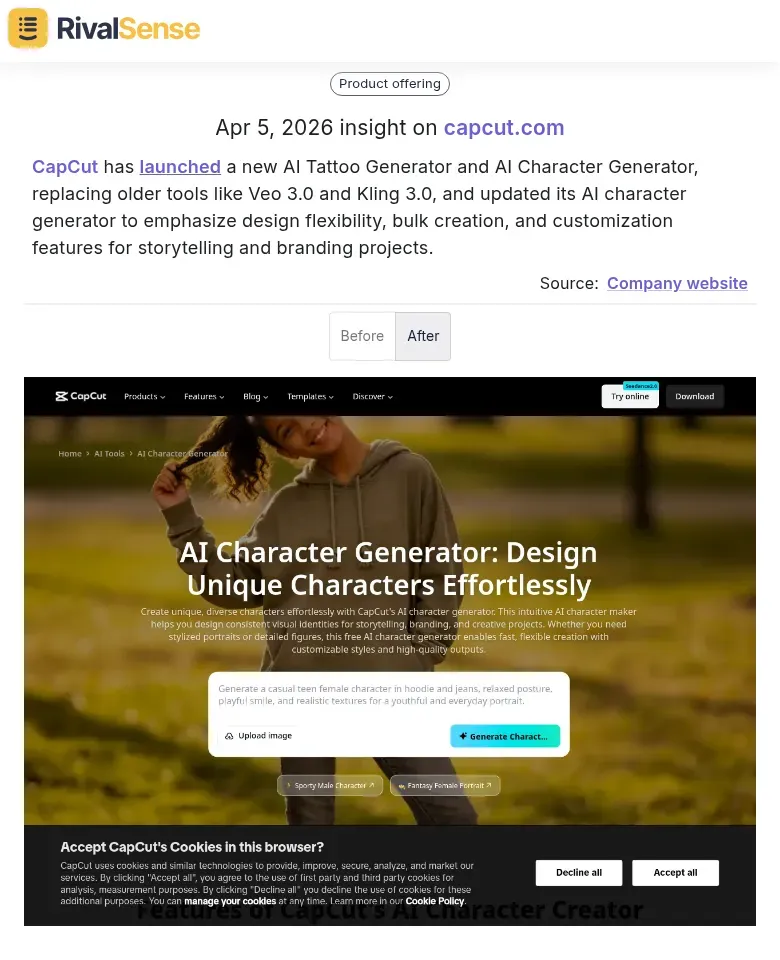
Real-World Example: RivalSense recently captured that CapCut launched a new AI Tattoo Generator and AI Character Generator, replacing older tools like Veo 3.0 and Kling 3.0. This product launch insight is valuable because it shows how competitors are pivoting to AI-driven creativity tools, emphasizing design flexibility, bulk creation, and customization for storytelling and branding projects. Tracking such updates helps you understand where the market is heading and adjust your offerings accordingly.
Hardware and Product Line Expansion: Tracking Physical Product Innovations
Tracking hardware competitors requires a focused approach on comfort, specifications, and partnerships. These elements reveal strategic shifts and market positioning before formal announcements. By monitoring these areas, you can anticipate competitive moves that might affect your key accounts in industries reliant on physical products.
When tracking hardware competitors, focus on three key areas: comfort innovations, technical specifications, and partnership strategies. Monitor how competitors enhance user experience through ergonomic redesigns, weight reduction, and material improvements in new product iterations. These comfort-focused changes often signal market positioning shifts before official announcements.
Practical Checklist for Hardware Tracking:
- Document all product specification changes (resolution, battery life, processing power)
- Track comfort improvements through customer reviews and unboxing videos
- Monitor co-branded launches for partnership patterns
- Analyze frame variations for market segmentation strategies
- Set up alerts for patent filings and FCC certifications
Technical specification improvements reveal strategic priorities. A 20% battery life increase suggests investment in power efficiency, while resolution upgrades indicate premium positioning. Track these changes quarterly to identify market trends.
Partnership strategies provide early warning of market expansion. Co-branded product launches with fashion brands signal lifestyle positioning, while frame variations with sports brands indicate athletic market targeting.
Real-World Example: RivalSense tracked that Meta launched new Ray-Ban Meta AI glasses with Blayzer and Scriber frames, featuring enhanced comfort, 3K Ultra HD video, and up to 8 hours of battery life. This hardware launch insight is valuable because it highlights how competitors are integrating AI into wearable tech, with a focus on comfort and high-end specifications. Such insights help you gauge the competitive landscape for hardware innovations and prepare your response.
Platform Integration and API Access: Learning from Developer-Focused Changes
Developer-focused changes in platform integrations and API access are critical indicators of ecosystem strategy. By monitoring these updates, you can understand how competitors are expanding their market reach and targeting enterprise clients. This knowledge helps you refine your own integration offerings and protect key accounts.
When competitors expand their platform integrations and API capabilities, they're revealing their ecosystem strategy. Monitor their developer documentation for new multi-client access patterns - when you see support for multiple authentication methods (OAuth, API keys, service accounts), it signals they're targeting enterprise clients who need varied access levels across departments. Practical tip: Create a checklist tracking API endpoint expansions, rate limit increases, and new SDK releases across languages.
Read/write capability expansions are particularly telling. When a competitor transitions from read-only APIs to full CRUD operations, they're moving upmarket - developers can now build full applications on their platform. Look for new webhook support, real-time streaming endpoints, or batch operations that indicate they're prioritizing developer productivity. Actionable step: Set up alerts for new sections in their API docs about "mutations," "write operations," or "data modification."
New documentation sections about target user onboarding reveal market maturity. When you see dedicated guides for "agent integration," "multi-tenant setups," or "enterprise deployment," they're signaling focus on larger accounts.
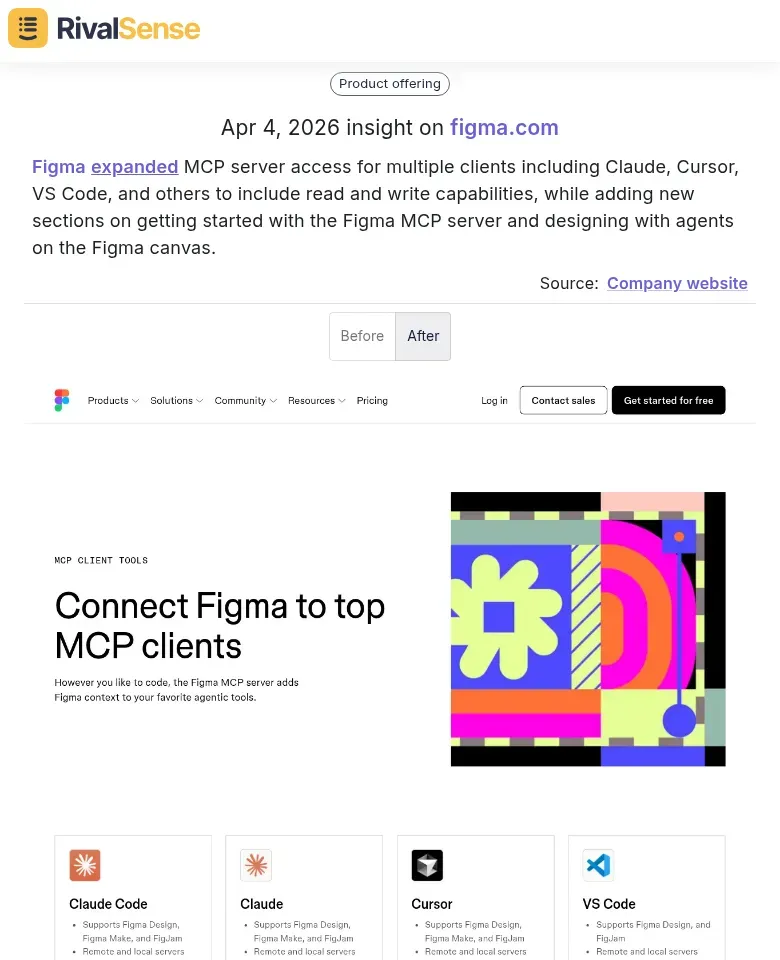
Real-World Example: RivalSense identified that Figma expanded MCP server access for multiple clients including Claude, Cursor, VS Code, and others to include read and write capabilities, while adding new sections on getting started and designing with agents. This platform integration insight is valuable because it demonstrates how competitors are enhancing developer tools to support a broader ecosystem, which can attract larger clients and lock in key accounts through improved workflow integration.
Strategic Implementation: Turning Website Changes into Key Account Insights
To effectively use competitor website changes, you need a systematic framework that translates data into actionable strategies. This process involves categorization, alert systems, and cross-functional collaboration to ensure insights drive business decisions.
To transform competitor website changes into actionable key account insights, implement a systematic framework. First, categorize changes by strategic impact: pricing updates, feature launches, case studies, leadership changes, and partnership announcements. Prioritize based on relevance to your key accounts' industries, pain points, and decision-making timelines.
Create intelligent alert systems that filter noise. Set up keyword monitoring for account-specific terms, competitor executive names, and industry jargon. Use change detection tools with customizable thresholds—ignore minor CSS tweaks but flag new product pages or pricing sections. Establish severity levels: critical (immediate action), important (weekly review), and informational (monthly analysis).
Build cross-functional processes where sales, marketing, and product teams collaborate weekly. When a significant change is detected, conduct rapid analysis: How does this affect our value proposition? Which accounts are most vulnerable? What counter-messaging is needed? Create account-specific action plans: update battle cards, prepare talking points for upcoming meetings, and adjust proposal strategies.
Practical Checklist:
- Map competitor changes to account priorities
- Assign ownership for each insight category
- Establish 24-hour response protocol for critical updates
- Maintain shared repository of competitor intelligence
- Conduct quarterly reviews of alert system effectiveness
Conclusion: Building a Sustainable Competitive Intelligence Practice
A sustainable competitive intelligence practice is not a one-time effort but an integrated part of your business operations. By establishing regular routines and measuring impact, you can ensure that insights continually drive value for your key accounts and overall strategy.
Building a sustainable competitive intelligence practice requires systematic integration into your daily operations. Start by establishing a regular review cadence: schedule weekly 30-minute sessions for high-priority competitors and monthly deep-dives for broader market analysis. Use automated alerts for critical changes (pricing updates, feature launches) to stay proactive without constant manual checking.
Integrate insights directly into existing workflows: add competitor intelligence to sales playbooks, marketing campaign briefs, and product roadmap discussions. Create a shared dashboard where teams can access real-time competitor updates alongside customer data.
Measure ROI through concrete metrics: track win rates against specific competitors, monitor account retention improvements, and calculate time saved on manual research. Establish baseline metrics before implementing systematic tracking to demonstrate clear business impact.
Practical Checklist:
- Set up automated alerts for key competitor website sections
- Create a centralized intelligence repository accessible to all teams
- Schedule recurring competitor review meetings
- Document competitor responses in CRM opportunities
- Calculate monthly time savings from automated tracking
- Review win/loss analysis quarterly for competitor patterns
Remember: The most effective competitive intelligence isn't about collecting more data, but about making existing insights actionable across your organization.
Ready to transform your competitor tracking? Try out RivalSense for free and get your first competitor report today. With automated tracking of product launches, pricing updates, partnerships, and more, RivalSense delivers weekly insights directly to your inbox, helping you stay ahead and protect your key accounts.
📚 Read more
👉 How to Use AI Meeting Transcription for Competitor Market Research
👉 Competitor Pricing Workflow: How to Leverage Insights for Content Strategy
👉 Decoding Competitor Strategy Through Hires: Lessons from Adobe's New Appointment
👉 How to Track Key Account Renewal Dates: A Strategic Guide for 2026
👉 IT Asset Management Competitor Benefits Cheat Sheet: Turn Insights into Advantage