
Predictive Workforce Analytics: How to Forecast Key Account Feedback Trends for B2B Success
In today's competitive B2B landscape, reactive feedback management is no longer sufficient. Predictive workforce analytics transforms this process into a proactive strategic imperative by forecasting key account feedback trends before they impact your business. By analyzing patterns in employee performance data, customer interactions, and historical feedback, you can anticipate client concerns and opportunities 30-90 days in advance.
Practical Implementation Checklist:
- Integrate Data Sources: Connect your CRM, support tickets, and employee performance metrics into a unified analytics platform 📊
- Identify Leading Indicators: Track metrics like response time escalation, support ticket complexity, and account manager engagement scores
- Establish Baseline Patterns: Analyze 6-12 months of historical data to identify seasonal trends and correlation patterns
- Set Early Warning Triggers: Create automated alerts for when key metrics deviate from predicted ranges ⚠️
This approach directly impacts retention and revenue growth. Companies implementing predictive workforce analytics report 15-25% improvements in key account retention and identify upsell opportunities 60% earlier than traditional methods. The analytics bridge the critical gap between employee performance and customer satisfaction, revealing how specific team behaviors correlate with client sentiment shifts.
Pro Tip: Start with your 3-5 most valuable accounts. Focus on forecasting at least one critical feedback trend per quarter, then expand your predictive models as you validate accuracy and business impact. 🎯
Building Your Predictive Analytics Foundation: Data Collection and Integration
Building a robust predictive analytics foundation starts with strategic data collection and seamless integration. First, identify your core data sources: employee performance metrics (productivity, tenure, training completion), customer feedback channels (NPS surveys, support tickets, account reviews), and operational data (project timelines, service delivery metrics, account health scores).
Integrate these disparate systems by implementing APIs or middleware solutions that connect your CRM, HRIS, and customer support platforms. Consider cloud-based data warehouses like Snowflake or BigQuery to create a unified analytics environment. Start with a pilot integration between your CRM and customer feedback tool to validate the approach.
Establish data quality protocols with these practical steps:
- Create data validation rules to flag anomalies in feedback scores ✅
- Implement automated data cleansing for duplicate entries and formatting inconsistencies
- Set up regular data audits (quarterly minimum) 📅
- Define clear data ownership and governance policies
Pro tip: Begin with 3-5 key metrics that directly correlate with account satisfaction, such as response time trends combined with CSAT scores. This focused approach yields actionable insights faster while building your data infrastructure. 🚀
AI-Powered Forecasting: From Benchmarks to Early Risk Detection
AI-powered forecasting transforms reactive account management into proactive strategy. By leveraging machine learning, you can predict key account feedback trends with greater accuracy and speed. Start by implementing benchmark analytics: collect industry-standard metrics on response times, resolution rates, and satisfaction scores.
Compare your team's performance against these benchmarks monthly to identify gaps. Develop early warning systems by tracking subtle indicators: declining engagement metrics, increased escalation requests, or changes in communication patterns. Set automated alerts when these metrics deviate from historical norms by more than 15%.
For example, RivalSense tracked that Time Doctor launched Benchmarks AI to help leaders track trends, spot risks early, and measure team performance against peers.
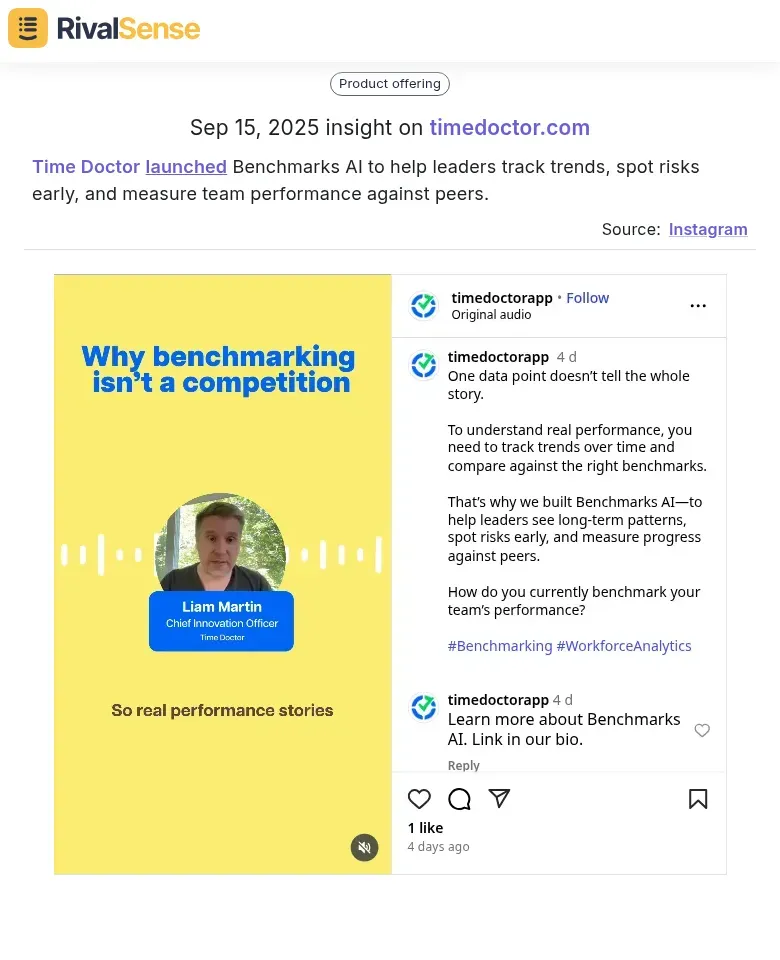
Understanding such competitor AI tool launches is valuable for business strategy, as it reveals how rivals are enhancing their forecasting capabilities, allowing you to adapt or innovate your own models. 🧠
Create predictive models that connect workforce behaviors to feedback patterns. Analyze how factors like agent experience levels, training completion rates, and internal collaboration metrics correlate with customer satisfaction scores. Use machine learning to identify which workforce behaviors most strongly predict positive or negative feedback.
Practical Checklist:
- Identify 3-5 key performance benchmarks from your industry 📈
- Set up automated data collection for workforce and customer metrics
- Establish alert thresholds for early warning indicators
- Run correlation analysis between workforce behaviors and feedback scores
- Test predictive models with historical data before full implementation
- Create monthly review cycles to refine your forecasting accuracy 🔄
Tip: Start with simple linear models before advancing to complex machine learning algorithms. The most valuable insights often come from clear, interpretable connections between workforce actions and customer outcomes. 💡
Strategic Industry Adaptation: Expanding Analytics Across Business Verticals
To maximize predictive workforce analytics for key account feedback forecasting, organizations must customize models for specific industry requirements. Different sectors have unique feedback channels, regulatory constraints, and performance metrics that demand tailored approaches.
Healthcare demands HIPAA-compliant models tracking patient satisfaction and clinical outcomes, while financial services require regulatory-aligned frameworks monitoring compliance metrics and risk indicators. Retail analytics should focus on seasonal patterns and customer sentiment during promotional events.
RivalSense insights show how companies adapt: Time Doctor added 'Benchmarks AI' and 'Unusual Activity Report' as features, removed 'Profitability' and 'Empowering Employees', and expanded its industry focus to include Healthcare.
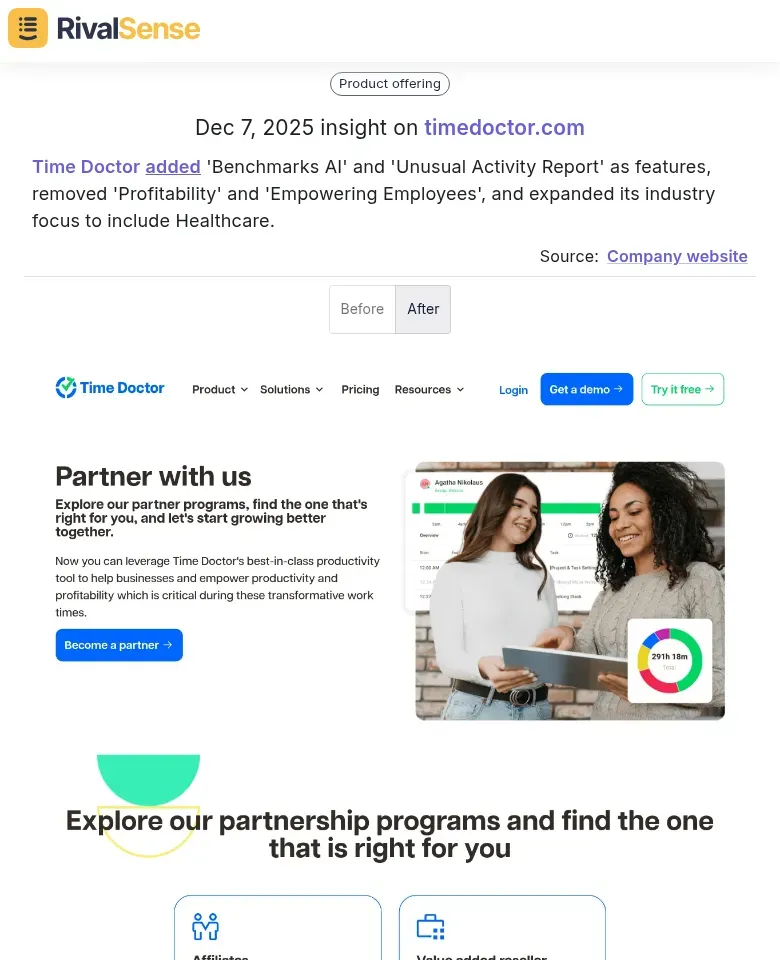
Tracking competitor feature changes and industry expansions is crucial for business strategy, as it helps you anticipate market shifts and align your analytics with emerging sector needs. 🏥
Practical Implementation Checklist:
- Conduct industry-specific regulatory audits before model development 📋
- Map key account feedback channels unique to each sector (e.g., patient portals in healthcare, trading platforms in finance)
- Develop modular analytics frameworks with interchangeable components for different verticals
- Establish cross-functional teams combining data scientists with industry domain experts 👥
- Create feedback loops incorporating sector-specific customer journey touchpoints
Adaptation Tips:
- Healthcare: Prioritize empathy metrics and clinical outcome correlations
- Financial Services: Emphasize accuracy metrics and regulatory compliance tracking
- Retail: Focus on sentiment analysis during peak shopping periods and promotional cycles
- Technology: Monitor support ticket resolution patterns and feature request trends
Build flexible systems using microservices architecture that allows rapid component updates as market demands evolve. Implement continuous learning algorithms that adapt to changing industry focus areas, ensuring your analytics framework remains relevant across business cycles and regulatory shifts. ⚙️
Actionable Intelligence: Turning Predictions into Business Outcomes
Predictive workforce analytics delivers its true value when forecasts translate into concrete business actions. Moving from insights to execution requires a systematic approach that bridges data science with operational strategy. Here's how to transform predictions into strategic outcomes:
1. Develop Prescriptive Recommendations
Move beyond "what will happen" to "what to do about it." For example, if models forecast declining satisfaction in key accounts, create action plans: assign dedicated support teams, schedule proactive check-ins, or adjust service levels. Build a decision matrix linking each predicted trend to specific interventions.
2. Create Executive Dashboards
Design dashboards that visualize forecasted trends alongside recommended actions. Include metrics like predicted satisfaction scores, risk levels, and recommended resource allocations. Use color-coded alerts (red/yellow/green) to highlight accounts needing immediate attention. Ensure dashboards show both the prediction and the prescribed response. 📊
3. Implement Feedback Loops
Track the outcomes of your interventions and feed this data back into your models. Did the assigned support team improve satisfaction as predicted? Use this real-world validation to refine algorithms. Establish a quarterly review cycle where data scientists and account managers collaborate to adjust models based on what actually worked.
Practical Checklist:
- Map each predicted trend to at least 2-3 specific action options ✅
- Design dashboards with "prediction + prescription" paired displays
- Create a feedback tracking system to measure intervention effectiveness
- Schedule regular model refinement sessions with cross-functional teams
- Start with pilot accounts before scaling to entire portfolio 🚀
By closing the loop between prediction, action, and validation, you create a continuously improving system where analytics directly drive workforce strategy and key account success. 🔄
Competitive Advantage: Industry Engagement and Continuous Innovation
To build competitive advantage in predictive workforce analytics, focus on three strategic pillars. First, leverage industry events and conferences to validate your analytics approaches and stay ahead of trends. Attend key sessions, network with HR leaders, and gather real-time feedback on your forecasting models.
RivalSense insights reveal competitor movements: Time Doctor is exhibiting at Booth #25 at Genesys Xperience 2025 in Nashville, connecting with CX leaders and showcasing its productivity tools.
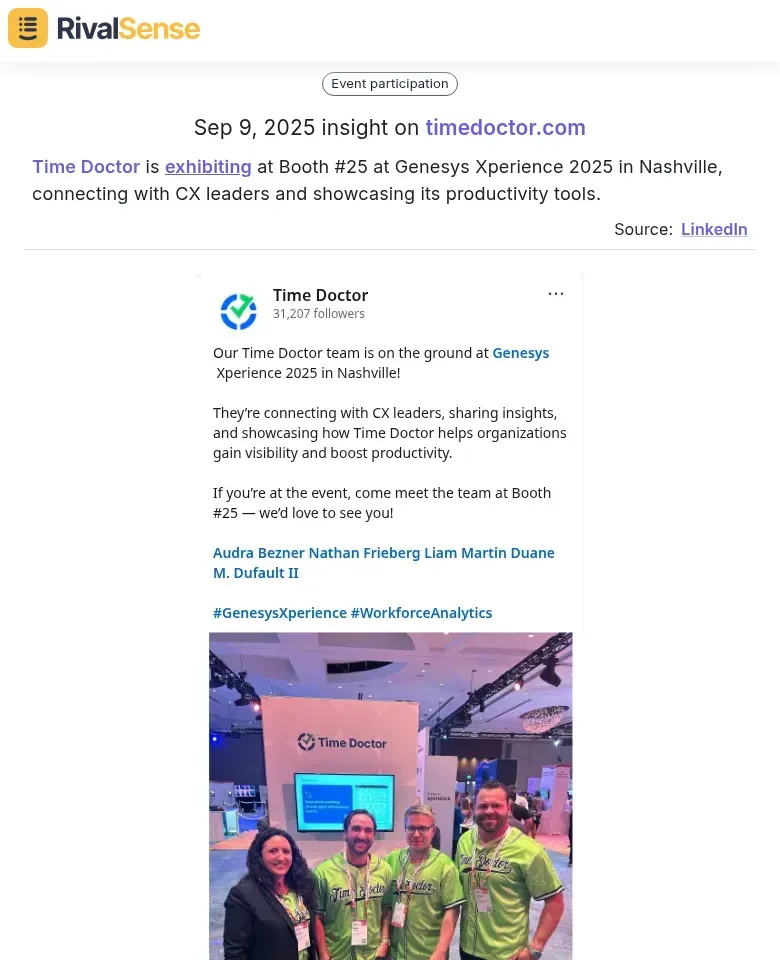
Monitoring competitor event participation is valuable for business strategy, as it provides insights into their market positioning, networking efforts, and potential partnerships, helping you refine your own engagement tactics. 🎪
Second, build thought leadership through compelling case studies. Showcase real-world implementations where your analytics predicted account feedback shifts 6-12 months in advance. Include specific metrics like 30% reduction in client churn or 25% improvement in account satisfaction scores. Share these examples through webinars, whitepapers, and industry publications.
Third, establish continuous improvement cycles that incorporate competitor insights. Monitor how rivals are using AI for workforce predictions, track their published research, and analyze their client success stories.
Create a quarterly review process:
- Analyze competitor positioning and feature updates 🕵️♂️
- Gather client feedback on your predictions and interventions
- Update your models based on market signals and validation data
This creates a feedback loop where industry engagement informs innovation, keeping you ahead in forecasting key account trends. 🏆
Putting It All Together: Leverage Competitor Insights with RivalSense
Implementing predictive workforce analytics requires not only internal data but also external intelligence on competitor movements. By tracking product launches, pricing updates, event participations, and industry expansions, you can anticipate market shifts and adapt your strategies proactively.
Ready to enhance your competitive edge? Try out RivalSense for free to track competitor product launches, pricing changes, event participations, partnerships, and more—all delivered in a weekly email report. Get your first competitor report today and start forecasting key account feedback trends with greater accuracy and insight! 📈
📚 Read more
👉 From Headlines to Strategy: How to Decode Competitor Moves Through Media Mentions
👉 DHL's Tesla Semi Trial: A Competitor Analysis Case Study
👉 How a Key Account Tracking API Works to Monitor Your Most Important Competitors
👉 Advanced Tactics: Monitor Fintech Competitor Product Launches for B2B Payments
👉 How Roblox's SLIM and $50K Tournament Revealed Competitors' Next Moves