
Predictive Sales Forecasting: Outmaneuver Competitors in Organizational Consulting
In today's hyper-competitive organizational consulting landscape, moving from reactive to proactive competitor analysis isn't just an advantage—it's a strategic imperative. Traditional market intelligence tells you what competitors did yesterday; predictive sales forecasting reveals what they'll do tomorrow. This shift transforms your competitive strategy from playing catch-up to setting the pace.
Predictive analytics converts historical data into actionable foresight by analyzing patterns in competitor pricing, service offerings, client acquisition, and market positioning. For consulting firms, this means anticipating competitor moves before they happen—whether it's a new service launch, pricing strategy shift, or geographic expansion.
Practical steps to implement predictive forecasting:
- Collect comprehensive competitor data (pricing, services, client wins, marketing activity)
- Identify key performance indicators specific to consulting (win rates, project duration, client retention)
- Use regression analysis to spot trends and correlations
- Monitor leading indicators like hiring patterns and technology investments
- Validate predictions against actual outcomes to refine your model
Data-driven decision making in consulting now requires anticipating competitor moves 6-12 months ahead. Start by analyzing 3-5 key competitors, focusing on their most successful service lines and client segments. The firms that master predictive forecasting don't just react to market changes—they shape them.
Key Data Sources for Predictive Competitor Sales Analysis
To build accurate predictive models for competitor sales in organizational consulting, you need reliable and actionable data sources. These sources provide the raw material for forecasting future moves and strategizing accordingly. Focus on these three key areas:
-
Hiring Patterns & Organizational Structure 📈
Monitor job postings for key roles like consulting leads, practice directors, and specialized experts. A surge in senior consultant hires often precedes major client wins by 3-6 months. Track LinkedIn employee growth trends and department expansions as leading indicators of revenue scaling.
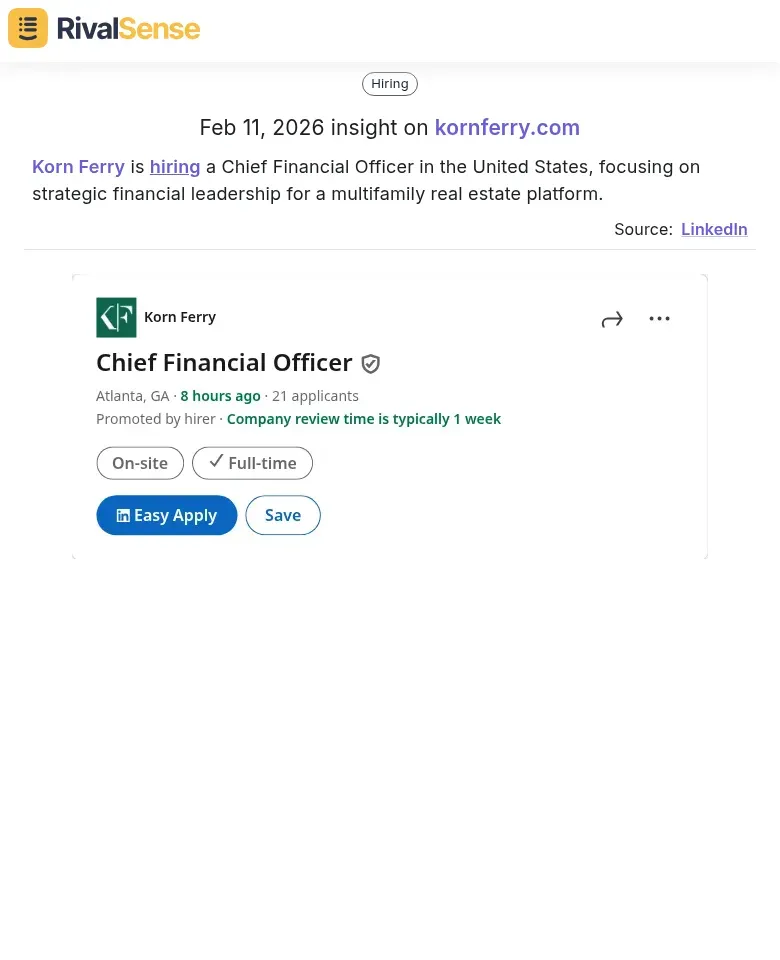
Example from RivalSense: Korn Ferry is hiring a Chief Financial Officer in the United States, focusing on strategic financial leadership for a multifamily real estate platform. This type of insight is valuable because executive hires signal strategic shifts and potential expansion into new business areas.
-
Strategic Partnerships & Client Engagements 🤝
Follow partnership announcements with technology platforms like Workday or SAP, industry associations, and academic institutions. High-profile client case studies and executive testimonials signal market validation and upcoming service expansion.
Example from RivalSense: Korn Ferry's chief marketing officer Jill Wiltfong leads the company's role as the official talent and organizational consulting partner for the LA28 Summer Olympics, helping build the workforce from scratch. Such partnerships are valuable as they indicate competitive positioning and access to large-scale projects.

-
Leadership Team Composition 👔
Analyze executive team changes, board appointments, and advisory board expansions. New C-suite hires with specific industry expertise forecast upcoming vertical specialization. Monitor leadership's speaking engagements at industry conferences for service roadmap clues.
Practical Checklist:
- [ ] Use LinkedIn Sales Navigator to track competitor employee growth
- [ ] Set up Google Alerts for competitor + "partnership" announcements
- [ ] Monitor industry conference speaker lists quarterly
- [ ] Analyze job description changes for emerging service keywords
- [ ] Track executive team LinkedIn profile updates monthly
Methodologies for Building Predictive Sales Forecasting Models
Building predictive sales forecasting models for organizational consulting competitors requires a systematic and data-driven approach. Start by developing correlation models between organizational changes and revenue growth patterns. This involves tracking competitor restructuring announcements, leadership changes, and department expansions, then correlating these with quarterly revenue data over 2-3 years.
Create predictive algorithms based on talent acquisition trends and market expansion signals. For instance, monitor job postings for specialized roles and correlate hiring spikes with upcoming service launches. When competitors post multiple senior consultant roles in a new geographic region, this typically signals market expansion within 3-6 months.
Implement machine learning approaches to identify patterns in competitor strategic moves. Use historical data on investments, partnerships, and technology adoptions to train models. Here are practical steps:
- Collect 3+ years of competitor data
- Identify key variables (hiring rates, office openings, service launches)
- Test multiple algorithms (regression, time series, neural networks)
- Validate predictions against actual outcomes
- Continuously refine models with new data
The most effective models combine quantitative data with qualitative insights from client wins and thought leadership patterns.
Interpreting Predictive Insights for Strategic Decision Making
Predictive insights only create value when translated into strategic action. Understanding how to interpret key signals can lead to decisive moves that outpace competitors. Here’s a breakdown of how to decode common indicators:
-
Hiring Patterns → Service Expansion 🚀
When competitors hire specialists in emerging domains like AI governance or ESG compliance, anticipate service line expansion within 6-9 months. Track job postings for specific certifications to gauge market focus shifts. -
Partnerships → Competitive Positioning 🎯
Strategic alliances with tech platforms signal upcoming premium service bundles. Analyze partnership announcements for exclusivity clauses to forecast pricing strategies—exclusive partnerships often precede 15-25% price increases. -
Leadership Expertise → Market Entry 🌍
New executives with industry-specific backgrounds reveal expansion plans. Create a leadership matrix tracking previous employers and expertise domains to anticipate competitive threats in your core markets.
Actionable Checklist:
- [ ] Weekly: Monitor competitor job boards for new role patterns
- [ ] Monthly: Analyze partnership announcements for technology stack implications
- [ ] Quarterly: Update leadership expertise database with new hires
- [ ] Immediately: Cross-reference predictive signals with your strategic roadmap gaps
Pro tip: Combine multiple signals—when hiring spikes coincide with strategic partnerships, expect aggressive market moves within the quarter.
Practical Applications: Turning Predictions into Competitive Advantage
Transform predictive competitor sales forecasts into tangible competitive advantage with these practical applications. By acting on insights before competitors make their moves, you can secure market position and drive growth.
-
Service Offering Adjustments 🔧
When forecasts indicate competitors will launch new services in 3-6 months, proactively enhance your existing offerings. For example, if data suggests a rival will target digital transformation consulting, strengthen your own digital strategy services now. -
Resource Optimization ⚙️
Use sales predictions to allocate talent strategically. If competitor expansion into a new market is forecasted, begin recruiting specialists with that regional expertise 4-8 months ahead. -
Counter-Strategy Development 🛡️
Develop contingency plans before competitors fully implement expansion. Create "if-then" scenarios and maintain a living document of 3-5 counter-strategies for top competitors.
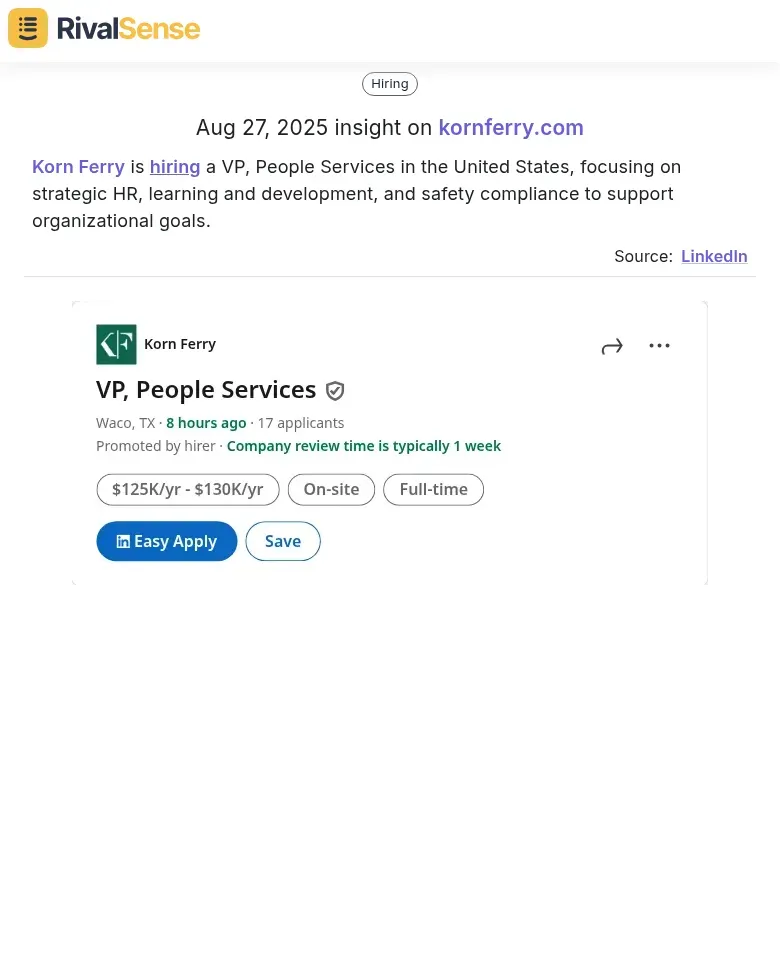
Example from RivalSense: Korn Ferry is hiring a VP, People Services in the United States, focusing on strategic HR, learning and development, and safety compliance to support organizational goals. This insight is valuable as it highlights investments in internal capabilities, which can precede service enhancements or new market offerings.
Actionable Checklist:
- [ ] Monthly: Review competitor sales trend predictions
- [ ] Quarterly: Update service enhancement priorities
- [ ] Biannually: Reassess talent acquisition pipeline
- [ ] Annually: Refresh counter-strategy playbooks
Pro tip: Combine predictive analytics with real-time competitor tracking to validate forecasts and adjust tactics dynamically.
Implementation Framework: Building Your Predictive Analysis Capability
To build predictive analysis capability for forecasting competitor sales, start with systematic data collection and integration. Establishing a robust framework ensures that insights are actionable and aligned with your business goals.
Create a centralized competitor intelligence database tracking key metrics: client wins, project announcements, hiring patterns, pricing changes, and thought leadership output. Use automated tools to monitor competitor websites, social media, job boards, and industry publications.
Integrate predictive analytics with your existing competitive intelligence system by connecting data sources through APIs. Choose tools that offer machine learning algorithms designed for sales forecasting. Start with simple models and progress to more sophisticated analyses as your data matures.
Establish feedback loops by comparing predictions against actual competitor performance quarterly. Create a 'prediction accuracy scorecard' to track reliable indicators. Involve your sales team in validation for frontline insights.
Practical Checklist:
- [ ] Identify 3-5 key competitor metrics to track consistently
- [ ] Set up automated data collection workflows
- [ ] Choose analytics tools that integrate with your existing systems
- [ ] Create quarterly review cycles
- [ ] Document learnings to refine your approach continuously
Conclusion and Call-to-Action
Mastering predictive sales forecasting in organizational consulting requires diligence, the right data sources, and a systematic approach. By anticipating competitor moves, you can stay ahead of the curve and make informed strategic decisions.
To streamline this process, consider using specialized tools like RivalSense. It tracks competitor product launches, pricing updates, event participations, partnerships, regulatory aspects, management changes, and media mentions across various sources, delivering insights in a weekly email report.
Ready to gain a competitive edge? Try out RivalSense for free at https://rivalsense.co/ and get your first competitor report today!
📚 Read more
👉 How Competitor Insights Solve Market Entry Challenges for Key Account Growth
👉 Turning Competitor Awards into Strategic Advantage
👉 Key Account Management for SaaS: The Complete 2026 Guide to Strategic Growth
👉 Predictive Analytics for Water Treatment Key Account Risk: A Strategic Guide
👉 How Block's UCP Integration Accelerated Competitors in Agentic Commerce