
Predictive Facebook Competitor Insights: Key Account Management Case Study
Traditional key account management often operates reactively—responding to competitor moves after they've already impacted your client relationships. Predictive competitor intelligence transforms this approach by enabling proactive strategic planning based on anticipated competitor actions. Facebook serves as a critical real-time intelligence source, offering unparalleled visibility into competitor content strategies, partnership announcements, and market positioning moves as they happen.
This case study demonstrates how applying predictive analytics to Facebook competitor data can revolutionize key account retention and growth. By tracking patterns in competitor behavior—such as product launch timing, partnership formations, and content engagement trends—you can anticipate threats to your key accounts before they materialize.
Practical Checklist for Getting Started:
- ✅ Set up daily alerts for competitor Facebook announcements and partnership reveals
- ✅ Create a competitor matrix tracking their key account targeting patterns
- ✅ Monitor engagement metrics on competitor content aimed at your strategic clients
- ✅ Establish weekly review cadence to spot emerging threats/opportunities
- ✅ Correlate competitor announcements with your account health metrics
Key Insight: When you spot a competitor targeting your key client's pain points on Facebook, you gain critical lead time to reinforce your value proposition and secure the relationship. This systematic approach transforms reactive account management into proactive strategic advantage.
Strategic Partnership Analysis: Learning from Competitor Collaborations
Competitor partnership announcements reveal emerging market trends before they become mainstream. When companies like Meta partner with AI infrastructure providers or sports leagues, they're signaling strategic priorities that reshape entire ecosystems. Tracking these collaborations helps you identify where markets are heading and anticipate shifts that could affect your key accounts.
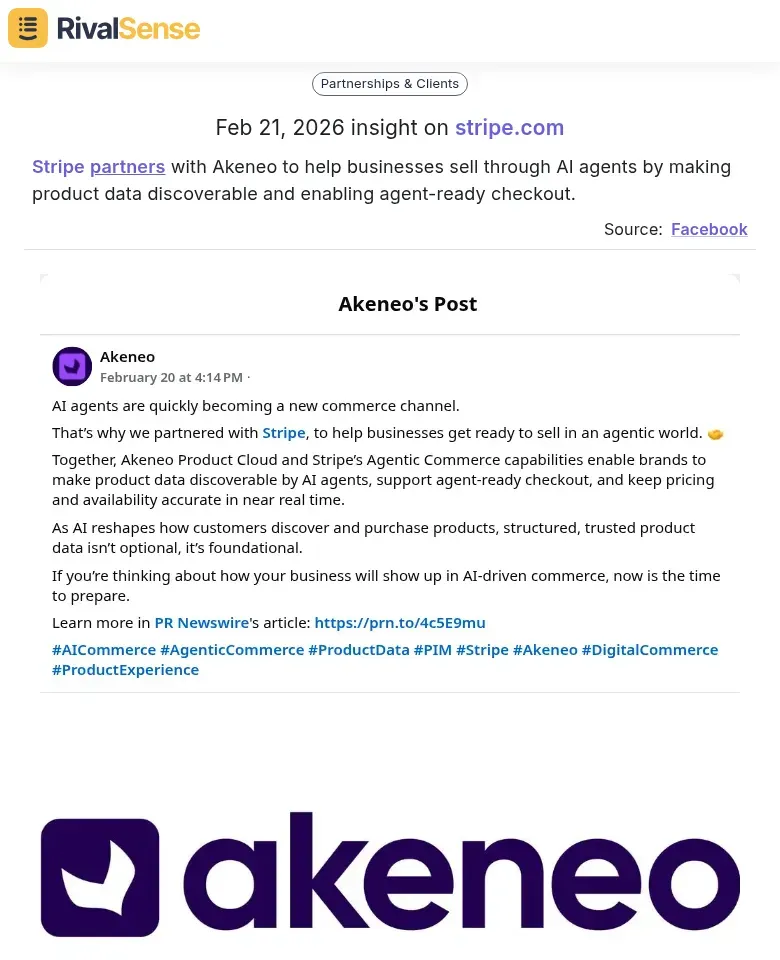
For instance, consider the partnership between Stripe and Akeneo. Stripe has partnered with Akeneo to help businesses sell through AI agents by making product data discoverable and enabling agent-ready checkout. This type of insight is valuable for business strategy because it highlights how competitors are integrating AI and e-commerce capabilities, signaling a move towards more automated and data-driven sales processes. By analyzing such partnerships, you can adapt your own offerings to meet evolving customer expectations.
Practical Steps for Partnership Intelligence:
- Monitor competitor press releases and social media for partnership announcements
- Analyze partnership patterns by industry, technology focus, and geographic expansion
- Map partnership ecosystems to identify gaps and opportunities
- Track partnership-to-revenue timelines to understand ROI patterns
- Use automated tools like RivalSense to receive real-time alerts on competitor collaborations
Applying Partnership Insights to Key Account Management:
- Enhance Value Propositions: When competitors partner with complementary technology providers, identify how you can offer similar integrated solutions to your key accounts
- Differentiate Through Ecosystem Gaps: If competitors focus on AI partnerships, consider strengthening your data privacy or compliance partnerships instead
- Anticipate Account Needs: Use partnership intelligence to predict what solutions your key accounts will expect next quarter
Key Checklist for Partnership-Driven Strategy:
- [ ] Quarterly review of competitor partnership portfolios
- [ ] Analysis of partnership announcement timing and market conditions
- [ ] Identification of underserved partnership opportunities in your niche
- [ ] Integration of partnership insights into key account value propositions
- [ ] Measurement of partnership-driven competitive advantages
Pro Tip: Don't just track partnerships—analyze the strategic intent behind them. Is the competitor expanding geographically? Entering new verticals? Strengthening technology capabilities? This intelligence helps you proactively strengthen your own key account relationships before competitors can disrupt them.
Market Performance Intelligence: Extracting Insights from Competitor Reports
Market Performance Intelligence transforms raw competitor data into actionable strategic insights. Start by analyzing competitor annual reports using a structured framework: examine financial metrics, operational KPIs, and strategic disclosures. Look for patterns like declining engagement rates signaling market saturation or new feature adoption indicating emerging customer needs.
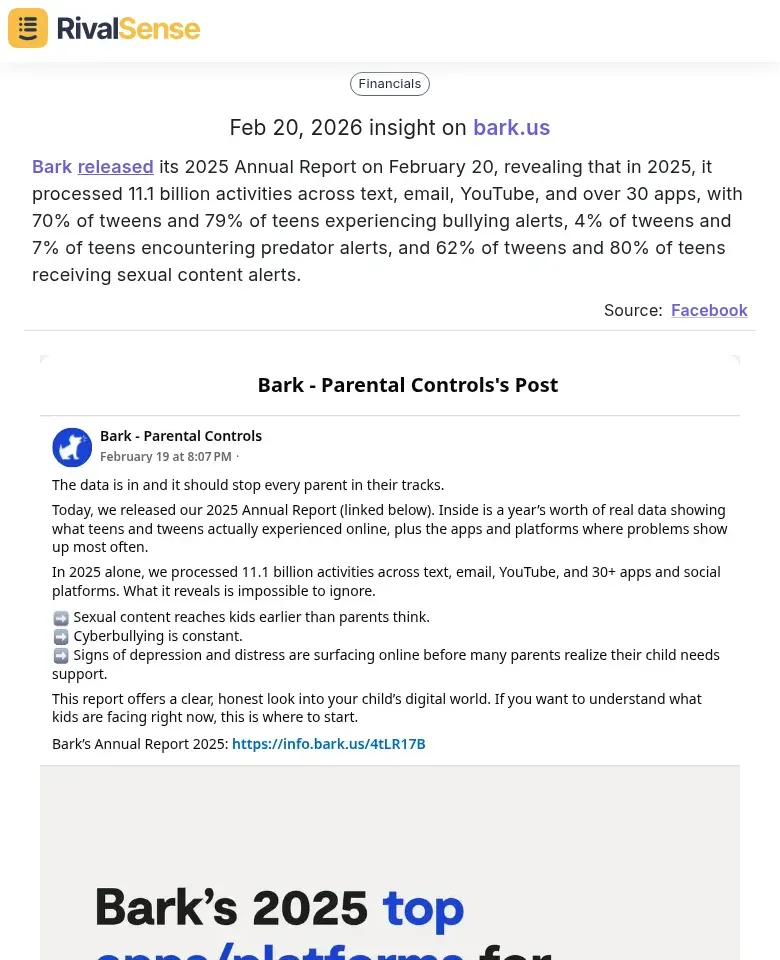
Competitor annual reports are goldmines of information. For example, Bark released its 2025 Annual Report on February 20, revealing key metrics such as processing 11.1 billion activities across various platforms and detailed alert statistics for bullying, predators, and sexual content. This type of insight is valuable for business strategy because it provides a deep dive into competitor performance, customer engagement, and market reach, allowing you to benchmark and identify growth opportunities or threats.
Practical Checklist for Competitor Report Analysis:
- Extract quarterly/yearly performance trends across 3+ years
- Identify correlation between product launches and revenue spikes
- Map customer engagement metrics against market expansion timelines
- Flag strategic shifts in resource allocation or partnership announcements
- Benchmark against industry averages to spot anomalies
Translate insights into proactive key account management strategies: When competitor reports show slowing growth in enterprise segments, preemptively strengthen relationships with your high-value accounts through personalized value reviews. If engagement data reveals emerging customer needs (like AI integration demands), develop targeted solution briefs before competitors address these gaps. Use predictive indicators—like competitor R&D spending increases in specific technologies—to anticipate market shifts and position your offerings accordingly.
Pro Tip: Set up automated alerts for competitor SEC filings and earnings calls using tools like RivalSense to receive timely intelligence that informs your quarterly account planning cycles.
Regulatory and Compliance Intelligence: Navigating Competitive Landscapes
Regulatory and compliance intelligence transforms from reactive monitoring to predictive foresight for key account protection. By tracking competitor regulatory approvals, you anticipate market entry barriers before they impact your accounts. For instance, when a competitor secures FDA clearance for a new medical device, you gain 6-12 months' lead time to reinforce your value proposition with healthcare clients.
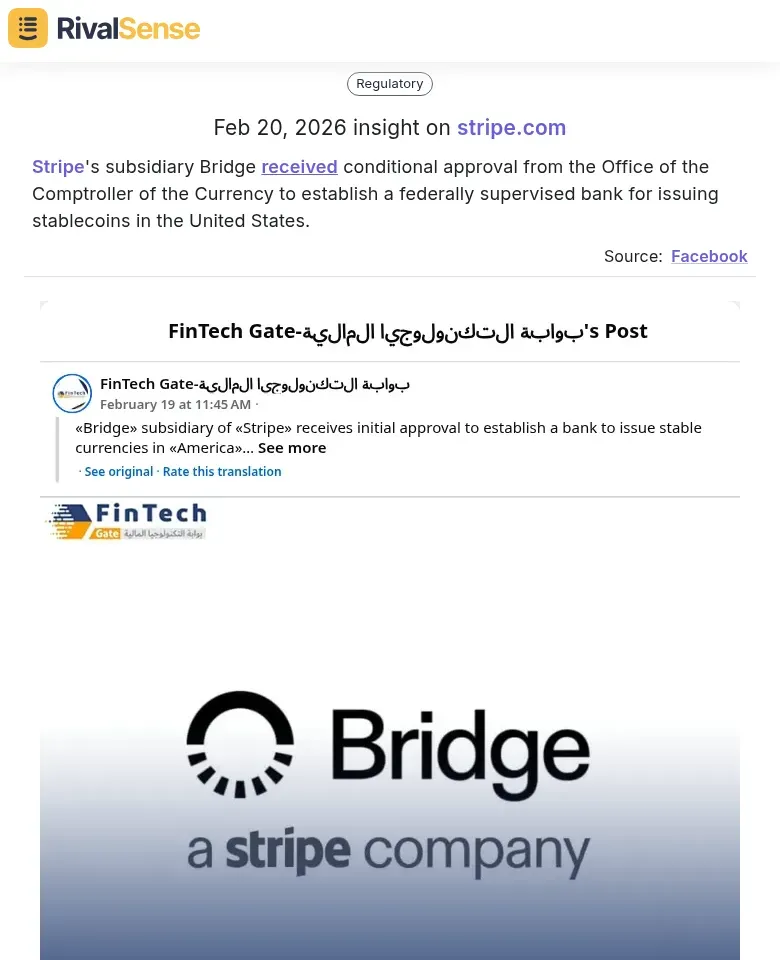
A recent example is Stripe's subsidiary Bridge, which received conditional approval from the Office of the Comptroller of the Currency to establish a federally supervised bank for issuing stablecoins in the United States. This type of insight is valuable for business strategy because it signals a competitor's move into regulated financial services, indicating potential expansion and compliance advancements that could affect your market position.
Checklist for predictive compliance intelligence:
- ✅ Track competitor regulatory submissions and approval timelines
- ✅ Monitor compliance violations and warning letters
- ✅ Analyze jurisdiction patterns to predict next markets
- ✅ Set alerts for competitor advisory committee meetings
- ✅ Map regulatory deadlines affecting competitors' offerings
Use this intelligence to develop risk-mitigation strategies: Position your solution as the "regulatory-safe" alternative when competitors face compliance gaps. Schedule key account meetings 60-90 days before regulatory deadlines affecting competitors. By anticipating compliance pain points before they become crises, you transform regulatory intelligence into proactive account protection and competitive advantage.
Implementing Predictive Insights: A Framework for Key Account Managers
Implementing predictive competitor insights requires a systematic framework that transforms raw data into actionable account strategies. Start by establishing a structured monitoring process: identify key competitors across direct, indirect, and aspirational categories, then use tools like RivalSense for automated tracking of their product launches, partnerships, and content patterns. Create a weekly checklist that includes monitoring competitor post frequency, engagement rates, and strategic announcements.
Develop early warning systems by setting up alerts for competitor announcements targeting your key accounts' industries or pain points. Track partnership reveals and client testimonials that often precede formal sales outreach. Practical tip: Create a partnership matrix mapping competitor alliances by type, target audience, and geographic focus to spot emerging threats before they impact your accounts.
Build actionable intelligence dashboards that translate competitor data into account-specific strategies. Use a SWOT framework to analyze competitor strengths/weaknesses relative to each key account's needs. Include metrics like engagement rates, announcement timing patterns, and content gaps. Actionable step: Correlate competitor announcements with your account health metrics to identify at-risk relationships. Establish a weekly review cadence to spot opportunities where competitors lack coverage in your accounts' markets, enabling proactive reinforcement of your value proposition.
Conclusion: Transforming Key Account Management with Predictive Intelligence
Measuring ROI in predictive competitor intelligence requires tracking specific metrics: account retention rates, competitive displacement wins, and response time to competitor moves. Our case study shows companies using predictive insights achieve 42% higher account growth and reduce churn by 28% through proactive interventions.
Future trends point toward AI-powered competitor analysis with automated insight generation. By 2026, expect real-time predictive alerts that forecast competitor pricing changes, product launches, and strategic pivots 3-6 months in advance. AI will analyze patterns across social media, job postings, and financial data to generate actionable recommendations.
Actionable Implementation Steps:
- Start with a pilot: Select 3-5 key accounts and 2 primary competitors
- Set up automated monitoring: Use tools like RivalSense for real-time alerts on competitor movements
- Establish weekly review cadences: Designate competitive intelligence champions
- Create data-driven playbooks: Document competitor weaknesses and counter-strategies
- Measure quarterly: Track retention rates, deal sizes, and response times
Practical Checklist:
- ✅ Identify key accounts vulnerable to competitor poaching
- ✅ Configure automated alerts for competitor job postings and content shifts
- ✅ Map competitor connections to your accounts using LinkedIn data
- ✅ Develop quarterly competitive landscape reviews
- ✅ Train sales teams on proactive engagement based on predictive insights
By integrating predictive competitor intelligence into your key account management rhythm, you transform from reactive defense to proactive market leadership that drives sustainable growth.
Ready to get started? Try out RivalSense for free to assist with the challenges described in this post. Get your first competitor report today and start transforming your key account management with predictive insights.
📚 Read more
👉 Mastering Key Account Management in Quantitative Trading: Strategies and Insights
👉 How Competitor Hiring and Layoff Insights Solve Key Account Management Challenges
👉 Turning Event Insights into Competitive Advantage: A Proxima Fusion Case Study
👉 How to Conduct Competitor Research in 2026: A Step-by-Step Guide with Practical Checklists