Predictive Analytics for Water Treatment Key Account Risk: A Strategic Guide
Water treatment key accounts represent complex, high-value partnerships where business risks are multiplying exponentially. Municipal contracts, industrial clients, and utility partnerships now face regulatory pressures, infrastructure aging, cybersecurity threats, and supply chain vulnerabilities that traditional reactive monitoring cannot address. Waiting for contract breaches, compliance violations, or service disruptions to occur before taking action leaves B2B water treatment providers vulnerable to revenue loss and competitive displacement.
Here are practical steps for implementing predictive analytics:
- Map your key account ecosystem - identify all stakeholders, dependencies, and risk factors
- Integrate data streams from SCADA systems, compliance reports, and partnership metrics
- Establish baseline risk indicators for each key account relationship
- Implement machine learning models that analyze historical patterns and predict future vulnerabilities
- Create automated alerts for emerging threats before they impact service delivery
Companies adopting predictive analytics gain 30-40% earlier warning on partnership risks, enabling proactive interventions that preserve revenue streams and strengthen competitive positioning. This shift from reactive firefighting to strategic foresight transforms key account management from a cost center into a competitive advantage driver.
Understanding Key Account Risk in the Water Treatment Industry
Key account management in water treatment involves safeguarding long-term, high-value contracts against multifaceted threats. These accounts are not just revenue sources but strategic partnerships that require vigilant risk monitoring. Water treatment key accounts face unique risks that demand specialized tracking. Regulatory compliance is paramount—changing EPA standards or local water quality regulations can instantly jeopardize contracts. Infrastructure aging presents another critical vulnerability: aging pipes, outdated filtration systems, and deferred maintenance create service disruption risks that competitors can exploit.
Financially, key account churn in water treatment is devastating. A single lost municipal contract can represent millions in annual revenue, plus the cascading effect on related service agreements. Service disruptions trigger penalty clauses, reputation damage, and potential regulatory fines that compound financial losses.
Competitor actions create acute vulnerability. When rivals introduce advanced filtration technologies, AI-driven monitoring systems, or aggressive pricing models, they target your most profitable accounts. For instance, tracking competitor product launches can reveal strategic shifts; tools like RivalSense provide insights such as when Decision Focus announced a new Data Privacy module for global compliance and extended their sponsorship partnership with Danish racing talent Alba Larsen for data-driven performance. This type of insight is valuable for anticipating market trends and competitor marketing strategies, helping you stay ahead in innovation and partnerships. 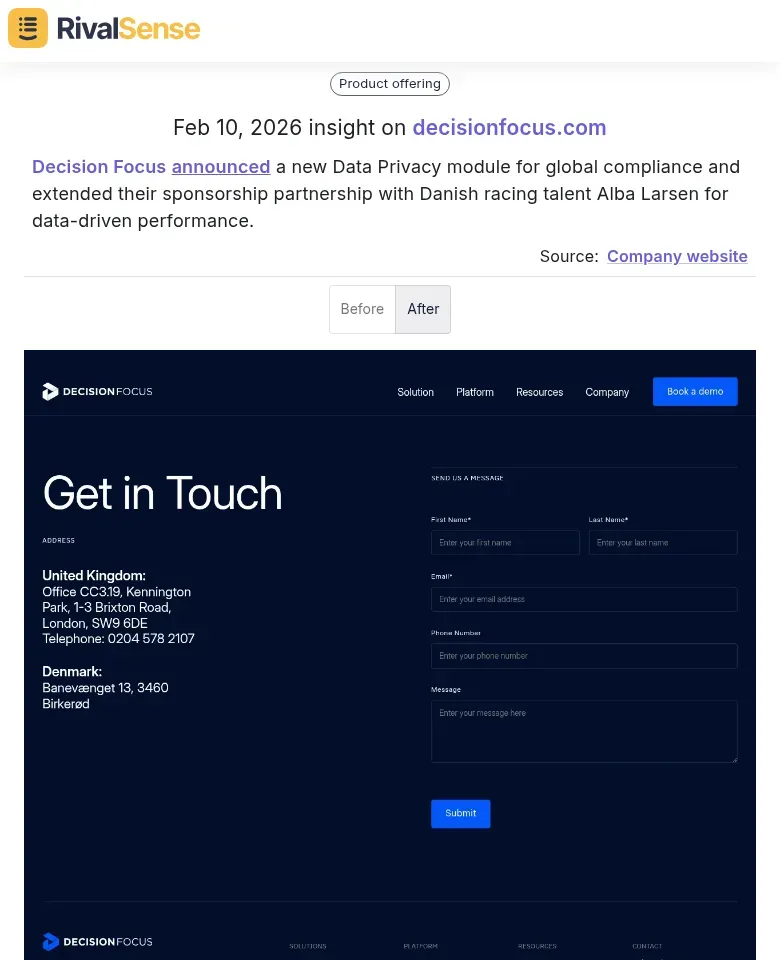
Market shifts like privatization trends or sustainability mandates create openings for competitors to reposition themselves.
Practical Steps for Risk Mitigation:
- Create a regulatory change monitoring system with automated alerts
- Conduct quarterly infrastructure assessments for key accounts
- Track competitor technology adoption through patent filings and product launches
- Establish early warning indicators for water quality fluctuations
- Develop contingency plans for each high-risk account
- Monitor competitor pricing strategies in your key account segments
- Build relationships with regulatory bodies to anticipate changes
- Implement predictive maintenance schedules to prevent service disruptions
Predictive Analytics Fundamentals for Risk Assessment
Predictive analytics leverages historical data to forecast future events, transforming water treatment account risk management from reactive to proactive. By identifying patterns and correlations, businesses can anticipate problems before they escalate. Core techniques include time-series forecasting for consumption patterns, classification algorithms for risk categorization, and regression models for predicting account churn probability. XGBoost and Random Forest excel at handling complex water quality and usage data, while LSTM networks capture temporal dependencies in account behavior.
Essential data sources span operational metrics (treatment efficiency, chemical usage), financial indicators (payment history, contract terms), and relationship signals (communication frequency, service request patterns). Key metrics include water quality compliance rates, treatment cost trends, and account satisfaction scores.
Practical Tip: Start with 12-24 months of historical data and validate models using cross-validation techniques.
Machine learning identifies early warning signs through anomaly detection in account behavior patterns. Look for decreasing communication frequency, increasing service complaints, or deviations from normal consumption patterns. Supervised learning models trained on historical churn data can flag at-risk accounts 30-90 days before actual attrition.
Checklist for Early Warning Signs:
- Monitor treatment cost per unit trends
- Track compliance violation frequency
- Analyze payment delay patterns
- Watch for reduced engagement in account reviews
Implement alert thresholds based on model confidence scores to prioritize intervention efforts effectively.
Building a Predictive Risk Tracking Framework for Water Treatment Accounts
Constructing a robust risk tracking framework requires a methodical approach that integrates diverse data points. This framework should provide real-time insights and predictive capabilities to safeguard key accounts. Start by establishing a comprehensive monitoring system that tracks three core areas: operational performance (water quality compliance, treatment efficiency, equipment uptime), contract metrics (payment history, service level agreement adherence, renewal timelines), and market intelligence (regulatory changes, competitor activity, local water stress levels).
Create a weighted risk scoring system with these practical steps:
- Assign risk scores (1-10) to each indicator based on severity
- Weight indicators by importance (e.g., compliance violations = 30%, payment delays = 25%)
- Set threshold triggers: Green (<30), Yellow (30-60), Red (>60)
- Implement automated alerts for red-zone accounts
Develop early intervention protocols:
- Weekly review meetings for yellow accounts
- Immediate escalation for red accounts with 48-hour action plans
- Quarterly risk assessment updates incorporating new market data
- Cross-functional response teams combining sales, operations, and compliance expertise
Pro Tip: Integrate IoT sensor data from treatment facilities with financial systems for real-time risk visibility. Use predictive analytics to identify patterns—like seasonal payment delays correlating with local economic downturns—enabling proactive interventions before accounts become critical.
Implementation Strategies and Best Practices
Successfully deploying predictive analysis demands alignment across technology, people, and processes. A phased approach minimizes disruption while maximizing early wins. Here’s a practical framework:
Technology Stack Recommendations:
- Core Platform: Use cloud-based analytics platforms (AWS SageMaker, Azure ML) with real-time data ingestion from SCADA systems, IoT sensors, and CRM data
- Data Integration: Implement APIs to connect water quality sensors (pH, turbidity, flow rates), maintenance logs, and customer usage patterns
- Visualization Tools: Deploy dashboards (Tableau, Power BI) for operations teams to monitor risk scores and predictive alerts
Organizational Alignment:
- Stakeholder Engagement: Create cross-functional teams with representatives from operations, sales, and customer service
- Training Programs: Develop role-specific training for field technicians on interpreting predictive alerts
- Communication Plan: Establish weekly risk review meetings with key account managers
Continuous Improvement Processes:
- Model Refinement: Implement A/B testing for new predictive features and monthly model performance reviews
- Feedback Loops: Create structured processes for field technicians to report false positives/negatives
- Accuracy Metrics: Track precision/recall rates and adjust thresholds based on seasonal water treatment patterns
Practical Checklist:
✅ Start with 3-5 high-value accounts for pilot implementation
✅ Define clear risk thresholds for different water treatment parameters
✅ Establish escalation protocols for high-risk predictions
✅ Document all model assumptions and data sources
✅ Schedule quarterly model retraining with updated historical data
Incorporating Competitive Intelligence: Monitoring competitor movements is crucial; for example, RivalSense tracked that Vanta is a founding host for Boston's first Techweek from May 26-31. Insights into event participation are valuable for understanding competitor market positioning and networking strategies, which can inform your own business development efforts and event planning. 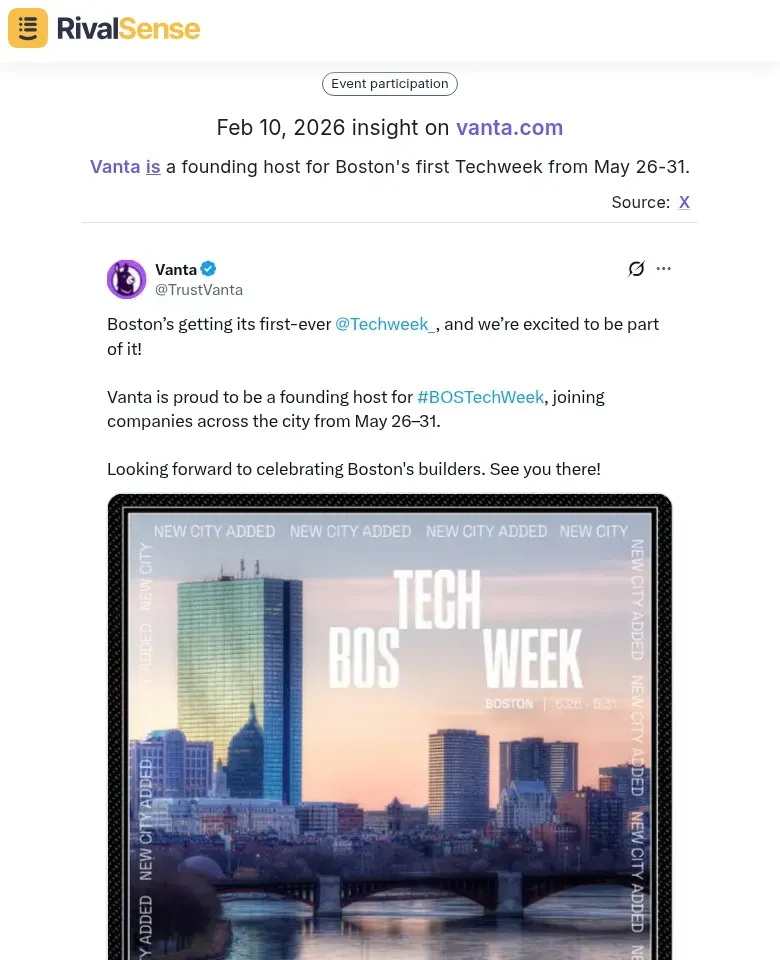
Measuring Success and Future Outlook
Evaluating the effectiveness of your predictive risk tracking system is essential for continuous improvement. Clear metrics help justify investments and guide refinements. To measure success, track these KPIs:
- Risk detection accuracy rate (aim for >85%)
- False positive rate (keep below 15%)
- Average lead time before account churn (target 60+ days)
- Revenue retention rate improvement
- Cost reduction in reactive account management
Case Study: A mid-sized water treatment firm implemented predictive analysis and achieved 92% risk detection accuracy, reducing account churn by 34% and increasing revenue retention by $2.8M annually. Their ROI calculation: ($2.8M retained revenue - $150K implementation costs) / $150K = 1,767% ROI in year one.
Future Outlook: Emerging trends include:
- AI-powered sentiment analysis of customer communications
- Integration with IoT sensor data from treatment systems
- Predictive pricing models based on competitor moves
- Automated competitive intelligence dashboards
Practical Checklist:
• Start with 3-5 key risk indicators specific to water treatment accounts
• Validate predictions against actual outcomes monthly
• Integrate predictive insights into existing CRM workflows
• Train sales teams on interpreting risk scores
• Regularly update AI models with new competitive data
Tip: Begin with a pilot program focusing on your 20% highest-value accounts before scaling to your entire portfolio.
Keeping an eye on hiring trends can signal strategic shifts; for instance, RivalSense reported that Eli Lilly is hiring for a Senior Director, Quality Assurance - Site Quality Leader position in the United States, focusing on ensuring quality management systems for a new manufacturing facility. Such insights are valuable for inferring competitor expansion plans and operational priorities, allowing you to anticipate market changes. 
Leverage Competitive Intelligence with RivalSense
Implementing predictive analytics for key account risk tracking is powerful, but it's even more effective when combined with real-time competitive intelligence. Tools like RivalSense track competitor product launches, pricing updates, event participations, partnerships, regulatory aspects, management changes, and media mentions across company websites, social media, and various registries, delivering all in a weekly email report.
By integrating such insights into your risk framework, you can anticipate market moves and stay ahead. The examples above show how tracking product launches, event hosting, and hiring trends can inform your strategy and mitigate risks.
Ready to enhance your competitive edge? Try out RivalSense for free at https://rivalsense.co/ and get your first competitor report today!
📚 Read more
👉 How Block's UCP Integration Accelerated Competitors in Agentic Commerce
👉 LinkedIn Competitor Insights Case Study: A Practical Key Account Tracking Workflow
👉 5 Event Participation Mistakes That Sabotage Your Competitor Intelligence
👉 Competitor Analysis in Action: Learning from Reddit's $1B Share Buyback