
Predictive Analytics for Engineering Consulting Key Account Management: Free Trial Guide
In engineering consulting, key account management (KAM) faces unique challenges that traditional approaches struggle to address. Technical projects involve complex stakeholder networks, long sales cycles averaging 6-12 months, and high-value contracts where a single lost account can impact 15-20% of annual revenue. The technical nature of services means decision-makers span engineering, procurement, and C-suite levels, each with different priorities and pain points.
Predictive analytics transforms this landscape by moving from reactive relationship management to proactive strategic planning. Instead of relying on quarterly reviews, you can now analyze historical project data, client communication patterns, and market signals to identify at-risk accounts 60-90 days before churn occurs. For example, by tracking engagement metrics across technical documentation downloads, proposal review times, and stakeholder meeting attendance, you can predict which accounts need intervention.
Practical steps to get started:
- Map your top 20 accounts with key stakeholders and decision criteria
- Identify 3-5 leading indicators of account health (e.g., project scope changes, communication frequency)
- Set up automated tracking for these indicators using your CRM and project management tools
- Create early warning alerts for accounts showing 2+ negative indicators
- Develop intervention playbooks for different risk scenarios
The strategic advantage is clear: data-driven KAM in technical services reduces account churn by 30-40% while increasing cross-selling opportunities by identifying unmet technical needs before clients even recognize them.
Core Predictive Analytics Capabilities for Engineering KAM
Predictive analytics transforms engineering consulting KAM from reactive to proactive. By leveraging data-driven insights, you can anticipate client needs and mitigate risks before they impact your business. Start with predictive modeling for client retention by analyzing engagement patterns, project satisfaction scores, and communication frequency. For expansion opportunities, track cross-selling signals like technology adoption rates and departmental penetration within client organizations.
Revenue forecasting requires analyzing historical project data, seasonal patterns, and market trends. Create weighted pipeline scoring models that consider deal size, probability, and timeline. Monitor key account health metrics including project margin trends, change order frequency, and billing cycle consistency.
Risk assessment should focus on early warning signs: scope creep patterns, resource allocation mismatches, and stakeholder turnover. Implement churn prediction by tracking engagement deterioration signals like reduced meeting frequency, delayed payments, and declining project satisfaction scores.
Practical checklist:
- Map client interaction data across all touchpoints
- Establish baseline metrics for each key account
- Set up automated alerts for risk indicators
- Create quarterly predictive health scores
- Develop intervention protocols for high-risk accounts
💡 Tip: Combine quantitative data with qualitative insights from account managers for most accurate predictions. Start with 3-5 key metrics per account rather than overwhelming data collection.
Implementing Predictive Analytics in Your KAM Strategy
Implementing predictive analytics in your KAM strategy requires a systematic approach tailored to engineering consulting's technical nature. It involves integrating multiple data sources and building models that reflect the complexities of technical service delivery. Start with data collection: integrate project management systems (like Jira, Asana), CRM platforms, billing software, and technical documentation repositories. Capture key metrics: project completion rates, technical issue resolution times, client satisfaction scores, and resource utilization patterns.
Build predictive models focused on technical service delivery: develop algorithms to forecast project risks based on historical technical challenges, predict client satisfaction from engineering team performance metrics, and identify cross-selling opportunities by analyzing technical dependencies between services. Use machine learning to correlate engineering team composition with project success rates.
Integrate insights into existing workflows: embed predictive alerts in your CRM when key accounts show risk indicators, create automated dashboards for account managers showing upcoming technical service needs, and establish weekly review sessions where analytics inform strategic account decisions.
Checklist for implementation:
- Audit existing data sources for integration
- Identify 2-3 high-impact predictive use cases
- Pilot with 3-5 key accounts first
- Train account managers on interpreting technical analytics
- Establish feedback loops to refine models
🔑 Key insight: The most successful implementations focus on predicting technical service delivery quality rather than just financial metrics, as engineering clients prioritize reliability and expertise over price.
Leveraging Competitor Intelligence for Predictive KAM
Predictive analytics isn't just about internal data; it also involves understanding external market movements. Monitoring competitor activities can provide early signals for strategic adjustments in your key account management, helping you stay ahead of industry trends and client expectations.
For instance, tracking product launches helps you anticipate shifts in client demands and competitive offerings. Consider this RivalSense insight: Harvey launched Shared Spaces with design partners to enable real-time collaboration and transparency for legal and professional services teams, as highlighted by leading organizations like Gleiss Lutz, Deutsche Telekom, PwC, IFS, King & Wood Mallesons, IAG, Thompson Hine LLP, and Flex.  This type of insight is valuable because it reveals how competitors are innovating to address client needs, allowing you to proactively adjust your service offerings or communication strategies before your accounts are influenced.
Similarly, AI-driven tools from competitors can signal efficiency gains that clients may start expecting. Gelato's AI Estimator helped Ink n Art reduce quoting time from 1.5-2 hours to 20 seconds for 14 packaging quotes, projecting 30% revenue growth in 2026, with a webinar featuring CEO Henrik Müller-Hansen on February 18-19.  Understanding such advancements helps you benchmark your own processes and identify opportunities for improvement or differentiation in your technical services, directly impacting account satisfaction and retention.
Awards and recognitions can also indicate market trends and client preferences. DiscoverCars.com awarded its 2025 Excellent Service Award to multiple Green Motion international locations on 19 February 2026 based on verified customer reviews. 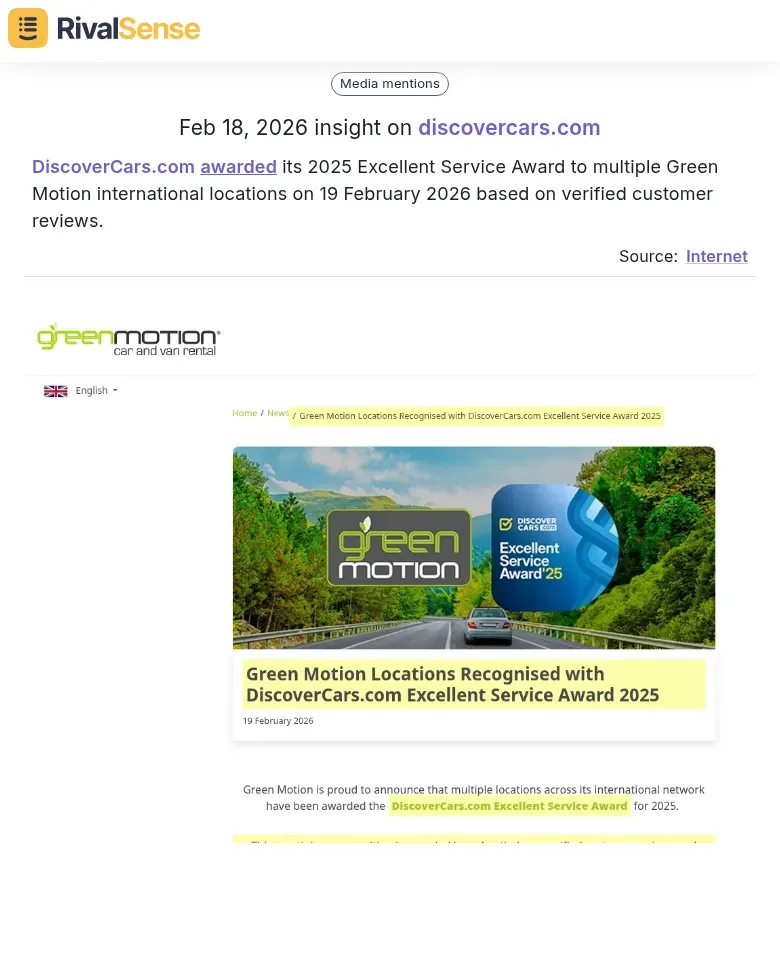 This insight is valuable as it highlights what clients value in service delivery, informing your own account management priorities and customer satisfaction metrics to enhance predictive models for client loyalty.
By integrating competitor intelligence into your predictive analytics, you can create a more comprehensive view of your market position and key account dynamics.
The RivalSense Free Trial: Getting Started with Predictive KAM
Ready to transform your engineering consulting key account management with predictive analytics? Here's how to maximize your RivalSense free trial to gain actionable insights, including competitor intelligence that informs your strategy.
1. Account Setup & Data Integration (First 24 Hours)
- Connect your CRM (Salesforce, HubSpot) and project management tools
- Import historical account data from the past 2-3 years
- Set up competitor tracking for your top 5-7 engineering rivals
- 💡 Tip: Start with your 3 most strategic accounts for focused insights
2. Key Dashboards to Monitor (Week 1)
- Account Health Scoreboard: Track engagement trends and risk indicators
- Competitive Intelligence Hub: Monitor rival moves in your key verticals
- Predictive Churn Alerts: Identify at-risk accounts before they disengage
- Revenue Forecasting Dashboard: Project future account growth potential
3. Practical Validation Exercises (Week 2)
- Test 1: Compare RivalSense's churn predictions against your last 6 months of actual account losses
- Test 2: Validate competitor activity alerts by cross-checking with your team's field intelligence
- Test 3: Use predictive insights to prioritize outreach to 2-3 at-risk accounts
- Checklist: Document 3 specific insights that surprised you and their potential business impact
🚀 Pro Tip: Schedule a weekly 30-minute review with your account team to discuss predictive findings and adjust strategies. The most successful trial users treat this as a discovery sprint, not just a software test.
Maximizing Value During Your Free Trial Period
To maximize value during your free trial, focus on three key areas that demonstrate tangible business impact for your engineering consulting firm.
-
Identify High-Potential Accounts: Use predictive scoring to prioritize accounts with the highest conversion potential. Look for accounts showing engagement signals like frequent website visits, content downloads, or multiple decision-maker interactions. Create a target list of 10-15 accounts with predictive scores above 80%.
-
Test Intervention Strategies: Run A/B tests with different approaches:
- Proactive outreach vs. reactive support
- Technical content vs. business case content
- Email sequences vs. personalized demos
Track which strategies yield the highest engagement and pipeline movement.
-
Measure ROI & Business Impact: Calculate tangible metrics:
- Pipeline velocity improvements
- Deal size increases
- Win rate changes
- Time saved on account research
Use your trial dashboard to compare pre-trial vs. trial-period performance.
Practical Checklist:
- Score all trial accounts within first 3 days
- Test at least 2 intervention strategies
- Document 3-5 specific ROI examples
- Schedule weekly review sessions
- Gather stakeholder feedback on insights generated
Focus on proving concrete business value that justifies continued investment in predictive analytics for key account management.
Next Steps: From Trial to Transformation
Now that you've experienced predictive analytics in action, it's time to scale your success. Here's your roadmap for transforming your engineering consulting KAM approach with data-driven intelligence.
1. Scale Across Your Portfolio
- Start with your top 5-10 accounts using similar predictive models
- Create a tiered implementation plan based on account value and complexity
- Document successful patterns and replicate them systematically
2. Build a Data-Driven Culture
- Train your team on interpreting predictive insights, not just data points
- Establish weekly review sessions to discuss predictive findings and actions
- Create simple dashboards that make predictive analytics accessible to all team members
- Reward data-informed decisions, not just outcomes
3. Optimize Continuously
- Set quarterly review cycles to assess model accuracy and business impact
- Track key metrics: prediction accuracy, account retention rates, and revenue growth
- Gather feedback from account managers on what insights are most actionable
- Refine your models based on new data patterns and market changes
Pro Tips:
- Start small but think big - pilot with willing team members first
- Make predictive insights part of your regular account review templates
- Don't just collect data; create clear action plans from every prediction
- Remember: The goal isn't perfect predictions, but better decisions
Your free trial has shown you what's possible. Now transform your entire account management approach with predictive intelligence that grows with your business.
Ready to put predictive analytics to work? Try RivalSense for free at https://rivalsense.co/ and get your first competitor report today to start transforming your key account management with insights on product launches, pricing updates, events, and more.
📚 Read more
👉 How Glean's AI Assistant Evolution Revealed Competitor Growth Opportunities
👉 Optimizing Competitor Website Monitoring for Influencer Partnership Insights
👉 Nanotech SEO Hacks: Quick Competitor Strategy Wins
👉 Optimize Pricing with Competitor Insights to Boost Key Account Metrics