
Performance Marketing Competitor Analysis: A Beginner's Guide to Boosting ROI
Performance marketing is a results-driven approach where every dollar spent is measured against specific outcomes—clicks, conversions, revenue. 🎯 Unlike traditional brand marketing, it's about optimizing campaigns in real-time based on data. This measurement-driven nature makes competitor analysis not just useful but essential for success in today's competitive landscape.
Why is it crucial? In performance marketing, you're competing for the same audience attention and ad space. Without understanding your competitors' strategies—their keywords, ad copy, landing pages, and conversion tactics—you risk overspending on underperforming campaigns. Competitive intelligence transforms your ROI by revealing gaps in the market and opportunities to outperform rivals.
Practical steps to get started:
- Identify 3-5 key competitors using tools like RivalSense
- Track their ad spend, messaging, and target keywords weekly
- Analyze their landing page conversion elements (CTAs, forms, offers)
- Benchmark your performance metrics against theirs
💡 Tip: Focus on competitors who consistently appear in your target search results or social feeds—they're likely optimizing effectively. By leveraging these insights, you can allocate budget smarter, craft more compelling ads, and make strategic decisions that drive measurable growth.
Key Benefits of Competitor Analysis in Performance Marketing
Competitor analysis in performance marketing delivers three transformative benefits that directly impact your bottom line. First, it reveals market gaps and untapped opportunities by analyzing competitor messaging, targeting strategies, and audience segments they're overlooking. Second, benchmarking against industry leaders provides realistic performance targets for your campaigns. Third, competitive insights optimize ad spend efficiency, helping you reallocate resources to high-ROI areas.
Here’s a breakdown of each benefit with actionable tips:
✅ Reveal Market Gaps: Create a competitor messaging matrix to identify underserved customer pain points and audience segments. This helps you tailor your offers to fill those voids.
✅ Benchmark Performance: Track competitors' CTR, conversion rates, CPA, and ROAS to establish achievable KPIs. Monitor 3-5 key competitors monthly, noting their ad placements and seasonal patterns.
✅ Optimize Ad Spend: Analyze competitors' bidding strategies and creative approaches to identify cost-saving opportunities. Use this intelligence to shift budget from underperforming channels to domains they dominate, often improving efficiency by 15-30% within a quarter.
Learning from Strategic Partnerships and Data Integration
Strategic partnerships with data providers transform performance marketing competitor analysis from guesswork to precision. By integrating verified consumer data from trusted sources, you gain accurate insights into competitor targeting, messaging, and conversion strategies. This approach reduces analysis time and enhances reliability, giving you a competitive edge.
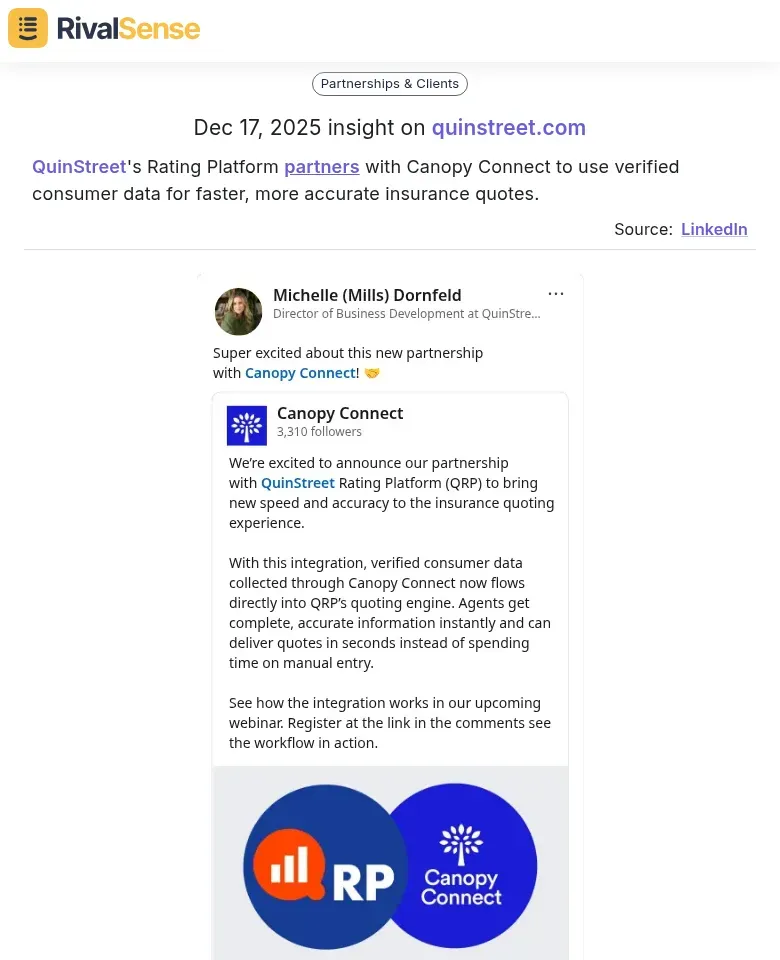
For instance, RivalSense tracked that QuinStreet's Rating Platform partnered with Canopy Connect to use verified consumer data for faster, more accurate insurance quotes. This type of insight is valuable because it reveals how competitors are enhancing their data capabilities, which can signal shifts in market positioning or new service offerings you need to anticipate.
Data integration creates three key advantages:
- Enhanced Accuracy & Speed: Access validated consumer profiles to reduce analysis time from weeks to days.
- Improved Conversion Intelligence: Learn which competitor offers and channels actually convert audiences.
- Competitive Data Integration: Merge first-party data with external sources for unique insights.
Practical Steps to Implement:
- Identify 3-5 reputable data providers in your industry
- Test integration with one provider first to validate data quality
- Create a dashboard that merges competitor data with your performance metrics
- Establish regular data refresh cycles (weekly or bi-weekly)
- Monitor conversion lift from data-informed campaign adjustments
🚀 Pro Tip: Look for data partnerships with real-time updates to stay ahead of rapidly changing competitor strategies. The most successful performance marketers predict moves before they happen.
Analyzing Organizational Moves and Talent Shifts
Executive departures and talent shifts offer critical intelligence about industry dynamics and emerging opportunities. When key leaders leave established players, it often signals internal challenges or strategic redirections. By monitoring these changes, you can anticipate market shifts and adjust your own strategies accordingly.
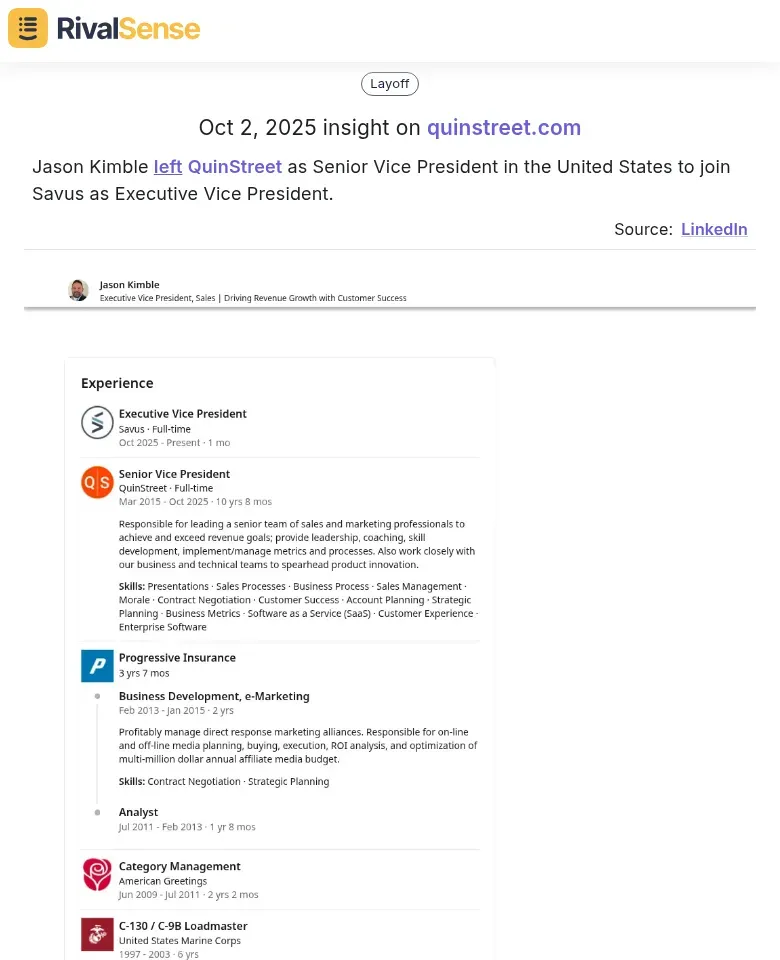
For example, RivalSense reported that Jason Kimble left QuinStreet as Senior Vice President in the United States to join Savus as Executive Vice President. Tracking executive departures is crucial as it can indicate internal challenges or new strategic directions for competitors, giving you early warnings about potential threats or openings.
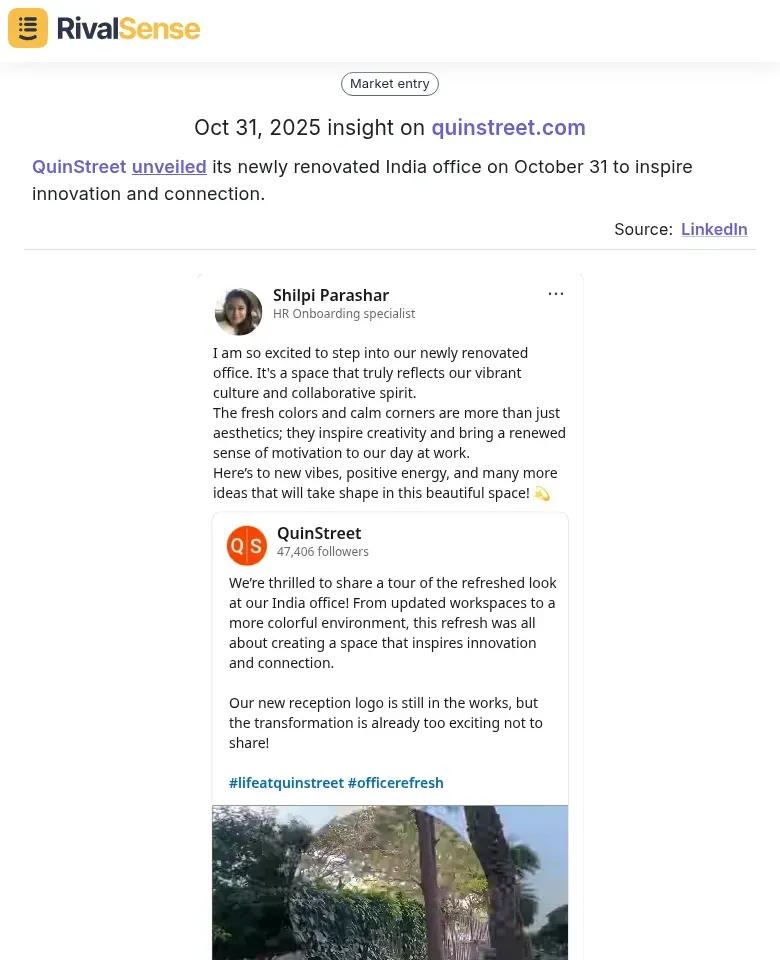
Similarly, monitoring company events like office expansions can provide insights into growth and innovation investments. RivalSense noted that QuinStreet unveiled its newly renovated India office to inspire innovation and connection. Such insights are valuable because they signal geographic expansion or increased focus on specific regions, which might affect local competition.
Practical steps for analyzing organizational moves:
- Track executive departures using LinkedIn alerts for competitor leadership teams.
- Monitor where departing talent lands—are they joining direct competitors or adjacent markets?
- Analyze timing patterns—do departures cluster around product launches or earnings reports?
Checklist for organizational analysis:
- Set up alerts for competitor leadership changes
- Map talent flows between companies in your space
- Correlate hiring patterns with market announcements
- Identify which competitors are losing key talent
- Track where industry experts are moving
📈 Remember: Organizational changes often precede strategic shifts by 6-12 months. By monitoring talent movements, you gain early warning signals about competitive threats and market opportunities.
Practical Steps for Conducting Competitor Analysis
Conducting effective competitor analysis requires a structured approach. Start by mapping your competitive landscape and categorizing rivals based on their relevance and threat level. Then, track essential metrics across various channels to gather actionable data. Finally, transform this data into strategic insights that drive your marketing decisions.
Step 1: Identify and Categorize Competitors
Begin by categorizing competitors into three groups:
- Direct competitors: Companies offering similar services to the same audience (e.g., other PPC agencies).
- Indirect competitors: Different solutions solving the same marketing problems (e.g., content marketing agencies).
- Aspirational competitors: Industry leaders whose strategies you can learn from.
🔍 Pro tip: Use tools like SEMrush or Ahrefs to discover who's ranking for your target keywords, not just who you think your competitors are.
Step 2: Track Essential Metrics and Activities
Monitor these key performance marketing metrics across competitors:
- Paid advertising: Ad spend, CTR, CPC, ad copy variations, landing page strategies
- SEO performance: Keyword rankings, organic traffic, backlink profiles
- Content marketing: Content gaps, engagement rates, lead magnet effectiveness
- Social media: Platform presence, engagement metrics, campaign performance
Essential tools checklist:
✓ SEMrush/SpyFu for PPC analysis
✓ SimilarWeb for traffic estimates
✓ BuzzSumo for content performance
✓ Social media monitoring tools for engagement tracking
Step 3: Create Actionable Insights
Transform data into strategy with these steps:
- Identify gaps: Where are competitors underperforming? (e.g., weak email follow-up sequences)
- Spot opportunities: What channels are they neglecting? (e.g., LinkedIn advertising in B2B)
- Benchmark performance: Compare your metrics against industry averages
- Funnel hack: Sign up for competitor email sequences and analyze their customer journey
Actionable insight framework:
- Quick wins: Copy successful ad copy structures
- Strategic advantages: Develop content that fills gaps competitors ignore
- Budget optimization: Reallocate spend to underutilized channels with high ROI potential
💼 Practical tip: Create a monthly competitor analysis dashboard with key metrics to track trends over time and make data-driven decisions.
Turning Insights into Competitive Advantages
Turning competitive insights into sustainable advantages requires systematic execution and continuous monitoring. First, develop differentiated positioning by analyzing competitor weaknesses and aligning them with your strengths. Second, implement systems to track competitor movements in real-time, ensuring you stay ahead of market changes. Third, measure the impact of your strategies through specific KPIs to validate effectiveness.
Here’s a practical checklist to get started:
- Map 3-5 competitor weaknesses to your unique strengths
- Set up automated monitoring for pricing, features, and content
- Create quarterly competitive intelligence reports
- Establish baseline metrics before implementing changes
- Test competitor-informed strategies in controlled campaigns first
For instance, if competitors focus on enterprise clients but neglect mid-market needs, position your solution as the 'mid-market specialist' with tailored pricing and support. Use tools like RivalSense to track social media engagement, ad spend patterns, and keyword targeting automatically, saving you time and providing timely insights.
📊 Measure impact through specific KPIs: Track metrics like market share growth in segments where you've differentiated, win rates against key competitors, and customer acquisition cost improvements from optimized campaigns. A/B test competitor-informed strategies before full rollout to minimize risk.
Try RivalSense for Free and Get Your First Competitor Report Today
Competitor analysis in performance marketing doesn't have to be overwhelming. With the right tools, you can streamline the process and focus on strategic execution. RivalSense tracks competitor product launches, pricing updates, event participations, partnerships, regulatory aspects, management changes, and media mentions across websites, social media, and various registries—delivering all in a weekly email report.
Ready to transform your competitor analysis? Try RivalSense for free and get your first competitor report today to start gaining actionable insights that drive growth. Visit https://rivalsense.co/ to begin.
📚 Read more
👉 Optimizing Product Offerings with Win-Loss Analysis and Competitor Insights
👉 Mastering Competitor Analysis with Real-World Insights
👉 Key Account Management Best Practices 2024: The Strategic Playbook for B2B Growth
👉 Cloud Infrastructure Competitive Intelligence: A Strategic Guide for B2B Leaders
👉 How Real-Time Alerts on Competitor Leadership Moves Drive Business Strategy