
Optimizing Telecom Infrastructure Key Account Task Tracking: A Strategic Process Guide
Introduction: The Critical Role of Task Tracking in Telecom Key Account Management
Telecom infrastructure projects for key accounts present unique challenges that demand precise task tracking. Unlike standard deployments, these large-scale projects involve complex multi-vendor ecosystems, strict regulatory compliance requirements, and mission-critical uptime expectations. When tracking breaks down, the business impact is severe: delayed deployments can cost millions in lost revenue, while communication gaps strain client relationships and damage trust.
Optimized tracking processes create tangible competitive advantages. By implementing structured workflows with clear accountability, telecom providers can reduce project delays by 30-40% and improve client satisfaction scores. Practical steps include establishing standardized task templates for common infrastructure scenarios, implementing real-time status dashboards accessible to both internal teams and key account stakeholders, and conducting weekly alignment meetings with predefined agenda templates.
Key checklist items:
- Map all critical path dependencies between tasks
- Assign clear ownership with escalation protocols
- Implement automated milestone notifications
- Maintain centralized documentation accessible to all stakeholders
These systematic approaches transform task tracking from administrative overhead into strategic differentiator, enabling telecom providers to consistently deliver on complex infrastructure commitments while strengthening key account partnerships.
Foundations: Building Your Telecom Key Account Task Tracking Framework
Building a robust telecom key account task tracking framework starts with defining clear task categories specific to infrastructure projects. Create four core categories:
- Network Deployment (site surveys, equipment installation, fiber splicing)
- Maintenance & Upgrades (predictive maintenance, software updates, capacity expansions)
- Compliance & Documentation (regulatory reporting, safety audits, asset tagging)
- Customer Service Tasks (SLAs monitoring, incident response, performance reporting)
Establish standardized workflows using automation tools that follow this sequence: Task Creation → Assignment → Execution → Verification → Documentation. For network deployment, implement a checklist: Pre-deployment site assessment → Equipment validation → Installation verification → Testing protocols → Handover documentation.
Implement accountability structures with RACI matrices:
- Responsible (field technicians)
- Accountable (project managers)
- Consulted (network architects)
- Informed (account executives)
Use role-based permissions in your tracking system: Network Engineers (full access to technical tasks), Account Managers (customer-facing tasks only), Compliance Officers (documentation oversight). Tip: Integrate with existing OSS/BSS systems for real-time data synchronization and automate status updates to reduce manual reporting overhead.
Process Optimization: Streamlining Telecom Infrastructure Task Management
Streamlining telecom infrastructure task management requires a systematic approach to process optimization. Start by automating routine tracking for network provisioning and site management using RPA tools to handle repetitive tasks like equipment inventory updates, site readiness checks, and bandwidth allocation monitoring. Implement automated alerts for SLA breaches and milestone completions.
Integrate task tracking with existing telecom project management systems through API connections. Create bi-directional sync between your task management platform and systems like Jira, Asana, or Monday.com. Use webhooks to trigger automatic task creation when network tickets are logged in your NMS (Network Management System).
Establish clear escalation protocols for critical infrastructure issues:
- Define severity levels (P1-P4) with specific response times
- Create automated escalation triggers based on time thresholds
- Designate escalation paths to senior engineers and management
- Implement automated notifications to stakeholders when issues breach SLA thresholds
Maintain a centralized dashboard showing real-time status of all critical tasks with color-coded priority indicators.
Technology Integration: Tools for Enhanced Telecom Task Visibility
To optimize telecom infrastructure key account task tracking, start by selecting specialized telecom project management software with built-in tracking capabilities. Look for tools that offer telecom-specific features like tower maintenance scheduling, fiber deployment tracking, and regulatory compliance workflows.
Key criteria should include:
- Integration with existing telecom systems (OSS/BSS)
- Customizable workflow templates for common infrastructure projects
- Real-time collaboration features for cross-functional teams
Next, implement real-time dashboards that provide at-a-glance visibility into infrastructure project status. These dashboards should display critical metrics like: project completion percentages, SLA compliance rates, technician allocation status, and equipment deployment timelines. Use color-coded alerts for delays or bottlenecks, ensuring project managers can intervene proactively. Tip: Configure role-based views so executives see high-level KPIs while field supervisors access granular task details.
Finally, leverage mobile solutions for field technicians to enable on-site task updates. Equip teams with mobile apps that allow: photo documentation of work completed, GPS-based location tracking, offline capability for remote sites, and instant status reporting. This eliminates manual paperwork delays and provides accurate, timestamped progress data.
Checklist for mobile solutions:
- ✅ Integrate with your central project management platform
- ✅ Include safety compliance checklists for field operations
- ✅ Enable real-time photo/video documentation
- ✅ Provide offline synchronization capabilities
Leveraging Competitive Intelligence for Strategic Advantage
While internal task tracking is crucial, external competitive intelligence provides essential context for strategic decision-making. Monitoring competitor moves—from product integrations to personnel changes—can inform your own infrastructure planning and account strategies. This intelligence helps you anticipate market shifts, identify partnership opportunities, and stay ahead of regulatory requirements.
For example, tracking technology partnerships can reveal industry trends and emerging standards. Knowing when competitors form new integrations helps you assess whether to follow similar paths or differentiate.

Example: OneTrust integrates with Amazon Web Services Bedrock to help organizations accelerate AI readiness.
Strategic Value: This type of insight reveals how competitors are adapting their technology stacks for emerging trends like AI, helping you benchmark your own technology roadmap and partnership strategies.
Similarly, tracking management changes at competitor organizations can signal strategic shifts in focus or expansion into new markets. These moves often precede changes in service offerings or geographic coverage that could impact your key accounts.
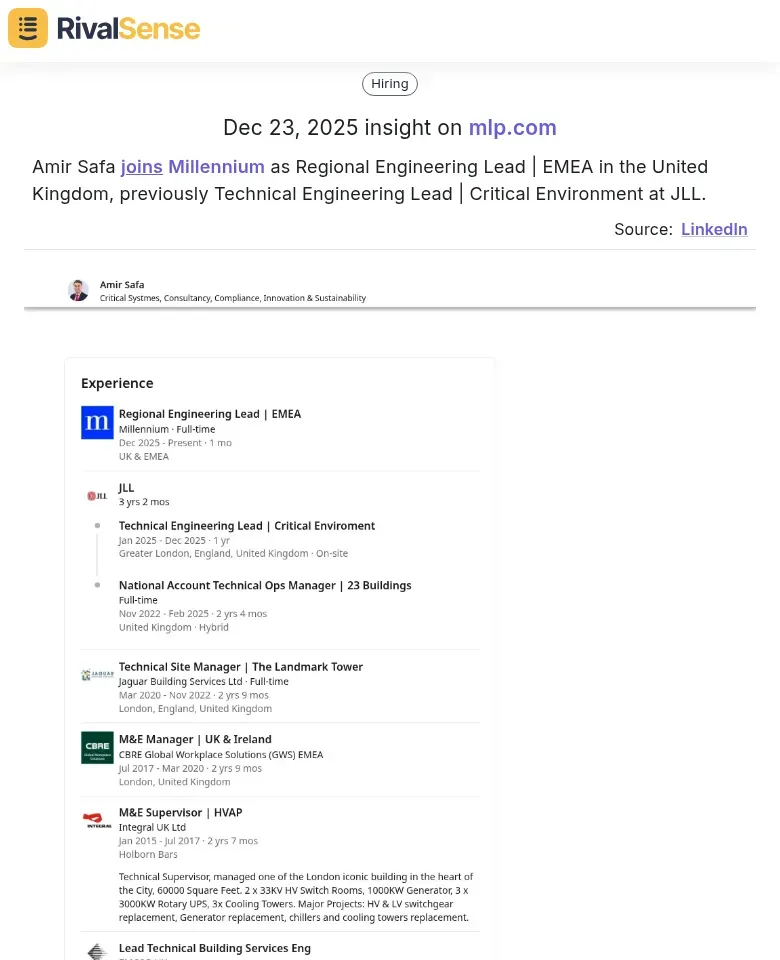
Example: Amir Safa joins Millennium as Regional Engineering Lead | EMEA in the United Kingdom, previously Technical Engineering Lead | Critical Environment at JLL.
Strategic Value: Leadership hires often indicate new strategic initiatives or market expansions. Tracking these changes helps you anticipate competitor moves that could affect your key account relationships and infrastructure projects.
Finally, monitoring regulatory certifications and compliance updates is essential for telecom infrastructure projects. Changes in certification status can impact bidding processes, partnership eligibility, and service delivery capabilities.

Example: Destination Asia Indonesia's Travelife certification has been extended from August 22, 2025 to October 24, 2027, and Destination Asia Malaysia's Travelife Partner status has been updated.
Strategic Value: Certification updates signal operational readiness and compliance commitments. Tracking these helps ensure your own certifications remain competitive and identifies when competitors gain or lose compliance advantages that could affect client selection.
Performance Measurement: Tracking Success in Telecom Key Account Management
Effective performance measurement in telecom key account management requires a structured approach to tracking task completion and quality. Start by defining clear KPIs: track on-time completion rates (target: 95%+), first-time-right quality scores (aim for 90%+), and client satisfaction metrics via quarterly surveys. Implement weekly internal reviews and monthly client reporting cycles—use standardized dashboards to highlight progress against SLAs and flag any deviations.
Leverage data analytics to identify bottlenecks: analyze task duration data to pinpoint stages with consistent delays (e.g., permitting or equipment delivery), and use root-cause analysis to address systemic issues.
Checklist for performance reviews:
- Review KPI trends vs. targets
- Assess client feedback patterns
- Identify top 3 bottlenecks
- Update action plans with specific owners
Tip: Automate data collection from project management tools to reduce manual effort and ensure real-time visibility. This data-driven approach enables proactive improvements, enhancing both operational efficiency and client trust in infrastructure projects.
Continuous Improvement: Evolving Your Telecom Task Tracking Strategy
To evolve your telecom task tracking strategy, implement quarterly process audits using a 5-point checklist:
- Review task completion rates and bottlenecks
- Assess technology integration gaps (e.g., 5G, IoT)
- Analyze client satisfaction scores
- Evaluate team accountability metrics
- Benchmark against industry best practices
Collect stakeholder feedback through monthly surveys with key account managers, clients, and technical teams—focus on pain points like real-time updates or compliance tracking.
Adapt tracking methods by leveraging AI-driven tools for predictive analytics on network maintenance or cloud migration tasks. For example, use automated dashboards that adjust to new telecom standards (e.g., Open RAN) and client-specific SLAs. Incorporate agile methodologies, breaking large projects into sprints with clear ownership and deadlines.
Build a culture of accountability by establishing transparent KPIs (e.g., on-time delivery, issue resolution rates) and regular review meetings. Encourage continuous optimization through gamification—reward teams for process improvements or innovative tracking solutions. Tip: Create a 'lessons learned' repository after each major project to refine workflows and avoid recurring delays.
Enhance Your Strategy with Automated Competitive Intelligence
Maintaining comprehensive task tracking while staying ahead of market changes is challenging. Manual competitor monitoring consumes valuable time that could be spent on strategic execution. This is where automated competitive intelligence tools provide significant advantage.
RivalSense delivers actionable insights directly to your inbox, tracking competitor product launches and updates, pricing changes, event participations, partnerships, regulatory developments, management changes, and media mentions. These weekly reports give you the external context needed to refine your task tracking priorities and key account strategies.
Ready to enhance your telecom infrastructure strategy with competitive intelligence? Try RivalSense for free and get your first competitor report today. See how automated insights can complement your internal task tracking and help you stay ahead in the competitive telecom landscape.
📚 Read more
👉 How Nextiva's EHR Integration Strategy Enabled Competitors to Counterattack
👉 Internet Intelligence Workflow: Uncovering Why Competitors Succeed
👉 Best Practices for Mobility Trade Show Strategy to Outpace Competitors
👉 Quick Tips: Monitor Competitor Hiring & Layoffs via Regulatory Filings
👉 How to Respond to Competitor Pricing Changes: A Case Study on Vivigo