
Optimizing Key Account Management with Competitor Website Intelligence
In today's competitive B2B landscape, key account management demands more than just relationship-building—it requires proactive intelligence. Competitor website monitoring provides the early warning system that transforms reactive account management into strategic foresight. By tracking competitor websites, you gain visibility into strategic shifts before official announcements, allowing you to anticipate moves that could threaten your key accounts.
Practical steps to implement:
- Set up automated monitoring for competitor homepage changes, pricing pages, and case studies
- Track new product launches or feature announcements that could impact your accounts
- Monitor career pages for hiring patterns indicating new strategic directions
- Analyze blog content and resource sections for emerging thought leadership themes
When you notice a competitor highlighting a new industry vertical or showcasing a client success story in your account's sector, these are signals to assess account vulnerability. Connect these insights directly to your account planning by asking: "If our competitor is targeting this industry, which of our key accounts are most at risk?" This intelligence enables you to proactively address concerns, reinforce your value proposition, and strengthen account defenses before competitors make their move.
Decoding Strategic Signals from Competitor Website Updates
Competitor website changes reveal critical strategic shifts that directly impact your key account management strategy. By systematically monitoring these updates, you can anticipate market moves and protect your most valuable client relationships. Here’s how to decode these signals effectively.
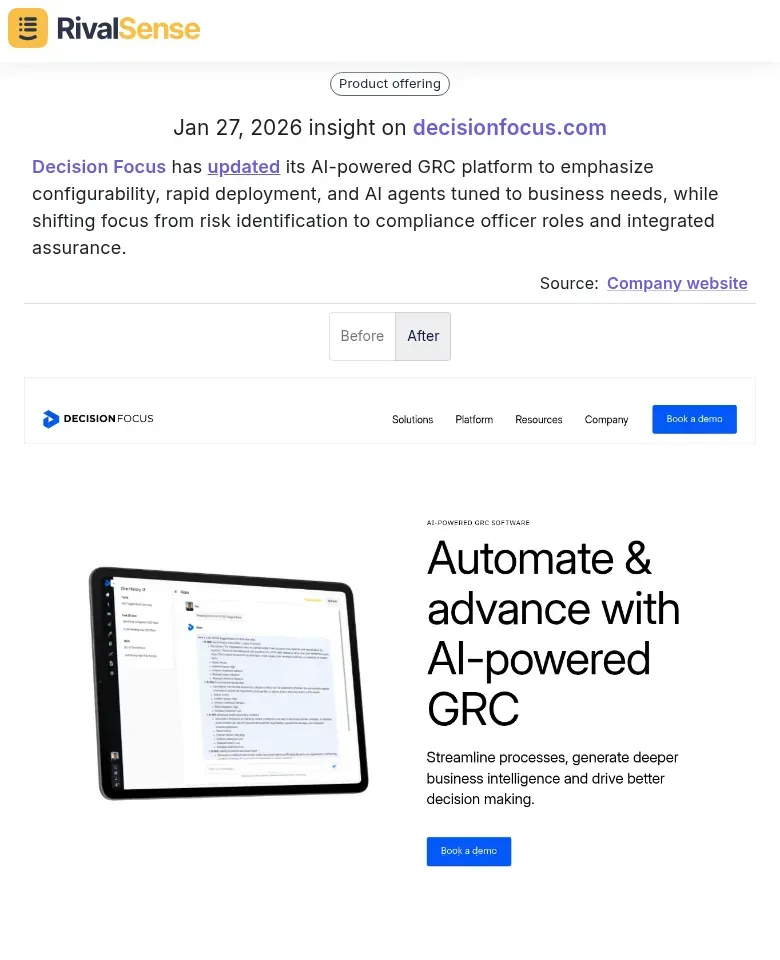
Analyzing Product Positioning Shifts: When competitors reposition products, they're responding to emerging market needs. Track homepage messaging changes, feature prioritization, and pricing tier adjustments. For example, RivalSense captured that Decision Focus updated its AI-powered GRC platform to emphasize configurability, rapid deployment, and AI agents tuned to business needs. This type of product update insight is valuable because it reveals how competitors are adapting to market demands, allowing you to adjust your own product positioning and messaging proactively.
Practical tip: Create a tracking matrix comparing launch dates, target segments, and value propositions across competitors. Look for patterns—if multiple rivals emphasize AI features, it signals enterprise demand for automation solutions.
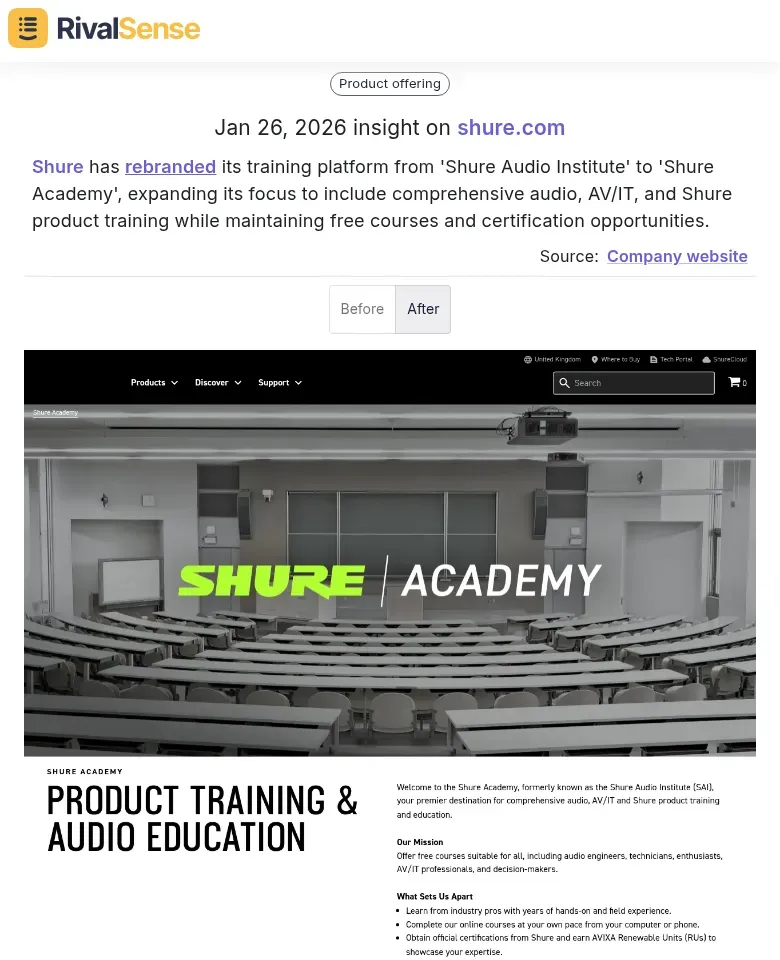
Monitoring Rebranding and Platform Expansions: Major redesigns often indicate new customer segment targeting. When a competitor expands their platform or adds new service tiers, analyze their navigation structure and landing pages. For instance, Shure rebranded its training platform from 'Shure Audio Institute' to 'Shure Academy', expanding its focus to include comprehensive audio, AV/IT, and Shure product training. Tracking such rebranding efforts is valuable as it shows how competitors are evolving their educational offerings to capture broader market segments, which can inform your own training and certification strategies.
Checklist item: Review homepage layouts weekly for new CTAs, navigation changes, and visual branding updates. These reveal whether they're targeting SMBs, enterprises, or specific verticals.
Tracking Compliance and Regulatory Updates: Legal and compliance page changes serve as early warning signals for industry shifts. Monitor terms of service, privacy policy, and regulatory documentation updates. Practical step: Set automated alerts for competitor compliance pages using tools like RivalSense. When you see GDPR or industry-specific compliance updates, anticipate how these changes might affect your key accounts' requirements.
Actionable Implementation:
- Weekly review: Check homepage layouts, pricing pages, and compliance sections
- Document changes in a competitive intelligence dashboard
- Map observed patterns to your key account vulnerabilities and opportunities
- Brief your account management team on strategic implications
By transforming website monitoring into structured analysis, you gain 2-3 month lead time on market shifts, allowing proactive adjustments to your key account strategy before competitors impact your client relationships.
Mapping Competitor Insights to Key Account Lifecycle Stages
Strategic competitor website monitoring transforms key account management by aligning insights with each lifecycle stage. From acquisition to expansion, every phase benefits from timely intelligence on competitor moves. Let's explore how to map insights effectively across the account journey.
For new account acquisition, track competitor press releases, case studies, and partnership announcements to identify emerging market opportunities and target accounts actively seeking solutions. Create a monitoring checklist:
- Set alerts for competitor 'customer wins' announcements
- Analyze implementation timelines in case studies
- Track new feature releases that signal market gaps
During onboarding, study competitor implementation patterns to streamline your processes. Analyze how competitors structure onboarding timelines, support documentation, and training materials. Practical tip: Create a competitor implementation timeline comparison chart to identify best practices and potential friction points you can address proactively.
For account expansion, monitor competitor upselling signals like tiered pricing changes, add-on feature launches, and customer success stories highlighting expanded usage. Additionally, track event participations and financial announcements, as they can indicate strategic priorities. For example, Lyft announced its Fourth Quarter 2025 earnings call scheduled for February 10, 2026. This type of event insight is valuable because it provides clues about a competitor's financial health and future investments, helping you anticipate their resource allocation and competitive thrusts.

Set up alerts for competitor pricing page updates and feature announcements. When competitors introduce new enterprise features, proactively reach out to your accounts with similar needs, positioning your solution as the strategic alternative. This anticipatory approach turns competitor moves into expansion opportunities.
Practical Framework: Building Your Competitor Website Monitoring System
To build an effective competitor website monitoring system, start with automated tracking. Use tools like RivalSense to monitor competitor websites, landing pages, pricing pages, and blog content. Set up daily or weekly scans for changes in messaging, product features, pricing structures, and content strategy.
Create structured matrices to organize insights. Use a 3x3 framework: vertical axis (website elements: homepage, pricing, content) and horizontal axis (competitors: primary, secondary, emerging). Prioritize insights using impact vs. urgency scoring (1-5 scale). Track changes in value propositions, feature additions, and pricing experiments.
Implement tiered alert systems:
- Level 1 (Critical): Pricing changes, major feature launches, leadership announcements
- Level 2 (Important): Content strategy shifts, messaging updates, UX improvements
- Level 3 (Informational): Minor copy changes, blog frequency adjustments
Practical checklist:
✓ Identify 3-5 key competitors
✓ Set up automated monitoring for homepage, pricing, and blog
✓ Create change log with timestamps
✓ Establish weekly review cadence
✓ Share insights with sales and product teams
Tip: Focus on patterns rather than isolated changes. Competitor website monitoring reveals strategic direction, not just tactical moves.
Turning Website Insights into Strategic Account Advantages
Transform competitor website analysis into tangible account advantages with these actionable strategies. By systematically converting insights into actions, you can outmaneuver competitors and secure key relationships.
-
Identify Gaps in Competitor Offerings: Systematically review competitor websites for missing features, service limitations, or outdated solutions. Create a gap analysis matrix comparing their offerings against your capabilities. For example, if a competitor lacks 24/7 support or advanced integrations, document these as opportunities to strengthen your value proposition.
-
Develop Counter-Strategies: Analyze competitor weaknesses like slow response times, limited customization, or poor user experience. Develop targeted counter-strategies: if they have complex pricing, emphasize your transparent pricing; if they lack mobile optimization, highlight your responsive platform.
-
Create Targeted Messaging: Craft messaging that directly addresses competitor limitations while showcasing your superior solutions. Use specific language like "Unlike [Competitor], we offer [Your Superior Feature]" or "While others struggle with [Competitor Limitation], our solution provides [Your Advantage]."
Practical Checklist:
- Weekly competitor website audits for feature updates
- Document 3-5 specific competitor weaknesses per quarter
- Create battle cards with counter-arguments for sales teams
- Test messaging with pilot accounts before full rollout
By systematically converting website insights into strategic actions, you can position your solutions as the clear choice for key accounts.
Conclusion: Mastering Continuous Intelligence for Account Excellence
Mastering continuous intelligence transforms key account management from reactive to proactive. Establish disciplined review cadences by scheduling weekly 15-minute competitor website scans and monthly deep-dive sessions to track feature updates, pricing changes, and messaging shifts. Integrate these insights directly into quarterly account planning by creating a 'Competitor Intelligence' section in your account review templates, highlighting specific competitor threats and opportunities for each key account.
Measure impact systematically by tracking three key metrics: (1) account retention rates before/after implementing competitor insights, (2) upsell/cross-sell velocity in accounts where you've countered competitor messaging, and (3) client satisfaction scores on your competitive positioning. Create a simple dashboard comparing these metrics quarterly.
Practical checklist:
- Set calendar reminders for weekly competitor scans
- Document 2-3 competitor changes per key account monthly
- Share 1 actionable insight with each account team weekly
- Review competitor impact metrics in QBRs
- Update competitive battle cards quarterly based on website intelligence
This continuous intelligence loop ensures you're always one step ahead, turning competitor website insights into tangible account growth and retention wins.
Ready to take action? To assist with the challenges described in this post, try RivalSense for free at https://rivalsense.co/ and get your first competitor report today!
📚 Read more
👉 Best Practices: How Competitors Attract Customers in Convergent TV Advertising
👉 Competitor Pricing Workflow Breakdown: Strategic Account Tracking Tools
👉 Turning Competitor Personnel Moves into Strategic Insights
👉 Renewable Energy Key Account Tracking: Master Spreadsheet Template and Cheat Sheet