
Optimizing Competitor Website Monitoring for Influencer Partnership Insights
In today's competitive landscape, influencer partnerships have become a critical growth lever for B2B companies. Understanding how competitors leverage these partnerships can provide a significant edge in your marketing strategy. Yet most businesses monitor competitors' social feeds while overlooking their most valuable intelligence source: competitor websites. Every website update—from new case studies and team bios to content positioning and partnership announcements—reveals strategic priorities in influencer marketing.
To effectively harness this data, you need a structured approach. By connecting website monitoring to competitive intelligence, you gain actionable insights into which influencers competitors prioritize, what partnership models work best, and how they measure success.
Practical Tip: Create a monitoring checklist tracking these key website elements:
- 🧑💼 Team/Leadership page updates (new hires often signal partnership focus)
- 📊 Case study additions (reveal successful influencer collaborations)
- 📚 Resource center expansions (indicate content partnership strategies)
- 📢 Press release sections (announce formal influencer partnerships)
- 🧭 Navigation changes (show evolving partnership priorities)
This framework transforms passive observation into strategic advantage, enabling data-driven decisions about your own influencer partnerships based on competitor validation rather than guesswork.
Decoding Product and Service Updates for Partnership Opportunities
Product and service updates are goldmines for partnership intelligence. They reveal where competitors are investing and what new capabilities they're offering, which directly influences their influencer collaboration strategies. By decoding these updates, you can anticipate partnership opportunities before they're publicly announced.
Here’s how to decode them effectively:
-
Feature Analysis: When competitors add new features (like video editing tools or analytics dashboards), identify which influencers would benefit most. Example: A social media platform adding live shopping features signals opportunities for e-commerce influencers.
-
Service Expansion Tracking: Monitor when competitors expand into new verticals or geographies. This reveals emerging partnership categories. Checklist: Track new service offerings, target audience changes, and pricing model shifts.
-
Positioning Shift Detection: Analyze how competitors reposition themselves (from "budget" to "premium" or from "B2C" to "B2B"). This reveals their influencer targeting strategy. Practical tip: Compare messaging changes across website, social media, and press releases.
-
Timing Insights: Product launches often precede influencer campaigns by 2-4 weeks. Use this window to secure similar partnerships first.
-
Gap Identification: Look for features competitors lack but your product offers. These become unique selling points for influencer collaborations.
Actionable steps: Set up alerts for competitor product updates, analyze feature release notes for partnership clues, and create a matrix mapping competitor changes to potential influencer categories.
💡 RivalSense Insight Example:
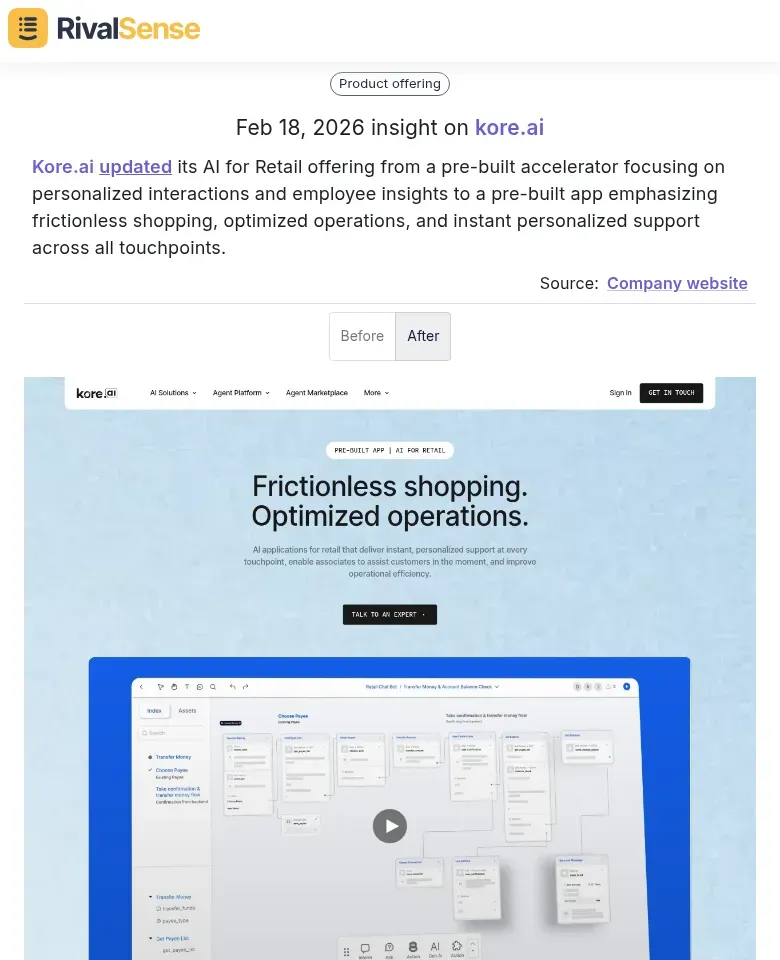
Kore.ai updated its AI for Retail offering from a pre-built accelerator focusing on personalized interactions and employee insights to a pre-built app emphasizing frictionless shopping, optimized operations, and instant personalized support across all touchpoints.
Monitoring such product updates is invaluable because it reveals strategic pivots that may lead to new influencer partnerships, such as collaborations with retail tech influencers to promote the enhanced offering.
Monitoring Pricing and Geographic Changes for Partnership Insights
Pricing and geographic adjustments are clear indicators of shifting partnership strategies. When competitors change their prices or expand into new regions, they often adjust their influencer partnerships accordingly. Understanding these changes helps you benchmark your own partnership economics and identify new opportunities.
Track price adjustments to understand commission structures—when competitors raise prices, they may be increasing influencer payouts or testing new partnership models. For example, a 15% price increase could signal higher commission rates to attract premium creators.
Practical steps:
- Set up alerts for competitor price changes across product lines
- Compare pricing before/after influencer campaigns launch
- Document geographic expansions—new regions often indicate targeted influencer recruitment
- Monitor market exits as potential partnership opportunity windows
Geographic expansions reveal regional targeting strategies. When competitors enter new markets, they typically partner with local influencers first. Track these moves to identify which regions receive priority investment and which influencer niches they're targeting.
Checklist for actionable insights:
- 🗺️ Map competitor geographic coverage quarterly
- 💰 Note pricing changes within 48 hours of detection
- 🔗 Correlate geographic expansions with influencer campaign launches
- 📈 Identify patterns: Are exits followed by competitor influencer poaching opportunities?
Market entry/exit patterns create partnership windows. When competitors leave a market, their former influencer partners become available. When they enter new regions, they establish partnership economics you can benchmark against.
💡 RivalSense Insight Example:
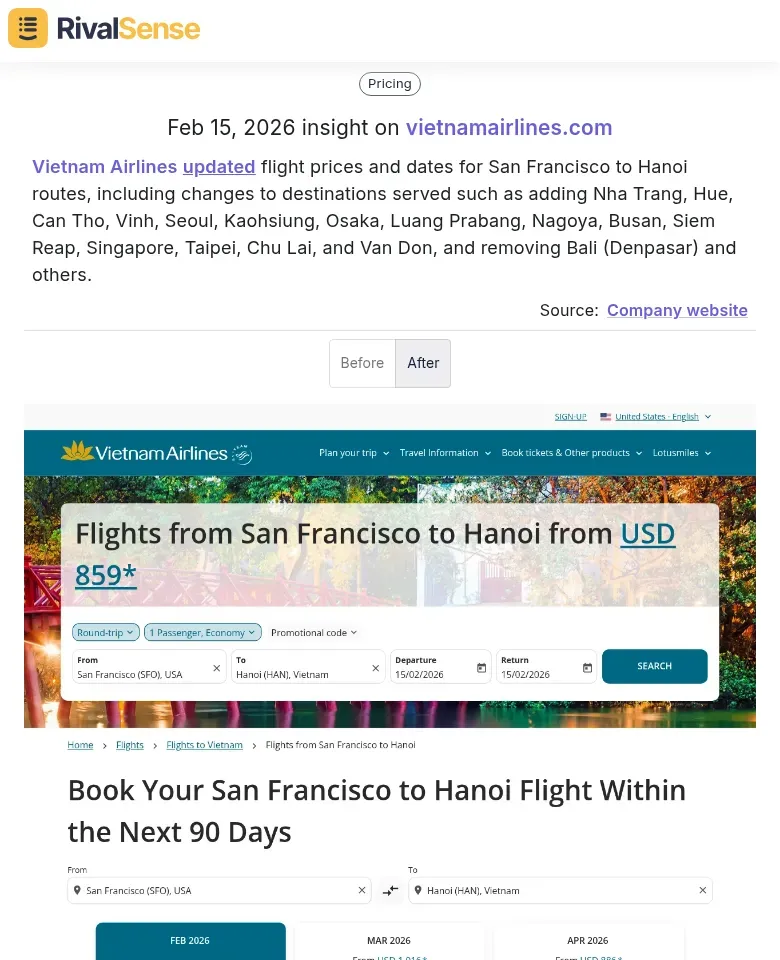
Vietnam Airlines updated flight prices and dates for San Francisco to Hanoi routes, including changes to destinations served such as adding Nha Trang, Hue, Can Tho, Vinh, Seoul, Kaohsiung, Osaka, Luang Prabang, Nagoya, Busan, Siem Reap, Singapore, Taipei, Chu Lai, and Van Don, and removing Bali (Denpasar) and others.
Insights into pricing and geographic changes like this are crucial for businesses, as they can signal shifts in market focus that may involve partnering with travel influencers or adjusting commission structures for affiliates.
Extracting Partnership Strategy from Infrastructure and Technology Updates
Infrastructure and technology upgrades often precede major partnership initiatives. These updates signal that competitors are scaling their operations to support larger or more sophisticated influencer campaigns. By monitoring these changes, you can anticipate their partnership moves and prepare your own strategy accordingly.
Start by monitoring competitor website upgrades that signal enhanced partnership capabilities. Look for:
-
Technology Stack Changes: Track API integrations, CRM systems, or influencer management platforms that indicate streamlined partner onboarding. For example, a new API endpoint for influencer data suggests automated partnership workflows.
-
Infrastructure Scaling: Monitor server upgrades, CDN implementations, or database migrations that reveal partnership scalability plans. A move to cloud infrastructure often precedes large-scale influencer campaigns.
-
Performance Optimizations: Analyze page speed improvements, mobile responsiveness enhancements, or content delivery upgrades that signal partnership quality standards. Faster load times may indicate premium partner content delivery.
Practical Checklist:
- ⚙️ Set up alerts for competitor website technology changes
- 👔 Monitor job postings for partnership-related technical roles
- 🔧 Track third-party tool integrations in competitor code
- 📊 Analyze website performance metrics quarterly
- 📝 Document infrastructure changes and correlate with partnership announcements
Pro Tip: Use tools like BuiltWith or Wappalyzer to automatically track technology stack changes, then cross-reference with partnership announcements to identify strategic patterns.
💡 RivalSense Insight Example:
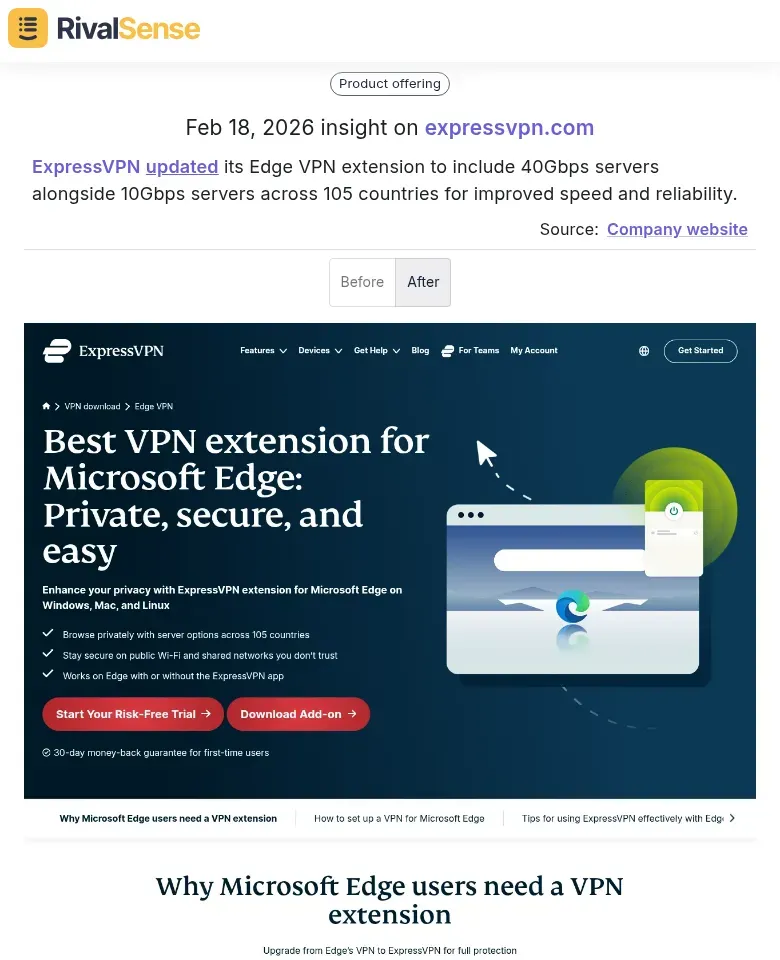
ExpressVPN updated its Edge VPN extension to include 40Gbps servers alongside 10Gbps servers across 105 countries for improved speed and reliability.
Technology updates like this are valuable for business strategy because they indicate investments in infrastructure that can support enhanced partner programs, such as affiliate marketing with tech influencers who value speed and reliability.
Building a Systematic Monitoring Framework for Partnership Intelligence
A systematic approach to monitoring ensures you never miss a critical competitor move. By automating tracking and analysis, you can focus on strategic decision-making rather than manual data collection. This framework transforms raw data into actionable partnership intelligence.
To build this framework, start by establishing automated tracking systems. Use tools like RivalSense to monitor competitor websites for changes in their 'Partners' or 'Customers' pages, case studies, press releases, and blog content mentioning collaborations. Set up alerts for new partner logos, updated success stories, or mentions of influencer campaigns.
Develop an analysis framework to translate website updates into actionable insights. Create a spreadsheet to track:
- Partner types (influencers, agencies, platforms)
- Partnership duration and frequency
- Campaign themes and messaging
- Success metrics mentioned
Analyze patterns to identify which partnerships drive the most value for competitors.
Create strategic alert systems for opportunity identification. Set priority alerts for:
- ✅ Competitors launching new partnership programs
- ✅ Influencers ending exclusive deals
- ✅ Seasonal partnership announcements
- ✅ Industry event collaborations
When you spot a competitor's influencer partnership ending, proactively reach out to that influencer with a tailored proposal.
Practical checklist:
- 📅 Monitor at least 3 key competitor websites weekly
- 👥 Track 5-10 influencer partnerships per competitor
- 📈 Set up monthly analysis reviews
- 🛠️ Create a 'partnership opportunity' alert dashboard
This systematic approach transforms competitor monitoring from reactive observation to proactive partnership strategy development.
Turning Insights into Action: Optimizing Your Influencer Partnership Strategy
Gathering intelligence is only the first step; the real value comes from applying these insights to your own strategy. By turning competitor data into actionable plans, you can outmaneuver rivals and secure the most valuable partnerships for your business.
First, develop counter-strategies by analyzing competitor patterns: If a rival consistently partners with micro-influencers in your niche, consider targeting macro-influencers they've overlooked. Create a checklist:
- Map competitor partnerships by influencer tier
- Identify their most successful collaborations
- Note seasonal partnership patterns
Second, identify partnership gaps by looking for whitespace opportunities. If competitors focus on YouTube creators but neglect emerging platforms like TikTok or Twitch, that's your opening. Practical tip: Use a spreadsheet to track competitor partnerships across platforms, noting which content formats they prioritize (video, blog, social posts).
Third, create agile approaches that respond to competitor movements. When a competitor launches a new partnership campaign, be ready to pivot within 48 hours. Steps:
- Monitor competitor announcements daily
- Have pre-approved partnership templates ready
- Maintain a pipeline of backup influencers
Example: If a competitor signs an exclusive deal with a key industry influencer, immediately approach complementary influencers in adjacent niches.
Key action items:
- 🔄 Develop quarterly partnership gap analyses
- 📘 Maintain a competitor response playbook
- ⚡ Establish rapid approval workflows for opportunistic partnerships
Conclusion: Leverage Competitor Insights with RivalSense
By now, you understand the power of competitor website monitoring for influencer partnership intelligence. However, manually tracking all these changes across multiple competitors can be overwhelming. That's where RivalSense comes in.
RivalSense automates competitor tracking by monitoring product launches, pricing updates, event participations, partnerships, regulatory aspects, management changes, and media mentions across company websites, social media, and various registries. It delivers all these insights in a weekly email report, saving you time and ensuring you never miss a critical update.
Ready to transform your competitor monitoring? Try RivalSense for free at https://rivalsense.co/ and get your first competitor report today to start gaining a strategic edge in your influencer partnerships.
📚 Read more
👉 Nanotech SEO Hacks: Quick Competitor Strategy Wins
👉 Optimize Pricing with Competitor Insights to Boost Key Account Metrics
👉 Turning Competitor Partnerships into Strategic Insights
👉 The Ultimate Key Account Tracking User Guide: Practical Strategies for 2026
👉 Air Freight Case Study: How Competitor Partnerships Build Winning Ecosystems