
Nanotech SEO Hacks: Quick Competitor Strategy Wins
Nanotechnology companies face unique SEO challenges that demand specialized competitive intelligence. Unlike traditional B2B sectors, nanotech marketing must bridge complex scientific innovation with commercial visibility, requiring strategic competitor analysis to navigate this technical landscape.
Key Challenges:
- Technical terminology creates search intent gaps between researchers and commercial buyers
- Long sales cycles mean SEO must work across multiple decision-making stages
- Patent-heavy content requires careful keyword strategy around proprietary terms
Competitor insights reveal critical market positioning opportunities. By analyzing how competitors structure their technical content, you can identify:
- Keyword gaps in emerging nanotech applications
- Content formats that successfully explain complex concepts
- Backlink patterns from academic and industry sources
Practical Steps:
- Map competitor keyword clusters around specific nanomaterials or applications
- Analyze their technical whitepaper SEO performance
- Track their patent-related content ranking for commercial terms
- Monitor their academic citation strategies for authority building
The connection between technical innovation and search visibility is direct: breakthrough research must translate into discoverable commercial solutions. Strategic SEO competitor analysis helps nanotech companies position their innovations where market demand meets search behavior, turning scientific advancement into competitive advantage.
🔍 Talent Acquisition Signals: Tracking Leadership Moves for SEO Advantage
Executive transitions reveal strategic shifts before they're public. By monitoring leadership changes, you can anticipate market pivots and adjust your SEO strategy accordingly. For instance, RivalSense tracked that Hanna Granö-Fabritius joined VSPARTICLE as President & COO in Finland, previously serving as Managing Director & Chief Commercial Officer at Elcogen. 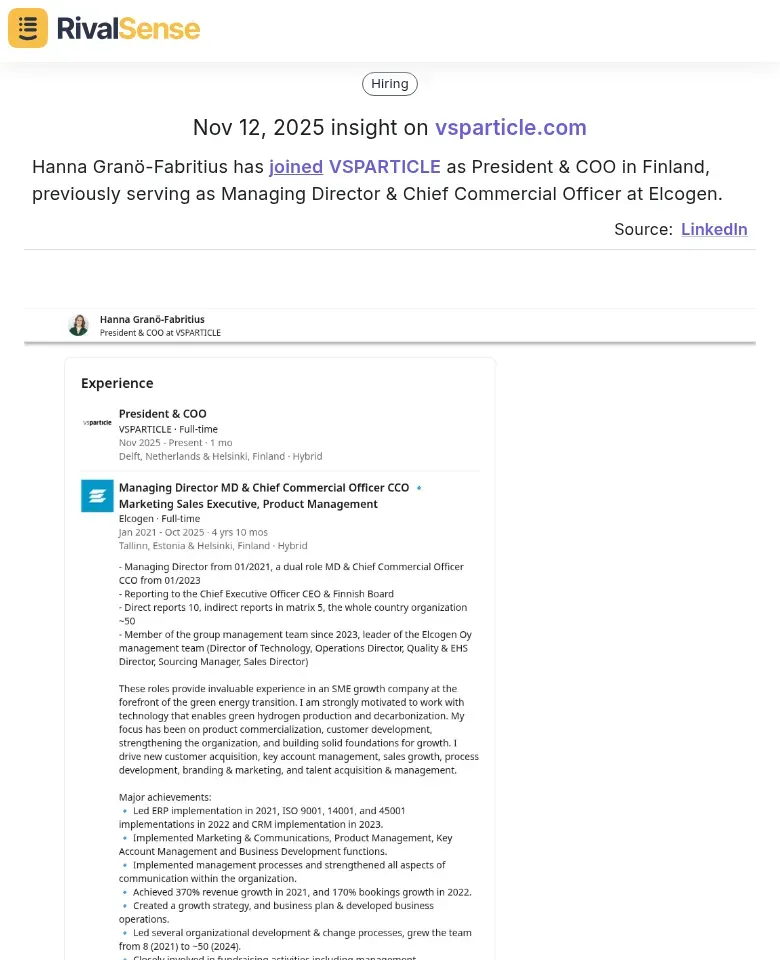 This type of insight is valuable because it signals potential expansions into new markets or expertise areas, allowing you to create content that establishes thought leadership before competitors do.
Practical steps:
- Set up Google Alerts for competitor executive names and titles
- Monitor LinkedIn for new connections and role changes in competitor networks
- Review executive bios for emerging expertise areas (e.g., sustainability, Web3)
- Cross-reference hires with recent patent filings or R&D investments
Leverage these signals for content authority: When a rival hires an industry veteran, create content addressing their expertise area before they do. For example, if they bring on a quantum computing specialist, publish foundational guides on quantum SEO implications.
Checklist for actionable intelligence:
- [ ] Map new hires to potential market expansions
- [ ] Analyze executive backgrounds for technology adoption patterns
- [ ] Identify gaps where your content can establish thought leadership first
- [ ] Monitor for patterns (multiple AI hires = AI strategy shift)
This proactive tracking turns personnel data into SEO advantage by anticipating content gaps and establishing authority in emerging focus areas.
🚀 Product Update Intelligence: Turning Technical Releases into SEO Opportunities
When competitors release technical updates, they're handing you SEO opportunities. Analyzing these updates can reveal emerging keywords and content gaps that you can capitalize on. For example, RivalSense identified that VSPARTICLE released a software update for its VSP-P1 nanoprinter, improving the quality and versatility of nanoporous layers and enhancing user experience. 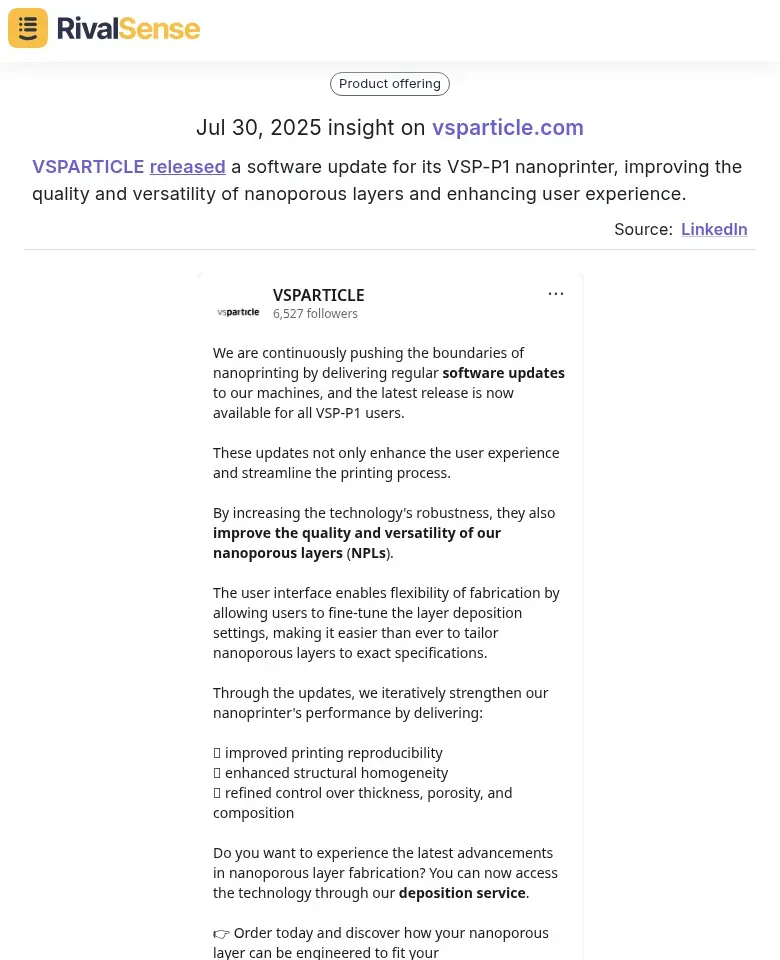 This insight is valuable as it highlights areas where you can create educational content or target new technical terms before competitors dominate search results.
1. Analyze Updates for Keyword Expansion
- Monitor competitor changelogs, release notes, and technical documentation
- Extract new feature names, technical specifications, and capability descriptions
- Identify emerging terminology before it becomes mainstream
- Example: If a competitor adds "quantum-resistant encryption," target related long-tail keywords
2. Create Educational Content Around New Capabilities
- Develop tutorials explaining how the new features work in practice
- Create comparison content showing different implementation approaches
- Produce case studies demonstrating real-world applications
- Tip: Use schema markup for tutorials to enhance rich results
3. Position as Thought Leaders Through Technical SEO
- Optimize your own technical documentation for search visibility
- Create comprehensive guides that address implementation challenges
- Develop API documentation with clear, search-friendly explanations
- Checklist: ✓ Include code snippets ✓ Add interactive examples ✓ Optimize for technical query intent
Actionable Steps:
- Set up alerts for competitor product announcements
- Create a keyword map for each technical release
- Develop content within 48 hours of competitor updates
- Optimize for both beginner and advanced technical audiences
- Track ranking improvements for newly targeted technical terms
By systematically analyzing competitor updates, you can identify emerging technical trends before they become competitive keywords, positioning your brand as the go-to educational resource in your niche.
🏗️ Platform Strategy Analysis: Decoding Digital Synthesis for Content Architecture
Platform Strategy Analysis requires mapping your competitor's technical capabilities to their content architecture. Start by reverse-engineering their content pillars: analyze how their CMS features, API integrations, and AI tools shape their content hierarchy. For example, if they use dynamic content modules, their pillar structure likely mirrors their product's modular scalability.
A practical example: RivalSense reported that VSPARTICLE built a digital synthesis platform that scales from material discovery to product integration, enabling AI use throughout the process.  This insight is valuable because it shows how competitors are leveraging AI for content and product integration, helping you identify opportunities for similar efficiencies in your SEO strategy.
Identify AI integration opportunities by examining their SEO automation patterns. Look for:
- Automated meta-tag generation across content types
- Dynamic content personalization based on user behavior
- AI-powered internal linking recommendations
- Automated schema markup implementation
Create scalable content frameworks by:
• Mirroring product feature releases with content launch cycles
• Building modular content components that can be repurposed across platforms
• Establishing content templates that scale with product updates
• Implementing automated content gap analysis against competitor updates
Practical checklist:
✓ Map 3-5 competitor content pillars to their platform capabilities
✓ Identify at least 2 AI-driven SEO automation patterns
✓ Create 1 scalable content template that mirrors your product roadmap
✓ Set up automated alerts for competitor content architecture changes
⚡ Implementation Framework: Quick-Win SEO Tactics for Nanotech Companies
To quickly implement SEO tactics, nanotech companies need a structured approach. This framework provides actionable steps for rapid wins in keyword analysis, technical SEO, and content planning.
Rapid Keyword Gap Analysis: Start by identifying 3-5 top nanotechnology competitors. Use tools like Ahrefs or SEMrush to analyze their ranking keywords. Look for patterns in their content clusters around specific nanotechnology applications (nanomedicine, nanomaterials, nanoelectronics). Create a checklist: 1) Identify high-volume keywords they rank for that you don't, 2) Analyze search intent patterns, 3) Prioritize keywords with lower competition scores. Quick win: Target 5-10 long-tail technical keywords your competitors rank for but have thin content.
Technical SEO Optimizations: Analyze competitor site structures using Screaming Frog. Look for patterns in URL architecture, internal linking, and schema markup. Check their page speed scores and mobile optimization. Implement quick fixes: 1) Optimize your nanotechnology glossary pages with better internal linking, 2) Add structured data for research papers and technical specifications, 3) Improve image optimization for microscopy images and technical diagrams.
Content Calendar Planning: Monitor competitor content release cycles using tools like BuzzSumo. Identify patterns in their publication timing around nanotechnology conferences, research announcements, and industry events. Create a 90-day calendar that strategically times your content to: 1) Publish before major nanotechnology events, 2) Release case studies when competitors announce research, 3) Schedule technical deep-dives during academic publication cycles. Quick tip: Use Google Alerts for competitor names + "nanotechnology" to track their announcements in real-time.
🏆 Conclusion: Building Sustainable SEO Advantage in Nanotechnology
Building sustainable SEO advantage in nanotechnology requires a systematic approach that combines continuous competitor monitoring with technical innovation. Here's your actionable roadmap:
Continuous Competitor Monitoring Checklist:
- Set up automated alerts for competitor content updates, backlink acquisitions, and keyword ranking changes
- Monitor patent filings and research publications for emerging nanotechnology trends
- Track competitor hiring patterns to anticipate strategic shifts
- Analyze competitor customer reviews and case studies for content gaps
Technical Innovation Integration:
- Map your R&D pipeline to content creation calendar (patent → whitepaper → blog post)
- Create interactive 3D molecular visualizations for complex nanotechnology concepts
- Implement structured data markup for research papers and technical specifications
- Develop voice search optimization for lab equipment and technical terminology
ROI Measurement Framework:
- Track organic traffic growth against R&D investment timelines
- Measure market positioning through share of voice in nanotechnology keywords
- Calculate customer acquisition cost reduction from organic vs. paid channels
- Monitor thought leadership metrics: speaking invitations, media mentions, academic citations
Pro Tip: Use competitor monitoring tools to identify gaps in nanotechnology education content—create comprehensive guides that address complex topics competitors oversimplify. This establishes authority while capturing high-intent traffic.
Sustainable nanotechnology SEO success comes from aligning technical innovation with search marketing excellence, creating a virtuous cycle where research breakthroughs drive organic visibility, which in turn attracts talent and investment for further innovation.
To effectively implement these strategies and stay ahead of competitors, consider using a tool like RivalSense. It tracks competitor product launches, pricing updates, event participations, partnerships, regulatory aspects, management changes, and media mentions, delivering all in a weekly email report. Try RivalSense for free at https://rivalsense.co/ to get your first competitor report today!
📚 Read more
👉 Optimize Pricing with Competitor Insights to Boost Key Account Metrics
👉 Turning Competitor Partnerships into Strategic Insights
👉 The Ultimate Key Account Tracking User Guide: Practical Strategies for 2026
👉 Air Freight Case Study: How Competitor Partnerships Build Winning Ecosystems
👉 How RivalSense Empowered Placet Group to Defend Against E-Invoicing Disruption