
Microsoft’s Q1 2026: AI Everywhere, Cloud Behemoth, and a BitLocker Privacy Storm
Microsoft entered 2026 firing on all AI cylinders, but a controversial encryption key disclosure and a major vulnerability raise questions about trust and regulatory risk. Based on exclusive RivalSense data, here is what actually moved the needle for Microsoft’s financial performance in the first quarter.
The Bullish Signals (Revenue & Margin Drivers)
1. Cloud & AI Revenue Explosion
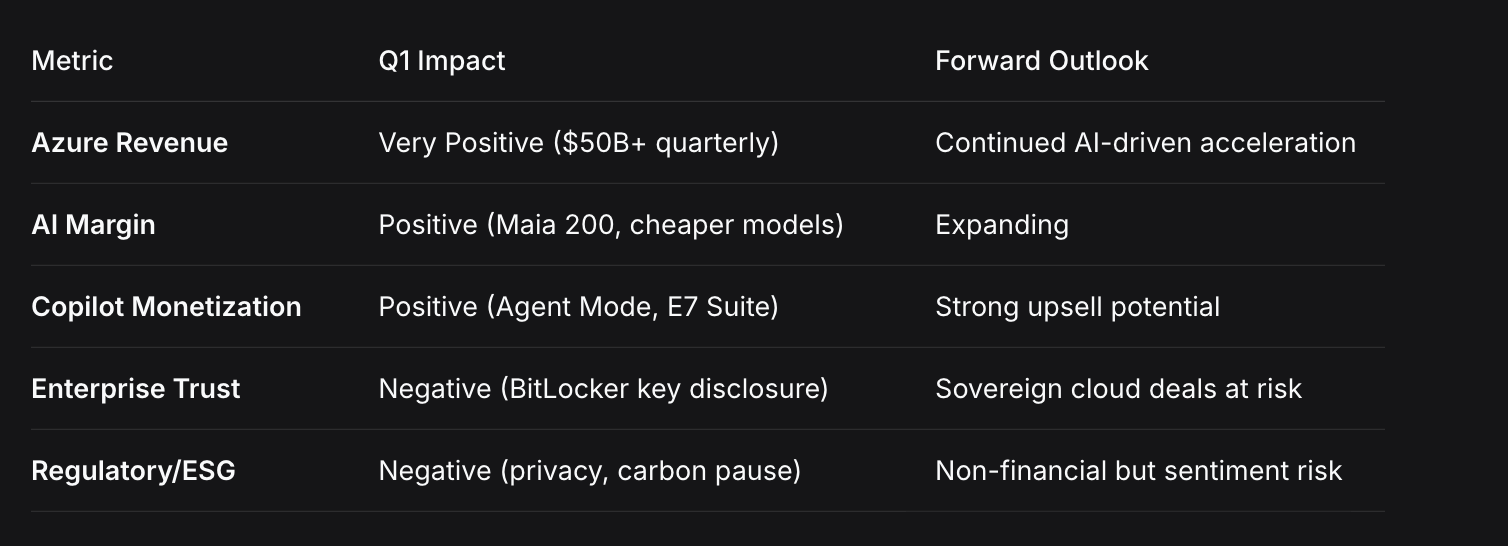
On January 29, CEO Satya Nadella reported quarterly cloud revenue exceeded $50 billion and stated that Microsoft’s AI business is now “larger than some of its biggest franchises built over decades.” This is a fundamental re-acceleration of Azure growth, directly driven by AI workloads.
2. Proprietary AI Infrastructure (Margin Protection)
Microsoft put its custom Maia 200 AI accelerator online in Azure (Jan 26), delivering 30% better performance per dollar than current systems. Combined with a cheaper/faster MAI-Image-2-Efficient model (April 19) and new MicroLED data transmission tech (March 21), Microsoft is aggressively lowering the cost of AI inference – a direct boost to cloud margins.
3. Aggressive Monetization of Copilot & Agents
- Agent Mode became the default Copilot experience across Word, Excel, PowerPoint (April 25).
- Microsoft 365 E7 Suite & Agent 365 launch on May 1 (announced March 28) – a new high-ASP bundle.
- Copilot Checkout with PayPal integration (Jan 8) enables in-Copilot purchases, opening a transaction revenue stream.
- Removed auto-renew grace periods and offered bundle discounts (April 12) – a churn-reduction and upsell move.
4. Strategic M&A & Talent
Acquired Fintool (April 17) for AI in financial services, and Osmos (Jan 24) to automate data engineering in Fabric. Also hired multiple ex-AWS and ex-Google leaders (e.g., Indraneel Mitra, Edgar Archila), strengthening GTM against rivals.
The Bearish Signals (Risks to Financials)
1. BitLocker Key Disclosure to FBI (HIGH REPUTATIONAL & REGULATORY RISK)
Microsoft confirmed on January 31 that it gave BitLocker encryption keys to the FBI for a fraud investigation, because Windows backs up recovery keys to Microsoft’s cloud by default. This undermines enterprise trust in Microsoft’s zero-access encryption claims and could trigger EU privacy investigations. For a company selling sovereign cloud solutions, this is acutely damaging.
2. Privilege Escalation Vulnerability in Entra
On April 25, a privilege escalation vulnerability was reported in Microsoft Entra (identity and access management). While patched, any serious Entra flaw spooks enterprise security buyers and could slow the migration of sensitive workloads to Azure.
3. Paused Carbon Removal Purchases
Microsoft, previously the world’s largest buyer of carbon removal, paused future purchases (April 12). This signals potential cost-cutting or a shift away from ESG commitments – bad for investor sentiment among ESG funds and corporate sustainability partners.
4. Executive Departures
Notable exits include:
- Nicola Driscoll (Director, Cloud & AI, UK → Salesforce)
- Miguel Fierro (Principal Data Scientist → Signature Management)
- Sean Jones (Chief Sustainability Officer, Germany → Ellen MacArthur Foundation)
Loss of AI and sustainability leadership during a high-growth phase is notable.
Financial Outlook Summary
The Bottom Line
Microsoft had a blowout Q1 operationally: cloud revenue surpassing $50B, AI becoming a core profit engine, and aggressive product-led monetization of Copilot. However, the BitLocker key disclosure is an underappreciated bomb – it directly contradicts Microsoft’s privacy marketing and could slow sovereign cloud adoption in Europe. Investors should watch for legal fallout and enterprise customer churn in the next two quarters.
Want this kind of forward-looking intelligence before earnings? Use RivalSense to track product launches, security flaws, and regulatory risks – and gain the edge on market moves.