
Mastering Key Account KPIs for Enterprise AI Platform Success
In the rapidly evolving AI landscape, tracking the right Key Performance Indicators (KPIs) is crucial for ensuring your platform delivers tangible business value. Without a strategic approach, AI initiatives can become cost centers rather than revenue drivers. Enterprise AI platforms represent massive investments, yet many organizations still rely on basic accuracy metrics that fail to capture true business impact. This limited view creates blind spots where AI initiatives appear successful technically but deliver minimal ROI. The reality is that AI success requires comprehensive KPI tracking across three critical dimensions: business outcomes, operational efficiency, and governance compliance.
Competitor intelligence reveals a crucial insight: leading AI adopters have moved beyond static reporting to real-time performance monitoring. They track not just model accuracy but also cost-per-inference, latency impacts on user experience, and business metric correlations. This holistic approach enables proactive optimization and competitive advantage.
To establish effective tracking, start with this framework:
- Business KPIs: Measure revenue impact, customer satisfaction scores, and conversion rate improvements 📈
- Operational KPIs: Monitor inference costs, system uptime, and model drift detection ⚙️
- Governance KPIs: Track compliance rates, bias detection, and data privacy adherence 🛡️
💡 Practical tip: Implement automated dashboards that surface these metrics alongside competitor benchmarks. This enables data-driven decisions about where to allocate resources and which AI initiatives deliver the highest business value.
Core Business Impact KPIs: Measuring Real Value Creation
Business impact KPIs translate technical success into financial outcomes, helping you justify AI investments and align them with organizational goals. To demonstrate real value from your enterprise AI platform, focus on KPIs that tie directly to business outcomes. Track revenue growth from AI-driven upsells and cross-sells, and measure customer retention improvements linked to AI-enhanced experiences—aim for at least 15% reduction in churn among AI-engaged accounts.
For cost reduction, quantify operational efficiency gains: monitor reductions in manual processing time (target 30-50% decrease), labor costs per transaction, and error rates in automated workflows. Use this checklist:
- [ ] Baseline current costs
- [ ] Implement AI solutions
- [ ] Track monthly savings
- [ ] Calculate ROI
Time-to-value metrics are critical—measure how quickly new AI features deliver ROI (target <6 months) and track scaling success across your portfolio. Monitor adoption rates across accounts (aim >70% usage) and expansion velocity (speed of deploying AI to new use cases). 💡 Practical tip: Create a dashboard with these KPIs, review quarterly with leadership, and adjust strategies based on portfolio-wide performance trends.
Technical Performance KPIs: Beyond Basic Model Accuracy
Technical KPIs ensure your AI platform operates efficiently and reliably, going beyond model accuracy to encompass system health and cost-effectiveness. For enterprise AI platforms, technical performance KPIs extend far beyond basic model accuracy. Production-grade systems require monitoring latency (response time), throughput (requests per second), and reliability (uptime/error rates). Track p95/p99 latency to ensure consistent user experience, especially for real-time applications.
Cost optimization is critical: monitor unit economics like cost per inference, GPU utilization rates, and model serving efficiency. Implement auto-scaling based on demand patterns and consider model compression techniques to reduce inference costs by 30-50%.
Model quality varies by use case:
| Use Case | Key Metrics |
|---|---|
| Classification | Precision/recall, F1-score, confusion matrices |
| Ranking | NDCG, MAP, click-through rates |
| Generative AI | BLEU/ROUGE scores, human evaluation scores, toxicity detection |
🔧 Practical checklist:
- Set up real-time monitoring dashboards for latency/throughput
- Implement A/B testing frameworks for model comparisons
- Establish cost allocation by team/use case
- Create automated alerting for performance degradation
- Regularly audit model drift and retraining needs
💡 Pro tip: Use canary deployments to test new models with 5-10% of traffic before full rollout, minimizing risk while gathering production performance data.
Adoption and User Experience KPIs: Ensuring Real-World Usage
Adoption KPIs measure how effectively users engage with your AI platform, with high adoption rates indicating that your solutions are solving real business problems. For enterprise AI platforms, adoption KPIs must move beyond vanity metrics to measure real-world impact. Track active users segmented by role (data scientists, business analysts, executives) and engagement patterns like session duration and feature usage frequency. Outcome-based metrics are crucial: measure task completion rates for key workflows (e.g., model deployment success rate) and resolution rates for AI-generated insights driving business decisions.
Monitor trust signals like override rates—how often users modify AI recommendations—which indicate confidence gaps. Collect user satisfaction via NPS or CSAT scores, and gather qualitative feedback through regular user interviews to understand pain points.
📋 Practical steps:
- Implement user segmentation in analytics tools
- Set up automated tracking for task completion events
- Create a dashboard with weekly reviews of override rates and satisfaction trends
- Schedule bi-weekly feedback sessions with key user groups
💡 Tip: Low adoption in a segment may signal UX issues—conduct usability tests to iterate quickly.
Competitive Intelligence KPIs: Learning from Market Leaders
Competitive intelligence KPIs provide insights into market trends and competitor strategies, enabling you to anticipate shifts and adapt your own approach. By monitoring these, you can benchmark your performance and identify opportunities for differentiation. Tracking competitor technology partnerships reveals integration capabilities that drive enterprise adoption.
Real-World Examples from RivalSense Insights
Here are practical examples of how competitor insights can inform your strategy:
-
Product Launch Insight: Deepgram announced on February 5 that you can now call OpenClaw over the phone using its technology, which includes Flux turn detection, Aura-2 TTS at 90ms latency, is 40% cheaper than alternatives, and is fully open source.
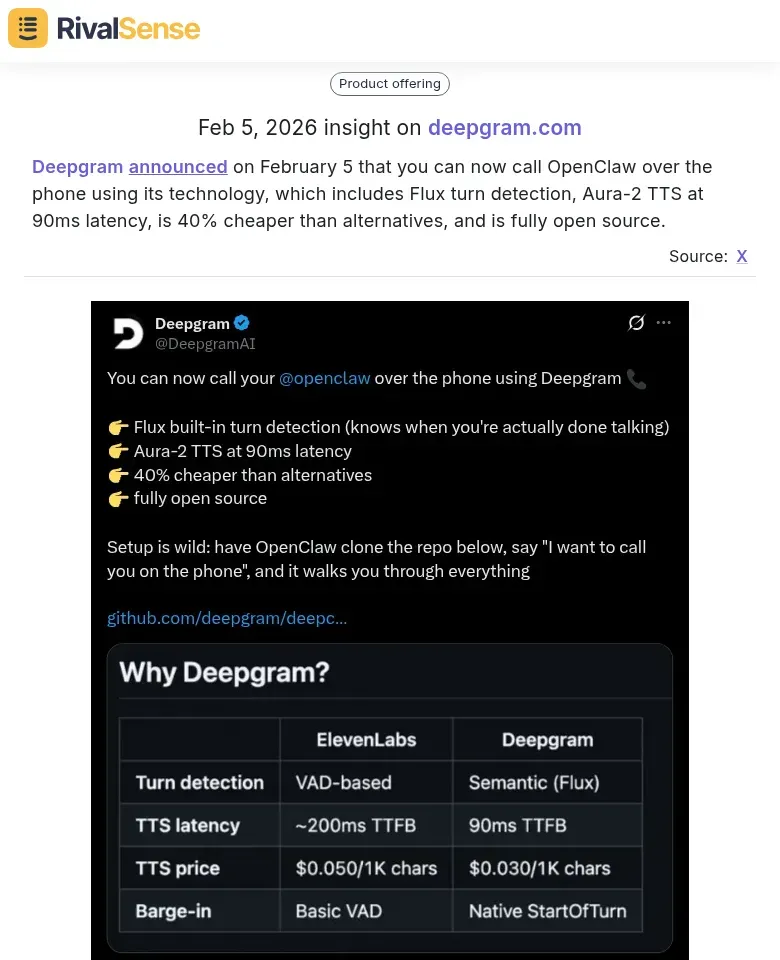
- Why it's valuable: Monitoring product launches helps you understand competitor innovations and pricing strategies, allowing you to benchmark your own offerings and identify gaps in your product roadmap.
-
Partnership Announcement: Deepgram partners with Maki to provide real-time speech-to-text for voice AI in hiring, enabling fast, accurate, and compliant global operations.
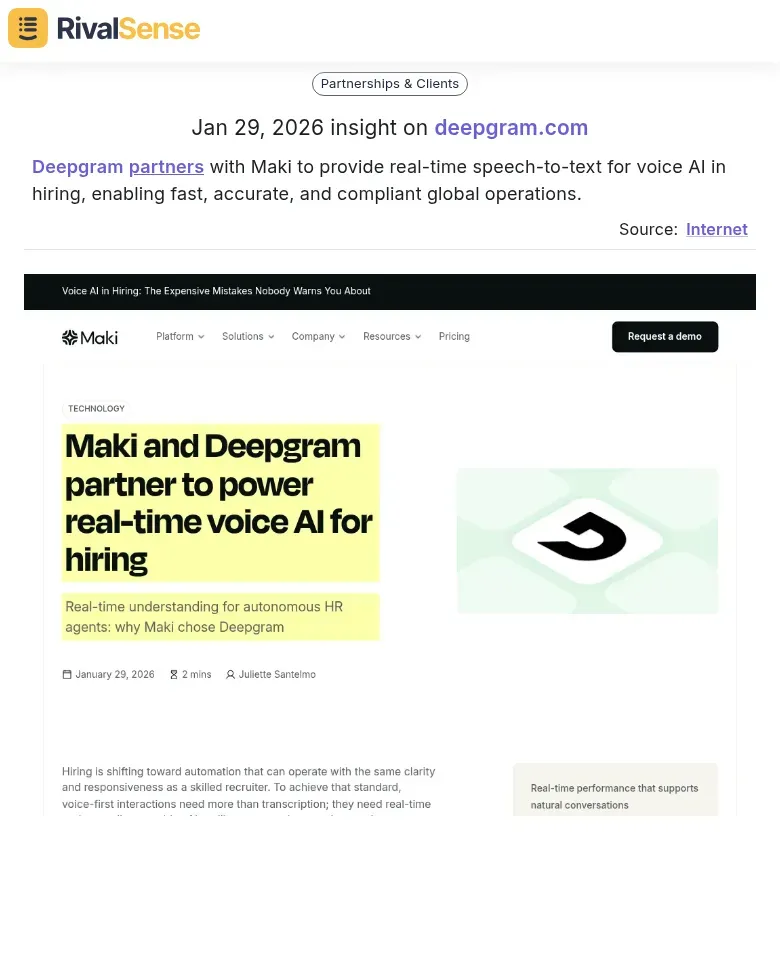
- Why it's valuable: Partnership insights reveal ecosystem expansions and integration capabilities, helping you assess competitive threats and explore collaboration opportunities to enhance your platform's reach.
-
Executive Insight: Deepgram's CEO Scott discussed the impacts of Voice AI, the acquisition of OfOne, and the audio Turing Test in an interview with SiliconANGLE and theCUBE.

- Why it's valuable: Executive interviews provide strategic context, such as market positioning and future roadmaps, enabling you to align your strategy with industry trends and anticipate competitive moves.
Performance benchmarks and cost leadership indicators provide quantitative competitive intelligence. Track public case studies, whitepapers, and pricing page changes. Look for metrics like inference speed, model accuracy, and total cost of ownership comparisons. Set up alerts for when competitors publish performance claims or adjust pricing tiers.
📋 Practical checklist:
- Maintain a partnership tracker with integration capabilities
- Set up alerts for competitor performance claims and pricing changes
- Review quarterly earnings transcripts for strategic themes
- Benchmark your platform against competitor case study metrics
- Monitor API documentation for new integration capabilities
Governance and Risk Management KPIs: Enterprise-Grade Success
Governance KPIs ensure your AI platform meets regulatory and ethical standards, mitigating risks and building trust with stakeholders. For enterprise AI platforms, governance and risk management KPIs are non-negotiable. Start by tracking compliance coverage metrics: measure regulatory alignment (e.g., GDPR, CCPA, AI Act) with automated audits and gap analysis dashboards. Aim for 95%+ coverage across jurisdictions where you operate.
Security and privacy KPIs should include: vulnerability closure rates (target <72 hours), data breach detection time (goal <1 hour), and responsible AI metrics like bias detection accuracy (>99%) and explainability scores for model decisions. Implement frameworks like NIST AI RMF or ISO/IEC 42001 for structured measurement.
For incident management, track: mean time to resolution (MTTR <4 hours for critical issues), operational reliability via uptime (99.9%+ SLA), and change failure rate (<15%). Create a risk register with heat maps showing likelihood vs. impact scores for AI-specific risks (e.g., model drift, adversarial attacks).
🛡️ Practical checklist:
- Automate compliance scanning with specialized tools
- Set up real-time security dashboards with anomaly detection
- Conduct quarterly responsible AI audits with external validators
- Implement incident playbooks with severity tiers and escalation paths
- Track risk-adjusted ROI by correlating governance metrics with business outcomes
💡 Tip: Use competitor intelligence to benchmark your KPIs against industry leaders—aim to exceed their governance standards by 10-15% for competitive advantage.
Take Action with Competitive Insights
Tracking KPIs effectively requires not only internal monitoring but also external competitive intelligence. Tools like RivalSense can automate this process by tracking competitor product launches, pricing updates, event participations, partnerships, regulatory aspects, management changes, and media mentions across various sources. This delivers all insights in a weekly email report, saving you time and keeping you informed.
🚀 Try RivalSense for free at https://rivalsense.co/ and get your first competitor report today to enhance your KPI tracking strategy!
📚 Read more
👉 Beginner's Guide to Competitor Pricing Insights and Key Account Sentiment Tracking
👉 Leveraging Social Clues for Competitor Analysis: A Case Study on Huel
👉 Mastering Competitor Intelligence: Leveraging Customer Reviews in Systems Software Development
👉 How BASF's Fungicide Registration in Italy Enabled Smarter Competitor Strategies