
Mastering Facebook Competitor Insights: A Cheat Sheet for Key Account Management
In today's hyper-competitive B2B landscape, Facebook competitor insights have evolved from optional monitoring to essential strategic intelligence for key account management. Real-time data from competitors' Facebook pages reveals strategic shifts, market positioning changes, and emerging trends that directly impact your most valuable accounts.
When a competitor announces a new product feature or service enhancement on Facebook, this isn't just social media noise—it's a direct threat to your account retention. These announcements signal where competitors are investing resources and which market segments they're targeting. By tracking these developments, you can proactively address client concerns before they become retention issues.
Practical steps to implement:
- Set up alerts for competitor Facebook page updates
- Monitor engagement patterns on competitor posts to gauge market interest
- Track competitor job postings and team announcements for strategic direction clues
- Analyze competitor response times and engagement with their audience
Connect competitor announcements to growth opportunities by identifying gaps in their offerings that you can fill for your key accounts. When you see competitors pivoting toward specific industries or use cases, you can anticipate client needs and position your solutions accordingly. This proactive approach transforms competitive intelligence from reactive monitoring to strategic account growth planning.
Analyzing Product Innovation Patterns: Learning from Feature Launches
Tracking product innovation patterns on Facebook reveals how competitors are evolving their offerings and responding to market demands. By analyzing feature launches, you can anticipate trends and identify gaps in your own account strategy.
Start by creating a launch tracking spreadsheet with columns for announcement date, product type, key messaging, engagement metrics, and target audience. Set up Facebook alerts for competitor pages to catch announcements in real-time. Identify patterns in their release cadence—whether they innovate quarterly, biannually, or around specific industry events.
Understanding market positioning through product unification announcements reveals strategic bundling. For example, when Tenable announced Tenable One AI Exposure unifying AI protection across enterprise, it signaled a move toward comprehensive security suites. Monitor how competitors position new features against existing offerings to anticipate market consolidation trends.
Practical Checklist:
✅ Track feature bundling strategies and pricing tiers
✅ Analyze comment sentiment to gauge market readiness
✅ Document messaging evolution across multiple launches
✅ Compare your account strategy gaps against competitor innovations
✅ Use Facebook's Ad Library to see promotion targeting
Customer reactions provide critical validation data. High engagement with positive sentiment indicates market readiness, while negative feedback reveals adoption barriers. Pro tip: Look for recurring themes in innovation announcements to anticipate market trends before they become mainstream. This intelligence helps you adjust your value proposition and prepare proactive responses for key accounts.
Decoding Security and Compliance Announcements: Building Trust Signals
Security and compliance announcements are powerful trust signals that can significantly influence key account decisions. By decoding these announcements, you can reinforce your own trust credentials and preempt competitor moves that might affect your accounts.
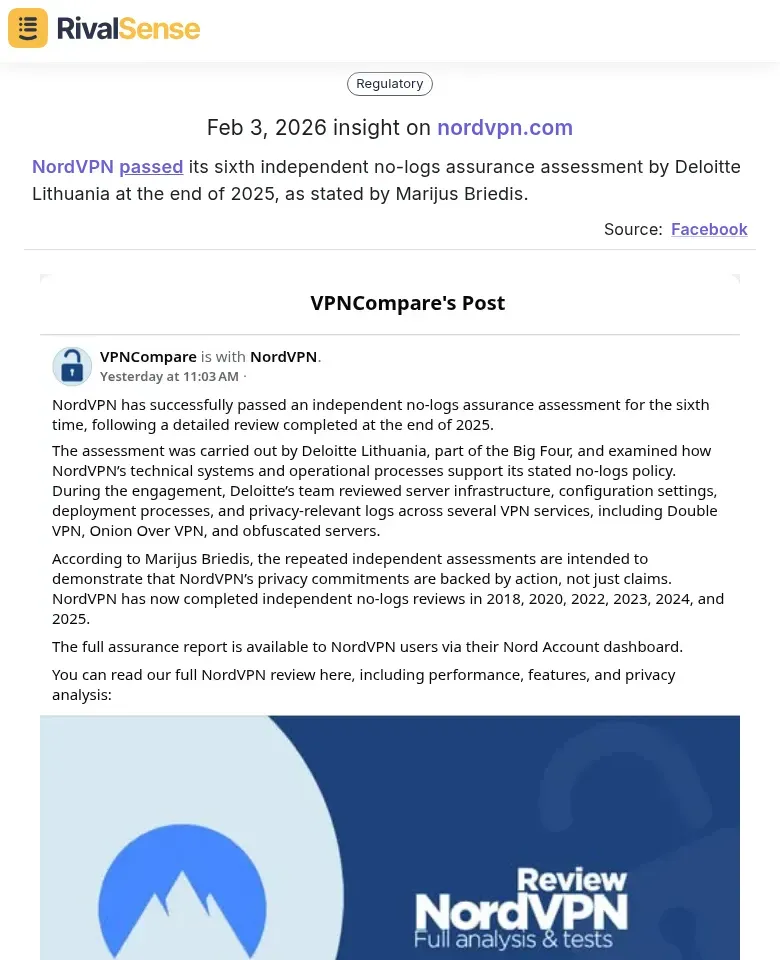
For instance, consider NordVPN's recent achievement: they passed their sixth independent no-logs assurance assessment by Deloitte Lithuania at the end of 2025, as stated by Marijus Briedis. This type of compliance insight is valuable for business strategy as it demonstrates how competitors are building trust through third-party validations. You can use similar insights to highlight your own compliance strengths or identify areas for improvement.
1. Audit & Certification Analysis:
- Track competitors' SOC 2, ISO 27001, or industry-specific certifications
- Note the timing: Are they announcing audits before contract renewals?
- Example: When a competitor announces a new security certification, map it against your own compliance calendar to preemptively address client concerns
2. Security Feature Translation:
- Every "new encryption feature" or "enhanced access control" is a trust-building opportunity
- Create a checklist: For each security announcement, identify which client personas would care most (e.g., healthcare vs. finance)
- Practical tip: When a competitor launches a security feature, immediately update your battle cards with: "While they focus on X, we've always prioritized Y security layer"
3. Compliance-to-Retention Strategy:
- GDPR, CCPA, HIPAA announcements signal which markets competitors are targeting
- Actionable step: Create a quarterly compliance announcement tracker. When competitors announce new compliance measures, proactively reach out to at-risk accounts with: "We noticed [Competitor] is now GDPR-compliant. Here's how we've been GDPR-ready since 2018..."
Key Insight: Security announcements often precede contract renewals. By monitoring these signals, you can anticipate which accounts competitors are targeting and reinforce your own trust credentials before renewal conversations begin.
Monitoring AI and Automation Tools: Learning from Contextual Insights
AI and automation tools are revolutionizing how competitors manage key accounts and deliver customer insights. Monitoring these tools provides crucial contextual insights into their strategies for efficiency and engagement.
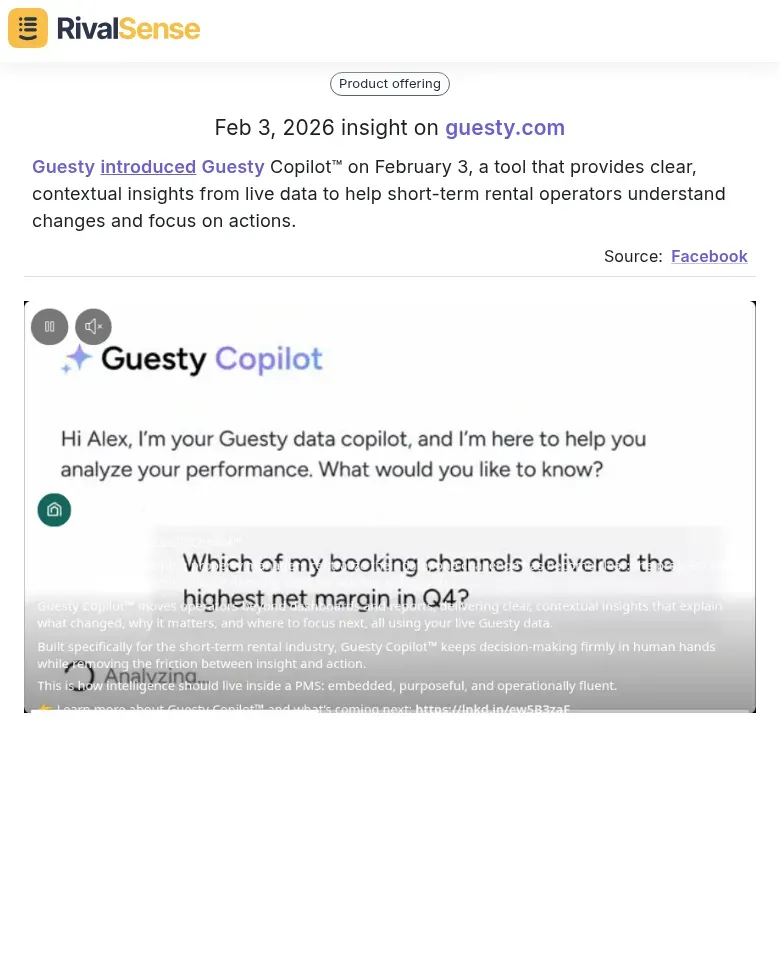
Take Guesty as an example: they introduced Guesty Copilot™ on February 3, a tool that provides clear, contextual insights from live data to help short-term rental operators understand changes and focus on actions. This insight is valuable for business strategy as it shows how competitors are leveraging AI for real-time decision support, indicating a trend towards data-driven account management that you can emulate or differentiate from.
Practical Steps for Monitoring AI Tools:
- Track automation announcements on competitor blogs and press releases
- Analyze how tools like NapoleonCat use AI for auto-moderation and social CRM
- Monitor integration announcements revealing workflow simplification strategies
- Identify data sources competitors monitor (earnings calls, SEC filings, job postings)
Checklist for Enhancing Key Account Service:
- [ ] Map competitor AI capabilities to your account management gaps
- [ ] Identify automation opportunities in repetitive research tasks
- [ ] Benchmark response times against AI-enhanced competitors
- [ ] Evaluate contextual insight delivery methods (Slack alerts, CRM updates)
- [ ] Analyze how competitors use predictive analytics for account prioritization
Key Insight: Competitors using AI tools like DemandFarm for stakeholder mapping and whitespace analysis achieve 10%+ more opportunities within key accounts. By monitoring these tools, you can identify opportunities to enhance your own key account service through similar data-driven approaches, such as implementing real-time buying signals or automated relationship mapping that reduces manual research by 50%+.
Implementing Insights into Key Account Strategy: From Intelligence to Action
Collecting competitor insights is only the first step; implementing them into your key account strategy is where real value is created. By turning intelligence into action, you can proactively protect and grow your accounts against competitive threats.
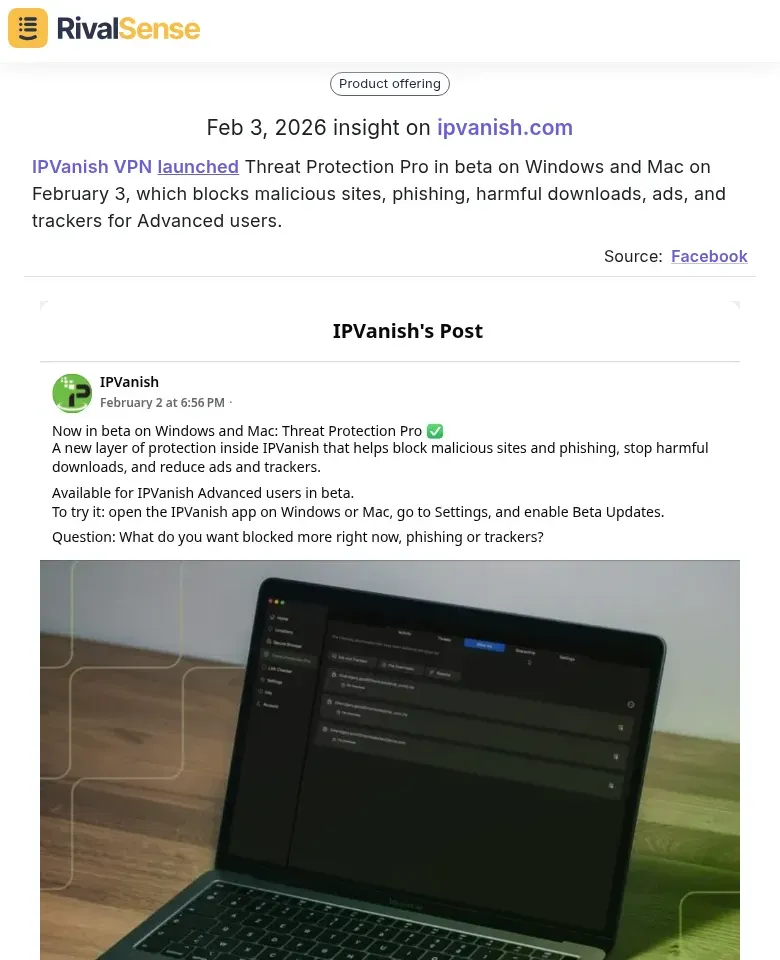
For example, when IPVanish VPN launched Threat Protection Pro in beta on Windows and Mac on February 3, which blocks malicious sites, phishing, harmful downloads, ads, and trackers for Advanced users, you need a response playbook. This type of product launch insight is valuable for business strategy as it alerts you to new competitive features that could affect account retention, allowing you to quickly address client concerns and highlight your own strengths.
Transform competitor intelligence into tangible account growth with these actionable frameworks:
-
Response Playbooks for Competitor Announcements
- Create tiered response templates (immediate/24hrs/1-week) for competitor product launches, pricing changes, or service disruptions affecting key accounts
- Example: When a competitor announces a price increase, your playbook should include: (a) immediate notification to affected accounts, (b) value comparison matrix within 24 hours, (c) tailored migration incentives within 1 week
- Tip: Assign specific team members to monitor competitor channels and trigger playbook execution
-
Weakness-to-Opportunity Mapping
- Build a matrix linking each competitor's documented weaknesses (poor support, feature gaps, implementation delays) to specific account pain points
- Example: If Competitor X has 48-hour support response times, map this to accounts experiencing critical downtime issues
- Checklist: Document 3-5 specific weaknesses per major competitor, identify which accounts would benefit most from each weakness exploitation
-
Intelligence Impact Measurement
- Establish KPIs tracking how competitor insights directly influence account outcomes: retention rate improvements, upsell conversion increases, churn prevention
- Framework: Measure (a) intelligence-to-action speed, (b) account sentiment improvement post-intervention, (c) revenue protected/gained from competitor responses
- Practical step: Create a quarterly dashboard showing correlation between intelligence utilization and key account growth metrics
Building Your Facebook Competitor Monitoring Framework: Practical Implementation
To build an effective Facebook competitor monitoring framework, start by identifying 3-5 primary competitors with active Facebook presence. This systematic approach ensures you capture relevant insights without being overwhelmed by data. Focus on those targeting similar audiences or offering comparable solutions to your key accounts.
Create a centralized tracking spreadsheet with standardized columns for: follower growth, engagement rates, content themes, ad frequency, and promotional offers. This will help you spot trends and anomalies over time.
Develop weekly review templates that capture:
- Content strategy patterns (educational vs. promotional mix)
- Engagement trends (peak posting times, top-performing formats)
- Audience interaction (response times, community management style)
Implement automated alerts for critical competitor moves:
• Price changes or new pricing tiers
• Feature announcements or product launches
• Partnership announcements
• Major content campaigns or rebranding efforts
• Significant follower growth spikes
Practical tip: Use Facebook's native analytics combined with competitive intelligence tools to track share of voice and sentiment trends. Set up Google Alerts for competitor mentions and monitor Facebook's Ad Library for their advertising strategies. Create a monthly competitive landscape report that highlights opportunities and threats based on your findings.
Take Action with RivalSense
Manually tracking competitor moves across Facebook and other channels can be time-consuming and prone to misses. To streamline this process and ensure you never miss a critical update, consider using a tool like RivalSense. RivalSense tracks competitor product launches, pricing updates, event participations, partnerships, regulatory aspects, management changes, and media mentions across company websites, social media, and various registries, delivering all in a weekly email report.
Try RivalSense for free today at https://rivalsense.co/ to get your first competitor report and start transforming insights into account growth strategies.
📚 Read more
👉 Biotech Key Account Tracking Automation Checklist for Precision Medicine
👉 Decoding Competitor Hiring and Layoffs: A Strategic Guide for Business Leaders
👉 Competitor Insight: Decoding Rivan Industries' Latest Filings
👉 The Ultimate Guide to Key Account Tracking Data Export: Practical Strategies for 2026
👉 Real-World SEO Mystery Shopping: How Top Agencies Outperform Competitors