
Mastering Competitor Trade Show Strategy for 2026 Business Growth
Bill Kenney
February 26, 2026
Bill Kenney is the Founder of MEET, where he helps international B2B and B2G companies scale in the U.S. through strategic trade shows, events, and meaningful connections. Since 2012, Bill has guided overseas-based businesses through the complexities of American market expansion, using his hands-on event expertise to turn trade show participation into measurable growth. We're proud to feature Bill as one of our trusted partners supporting international companies on their U.S. growth journey.
Welcome to this focused article on one of the biggest opportunities for growth in 2026: competitor-informed trade show strategy. While trade show success depends on strong preparation and meaningful analytics, it all starts with a clear, high-impact plan that accounts for your competitive landscape. In this article, we're zeroing in on strategy, the foundation that determines whether your trade show investment becomes a cost center or a true growth driver.
WHY COMPETITOR-INFORMED STRATEGY MATTERS
A new year demands a fresh look at how you approach trade shows and events. Start by asking three critical questions: Is our current strategy delivering the best results? Is our pipeline full of high-quality, high-velocity prospects? Are we maximizing efficiency by understanding our competitive environment?
Too often, B2B and B2G companies get complacent, ending up at the wrong events with outdated strategies. This wastes valuable resources and compromises growth. Your presence on the show floor should reflect your business objectives and competitive positioning, not simply consume your marketing budget.
When executed with intention and competitive intelligence, trade shows become powerful accelerators that fill your pipeline with qualified prospects, deepen account relationships, and position your brand as an industry leader. The difference between success and mediocrity lies in planning. Companies with deliberate, competitor-aware strategies consistently outperform those that simply "show up."
Here's how to build a high-impact annual trade show strategy that delivers measurable results.
THE FIVE-STEP FRAMEWORK FOR COMPETITOR-FOCUSED TRADE SHOW SUCCESS
1. DEFINE YOUR BUSINESS GOALS WITH COMPETITIVE CONTEXT
Strategy begins with clarity. What do you want to achieve this year? Are you focused on generating net-new leads, nurturing existing relationships, launching a product, or recruiting channel partners? Avoid vague aspirations like "increase brand awareness." Instead, establish specific, measurable outcomes tied directly to revenue growth—think "generate 200 qualified leads" or "close three enterprise deals influenced by trade show interactions."
Competitor Intelligence Tip: Before setting goals, research which trade shows your key competitors consistently attend. Companies that return year after year have found value in those events and likely have established relationships with regular attendees. Use this intelligence to prioritize events where you can directly compete for attention and market share.
Well-defined goals ensure every decision you make, from event selection to booth design to staffing, serves a clear purpose. They transform your trade show calendar from a collection of dates into a coordinated growth engine.
2. PRIORITIZE THE RIGHT SHOWS USING COMPETITIVE ANALYSIS
Not every trade show deserves your investment. With dozens of industry events competing for attention, selectivity is essential. Evaluate each opportunity through multiple lenses: audience composition, market reach, competitor presence, speaking opportunities, cost, and historical ROI.
Practical Checklist for Show Selection:
- [ ] Identify which competitors are confirmed exhibitors
- [ ] Analyze competitor booth sizes and sponsorship levels (indicates investment commitment)
- [ ] Review historical attendance patterns of key competitors
- [ ] Check if competitors are speaking or sponsoring major sessions
- [ ] Monitor social media for competitor pre-show promotional activity
A focused portfolio of five high-impact events typically outperforms a scattered approach across ten mediocre ones. Quality outperforms quantity. Consider whether each show delivers access to decision-makers in your target accounts, whether the timing aligns with your sales cycle, and whether the event's reputation matches your brand positioning.
Pro Tip: Companies like RivalSense track competitor event participations across 80+ sources, delivering weekly reports that show exactly where your competitors are investing their trade show budgets. This intelligence helps you avoid events where competitors dominate and identify opportunities where you can stand out.
For example, RivalSense recently tracked that CrowdStrike partners with VAST Data to secure the AI lifecycle by integrating VAST's native security with CrowdStrike's threat detection and automated response. 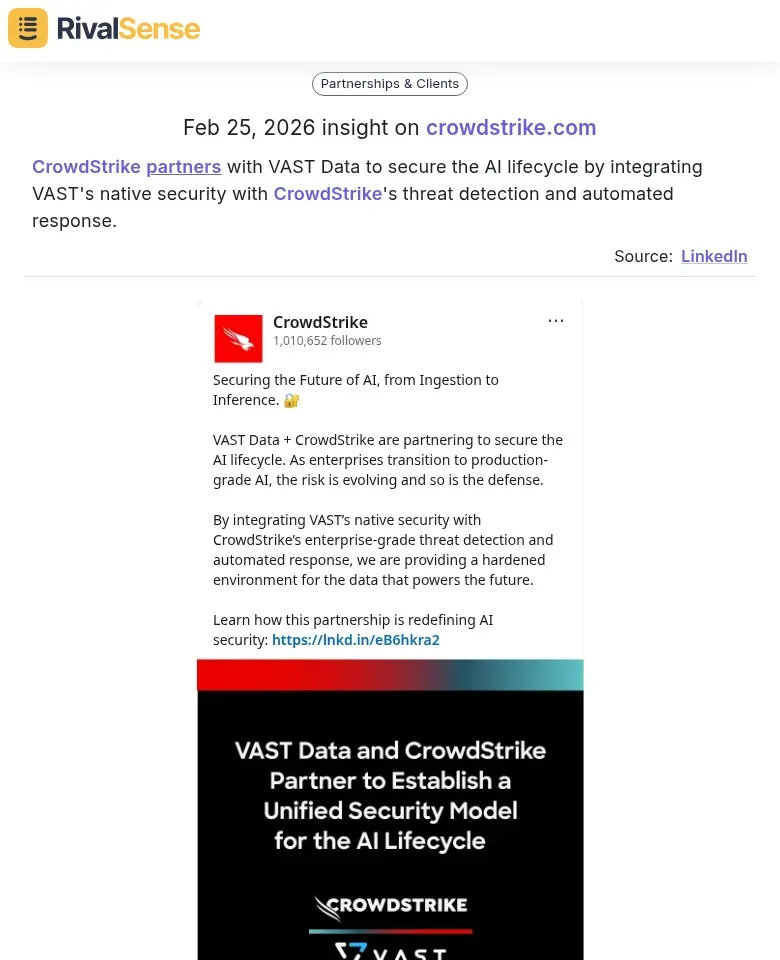
Tracking partnership insights like this can reveal strategic alliances that competitors might promote at trade shows. This helps you anticipate their messaging and prioritize events where such collaborations are highlighted, ensuring you're not caught off guard.
3. BUILD THE COMPLETE CUSTOMER JOURNEY WITH COMPETITIVE DIFFERENTIATION
The trade show floor is just one touchpoint in a longer engagement sequence. Strategic exhibitors think holistically about the entire customer journey. Before the event, implement targeted outreach campaigns that drive booth traffic and schedule meetings. During the show, create memorable experiences that attract your prospects and differentiate your brand from competitors.
Differentiation Framework:
- Product Capabilities: What unique features or integrations do you offer?
- Service & Support: How does your customer success differ?
- Company Attributes: What's unique about your team, culture, or approach?
- Pricing & Value: How does your pricing model benefit customers?
- Customer Outcomes: What specific results do you deliver?
Post-show follow-up is where many companies falter. Develop a systematic approach to nurture every connection made, from immediate thank-you emails to personalized content sequences. The best trade show strategies ensure no lead goes cold and every conversation advances toward a business outcome.
4. ALIGN BUDGET WITH STRATEGY AND COMPETITIVE INSIGHTS
Your budget reflects your priorities. Rather than defaulting to last year's allocation, align spending with your strategic goals and competitive intelligence. If thought leadership is your aim, invest in speaking opportunities and content marketing. If quality lead generation drives your strategy, allocate resources toward booth traffic-building campaigns and lead capture technology.
Consider the full spectrum of investment opportunities: exhibit design and production, pre-show marketing, booth staffing, hospitality events, digital amplification, and post-show nurture campaigns. Every dollar should connect directly to your defined objectives.
Budget Allocation Tips:
- Competitor Analysis: Allocate 5-10% of your trade show budget to competitive intelligence gathering
- Differentiation: Invest in booth design that visually stands out from competitors
- Staff Training: Budget for competitive scenario role-playing sessions
- Intelligence Tools: Consider automated monitoring solutions that track competitor movements
5. TRACK AND ADAPT WITH REAL-TIME COMPETITIVE INTELLIGENCE
Treat your annual strategy as a living document, not a rigid plan. Schedule periodic reviews to assess performance against goals. Which shows delivered the strongest ROI? Where did you see unexpected opportunities? Use these insights to reallocate resources toward what's working and eliminate what isn't.
Agility separates high-performing trade show programs from stagnant ones. Market conditions shift, competitor strategies evolve, and new events emerge. Your strategy should adapt accordingly.
Weekly Intelligence Checklist:
- [ ] Monitor competitor product launches/updates
- [ ] Track competitor pricing changes
- [ ] Note competitor event participations
- [ ] Watch for competitor partnerships
- [ ] Follow competitor media mentions
- [ ] Document competitor management changes
Pro Tip: Automated competitor tracking tools can save your team dozens of hours each month. Instead of manually scouring websites and social media, solutions like RivalSense deliver comprehensive competitor intelligence in weekly email reports, covering product launches, pricing updates, event participations, partnerships, regulatory aspects, management changes, and media mentions across 80+ sources.
For instance, Isometric certified version 1.3 of its Biogenic Carbon Capture and Storage Protocol on February 25, expanding eligibility to energy-from-waste projects and partnering with UK operators Cory and enfinium. 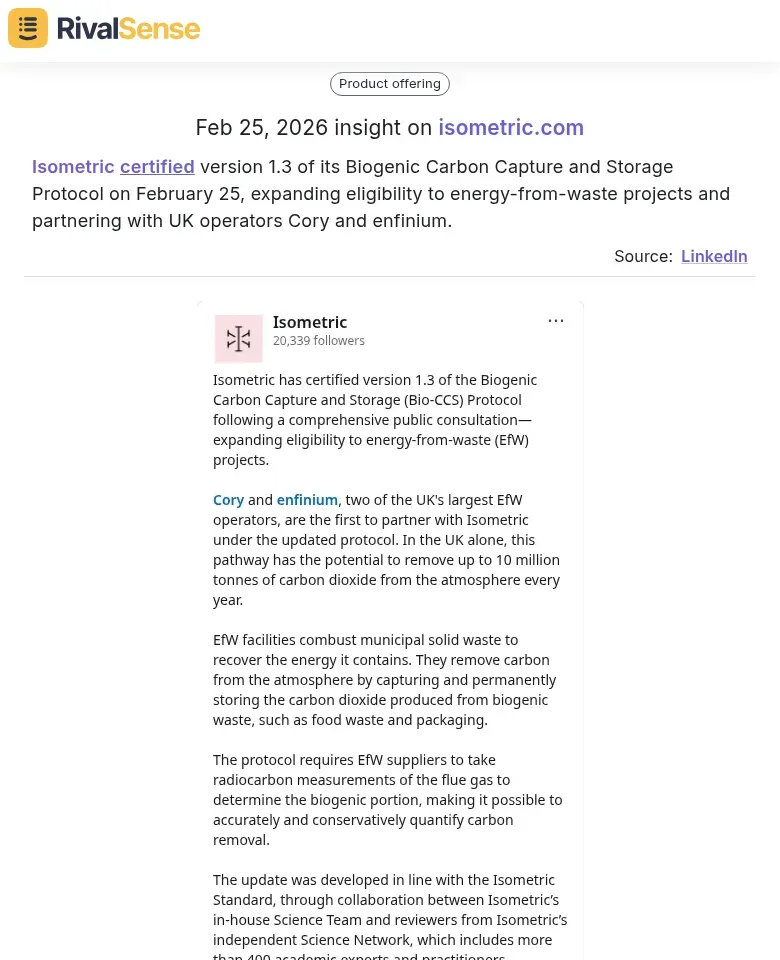
Tracking such regulatory and product updates can alert you to competitor innovations that may be launched at trade shows. This enables you to adapt your strategy in real-time, preparing counter-messaging or highlighting your own advancements.
THE COMPETITIVE INTELLIGENCE PLAYBOOK FOR TRADE SHOWS
Pre-Show Preparation (6-8 Weeks Before)
Effective pre-show preparation sets the stage for success. By gathering intelligence early, you can refine your messaging and anticipate competitor moves. Start by categorizing competitors and collecting relevant data.
-
Competitor Identification: Categorize competitors into three layers:
- Direct Competitors: Similar solutions, similar customers
- Indirect Competitors: Different solutions, same problem
- Emerging Threats: New entrants with fresh approaches
-
Intelligence Gathering:
- Review official exhibitor listings
- Monitor competitor social media for pre-show promotions
- Analyze competitor websites and landing pages
- Track press releases and media coverage
- Review historical show data
- For example, KAYAK launched a new brand platform called 'Got That Right' on February 24, 2026, to address travel planning stress by providing tools for confident booking.
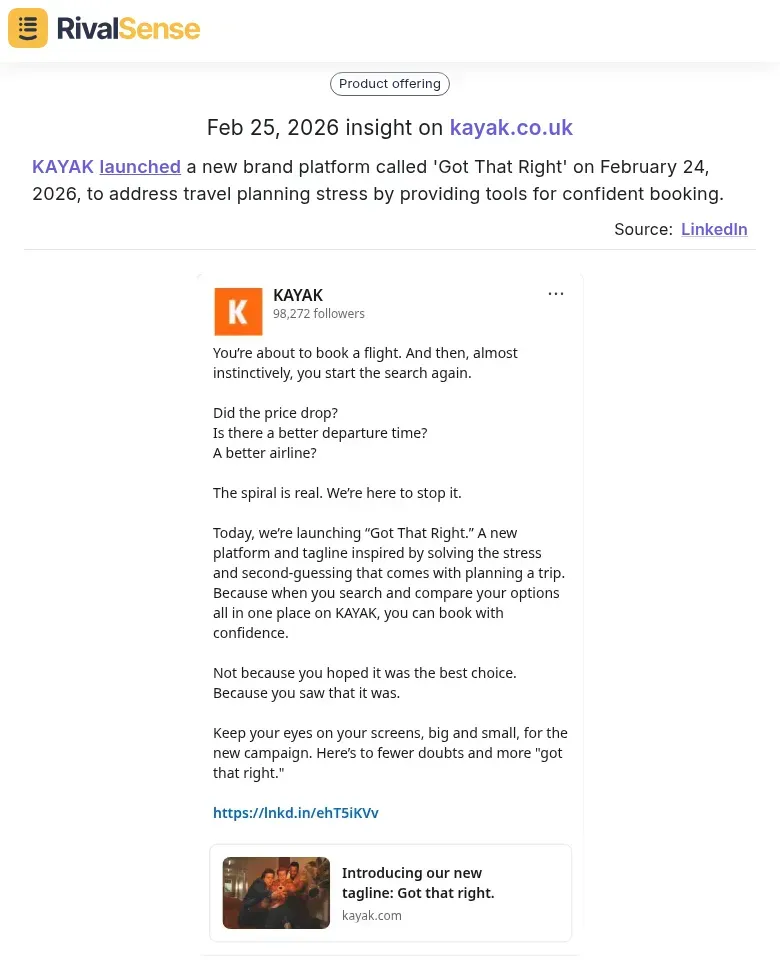
Monitoring media mentions and brand launches like this helps you understand competitor positioning and messaging shifts before the event, so you can refine your own approach to stand out.
-
Messaging Development:
- Create a messaging matrix for each major competitor
- Document their likely claims and your counter-messages
- Gather proof points (testimonials, case studies, metrics)
During the Show (Daily Execution)
Daily execution during the show requires coordination and adaptability. Morning briefings and evening debriefs keep your team aligned and responsive to competitor activities on the floor.
-
Morning Briefings:
- Review competitor booth locations and activities
- Share intelligence from previous day's conversations
- Practice handling competitive scenarios
-
Conversation Strategy:
- Ask prospect-led discovery questions
- Reframe competitive comparisons to focus on outcomes
- Deliver specific proof points naturally
- Capture real-time competitive intelligence
-
Evening Debriefs:
- Document what prospects said about competitors
- Note competitor messaging that resonated or fell flat
- Adjust strategy based on day's learnings
Post-Show Analysis (1-2 Weeks After)
Post-show analysis is crucial for continuous improvement. By assessing ROI and synthesizing competitive intelligence, you can refine future strategies and maximize returns from your trade show investments.
-
ROI Assessment:
- Measure leads generated against goals
- Calculate cost per qualified conversation
- Track pipeline influenced by show interactions
-
Competitive Intelligence Synthesis:
- Compare pre-show predictions with actual competitor behavior
- Update competitor profiles with new intelligence
- Identify patterns in competitor strategies
-
Strategy Refinement:
- Determine which shows delivered best ROI
- Reallocate budget based on performance
- Update messaging based on prospect feedback
THE PATH FORWARD
An intentional, competitor-informed trade show strategy transforms events from expenses into growth accelerators. With the right plan and competitive intelligence, every handshake and connection contributes to your company's success in 2026.
Remember: The companies that consistently win at trade shows aren't necessarily those with the biggest booths or largest budgets. They're the ones who understand the competitive landscape, articulate clear differentiation, and train their teams to have confident, differentiated conversations.
Ready to elevate your trade show strategy with competitor intelligence? Try RivalSense for free at https://rivalsense.co/ and get your first competitor report today. It tracks product launches, pricing updates, event participations, partnerships, regulatory aspects, management changes, and media mentions across 80+ sources, delivering everything in a weekly email report to help you outperform competitors on the show floor.
WANT TO LEARN MORE?
- Listen to our podcast episode with Bill to hear his insights on leveraging trade shows for U.S. growth
- Visit MEET's website to explore how his team helps international companies build traction and lasting connections in the American market
- Explore competitor intelligence solutions that can enhance your trade show strategy
About the Author: Bill Kenney has helped hundreds of international B2B companies navigate the competitive landscape of U.S. trade shows. His approach combines strategic planning with competitive intelligence to deliver measurable results.
📚 Read more
👉 A Step-by-Step Guide to Comparing Key Account Management Tools for Industrial Machinery Maintenance
👉 How n8n's Pricing Shift Let Competitors Capture Enterprise Clients
👉 Predictive Facebook Competitor Insights: Key Account Management Case Study
👉 Mastering Key Account Management in Quantitative Trading: Strategies and Insights
👉 How Competitor Hiring and Layoff Insights Solve Key Account Management Challenges