
Mastering Competitor Differentiation: A Guide to Internet Intelligence for B2B Leaders
In today's digital-first business landscape, internet sources have become the most revealing window into competitor differentiation strategies. Unlike traditional market research that relied on surveys and reports, real-time digital intelligence allows you to systematically analyze how competitors position themselves across websites, social media, review platforms, and industry publications. This approach reveals not just what competitors say about themselves, but how they're actually perceived by customers and the market.
To get started, here are practical steps to begin your analysis:
- Map your competitor's digital footprint across key platforms like LinkedIn, Twitter, industry forums, and their website.
- Track messaging consistency across their website, blog, and social channels to identify core positioning themes.
- Analyze customer reviews on sites like G2 or Capterra for pain points competitors address (or miss).
- Monitor content strategy through blogs and whitepapers to uncover their educational focus and expertise areas.
This systematic analysis uncovers hidden advantages—like a competitor's unexpected strength in customer education—and vulnerabilities, such as inconsistent messaging or unaddressed market needs. By transforming scattered online data into structured intelligence, you gain the insights needed to refine your own differentiation strategy and capture competitive advantage. 🚀
Key Internet Sources for Competitor Differentiation Insights
Earnings calls and investor presentations offer unfiltered strategic insights that are crucial for understanding competitor priorities. These communications provide direct access to management's thinking, revealing how they perceive their competitive advantages and market challenges. Listen for executives' language around 'differentiation,' 'competitive advantages,' and 'unique value propositions.' Note which metrics they emphasize (e.g., customer retention, market share gains) and how they position against competitors.
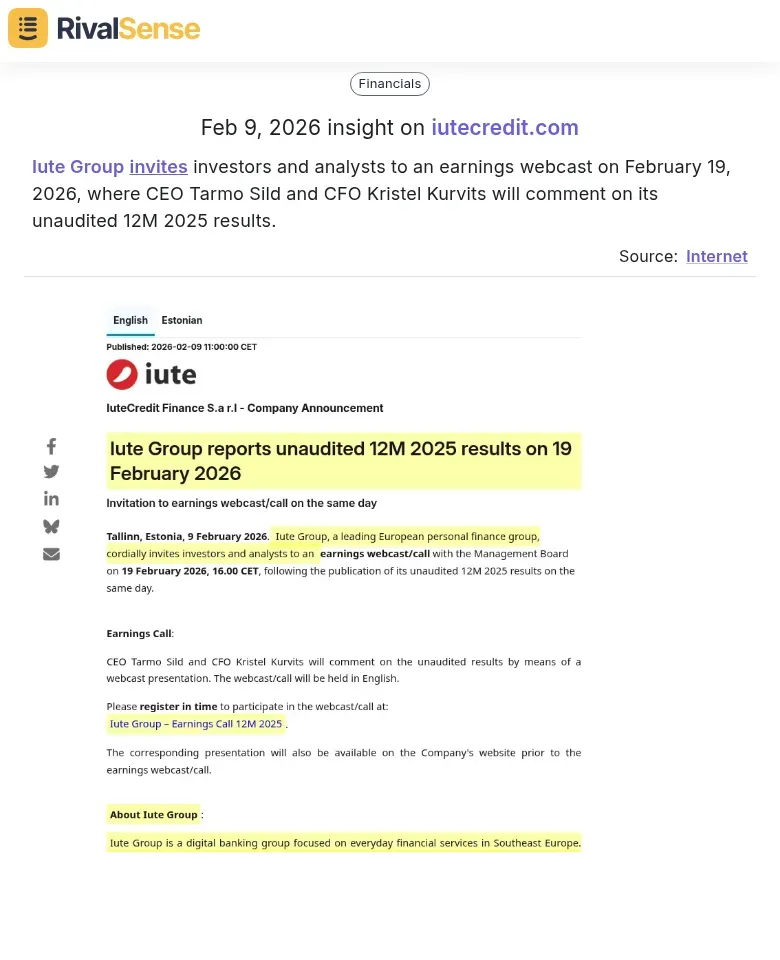
For example, Iute Group recently invited investors and analysts to an earnings webcast on February 19, 2026, where CEO Tarmo Sild and CFO Kristel Kurvits will comment on its unaudited 12M 2025 results. This type of insight is valuable because it signals upcoming strategic communications that can reveal new initiatives or performance trends before they are widely known. Monitoring such events helps you anticipate competitor moves and adjust your strategy accordingly.
Practical checklist for earnings calls:
- 📊 Track recurring themes and strategic priorities
- 🔍 Analyze Q&A sessions for competitive concerns
- 📈 Compare messaging across quarters to identify shifts
- 🗓️ Note timing relative to product launches or market entries
Financial reports and SEC filings (10-K, 10-Q) reveal operational realities behind marketing claims. Analyze segments showing above-average growth or profitability - these often indicate competitive strengths. Look for R&D investments, geographic expansions, or operational efficiencies that competitors might lack.
Tip: Compare gross margins, customer acquisition costs, and capital expenditure patterns across competitors to identify structural advantages. Use spreadsheets to visualize trends over time.
Press releases and executive communications highlight strategic direction in real-time. Monitor announcements about new partnerships, product launches, or market entries that signal differentiation moves. Track executive interviews and thought leadership pieces for positioning statements.
Create a system: Categorize announcements by strategic theme (innovation, expansion, customer focus), note timing relative to competitor moves, and analyze language patterns that reveal confidence in specific differentiators.
Analyzing Strategic Positioning Through Financial Performance Data
Financial performance data reveals competitors' strategic positioning through three critical lenses. First, analyze revenue growth patterns across business segments to identify where competitors are winning. For example, if a SaaS competitor shows 40% growth in enterprise sales but only 5% in SMB, they're likely prioritizing high-value accounts. Create a quarterly tracking spreadsheet comparing segment growth rates across competitors.
Second, examine margin pressures to understand operational efficiency. Calculate gross margin trends over 8 quarters - declining margins may indicate price wars or rising costs. Compare operating margins to identify who's running leanest. Tip: Look at SG&A expenses as percentage of revenue - a competitor reducing this ratio while growing revenue has likely optimized operations.
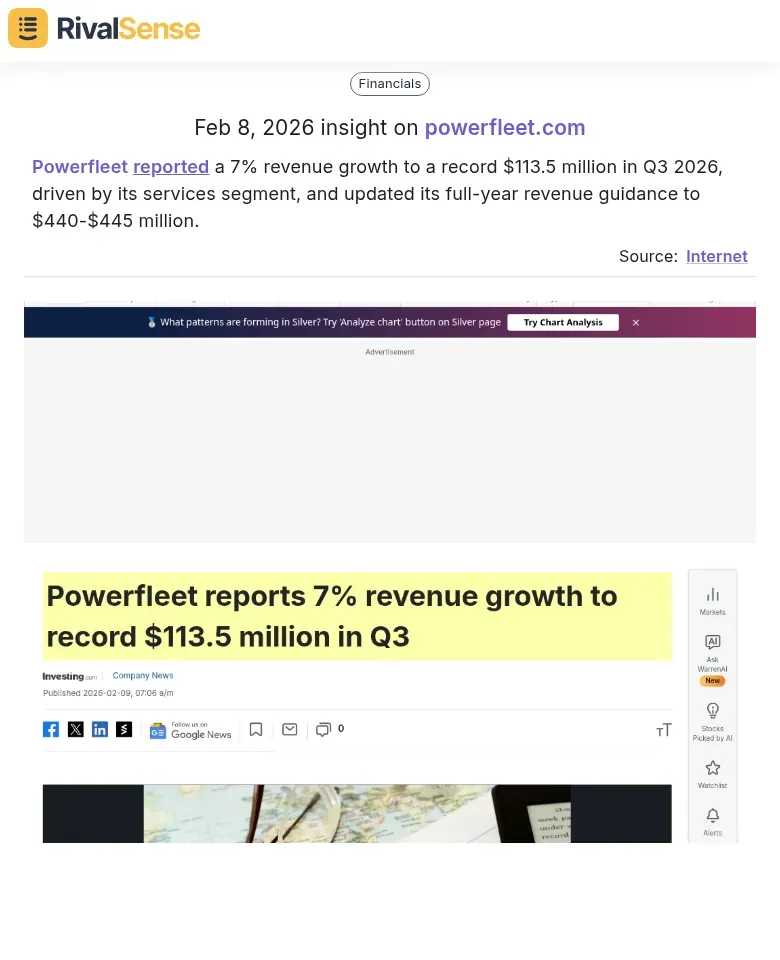
Third, scrutinize guidance updates in earnings calls. When competitors revise forecasts upward, they're signaling confidence in strategic initiatives. Downward revisions often precede strategic shifts. For instance, Powerfleet reported a 7% revenue growth to a record $113.5 million in Q3 2026, driven by its services segment, and updated its full-year revenue guidance to $440-$445 million. This insight is valuable because it shows how a company is performing against its own targets and where it sees future growth, helping you benchmark their confidence and strategic focus.
Practical checklist for financial analysis:
- 📊 Track guidance vs. actual performance over 4 quarters
- 📝 Note language changes in forward-looking statements
- 🔄 Compare guidance timing to product launches or market entries
- 📈 Use visual dashboards to monitor trends
Combine these insights: A competitor with strong segment growth but margin compression might be aggressively pricing to gain share. One maintaining margins while missing guidance could be facing market saturation. Use this analysis to anticipate competitive moves and position your offerings accordingly.
Extracting Differentiation Signals from Management Communications
Management communications during earnings calls and webcasts reveal critical differentiation signals that competitors won't advertise publicly. These insights go beyond financial numbers to uncover operational strategies and technological adoptions. Here's how to extract them effectively:
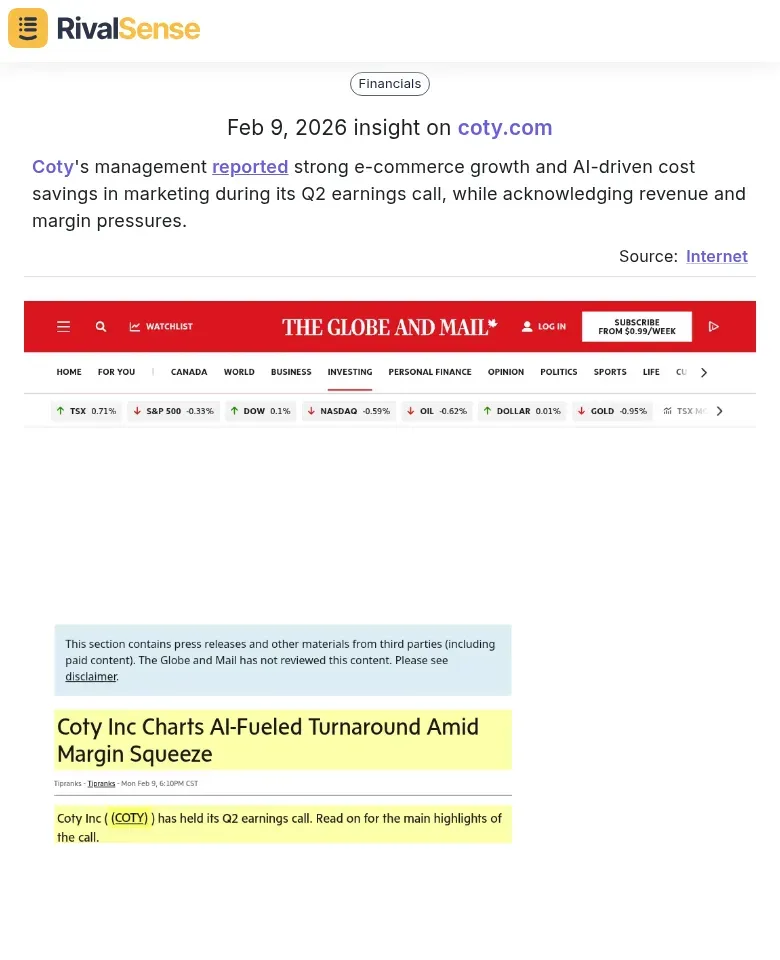
- Technology Adoption Patterns: Listen for specific mentions of AI-driven cost savings, automation percentages, or digital transformation timelines. For example, Coty's management reported strong e-commerce growth and AI-driven cost savings in marketing during its Q2 earnings call, while acknowledging revenue and margin pressures. This type of insight is valuable because it highlights how competitors are leveraging technology to improve efficiency and drive growth, giving you benchmarks for your own innovation efforts.
-
Growth Narrative Analysis: Track recurring themes in strategic priorities. Are they emphasizing enterprise expansion, SMB penetration, or geographic growth? Create a quarterly tracking spreadsheet to identify shifts in focus that reveal market positioning.
-
Challenge Decoding: Pay attention to how management describes market challenges and their responses. Phrases like "competitive pricing pressure" followed by "value-based selling initiatives" indicate differentiation through premium positioning rather than price competition.
Practical Checklist for Management Communications:
- 🎧 Record earnings calls and use transcription tools for keyword analysis
- 📋 Create a quarterly comparison matrix of strategic priorities
- 🔢 Note specific technology adoption metrics mentioned
- 🛡️ Track management's language around competitive threats and responses
- 🔍 Identify patterns across 3-4 quarters to distinguish temporary tactics from long-term differentiation
Tip: Focus on what management emphasizes repeatedly - these are likely their true competitive advantages rather than temporary market responses.
Building a Systematic Framework for Differentiator Analysis
To build a systematic framework for differentiator analysis, start by creating structured templates that capture key signals across product features, pricing models, marketing messaging, customer experience, and market positioning. This ensures that your analysis is consistent and comprehensive, covering all aspects of competitor behavior. Use a standardized format with columns for competitor name, differentiator type, evidence source, date captured, and impact assessment.
Next, develop a scoring system that quantifies competitive advantages. Assign weights to different dimensions based on your strategic priorities (e.g., product innovation 40%, pricing 25%, customer service 20%, brand perception 15%). Use a 1-10 scale for each dimension, then calculate weighted scores to objectively rank competitors' strengths. Include qualitative notes explaining scoring rationale for context.
Establish monitoring protocols with regular cadences: daily for social media and news alerts, weekly for website updates and pricing changes, monthly for content analysis and feature releases. Create automated alerts for key differentiator changes using tools like RivalSense. Track trends over time with visual dashboards showing score evolution, enabling you to identify emerging advantages or weakening positions before they impact your market share.
Practical checklist for framework implementation:
- 📄 Template standardization across teams
- 📏 Clear scoring criteria documentation
- 🤖 Automated data collection setup
- 📅 Regular review meetings (e.g., monthly strategy sessions)
- 📊 Trend analysis integration into strategic planning
Translating Insights into Competitive Strategy and Action
Translating competitor insights into actionable strategy requires systematic execution and a clear roadmap. First, identify market gaps by analyzing competitor performance patterns: examine customer reviews for recurring complaints, map feature gaps in competitor offerings, and identify underserved segments through demographic analysis. Create a gap prioritization matrix scoring each opportunity by market size, alignment with your capabilities, and defensibility.
Develop counter-strategies by targeting competitor weaknesses: if competitors have slow customer support, implement 24/7 response guarantees; if they lack specific features, develop those as your core differentiators. Create a vulnerability assessment checklist covering operational gaps, pricing weaknesses, and service deficiencies.
Build a differentiation roadmap with quarterly milestones:
- Month 1-3: Address immediate gaps with quick-win solutions.
- Month 4-6: Develop unique features based on competitor intelligence.
- Month 7-9: Launch targeted marketing to underserved segments.
- Month 10-12: Establish market leadership in identified gaps.
Track progress with KPIs measuring market share in targeted segments, customer acquisition from competitor weaknesses, and differentiation index scores. Maintain continuous competitor monitoring to adapt your roadmap as market conditions evolve. 🔄
Conclusion: Leverage Tools for Continuous Intelligence
Mastering competitor differentiation analysis from internet sources is an ongoing process that requires diligence and the right tools. By systematically tracking earnings calls, financial reports, management communications, and other digital footprints, you can uncover strategic insights that drive your business forward.
To streamline this process, consider using RivalSense, a competitor tracking tool that monitors product launches, pricing updates, event participations, partnerships, regulatory aspects, management changes, and media mentions across company websites, social media, and various registries. It delivers all this intelligence in a weekly email report, saving you time and ensuring you never miss a critical update.
Ready to optimize your competitor analysis? Try out RivalSense for free at https://rivalsense.co/ and get your first competitor report today! 🚀
📚 Read more
👉 Predictive Sales Forecasting: Outmaneuver Competitors in Organizational Consulting
👉 How Competitor Insights Solve Market Entry Challenges for Key Account Growth
👉 Turning Competitor Awards into Strategic Advantage
👉 Key Account Management for SaaS: The Complete 2026 Guide to Strategic Growth
👉 Predictive Analytics for Water Treatment Key Account Risk: A Strategic Guide