
Market Entry Mistakes: Avoiding Competitor Blind Spots with Centralized Intelligence
Entering new markets without centralized competitor intelligence is like navigating with a fragmented map—you'll miss critical signals and make costly mistakes. When competitor data lives in spreadsheets, emails, and disconnected tools, teams miss expansion signals like hiring spikes in new regions, organizational restructuring for market entry, or strategic partnerships that reveal competitor priorities.
Centralized intelligence systems transform this chaos into strategic advantage. By consolidating competitor tracking into a single platform, you can spot patterns that signal expansion: when a competitor suddenly hires 20+ sales reps in a new country, restructures their leadership team for regional focus, or launches localized content. These signals, visible only through centralized analysis, help you anticipate moves and time your entry strategically.
Practical steps to avoid blind spots:
- Consolidate competitor tracking into one platform (like RivalSense) for real-time alerts
- Monitor hiring trends in target regions—spikes indicate expansion
- Track organizational changes and leadership appointments in new markets
- Analyze competitor content localization and partnership announcements
- Set up automated alerts for competitor job postings in specific geographies
💡 Example: A SaaS company avoided entering a saturated European market after their centralized system revealed three competitors had doubled their local sales teams in 90 days—a clear signal of intense competition they would have missed with fragmented intelligence.
Learning from Competitor Expansion Signals: Global Growth Team Insights
Competitor hiring announcements are your earliest warning system for market entry. When a rival posts roles like "APAC Growth Lead" or "EMEA Market Expansion Manager," they're revealing expansion plans 3-6 months before official launches. By centralizing these signals, you can decode their strategic priorities and adjust your own timeline accordingly.
For instance, RivalSense tracked that OpenAI's Terri Wang announced on December 10 that the company is expanding its product growth team globally and hiring growth specialists in EMEA.
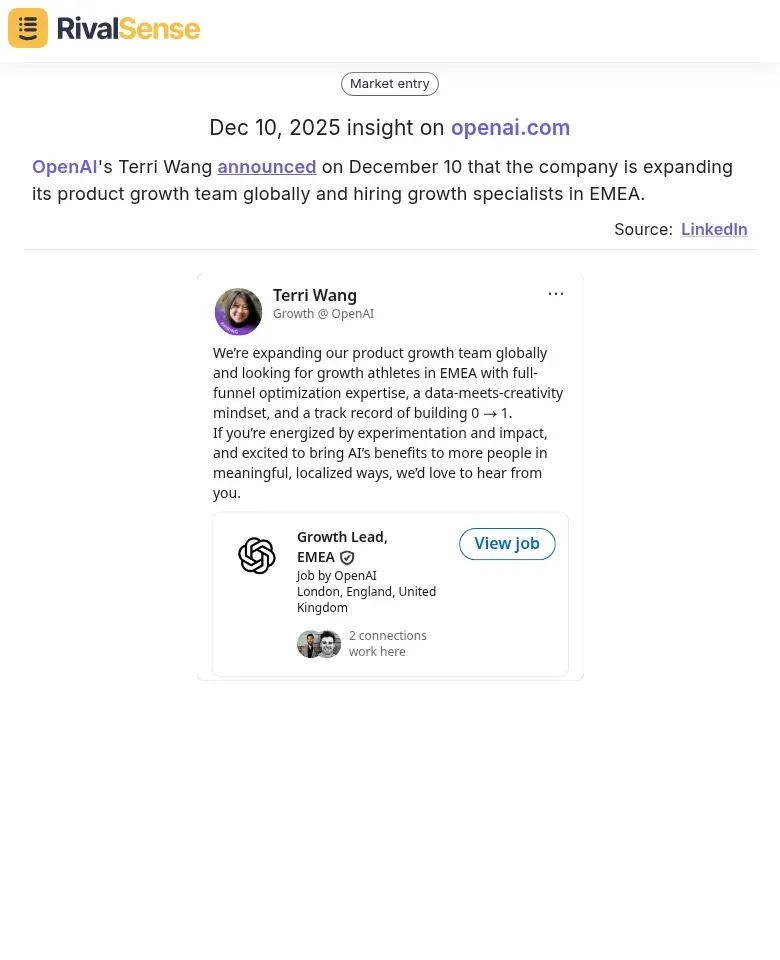
This type of insight is valuable because it signals a deliberate investment in a specific region, allowing you to anticipate their market focus and adjust your own expansion strategy before they gain a foothold.
Early Indicators Checklist: ✅
- Monitor for specialized roles: Growth specialists, international business development, localization experts
- Watch for location-specific hiring spikes in new regions
- Note reporting structures - roles reporting to "Head of International" signal serious commitment
Actionable Steps:
- Set up alerts for competitor job postings in target expansion markets
- Analyze hiring velocity - rapid hiring (5+ roles/month) signals aggressive timelines
- Cross-reference with leadership appointments and office openings
- Use centralized intelligence tools to track patterns across multiple competitors simultaneously
🔍 Remember: Competitors often test markets with small teams before full-scale entry. A single "Country Manager" hire today could mean a 50-person office next quarter. By centralizing these signals, you transform scattered hiring data into predictive intelligence for smarter market timing decisions.
Local Market Presence Intelligence: Decoding Regional Strategy Moves
When competitors announce new market entries, most companies focus on surface-level signals like office openings or press releases. But the real strategic insights come from analyzing their on-the-ground hiring patterns. Local hiring—especially specialized roles—signals deeper market commitment and reveals nuanced localization strategies that can impact your own entry plans.
Take Harvey, which expanded its on-the-ground presence in Madrid by hiring Gerardo Conde Garrido as Legal Product Specialist and Jordan D. as Customer Success Manager to support Spanish customers locally.

Tracking such hires is valuable because it highlights a competitor's focus on local compliance and customer adaptation, key for navigating regional regulations and building trust. This insight helps you anticipate their localization depth and identify potential gaps in your own strategy.
Why Local Hiring Matters:
- Legal/compliance hires indicate navigating complex regulations
- Customer success teams signal focus on local service adaptation
- Marketing specialists reveal cultural customization plans
Practical Checklist: ✅
- ✓ Create alerts for competitor job postings in target markets
- ✓ Build a database of competitor local hires by region
- ✓ Analyze hiring velocity—rapid scaling signals aggressive entry
- ✓ Cross-reference with office locations and partnership announcements
🏆 Competitive Advantage: Understanding these signals before market entry helps you anticipate competitor localization strategies, identify underserved niches, and time your own entry to maximize first-mover advantages in specific customer segments.
Strategic Transformation Insights: Learning from Long-Term Competitor Evolution
Anniversary milestones offer critical windows into competitor maturity and strategic pivot points. When a company celebrates 5, 10, or 20 years, analyze what changed: Did they shift from product-led to service-driven models? Did they expand into new verticals? These moments often signal strategic reinvention that can redefine industry landscapes and affect your market positioning.
Consider Civinity, which celebrated its 20-year anniversary in September 2025, employs over 1,600 people across Lithuania, Latvia, Estonia, and the UK, and aims to transform from a building maintenance business into a city lifestyle company.

This insight into long-term evolution is valuable because it reveals strategic pivots and scaling capabilities, helping you anticipate market shifts and identify new competitive threats or partnerships before they become mainstream.
Workforce Growth Patterns:
Monitor hiring spikes in specific departments: A surge in sales hires suggests aggressive market capture, while R&D expansion indicates innovation focus.
Business Model Transformations:
When competitors shift from perpetual licenses to subscriptions, or from direct sales to partner channels, they're adapting to market evolution. Map their revenue model changes against market trends to spot emerging standards.
Simple Checklist: ✅
- Track quarterly headcount changes
- Note department-specific hiring
- Correlate with product launches and anniversary announcements
💡 Practical Tip: If a competitor doubles engineering staff while slowing sales hires, they're likely building for future markets rather than current competition. Centralize these insights in a competitive intelligence dashboard to spot patterns early.
Building Your Centralized Intelligence Framework
Building a centralized intelligence framework starts with creating a unified dashboard that consolidates competitor signals across hiring, expansion, and transformation. Use tools like RivalSense to track job postings, new office openings, product pivots, and leadership changes in one place. This eliminates data silos and provides a holistic view of competitive movements that informs strategic decisions.
Establish automated alerts for critical activities across multiple data sources. Set up notifications for when competitors post senior roles (indicating strategic shifts), announce new markets, or launch major product updates. Configure alerts to match your business priorities—daily for urgent signals, weekly for trend analysis.
Develop intelligence workflows that connect disparate signals into actionable insights. For example:
- When a competitor hires multiple data scientists, flag potential AI initiatives
- Track office expansions to identify geographic priorities
- Monitor patent filings to anticipate product directions
Practical Checklist: ✅
- ✓ Weekly dashboard review
- ✓ Monthly trend analysis
- ✓ Quarterly strategy alignment
🚀 Pro Tip: Start with 3-5 key competitors and 2-3 signal types to avoid overwhelm. Use templates to standardize reporting and ensure insights reach decision-makers promptly. The goal is transforming raw data into strategic foresight that informs your market entry decisions.
Conclusion: Turning Intelligence into Market Entry Advantage
Centralized intelligence transforms market entry from reactive guesswork to proactive strategy. By consolidating competitor data into a single dashboard, you prevent blind spots that lead to costly post-entry corrections. The ROI is clear: proactive monitoring costs far less than fixing positioning mistakes after launch, and it enables you to seize opportunities before competitors do.
Practical steps to maintain advantage:
- Establish a centralized intelligence hub (like RivalSense) for all competitor data
- Set automated alerts for competitor pricing, feature, and messaging changes
- Conduct weekly intelligence reviews with your leadership team
- Create a competitor response playbook for common scenarios
Building a culture of continuous intelligence means making competitor analysis part of your weekly rhythm, not just a pre-launch exercise. This sustained vigilance creates lasting market leadership by anticipating moves before they happen, not reacting after the fact.
🔍 Ready to eliminate competitor blind spots? Try out RivalSense for free to centralize your competitor tracking and get your first competitor report today. Spot expansion signals, hiring trends, and strategic pivots all in one place—turning intelligence into your market entry advantage.
📚 Read more
👉 Mastering Competitor Analysis: Insights from Real-World Examples
👉 Air Freight Podcast Intelligence: A Strategic Guide to Tracking Competitors
👉 How RivalSense Alerted Competitors to CrowdStrike's AI Security Move
👉 Competitor Insights Cheat Sheet: Mastering Key Account Lifecycle Tracking for B2B Success