
Market Entry Analysis: Leveraging Competitor Funding for Strategic Insights
When entering new markets, competitor funding intelligence provides crucial strategic insights that go beyond basic market research. Funding rounds reveal not just capital availability, but strategic priorities, expansion capabilities, and market timing signals. A competitor's recent Series B or C funding often indicates imminent market expansion, while bridge rounds may signal consolidation before aggressive moves.
Practical steps for leveraging this intelligence:
- Track Funding Patterns: Monitor competitors' funding history, investor profiles, and use-of-funds statements to understand their expansion roadmap.
- Analyze Timing Signals: Funding rounds typically precede major market moves by 6-12 months. Use this window to prepare your entry strategy.
- Assess Resource Allocation: Well-funded competitors can afford aggressive pricing, marketing blitzes, and talent acquisition. Factor this into your resource planning.
- Checklist for Action:
- Map competitor funding against their product launches and geographic expansion
- Analyze investor expertise (do they specialize in your target market?)
- Calculate burn rates to estimate how long funding will support aggressive moves
- Identify funding gaps where competitors may be vulnerable
Funding intelligence transforms financial data into actionable market entry decisions, helping you time your entry, allocate resources effectively, and anticipate competitive responses before they materialize.
Decoding Funding Signals: What Competitor Investment Reveals About Strategy
When a competitor announces funding, look beyond the headline dollar amount. Analyze three key dimensions to extract strategic insights:
1. Funding Amount & Sources = Market Commitment & Risk Appetite
Large rounds from top-tier VCs signal aggressive growth ambitions and willingness to burn cash for market share. Corporate venture capital (like Google Ventures) often indicates strategic partnerships or acquisition potential. Practical tip: Create a funding tracker spreadsheet with columns for amount, investor type, and round stage to spot patterns.
2. Allocation Patterns = Strategic Focus Areas
Follow the money trail. When Xometry secured funding, their subsequent investments in aerospace/defense/medical certifications revealed their high-value sector focus.
Insight Example:

This type of insight is valuable because it shows how competitors allocate funds to specific industries, indicating their strategic priorities and where they plan to dominate. By tracking such product focus shifts, you can anticipate market moves and adjust your strategy accordingly.
Checklist: Monitor competitor job postings (are they hiring aerospace engineers?), patent filings, and partnership announcements to identify where capital is flowing.
3. Timing Analysis = Market Expansion Signals
Funding rounds typically precede major moves by 6-12 months. Track this sequence: funding announcement → hiring spree in specific departments → geographic expansion → product launches. Actionable step: Set calendar alerts 3-6 months post-funding to watch for operational changes. When you see Series B funding, expect international expansion within 9 months.
Pro Tip: Use tools like Crunchbase to create competitor funding timelines. Overlay these with their market announcements to identify predictable patterns. Remember: funding isn't just capital—it's a publicly available roadmap of your competitor's next 18-24 month strategy.
Operational Intelligence: Translating Funding into Market Entry Actions
Funding isn't just capital—it's a blueprint for competitor expansion. When rivals secure investment, track how they translate dollars into operational capabilities.
Insight Example:
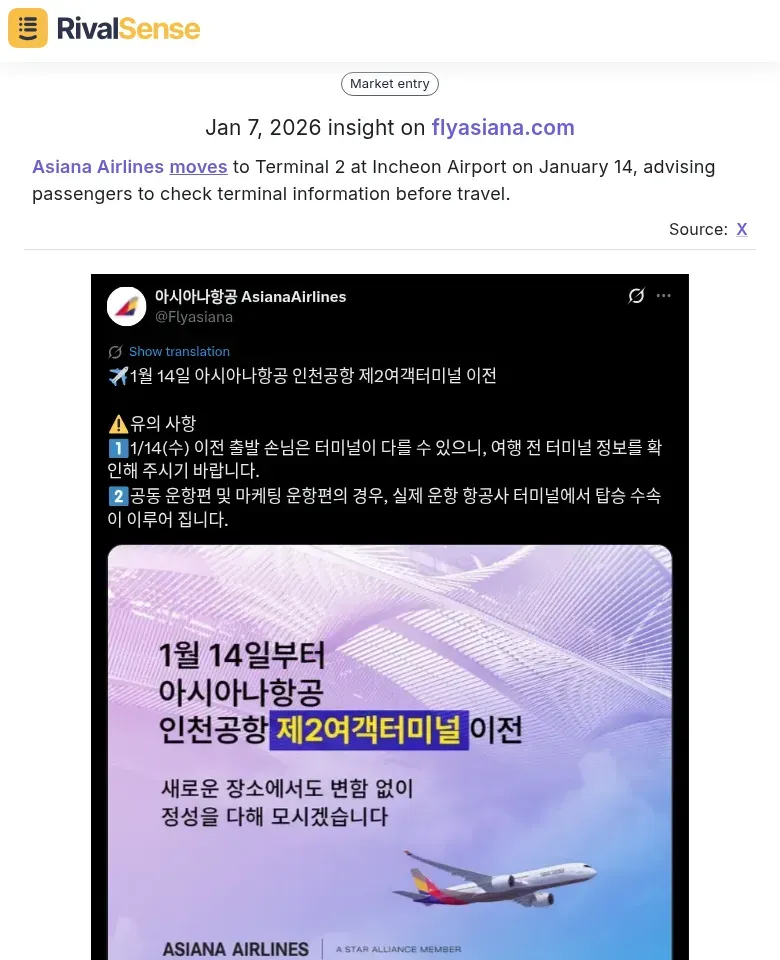
Asiana Airlines' terminal relocation after funding demonstrates infrastructure development that directly impacts market presence. Tracking such operational changes is crucial as it reveals how competitors are investing in customer experience and logistical improvements, which can give them a competitive edge.
Insight Example:

Air India's route expansions following capital injections reveal service scaling patterns. This insight highlights market expansion moves, allowing you to anticipate competitive threats in new routes or regions and plan your counter-strategies.
Practical intelligence gathering:
- Map funding announcements to physical infrastructure projects within 3-6 months
- Monitor hiring surges in specific departments (operations, logistics, customer service)
- Track equipment purchases or facility expansions in target markets
- Document service launches or route expansions following funding rounds
Resource allocation patterns reveal strategic priorities. When competitors allocate 60%+ of new funding to a specific region or service line, they're signaling their primary market entry focus. Create a funding-to-action timeline for each major competitor, noting the lag between capital infusion and operational execution.
Actionable checklist:
- Set up alerts for competitor facility permits and construction filings
- Monitor job postings for operational roles in expansion markets
- Track fleet/equipment registrations in new regions
- Document service launch dates relative to funding announcements
- Calculate resource allocation percentages by department/region
This operational intelligence transforms funding data into predictable market entry patterns, giving you 3-6 month visibility into competitor moves before they impact your market share.
Strategic Timing: Using Funding Cycles to Predict Market Moves
Funding cycles provide a predictable roadmap for anticipating competitor market moves. When a competitor announces funding, you're essentially seeing their growth playbook - they now have capital to execute expansion plans, and the clock starts ticking on investor expectations.
Practical Analysis Framework:
- Track the 90-Day Window: Most funded companies announce market expansion within 90 days of funding closure. Monitor their hiring patterns (especially for sales and marketing roles in new regions), partnership announcements, and geographic targeting in job postings.
- Analyze Investor Patterns: Different investors have distinct expansion playbooks. Series A investors often push for domestic market penetration, while Series B investors typically fund international expansion. Know your competitor's investor portfolio to predict their next moves.
- Timing Your Counter-Moves: Use competitor funding cycles to inform your own market entry timing. Consider these strategic options:
- Pre-emptive Entry: Enter a market 30-60 days before a well-funded competitor's expected expansion
- Parallel Entry: Launch simultaneously but with differentiated positioning
- Counter-Cyclical Entry: Enter during their funding gaps or between rounds
- Resource Planning Checklist:
- Adjust marketing budgets based on competitor funding amounts
- Accelerate hiring timelines for key positions in target markets
- Prepare competitive response playbooks for different funding scenarios
- Allocate contingency resources for market defense
Key Insight: The most predictable expansion pattern emerges 6-9 months post-funding, when companies have built teams and are ready to execute growth plans. By tracking funding announcements and subsequent hiring patterns, you can anticipate market entry with 70-80% accuracy.
Competitive Response Framework: Adapting Your Strategy Based on Funding Intelligence
When competitors secure funding, it signals both their capabilities and their strategic intent. Use this intelligence to develop a competitive response framework that adapts your market entry strategy based on two key dimensions: funding strength (capital available) and market commitment (how aggressively they're deploying it).
Practical Framework:
- Assess Competitor Posture: Map competitors on a 2x2 matrix: High/Low Funding vs. High/Low Market Commitment. High-Funding/High-Commitment players require defensive positioning, while Low-Funding competitors present attack opportunities.
- Identify Strategic Gaps: Funding-driven expansions often create underserved segments. When a competitor pours resources into enterprise solutions, they may neglect SMB needs—creating your entry wedge.
- Create Agile Response Plans: Develop scenario-based playbooks:
- Pre-emptive: If a competitor is fundraising, accelerate your launch timeline
- Counter: If they secure Series B+, differentiate through niche specialization
- Opportunistic: If funding rounds fail, target their vulnerable customer segments
Actionable Checklist:
✓ Monitor funding announcements and deployment patterns monthly
✓ Calculate competitor "runway" based on funding size and burn rates
✓ Identify 2-3 market gaps created by their expansion priorities
✓ Prepare 3 response scenarios with trigger points and resource allocations
✓ Establish rapid decision protocols for funding-related market shifts
Funding intelligence transforms from passive observation to active strategy when you systematically analyze how capital changes competitive dynamics and create flexible response mechanisms.
Implementation: Building a Systematic Competitor Funding Tracking System
Building a systematic competitor funding tracking system requires a structured approach. Start by establishing a monitoring framework: create a centralized database of target competitors, set up automated alerts for funding announcements via Google Alerts and Crunchbase, and schedule weekly reviews of venture capital news sources. Use tools like RivalSense to track funding rounds, investor details, and valuation changes in real-time.
Integrate funding data with operational tracking by mapping funding events to competitor activities. When a competitor raises capital, immediately monitor their hiring patterns, product launches, marketing spend, and geographic expansion. Create a dashboard that correlates funding amounts with operational metrics to identify strategic priorities.
Develop actionable insights processes through regular analysis sessions. Each quarter, review funding patterns to identify market trends, investor preferences, and competitive positioning. Use this data to inform your own fundraising strategy, identify potential acquisition targets, and anticipate competitive threats. Create a decision matrix that translates funding intelligence into specific actions: when a competitor raises Series B, should you accelerate hiring? When they expand to new markets, should you strengthen your local presence?
Practical checklist:
- Set up automated monitoring tools
- Create competitor funding profiles
- Establish weekly review cadence
- Build integrated dashboards
- Schedule quarterly strategic analysis
- Develop decision frameworks linking funding data to business actions
Take Action with RivalSense
Tracking competitor funding and translating it into actionable insights can be overwhelming without the right tools. That's where RivalSense comes in. RivalSense tracks competitor product launches/updates, pricing updates, event participations, partnerships, regulatory aspects, management changes, and media mentions across company websites, social media, the internet, and various registries. It delivers all this intelligence in a weekly email report, helping you stay ahead of the competition.
By using RivalSense, you can automatically monitor insights like the examples above—such as Xometry's industry focus, Asiana Airlines' operational changes, and Air India's route expansions—allowing you to anticipate market moves and adjust your strategy proactively.
Ready to leverage competitor funding intelligence for your market entry? Try out RivalSense for free at https://rivalsense.co/ and get your first competitor report today!
📚 Read more
👉 Analyzing Competitor Moves: Allison Loy's Role at OneTrust
👉 How to Track Competitor Pricing Changes: The Complete 2026 Playbook for B2B Leaders
👉 Aviation Fuel System Construction: Best Practices for Competitor Partnership Ecosystems
👉 How Tracking Meta's CTO Departure Gave Competitors an AR/VR Edge
👉 Mastering Facebook Competitor Analysis: A Strategic Guide for B2B Leaders