
Marine Port Services Key Account Risk Tracking Checklist 2026
🚢 Introduction: The Critical Importance of Key Account Risk Tracking in Marine Port Services
In 2026's volatile maritime landscape, key account risk tracking isn’t just prudent—it’s existential for marine port service providers. With 60-80% of revenue typically concentrated in 20% of clients, losing a single major account can trigger catastrophic financial collapse. Beyond revenue protection, inadequate risk tracking exposes ports to operational paralysis when critical clients face regulatory non-compliance or geopolitical disruptions.
Evolving maritime regulations—from IMO 2026 emissions standards to port state control digitization—create compliance minefields for key accounts. Simultaneously, geopolitical tensions in strategic waterways and trade route realignments amplify supply chain vulnerabilities. A single client’s failure to adapt can cascade into port congestion, contractual penalties, and reputational damage.
Practical steps for 2026:
✅ Map each key account’s regulatory exposure timeline
✅ Monitor geopolitical risk indicators for client trade routes
✅ Establish client financial health early warning systems
✅ Develop contingency plans for top 3 risk scenarios per account
✅ Implement quarterly risk review cadences with actionable mitigation checklists
Proactive tracking transforms risk from threat to strategic advantage, enabling ports to offer compliance guidance and resilience planning as value-added services.
📜 Regulatory Compliance and Enforcement Volatility in 2026
Regulatory compliance in marine port services faces unprecedented volatility in 2026, driven by fragmented enforcement patterns across maritime jurisdictions. Different regions—from EU ports to Asian hubs—apply varying interpretations of IMO and local regulations, creating compliance minefields for key accounts. Sanctions enforcement has intensified, with authorities targeting shipping networks and service providers through enhanced vessel tracking and financial transaction monitoring. Regional security conditions further complicate expectations; conflict zones demand heightened due diligence, while stable regions may unexpectedly tighten controls.
Practical steps for risk tracking:
- Map enforcement patterns by jurisdiction—maintain a compliance matrix tracking regional variations in documentation, inspection frequency, and penalty structures.
- Monitor sanctions lists weekly using automated tools to flag restricted entities in your shipping networks.
- Assess regional security quarterly: update risk ratings for ports based on geopolitical developments, piracy reports, and local enforcement actions.
- Implement dual compliance checks: align operations with both international standards (e.g., ISPS Code) and regional mandates (e.g., US Coast Guard requirements).
- Conduct scenario planning for enforcement volatility—simulate audits or sanctions investigations to test response protocols.
💡 Tip: Leverage competitor tracking to benchmark compliance strategies and identify emerging regional risks before they impact your accounts.
⚖️ Operational and Financial Risk Assessment Framework
A robust Operational and Financial Risk Assessment Framework is essential for protecting your marine port services business from key account vulnerabilities. Start by identifying critical risk categories: operational (equipment failures, labor shortages, cybersecurity breaches), financial (payment delays, credit exposure, currency fluctuations), reputational (service failures, environmental incidents), and strategic (market shifts, regulatory changes).
Practical Checklist:
- Quantify risk exposure using financial impact analysis (calculate potential revenue loss) and probability assessment (historical data + expert judgment)
- Establish risk tolerance thresholds for each category (e.g., “Red flag” at 15% revenue exposure)
- Implement escalation protocols: Level 1 (account manager), Level 2 (regional director), Level 3 (C-suite)
- Monitor Key Risk Indicators (KRIs): equipment downtime %, payment delinquency rates, customer satisfaction scores
- Conduct quarterly risk reviews with cross-functional teams
🔍 Pro tip: Use a risk matrix scoring system (1-5 for impact x 1-5 for probability) to prioritize mitigation efforts. Automate KRI tracking through your competitor intelligence platform to receive real-time alerts when thresholds approach danger zones.
🛠️ Digital Tools and Monitoring Systems for Proactive Risk Management
For proactive risk management in marine port services, implement a centralized compliance management system that aggregates data from port operations, vessel tracking, and regulatory databases. This provides real-time visibility into compliance status across all key accounts. Leverage AI-powered analytics to identify patterns and predict potential risks before they escalate. Set up automated alerts for critical thresholds like compliance deadlines, safety violations, or operational disruptions.
Practical steps:
- Integrate IoT sensors and AIS data with your compliance platform
- Configure AI models to analyze historical incident data and flag anomalies
- Establish automated reporting workflows for regulatory submissions
- Create escalation protocols for different risk severity levels
- Implement dashboard visualizations for executive oversight
🚨 Key tip: Use predictive scoring to prioritize high-risk accounts based on factors like compliance history, vessel age, and operator track record. This enables targeted interventions and resource allocation where they’re needed most.
📊 Leveraging Competitor Intelligence for Proactive Risk Management
In today's dynamic market, competitor movements often signal broader industry shifts that can impact your key account risks. Tracking competitors' product launches, management changes, and event participations provides early warning signs for regulatory changes, market trends, and strategic pivots. By integrating competitor intelligence into your risk management framework, you can anticipate disruptions and adapt your strategies accordingly.
Here are real-world examples from RivalSense that demonstrate the value of such insights:
Example 1: Management Changes
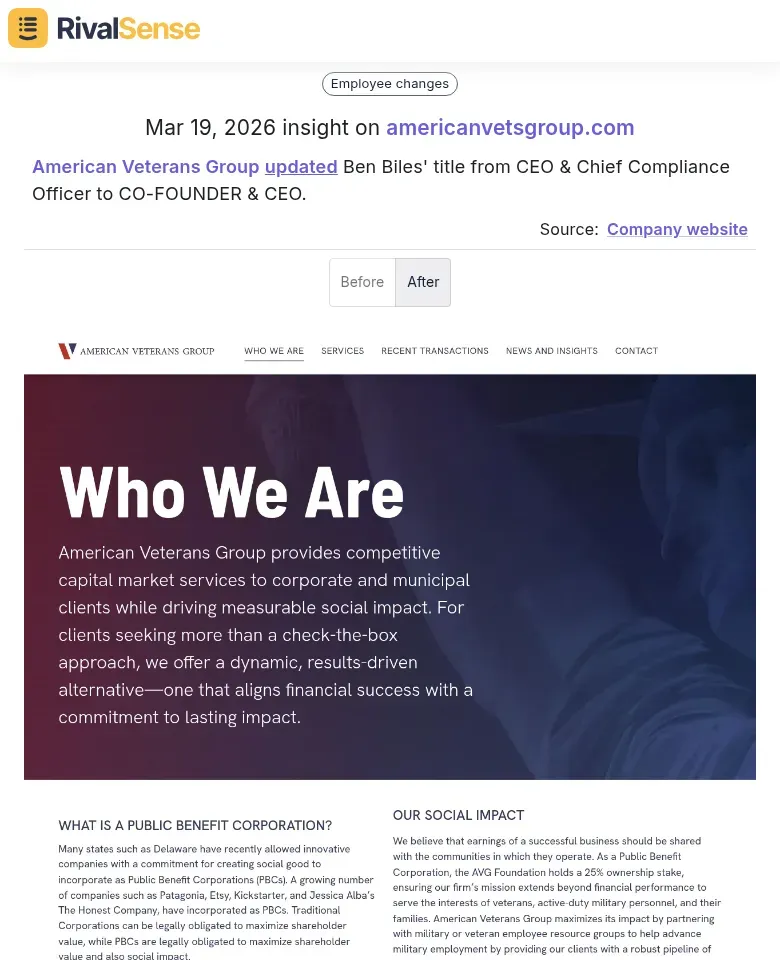
American Veterans Group updated Ben Biles' title from CEO & Chief Compliance Officer to CO-FOUNDER & CEO.
Why it matters: Management title changes can indicate strategic realignments, shifts in compliance focus, or preparation for new initiatives. For marine port services, this could signal changes in partnership dynamics or regulatory approaches from key players in your ecosystem.
Example 2: Product Launches

Lovable launched support for general tasks on March 19, allowing users to upload files and get usable outputs without coding.
Why it matters: New product features from competitors can reveal technological trends and customer demands. In port services, similar innovations might affect operational efficiency or require updates to your service offerings to stay competitive.
Example 3: Event Participations
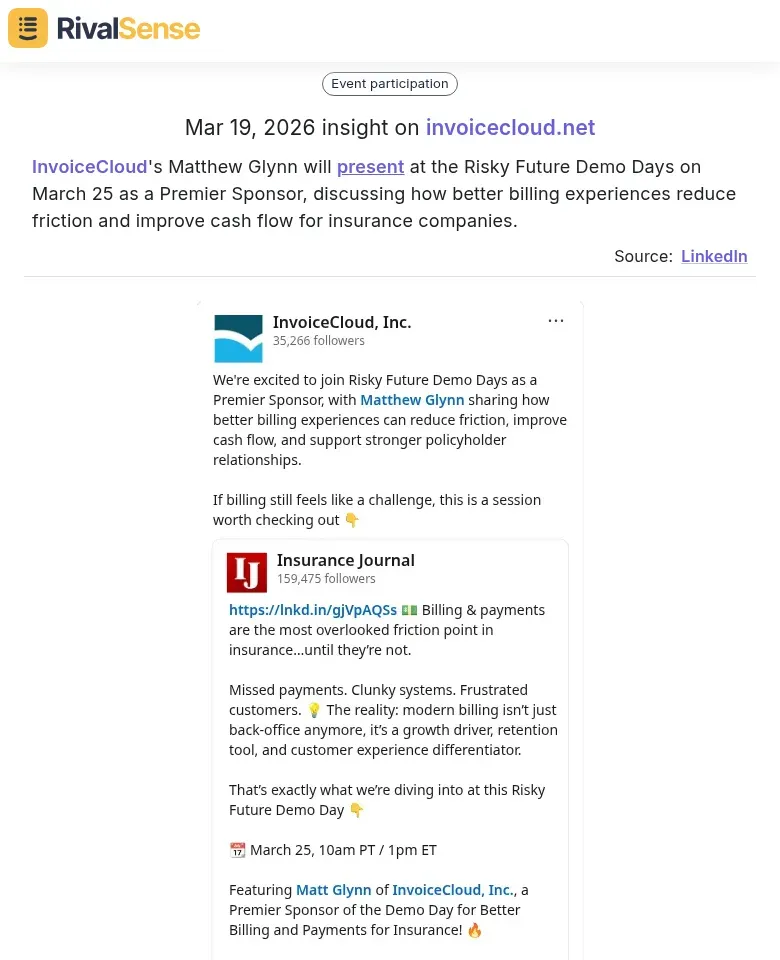
InvoiceCloud's Matthew Glynn will present at the Risky Future Demo Days on March 25 as a Premier Sponsor, discussing how better billing experiences reduce friction and improve cash flow for insurance companies.
Why it matters: Competitor presentations at industry events highlight focus areas and thought leadership. For risk management, this can provide insights into emerging regulatory topics or best practices that you should monitor for your key accounts.
Incorporating these insights helps you stay ahead of risks by understanding the competitive landscape and its implications for your business.
✅ The 2026 Key Account Risk Tracking Checklist Implementation
Implementing the 2026 Key Account Risk Tracking Checklist requires systematic application across the account lifecycle. Start with onboarding: document all contractual obligations, service level agreements (SLAs), and compliance requirements. Use verification checklists for each risk category—operational, financial, regulatory, and strategic—with evidence collection protocols.
During active management, apply monthly operational risk reviews using standardized templates that track port utilization rates, equipment availability, and service delivery metrics. Financial risk assessments should occur quarterly, analyzing payment history, credit exposure, and contract profitability. Regulatory compliance requires bi-annual audits with documented verification of safety protocols, environmental standards, and port authority requirements.
Establish a quarterly review cadence where cross-functional teams (operations, finance, legal) assess checklist effectiveness. Implement continuous improvement by tracking risk mitigation success rates and updating thresholds based on industry benchmarks. Create escalation protocols for high-risk indicators with clear action timelines.
Documentation must include timestamped verification records, risk scoring calculations, and mitigation action logs. Use digital platforms for real-time tracking and automated alerts. Regular stakeholder reviews ensure alignment between risk management and business objectives, with annual checklist refinements based on emerging port industry trends and regulatory changes.
🔄 Strategic Integration and Business Continuity Planning
Integrate risk tracking directly into your quarterly business reviews and account planning cycles. Create a standardized risk dashboard that maps key account vulnerabilities against strategic objectives. For marine port services, this means aligning risk monitoring with critical operational metrics like vessel turnaround times, cargo throughput, and compliance status.
Develop scenario-based contingency plans for high-risk scenarios:
- Port congestion crisis response plan with alternative routing options
- Regulatory compliance breach mitigation protocols
- Critical supplier failure backup strategies
- Geopolitical disruption rerouting procedures
Establish cross-functional risk management teams with representatives from operations, compliance, finance, and client services. Conduct quarterly tabletop exercises simulating port strikes, regulatory changes, or security incidents. Implement a tiered response system where different risk levels trigger specific escalation protocols and predefined mitigation actions.
Practical checklist:
- Map all key account dependencies and single points of failure
- Establish real-time monitoring of port congestion and regulatory changes
- Pre-negotiate contingency agreements with alternative service providers
- Maintain updated contact lists for emergency decision-makers
- Conduct quarterly business continuity plan reviews with key account teams
- Implement automated alerts for risk threshold breaches
- Document lessons learned from actual disruptions to refine future responses
Build organizational resilience by rotating team members through different risk management roles and conducting regular stress tests of your contingency plans. This ensures institutional knowledge isn’t concentrated in single individuals and your organization can maintain service continuity even during personnel changes or unexpected disruptions.
🚀 Take Action with RivalSense
Managing key account risks in marine port services requires constant vigilance and proactive intelligence. By tracking competitors' moves, you can anticipate market shifts and regulatory changes before they impact your business.
Ready to enhance your risk management strategy? Try RivalSense for free and get your first competitor report today. RivalSense tracks competitor product launches, pricing updates, event participations, partnerships, regulatory aspects, management changes, and media mentions across the web, delivering all insights in a weekly email report. Stay ahead of risks and turn competitor intelligence into your strategic advantage.
📚 Read more
👉 How ScraperAPI's New Tech Hire Revealed Competitor Expansion Plans
👉 Twitter Competitor Intelligence Framework: Key Account Health Dashboard Template
👉 How to Build a Key Account Management Playbook for AML Compliance
👉 Regulatory Compliance Checklist: Uncover Competitor Market Positioning Insights
👉 Analyzing Fanatics' Bundesliga Collection Launch: A Competitor Insight