
LinkedIn Competitor Intelligence Workflow: Cost-Effective Key Account Tracking for B2B Leaders
LinkedIn represents an untapped goldmine for tracking competitor key account relationships that most B2B businesses overlook. This platform provides direct visibility into competitor-client interactions through connection patterns, engagement metrics, and organizational changes at minimal cost. While expensive market research tools can cost thousands monthly, LinkedIn offers real-time intelligence that founders and CEOs can leverage for strategic decisions.
Transform passive browsing into a systematic workflow with these steps:
- Identify 3-5 key competitor accounts to monitor based on your target market.
- Set up LinkedIn Sales Navigator alerts for personnel changes and content updates.
- Track engagement patterns on competitor posts from your target accounts.
- Monitor connection growth between competitor teams and your prospects.
Practical tip: Create a weekly 30-minute review schedule to systematically check competitor activity, new hires in key accounts, and relationship developments. This cost-effective approach provides continuous intelligence without the $5,000+ monthly price tag of traditional competitive intelligence platforms.
Workflow Foundation: Setting Up Your LinkedIn Monitoring System
To build an effective LinkedIn competitor intelligence system, start by identifying 3-5 key competitors who consistently target your ideal customer profile. Prioritize those with overlapping target accounts, similar value propositions, or recent market traction to focus your efforts efficiently. Create a dedicated spreadsheet tracking their company pages, key executives, and top-performing content for organized analysis.
Configure LinkedIn alerts strategically: follow competitor company pages and turn on notifications for posts, job changes, and content updates. Set up Google Alerts for competitor mentions and use LinkedIn Sales Navigator's "Lead and Account Alerts" for real-time tracking of key account interactions. Consider using a social listening tool like Hootsuite or Sprout Social for consolidated monitoring across platforms.
Establish baseline metrics by analyzing 3 months of historical data: track engagement rates (likes, comments, shares), posting frequency, content themes, and key account interactions. Create a simple dashboard monitoring:
- Weekly engagement trends
- Key account comment activity
- Content performance by type
- Executive participation rates
Pro tip: Focus on quality over quantity - track 5 competitors thoroughly rather than 15 superficially. Update your baseline quarterly to account for seasonal variations and market shifts, ensuring your insights remain relevant.
Strategic Expansion Signals: Tracking New Business Units and Subsidiaries
Tracking organizational changes reveals competitors' expansion strategies before they impact your market. When rivals form new subsidiaries or business units, they're signaling strategic shifts that could threaten your key accounts. This intelligence is crucial for anticipating competitive moves and adjusting your own business strategy proactively.
For example, RivalSense recently tracked that Iute Group established Iute Affinity, a new insurance solutions subsidiary led by Alma Ribanovic, to embed fully digital insurance into its Myiute ecosystem through partnerships with companies like Allianz Partners.
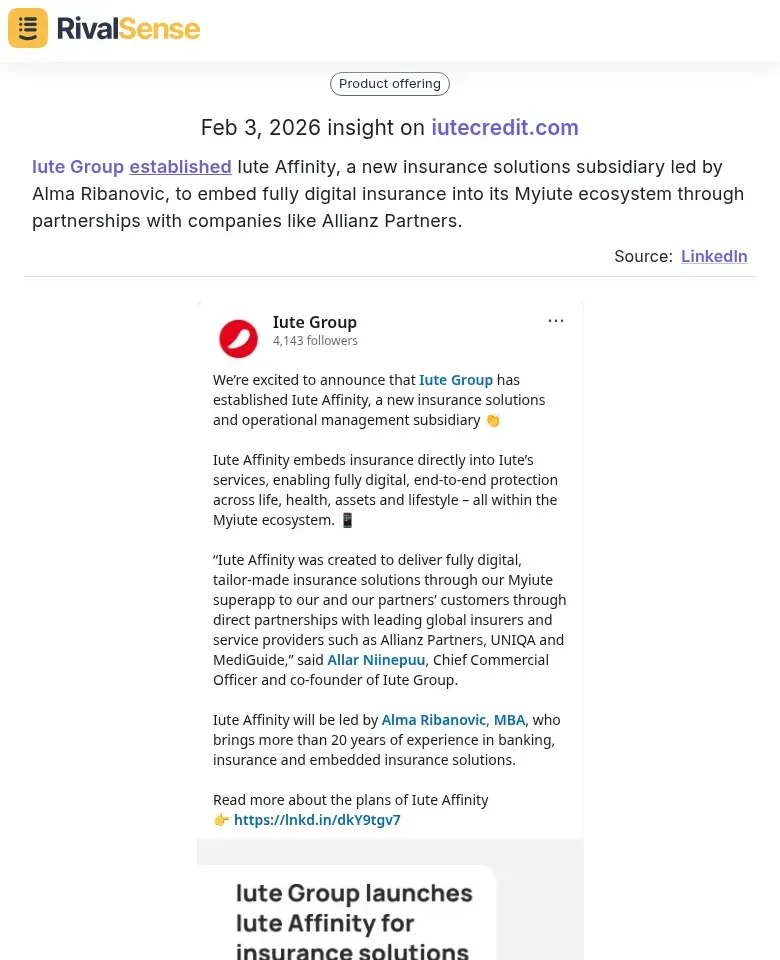
Understanding such expansions is valuable because it shows where competitors are investing resources and which markets they're entering. This allows you to strengthen relationships with affected accounts or develop counter-offers before losing ground.
Practical Monitoring Framework:
- Set Up Alerts: Use LinkedIn Sales Navigator to track leadership changes at target companies. Monitor for new VP/Director roles in unfamiliar departments.
- Analyze Subsidiary Patterns: When competitors create subsidiaries, examine their focus areas. Are they targeting specific industries, technologies, or geographic regions you serve?
- Decode Ecosystem Integration: Track partnerships and integrations announced on LinkedIn. Competitors building ecosystems around their core offerings are preparing for broader market plays.
Actionable Checklist:
- ✅ Weekly review of competitor leadership changes
- ✅ Monthly analysis of new business unit announcements
- ✅ Quarterly assessment of subsidiary formation patterns
- ✅ Immediate investigation of unfamiliar department creations
Key Insight: Subsidiaries often test new markets with lower risk. A competitor's experimental unit today could become your direct threat tomorrow. By tracking these organizational signals, you gain 3-6 month lead time to protect key accounts and anticipate competitive moves.
Technology Adoption Patterns: Decoding Customer Satisfaction Signals
Technology deployment announcements reveal how competitors prioritize customer satisfaction through feature rollouts and regional expansions. Tracking these patterns helps you understand which customer segments receive value first and identify gaps in your own offerings. For instance, when a competitor launches AI analytics for enterprise clients initially, it signals that enterprise satisfaction is a key priority.
RivalSense captured an insight where Kinaxia Logistics Limited now uses Samsara to protect its drivers while improving efficiency through reduced vehicle downtime, real-time updates, and increased visibility.

This type of insight is valuable because it highlights how competitors are leveraging technology to enhance customer experience and operational efficiency. By monitoring such adoptions, you can benchmark your own technology stack and identify opportunities for improvement or differentiation in your B2B strategy.
Practical step: Create a tracking spreadsheet with columns for feature release dates, target segments, and quantitative benefits mentioned. Partnership announcements expose customer support networks that enhance satisfaction. Monitor joint webinars, co-marketing campaigns, and partner advisory councils.
Checklist for technology adoption monitoring:
- Follow key partner company pages on LinkedIn
- Set up alerts for partnership announcements using keywords
- Track partner satisfaction mentions in customer reviews
- Analyze implementation case studies for quantitative metrics
Pro tip: Analyze which customer segments competitors showcase in case studies—are they targeting SMBs with affordability messages or enterprises with security narratives? This reveals satisfaction drivers to address in your own roadmap.
Talent Movement Intelligence: Early Warning Signals from Employee Transitions
Talent movement intelligence provides powerful early warning signals about competitor strategies. Tracking key personnel moves between competitors and their clients can identify relationship shifts and potential business opportunities. When a top executive changes roles, it often indicates strategic priorities or new market focuses that could impact your accounts.
For instance, RivalSense reported that Michael Waddell left Noom as Director, Total Rewards in the United States to join Maven Clinic as Director, People Operations and Total Rewards.
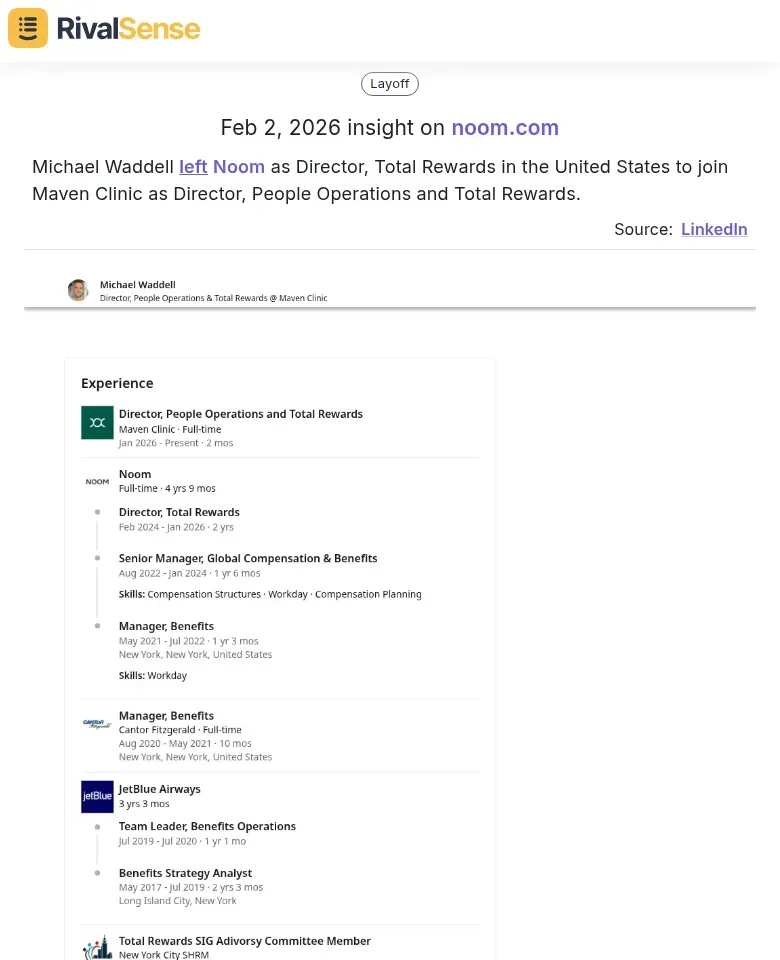
This insight is valuable because employee transitions, especially at the director level, can signal changes in company culture, compensation strategies, or expansion into new areas. By monitoring such moves, you can anticipate competitor initiatives and adjust your talent acquisition or retention strategies accordingly.
Analyze hiring patterns to reveal competitor focus areas. Monitor job postings for emerging roles in AI, cybersecurity, or new geographic markets. A competitor suddenly hiring multiple data scientists likely indicates a product pivot toward AI-driven solutions.
Actionable Checklist for Talent Intelligence:
- Identify 3-5 key competitors and list their top 10 clients.
- Set up Google Alerts for "[Competitor] hires" or "joins [Competitor]".
- Review competitor LinkedIn company pages weekly for employee count changes and new hires.
- Document patterns quarterly to identify strategic trends.
Practical tip: Create a tracking list of 5-10 key roles per competitor and set up LinkedIn alerts for relevant updates. Leadership changes signal strategic shifts; track these transitions monthly to stay ahead.
Actionable Intelligence: Turning LinkedIn Insights into Competitive Advantage
Transforming LinkedIn insights into tangible competitive advantage requires systematic workflows and consistent tracking. By leveraging the data collected, you can make informed decisions that protect your key accounts and seize new opportunities. Start by creating competitive benchmarking dashboards to visualize trends and identify patterns across multiple competitors.
First, develop early warning systems by setting alerts for key account executive departures, new solution-focused hires, partnership announcements, and negative sentiment spikes in comments. These signals indicate account vulnerability or strategic shifts. Implement cost-effective counter-strategies based on intelligence, such as deploying targeted content when competitors focus on specific accounts.
Second, use tools like RivalSense to automate data collection and gain comprehensive insights beyond LinkedIn. For example, monitoring competitor product launches, pricing updates, and media mentions can provide a holistic view of their strategy. This automated approach saves time and ensures you don't miss critical signals.
Pro tip: Start with 3-5 key competitors and 10-15 strategic accounts. Track consistently for 90 days to establish baselines before making strategic decisions. Use LinkedIn's own data—when competitors post about specific industries, respond with your differentiated approach in comments and direct outreach.
Streamline Your Competitor Intelligence with RivalSense
Manually tracking competitors on LinkedIn is effective but time-consuming for busy founders and CEOs. To enhance your workflow with automated insights across company websites, social media, and various registries, consider using a dedicated tool. RivalSense tracks competitor product launches, pricing updates, event participations, partnerships, regulatory aspects, management changes, and media mentions, delivering all in a weekly email report.
Ready to take your competitor intelligence to the next level? Try RivalSense for free at https://rivalsense.co/ and get your first competitor report today! This will help you stay ahead of market shifts and protect your key accounts with minimal effort.
📚 Read more
👉 Solving Visual Collaboration Gaps in Key Account Management Software
👉 Regulatory Competitor Insights: A Checklist for Key Account Growth
👉 Leveraging Personnel Changes for Competitor Analysis: A Real-World Example
👉 Competitor SWOT Analysis: Your Actionable Guide to Strategic Advantage
👉 2026 Trend Analysis: Why Competitor Analysis Drives Digital Marketing Agency Success