
LinkedIn Competitor Insights: Track Key Account Satisfaction with Real-World Examples
LinkedIn has evolved beyond professional networking to become a critical intelligence tool for B2B leaders. By monitoring competitor activity on this platform, you can gain unprecedented insights into key account satisfaction and market dynamics. When competitors announce new customer wins, feature case studies, or showcase testimonials, they reveal which accounts are happy and engaged, providing critical intelligence about where your competitors are succeeding and where your own key accounts might be vulnerable.
Monitoring competitor LinkedIn activity gives you a strategic advantage by revealing patterns in customer engagement. Look for announcements of expanded partnerships, customer success stories, or joint webinars—these indicate strong, satisfied relationships. Track which accounts consistently engage with competitor content through likes, comments, and shares.
Practical steps to get started:
- Identify 3-5 key competitors and follow their company pages on LinkedIn.
- Set up alerts for customer win announcements and case studies using LinkedIn notifications or third-party tools.
- Monitor engagement patterns on competitor posts from key accounts to gauge satisfaction levels.
- Note which accounts appear in multiple competitor success stories, indicating high satisfaction or vulnerability.
Real-world example: When a competitor announces a major expansion with a Fortune 500 client, it signals deep satisfaction and potential long-term lock-in. This insight helps you proactively address similar accounts in your portfolio before they consider switching.
Product Launch Intelligence: Decoding Customer Adoption Signals
When competitors launch new products on LinkedIn, they reveal crucial signals about customer satisfaction and adoption patterns. These announcements often include testimonials, case studies, or metrics that highlight why customers are adopting their solutions. By analyzing these signals, you can identify emerging trends and unmet needs in your market.
Track their announcement strategies: Do they emphasize customer testimonials, case studies, or ROI metrics? For example, if a competitor highlights "50 enterprise customers already onboarded" in their launch, it signals strong pre-launch validation and satisfaction drivers like integration ease or cost savings.
Monitor executive interviews on LinkedIn and industry podcasts. Executives often share unscripted insights about customer pain points. When a competitor's CTO mentions "customers demanded AI features," note this as a key satisfaction driver to address in your own roadmap.
Conference announcements reveal targeting strategies. Analyze which customer segments competitors showcase—are they targeting SMBs with affordability messages or enterprises with security narratives? For instance, RivalSense tracked that Wialon introduced its new product, Wialon Platform, at the Telematics & Connected Mobility conference in September, as detailed in an interview with Head of Product Aliaksandra Hancharova and Head of Wialon Platform Core Aleksey Shmigelski. This type of insight is valuable because it shows how competitors leverage industry events to launch products and engage with early adopters, signaling customer validation and strategic focus. 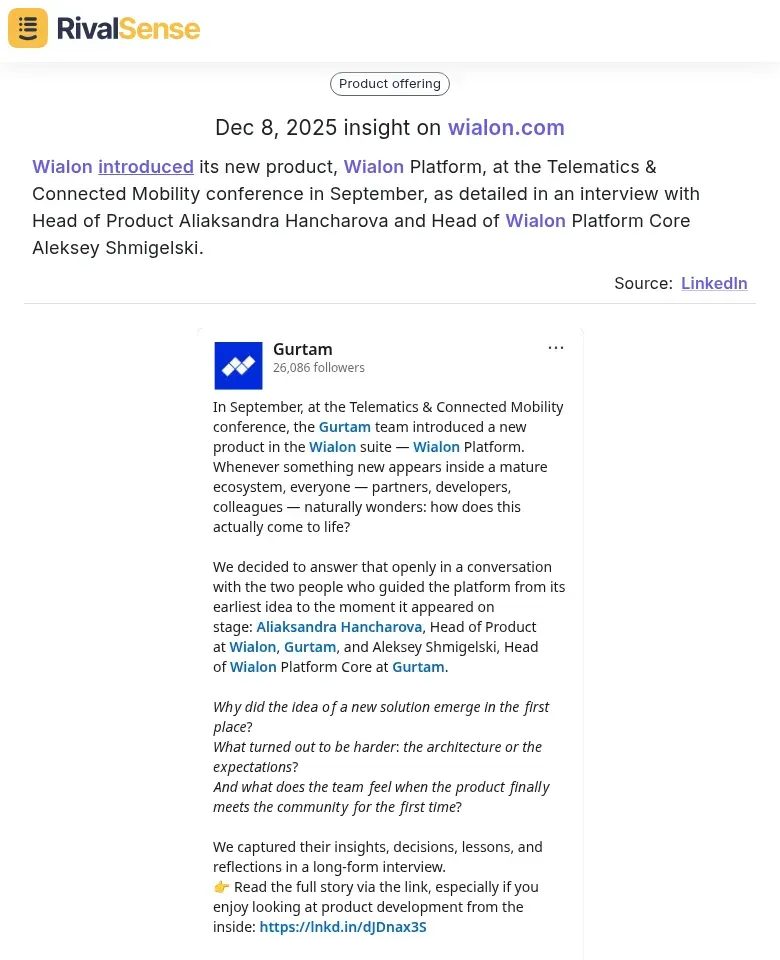
Create a tracking checklist:
- [ ] Capture launch messaging themes (e.g., "time-saving," "compliance")
- [ ] Document quoted customer segments and use cases
- [ ] Note executive interview keywords (e.g., "frustration," "delighted")
- [ ] Track conference session topics for unmet needs
Practical tip: Use LinkedIn's event pages and speaker lists to identify which competitors are presenting where—this indicates where they're investing in customer education and relationship-building.
Technology Deployment Patterns: Understanding Customer Value Delivery
Technology deployment patterns on LinkedIn reveal how competitors prioritize customer satisfaction through feature rollouts and regional expansions. By tracking these patterns, you can understand which customer segments receive value first and how competitors adapt to market demands.
These insights help you anticipate shifts in competitor focus and identify opportunities to enhance your own offerings. For example, RivalSense captured that Tesla's Nantes director Raphaël DUBOIS announced that passenger trials of Full Self-Driving (Supervised) are available in Nantes, using vision and neural networks trained on billions of kilometers of real-world data from over 6 million Tesla vehicles. This insight is crucial because it demonstrates how competitors pilot new technologies in targeted markets to gauge customer satisfaction and refine offerings, highlighting regional adoption signals. 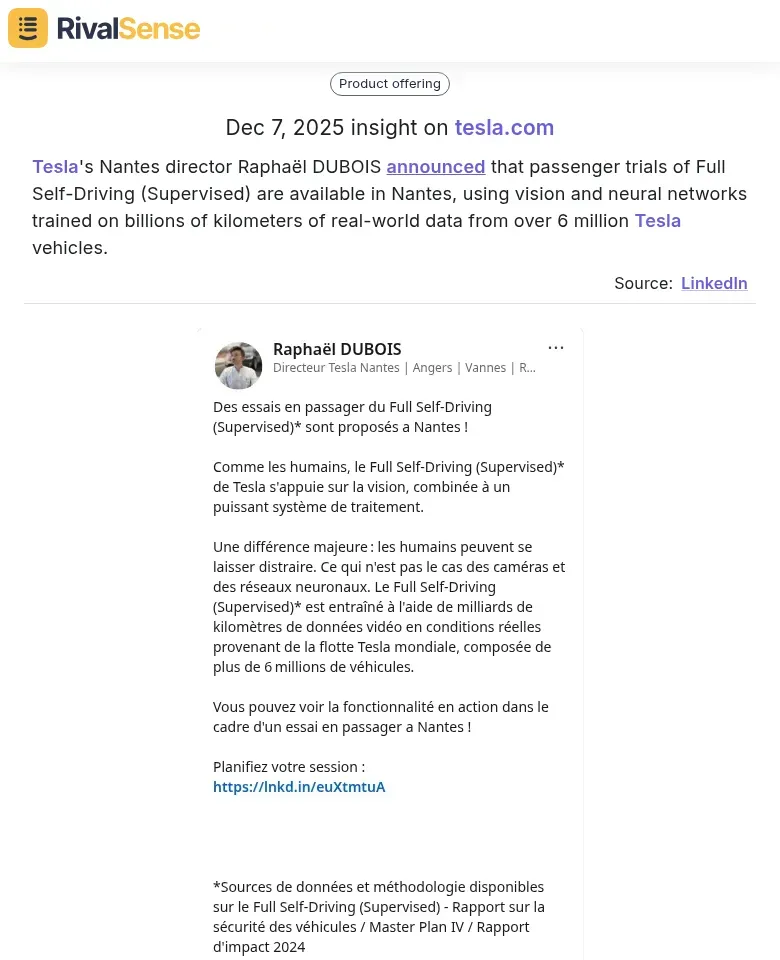
Practical Steps:
- Monitor feature announcements - Note which features get priority and which customer segments are mentioned. Example: If a competitor launches AI analytics for enterprise clients first, they're signaling enterprise satisfaction as a priority.
- Analyze data-driven case studies - Look for metrics like "30% faster onboarding" or "40% cost reduction" in announcements. These quantify value propositions for specific customer segments.
- Map geographic expansion - Track where competitors open new offices or hire regionally. Example: Expanding into Southeast Asia might indicate satisfied APAC customers driving growth.
Checklist for Tracking Technology Deployment:
- [ ] Document feature release dates and target segments
- [ ] Record quantitative benefits mentioned in announcements
- [ ] Note new office locations and hiring patterns
- [ ] Compare deployment speed across customer tiers
Key Insight: Early adopters of new features often represent a competitor's most satisfied customer base. By reverse-engineering their deployment logic, you can identify underserved segments in your own market.
Partner Ecosystem Engagement: Measuring Customer Support Networks
Partner ecosystem engagement on LinkedIn reveals critical customer support satisfaction signals through collaborations and community events. When competitors highlight partnerships or host joint activities, it indicates robust networks that enhance customer experience and loyalty.
Tracking these engagements helps you assess how competitors build trust and support their key accounts. For example, RivalSense observed that Grab held the Grab Dax Fair 2025 in early December, offering free haircuts, vehicle cleaning, and maintenance to its tuktuk and delivery partners, with support from partners like Bajaj Auto Ltd and government agencies. This insight demonstrates the value of monitoring partner ecosystems to understand how competitors strengthen customer relationships through support networks and community-building initiatives. 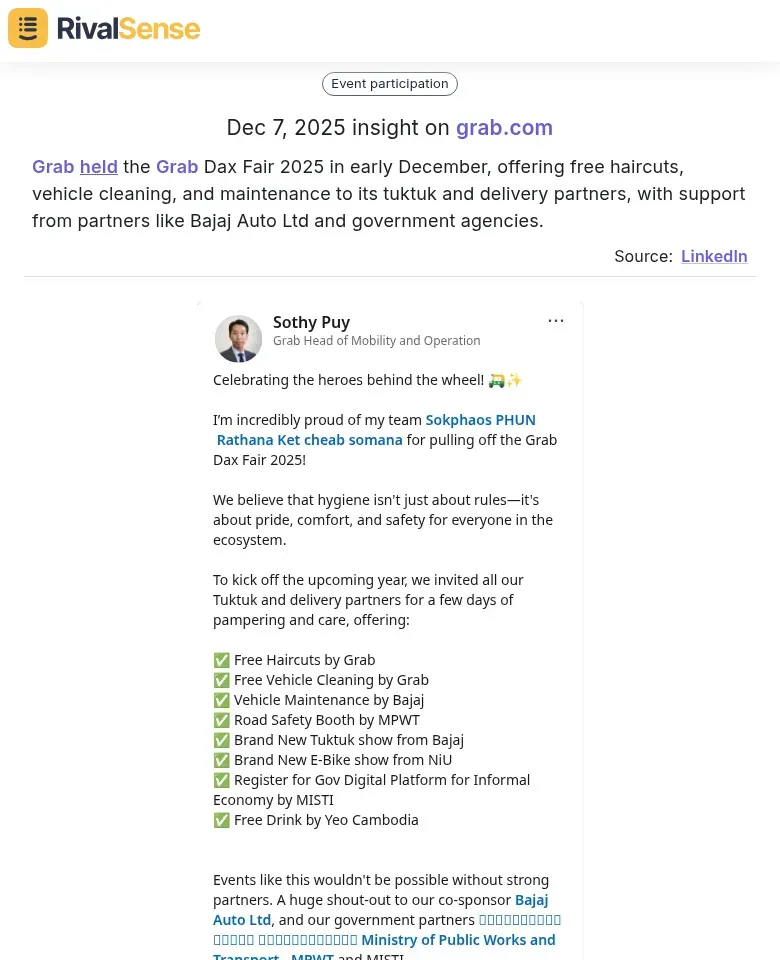
Analyze community-building initiatives as loyalty indicators. Track competitors' user group meetings, partner advisory councils, and co-marketing campaigns. When competitors establish formal partner communities with regular engagement, it suggests strong customer relationships and satisfaction.
Practical tip: Create a tracking spreadsheet with columns for partner event frequency, participation levels, and customer testimonials shared.
Monitor government and industry partnerships for trust signals. When competitors secure partnerships with regulatory bodies or industry associations, it validates their reliability and customer support quality.
Checklist for Partner Ecosystem Tracking:
- Follow key partner company pages on LinkedIn to stay updated on collaborations.
- Set up alerts for partnership announcements using keywords and hashtags.
- Track partner satisfaction mentions in customer reviews and comments.
- Monitor partner retention rates through employee movement patterns on LinkedIn.
These signals collectively reveal how effectively competitors leverage ecosystems to drive customer satisfaction.
Competitive Benchmarking Framework: Turning Insights into Action
To turn LinkedIn competitor insights into actionable intelligence, implement this three-part competitive benchmarking framework. This approach helps you systematically analyze data and make informed decisions to protect and grow your key accounts.
By consistently tracking and benchmarking, you can identify trends, vulnerabilities, and opportunities in your market. Start with a focused set of competitors and expand as you refine your process.
-
Develop Satisfaction Metrics: Track 5 key indicators: (1) Client testimonials & recommendations per account, (2) Employee-client connection growth on LinkedIn, (3) Case study publication frequency, (4) Engagement rates on client-focused content, and (5) Employee turnover in client-facing roles. Example: Monitor when competitors' key accounts publicly endorse new features or expand partnerships.
-
Create Smart Alerts: Set up notifications for:
- ✅ New client announcements or renewals
- ✅ Leadership changes in competitor's key accounts
- ✅ Negative sentiment in comments on client posts
- ✅ Sudden increase in competitor employees connecting with your target accounts
Tip: Use Boolean searches on LinkedIn like "[Competitor] AND [Client] AND (partner OR case study OR success)"
-
Build Intelligence Dashboards: Consolidate data into a visual dashboard with:
- Account health scores (0-100 scale)
- Relationship timeline visualization
- Sentiment analysis of public interactions
- Competitive positioning heatmaps
Checklist for Dashboard Management:
- [ ] Update weekly to ensure data freshness
- [ ] Flag anomalies with >20% change for immediate review
- [ ] Share insights with sales teams before quarterly planning sessions
Practical step: Start with 3-5 competitor accounts you're actively competing for, track their LinkedIn activity for 30 days to establish baselines, then expand monitoring scope.
Strategic Implementation: Protecting and Growing Your Key Accounts
When competitors show strong satisfaction signals from your key accounts on LinkedIn, it's essential to develop proactive counter-strategies. This involves analyzing competitor strengths, identifying risks, and taking action to reinforce your value propositions before accounts defect.
By implementing an early warning system and assigning dedicated resources, you can stay ahead of potential threats. First, analyze what competitors are doing right: Are they offering better pricing, superior features, or more responsive support?
Create a competitive response checklist:
- Match their strengths where feasible, such as improving support response times or adding requested features.
- Differentiate on your unique value propositions, like proprietary technology or industry expertise.
- Schedule proactive check-ins with at-risk accounts to address concerns before they escalate.
- Develop retention offers tailored to specific competitor threats, such as discounts or enhanced service packages.
Establish an early warning system by monitoring LinkedIn for these red flags:
- 🔴 Key decision-makers connecting with competitor employees
- 🔴 Increased engagement with competitor content from your accounts
- 🔴 Positive mentions of competitor solutions in industry groups
- 🔴 Job postings indicating technology stack changes that align with competitor offerings
Set up alerts for these signals and create a response protocol. For example, if a key account starts liking competitor posts, trigger a review by your account team.
Practical tip: Assign 'account defenders' to monitor 3-5 key accounts each, reviewing competitor interactions weekly. Use this intelligence to craft personalized value reinforcement messages before dissatisfaction escalates to defection.
Leverage Automated Tools for Comprehensive Competitor Tracking
Manually tracking competitor activity on LinkedIn can be time-consuming and may miss critical insights. Automated tools like RivalSense can streamline this process by monitoring competitor product launches, pricing updates, event participations, partnerships, regulatory aspects, management changes, and media mentions across company websites, social media, and various registries.
By subscribing to such services, you receive weekly email reports that consolidate all relevant competitor intelligence, allowing you to focus on strategic decision-making. For instance, the RivalSense insights shared in this post—covering product launches, technology deployments, and partner events—demonstrate how automated tracking can uncover valuable patterns that inform your business strategy.
Ready to streamline your competitor tracking? Try RivalSense for free at https://rivalsense.co/ to get automated insights delivered weekly. Get your first competitor report today and stay ahead in the game!
📚 Read more
👉 Predictive Workforce Analytics: How to Forecast Key Account Feedback Trends for B2B Success
👉 From Headlines to Strategy: How to Decode Competitor Moves Through Media Mentions
👉 DHL's Tesla Semi Trial: A Competitor Analysis Case Study
👉 How a Key Account Tracking API Works to Monitor Your Most Important Competitors
👉 Advanced Tactics: Monitor Fintech Competitor Product Launches for B2B Payments