
Key Account Tracking for Mobile Apps: A Strategic Guide to Monitoring Competitors
In today's hyper-competitive mobile app landscape, tracking your key competitors isn't just a nice-to-have—it's a strategic imperative. 🎯 Consider the case of DigiKhata, a popular expense tracking app with 5M+ downloads and 185K reviews, which faces critical issues like data sync problems and poor support revealed in recent app store reviews. These vulnerabilities represent opportunities for competitors to exploit, highlighting why systematic monitoring is essential.
Key account tracking for mobile apps goes beyond basic competitor monitoring. It's about systematically tracking your most important competitors—those 3-5 apps that directly compete for your target users, have similar feature sets, or are gaining market share. By understanding their every move, you can anticipate market shifts, identify opportunities, and avoid costly mistakes.
What is Key Account Tracking for Mobile Apps?
Key account tracking is the systematic process of monitoring your most important competitors across multiple dimensions. This approach provides deep, continuous insights that drive strategic decisions rather than superficial glances. For mobile apps, this means focusing on competitors that directly impact your market position and user acquisition.
Here are the key dimensions to track:
- Product & Feature Updates - New launches, feature enhancements, UI/UX changes
- Pricing & Monetization - Subscription changes, pricing tiers, in-app purchase strategies
- Marketing & Promotion - App store optimization (ASO) changes, advertising campaigns, partnerships
- User Feedback & Sentiment - App store reviews, ratings trends, customer complaints
- Business Developments - Funding rounds, executive changes, regulatory compliance
Unlike traditional competitor analysis that might look at dozens of apps superficially, key account tracking focuses on deep, continuous monitoring of your most strategically important competitors.
The 5-Step Framework for Effective Key Account Tracking
Step 1: Identify Your Key Competitors
Start by creating a competitor matrix to categorize your rivals effectively. This helps prioritize your tracking efforts and ensures you're not missing emerging threats. Focus on apps that directly challenge your market share or could disrupt your niche.
Categorize competitors into three groups:
- Direct Competitors: Apps with similar features targeting the same audience (e.g., for expense tracking apps: QuickBooks, FreshBooks, Wave)
- Indirect Competitors: Apps solving similar problems with different approaches (e.g., spreadsheet apps, banking apps with expense tracking features)
- Emerging Threats: New apps gaining traction or potential disruptors
Practical Checklist: ✅
- [ ] List 3-5 direct competitors
- [ ] Identify 2-3 indirect competitors
- [ ] Monitor app store rankings in your category
- [ ] Track "Similar Apps" sections on app stores
- [ ] Use keyword research tools to find competing apps
Step 2: Define Your Tracking Priorities
Not all competitor information is equally valuable, so focus on what matters most for your strategy. This ensures you allocate resources efficiently and avoid data overload. Tailor your tracking to different team needs for maximum impact.
For Product Teams:
- New feature launches
- UI/UX improvements
- Performance updates
- Bug fixes and patches
For Marketing Teams:
- ASO strategy changes
- Pricing updates
- Promotional campaigns
- Partnership announcements
For Business Strategy:
- Funding rounds
- Executive changes
- Regulatory compliance
- Market expansion
Tip: Create a weighted scoring system for different types of competitor movements based on their strategic importance to your business. 🏆
Step 3: Set Up Your Monitoring System
Manual tracking is time-consuming and unreliable, so automation is key to staying ahead. By leveraging tools, you can capture real-time data without manual effort. This step transforms tracking from a chore into a seamless process.
Essential Monitoring Tools:
- ASO Tools - Track competitor keyword rankings, metadata changes, and app store creatives
- Review Monitoring - Monitor app store reviews and ratings trends
- Social Listening - Track competitor social media activity and announcements
- Website Monitoring - Detect changes to competitor websites and pricing pages
- Comprehensive Tracking Solutions - Platforms that aggregate data from 80+ sources
Practical Advice: Consider using a solution like RivalSense that tracks competitor movements across 80+ sources including company websites, social media, regulatory databases, and news outlets, delivering consolidated weekly reports. This approach ensures you never miss critical competitor moves while saving hours of manual research.
Step 4: Analyze and Interpret the Data
Raw data is useless without analysis, so turn competitor intelligence into actionable insights. Look for patterns and gaps that inform your strategy. This step is where data transforms into strategic advantage.
Pattern Recognition:
- Are competitors consistently launching updates on specific days?
- Do they follow seasonal promotion patterns?
- What types of features generate positive vs. negative reviews?
Gap Analysis:
- What user needs are competitors failing to address?
- Where are competitors over-serving or under-serving the market?
- What pricing gaps exist in the market?
Strategic Implications:
- How should we respond to competitor pricing changes?
- What features should we prioritize based on competitor weaknesses?
- Where should we focus our marketing efforts?
Step 5: Implement and Iterate
Competitor intelligence should directly inform your strategy through regular reviews and adjustments. This ensures you're responsive to market changes and proactive in your approach. Make it a habit to translate insights into action.
Weekly Review Process:
- Review latest competitor movements
- Assess strategic implications
- Decide on response actions
- Update product roadmap
- Adjust marketing strategy
Monthly Strategic Assessment:
- Analyze competitor trends over time
- Update competitor threat assessment
- Re-evaluate market positioning
- Adjust long-term strategy
Real-World Examples: Learning from Competitor Moves
Case Study: DigiKhata's Missed Opportunities
Looking at DigiKhata's recent app store reviews reveals several strategic vulnerabilities that competing apps could exploit. These insights highlight how tracking user feedback can uncover opportunities for differentiation and improvement.
Data Sync Issues: Multiple users report that "data doesn't sync across multiple devices—each device shows a different balance." This represents a clear opportunity for competitors to differentiate with reliable multi-device sync.
Transaction Errors: Users complain that "debit entries sometimes appear as credit and credit as debit." Competitors could highlight their accurate transaction tracking as a key differentiator.
Poor Support: Numerous reviews mention unresponsive customer support. This creates an opening for competitors to win users by offering superior customer service.
Practical Insight: By systematically tracking these competitor weaknesses, you can position your app to address these pain points directly in your marketing and product development.
Case Study: Zoom's Strategic Positioning
Recent monitoring reveals that Zoom has expanded its government platform offerings to include Zoom for Defense and updated compliance certifications. For competing video conferencing apps, this signals strategic shifts that require attention and response.
Key Takeaways:
- Zoom is targeting high-compliance industries
- Security certifications are becoming a competitive differentiator
- Government and enterprise markets are strategic priorities
Actionable Takeaway: Competitors might need to accelerate their own security certifications or differentiate in other areas like user experience or pricing.
RivalSense Insights: Real-World Examples of Competitor Tracking
Here are actual insights from RivalSense that demonstrate the value of key account tracking for business strategy. Each example shows how monitoring specific competitor moves can inform your decisions and keep you ahead.
Product Launch & Event Tracking: Archer Integrated Risk Management
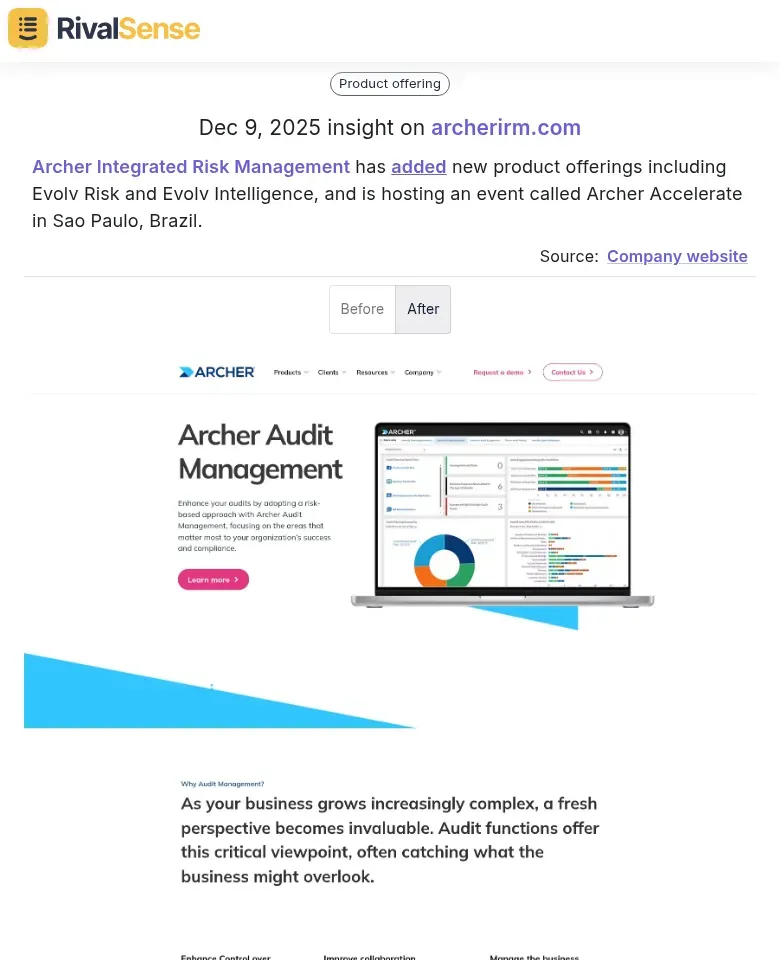
Archer Integrated Risk Management has added new product offerings including Evolv Risk and Evolv Intelligence, and is hosting an event called Archer Accelerate in Sao Paulo, Brazil. 📈 Tracking such product launches and events helps you understand competitor innovation and market expansion strategies, allowing you to anticipate their next moves and identify potential partnership opportunities.
Feature Update: Isometric's Certify Tool
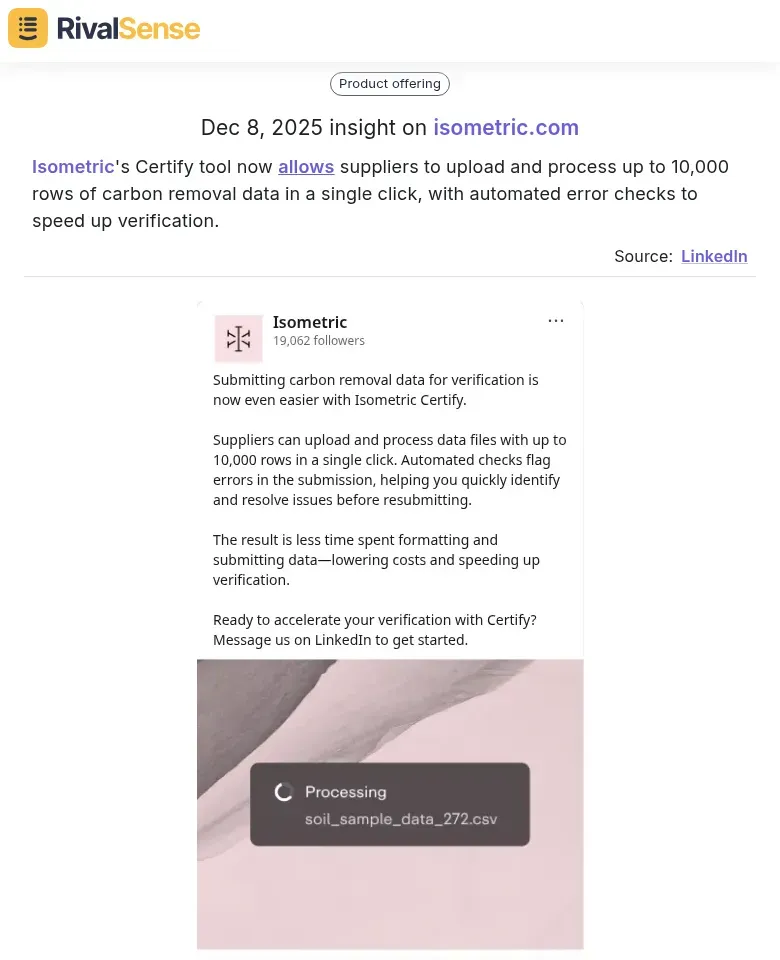
Isometric's Certify tool now allows suppliers to upload and process up to 10,000 rows of carbon removal data in a single click, with automated error checks to speed up verification. 🔧 Monitoring feature updates like this reveals competitor priorities and technological advancements, enabling you to benchmark your own features and spot gaps in your offering.
Pricing Strategy Change: Soundtrack
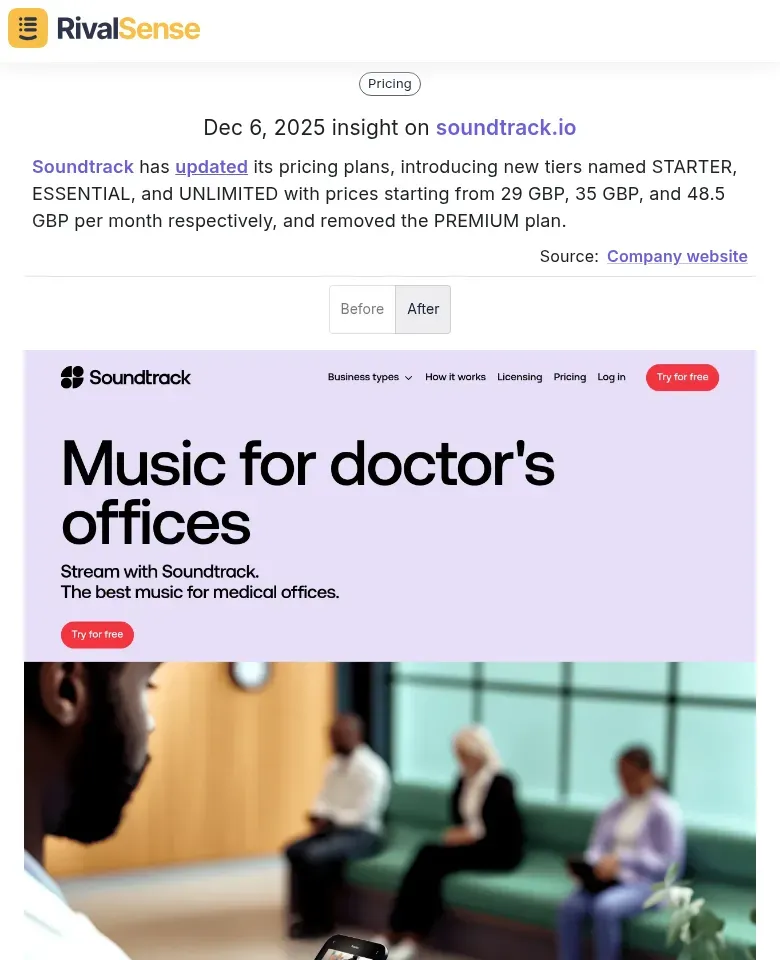
Soundtrack has updated its pricing plans, introducing new tiers named STARTER, ESSENTIAL, and UNLIMITED with prices starting from 29 GBP, 35 GBP, and 48.5 GBP per month respectively, and removed the PREMIUM plan. 💰 Keeping an eye on pricing changes is crucial for adjusting your monetization strategy, understanding market positioning, and responding to competitive pressures effectively.
Advanced Tracking Strategies
1. API-Based Automation
For businesses serious about competitor tracking, API integration provides the most efficient approach. It enables seamless data flow into your systems for real-time insights. Start with simple integrations before scaling to complex workflows.
A Key Account Tracking API allows you to:
- Automatically pull competitor data into your systems
- Set up real-time alerts for critical movements
- Integrate competitor intelligence with your CRM and BI tools
- Create custom dashboards and reports
Implementation Tip: Start with a simple integration—perhaps just pulling data into a spreadsheet or dedicated dashboard—before building complex automated workflows. 🔄
2. Sentiment Analysis
Go beyond star ratings to understand user sentiment deeply. This reveals emotional triggers and specific pain points that drive user behavior. Sentiment analysis transforms reviews into actionable product insights.
Key aspects to analyze:
- What specific features do users love?
- What pain points are most frequently mentioned?
- How does sentiment change after updates?
- What emotional triggers drive positive vs. negative reviews?
3. Competitive Benchmarking
Create regular benchmarks across key metrics to measure your performance against competitors. This provides a clear picture of where you stand and where to improve. Consistent benchmarking drives continuous optimization.
Benchmark these metrics regularly:
- App store rankings
- Download velocity
- Rating trends
- Review volume
- Update frequency
- Feature completeness
Common Pitfalls to Avoid
Avoid these common mistakes to ensure your tracking efforts yield real results. Pitfalls can undermine your strategy and waste resources, so proactive prevention is key. Stay focused and adaptive to maximize value.
1. Analysis Paralysis
Don't get overwhelmed by data. Focus on the 20% of competitor movements that have 80% of the strategic impact. Prioritize insights that directly influence your decisions.
2. Copycat Syndrome
Blindly copying competitors rarely works. Understand why their strategies succeed or fail, then adapt them to your unique context. Innovation beats imitation in the long run.
3. Ignoring Indirect Competitors
Sometimes the biggest threats come from unexpected directions. Keep an eye on adjacent markets and potential disruptors. Expand your monitoring scope to avoid surprises.
4. Infrequent Updates
The mobile app market moves quickly. Weekly monitoring is essential; monthly is the absolute minimum. Regular updates ensure you're always in the loop.
The RivalSense Advantage: Comprehensive Tracking Made Simple
While there are many tools for tracking specific aspects of competitor activity, comprehensive tracking requires monitoring 80+ sources. RivalSense aggregates data from all these sources, delivering actionable intelligence without manual hassle. This gives you a holistic view of the competitive landscape.
Platforms like RivalSense solve this challenge by aggregating data from all these sources and delivering actionable intelligence in weekly email reports. This approach ensures you get:
- Comprehensive Coverage: No blind spots from relying on single sources
- Time Savings: Automated tracking replaces hours of manual research
- Actionable Insights: Curated reports highlight the most important movements
- Strategic Advantage: Proactive intelligence rather than reactive responses
Implementation Checklist
Use this checklist to roll out your key account tracking system step by step. It breaks down the process into manageable phases, ensuring nothing is overlooked. Track your progress to stay on course.
Week 1-2: Foundation 🏗️
- [ ] Identify 3-5 key competitors
- [ ] Define tracking priorities
- [ ] Set up basic monitoring tools
- [ ] Create competitor profiles
Week 3-4: System Setup ⚙️
- [ ] Implement automated tracking
- [ ] Set up alert systems
- [ ] Create reporting templates
- [ ] Establish review processes
Month 2: Optimization 🔧
- [ ] Refine tracking priorities
- [ ] Integrate with existing systems
- [ ] Train team members
- [ ] Establish response protocols
Ongoing: Continuous Improvement 📈
- [ ] Weekly competitor reviews
- [ ] Monthly strategic assessments
- [ ] Quarterly system evaluations
- [ ] Annual competitor landscape analysis
Conclusion: Turning Competitor Intelligence into Competitive Advantage
Effective key account tracking transforms competitor monitoring from a reactive chore into a strategic advantage. By systematically tracking your most important competitors, you can anticipate shifts and make informed decisions that drive growth. This proactive approach is what separates leading apps from the rest.
Here's what you can achieve:
- Anticipate market shifts before they happen
- Identify opportunities your competitors are missing
- Avoid costly mistakes by learning from their failures
- Make data-driven strategic decisions
- Stay ahead in the rapidly evolving mobile app market
Remember: In the mobile app world, standing still means falling behind. The apps that consistently win are those that understand their competitors better than their competitors understand them. By implementing a systematic key account tracking strategy, you position your app not just to compete, but to lead.
Next Steps: Start today by identifying your 3 most important competitors and setting up basic tracking for their app store listings and social media activity. Within a month, you'll have valuable insights; within a quarter, you'll have a competitive intelligence system that drives strategic decisions.
Want to automate your competitor tracking? RivalSense tracks competitor movements across 80+ sources and delivers actionable intelligence in weekly email reports, helping you stay ahead without the manual work. Try it free today at https://rivalsense.co/ to get your first competitor report and start turning insights into advantage.
📚 Read more
👉 Aviation Fuel Construction CRM Mistakes: Avoiding Key Account Tracking Pitfalls
👉 How Wialon's Platform Launch Enabled Competitors to Accelerate Innovation
👉 LinkedIn Competitor Insights: Track Key Account Satisfaction with Real-World Examples
👉 Predictive Workforce Analytics: How to Forecast Key Account Feedback Trends for B2B Success
👉 From Headlines to Strategy: How to Decode Competitor Moves Through Media Mentions