
Key Account Planning Framework for Tech & Proxy Industry Leaders
In the fast-paced tech and proxy industries, where market dynamics shift rapidly and competitive pressures intensify daily, key account planning isn't just a sales tactic—it's a strategic imperative for survival and growth. The 80/20 rule applies with particular force here: approximately 80% of your revenue likely comes from just 20% of your accounts. These strategic relationships drive not only immediate revenue but also provide competitive intelligence, market validation, and partnership opportunities that fuel sustainable growth.
Competitor insights reveal a critical truth: while your rivals are implementing structured account planning frameworks, many tech companies operate reactively, missing opportunities to deepen relationships and defend against competitive threats. A recent analysis shows companies with formal key account planning processes achieve 15-25% higher revenue retention from strategic accounts compared to those without structured approaches.
Practical starting point: Begin with a simple 3-step framework:
- ✅ Identify your top 20% revenue-generating accounts.
- ✅ Map their strategic objectives against your capabilities.
- ✅ Create quarterly relationship development plans with specific value-add initiatives.
This structured approach transforms account management from transactional interactions to strategic partnerships that drive mutual growth and create formidable competitive moats in dynamic tech markets.
Competitor Intelligence: Learning from Market Moves to Inform Your Account Strategy
Competitor intelligence transforms market moves into actionable account strategy insights. By systematically analyzing competitor behavior, you can anticipate customer needs and identify strategic opportunities before they become mainstream trends. The key is to move beyond ad-hoc monitoring to a structured, integrated process.
Analyze Product Expansion Patterns: When competitors launch new products or features, they're signaling emerging customer pain points or market opportunities. Tracking these patterns helps you understand evolving requirements and adjust your own value proposition.
Example: Our competitor tracking at RivalSense recently captured that IPRoyal launched Web Unblocker, a tool that integrates as a proxy server to handle anti-bot systems and dynamic page loading for web scraping.
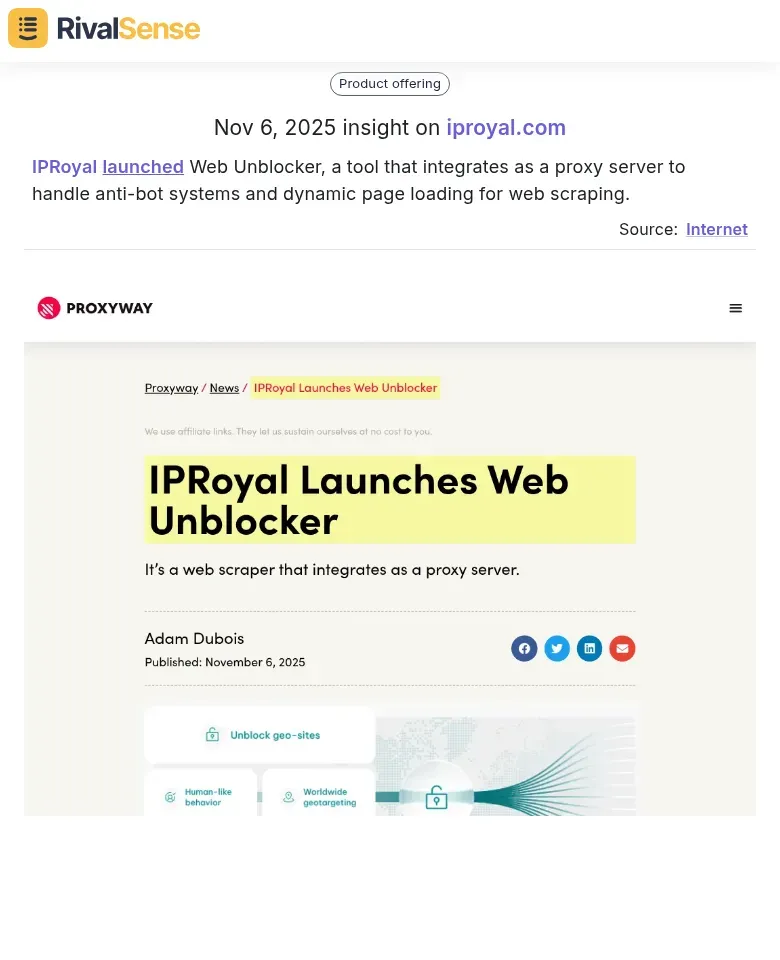
Why it's valuable: Monitoring product launches provides early signals of market demand shifts, allowing you to proactively address similar needs within your key accounts or adjust your product roadmap.
Monitor Geographic Expansion: Competitor moves into new regions often reveal untapped market potential or evolving client requirements in those areas. These expansions can be a leading indicator of localized demand.
Example: We observed that IPRoyal added Moldova to its ISP Proxy pool in early November.
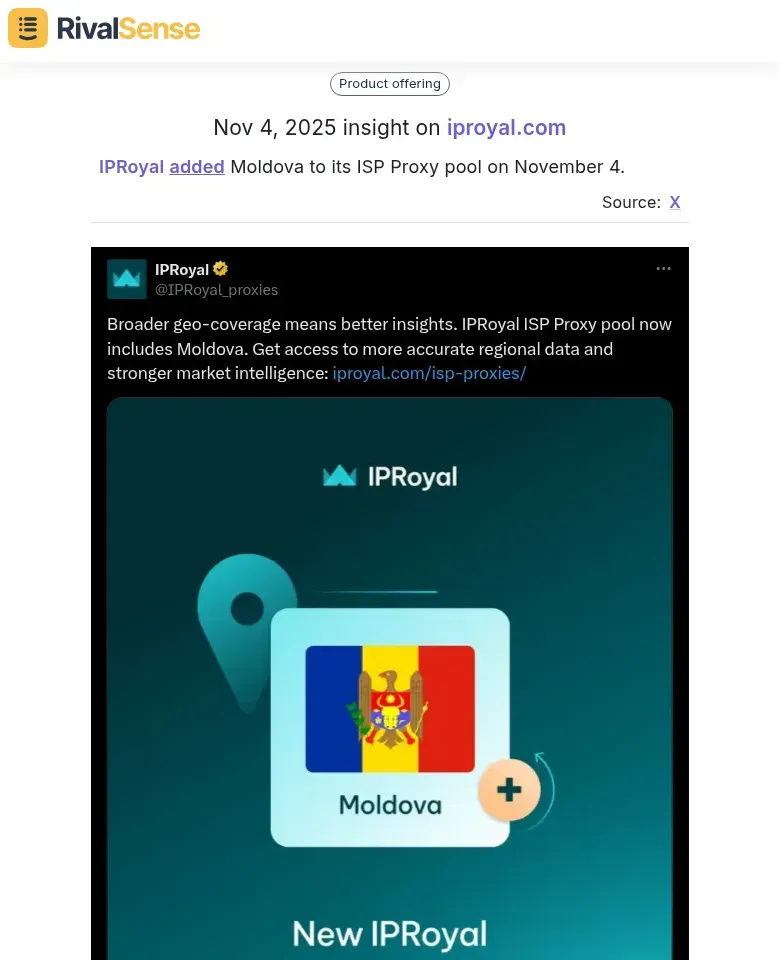
Why it's valuable: Geographic expansion insights help you identify new market opportunities for your own services and anticipate where competitors might focus their sales efforts, enabling you to strengthen your defenses in key accounts.
Track Organizational Growth Signals: Key hires, especially at the executive level, provide clear indicators of a competitor's strategic priorities, scaling plans, and capability investments.
Example: Our tracking showed IPRoyal is hiring a Chief Operating Officer in Lithuania to lead cross-functional operations and scale the company's internal systems and processes.
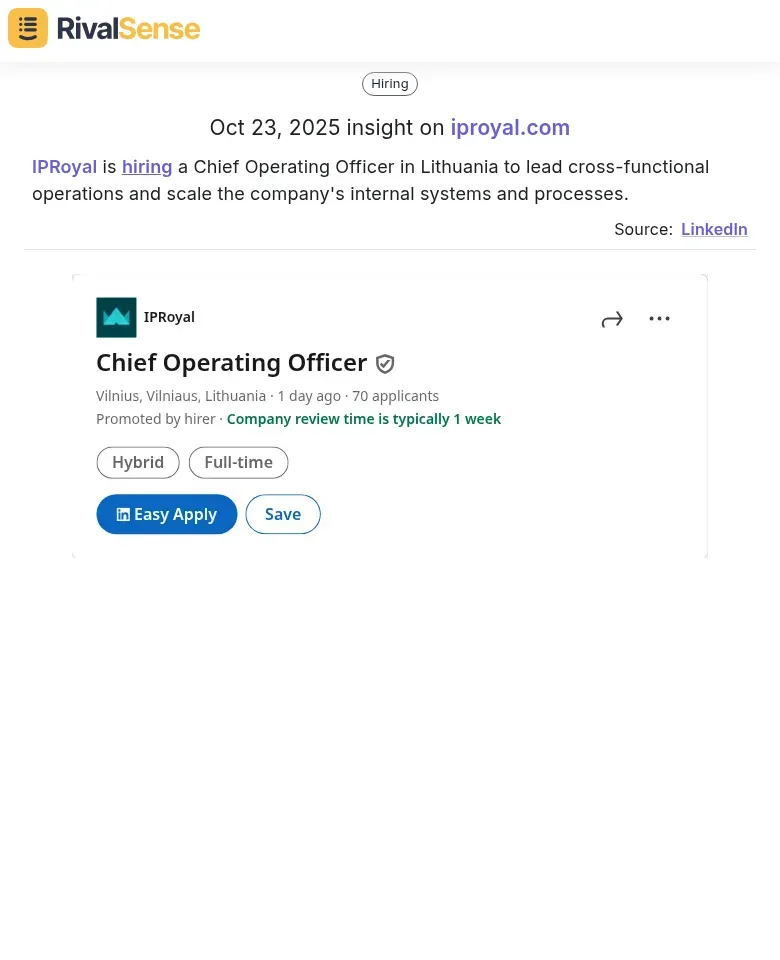
Why it's valuable: Executive hiring insights offer a window into a competitor's future direction and operational focus, helping you anticipate their capacity to serve large clients and adjust your account strategy accordingly.
🛠 Implementation Framework:
- Establish automated tracking for competitor announcements (product, geographic, organizational).
- Categorize moves by type and potential impact on your key accounts.
- Analyze patterns quarterly to identify strategic shifts.
- Translate insights into specific action plans for your account teams.
By converting competitor intelligence into structured account planning inputs, you can proactively address emerging customer needs and capitalize on market opportunities.
The 5-Pillar Key Account Planning Framework for Tech Leaders
Effective key account management requires a structured framework to move from reactive support to strategic partnership. The 5-Pillar Framework provides a repeatable process for deepening relationships and driving mutual growth. This approach ensures you're consistently delivering value and staying ahead of competitors who may be vying for the same strategic accounts.
| Pillar | Key Activities | Output/Deliverable |
|---|---|---|
| 1. Strategic Account Analysis | Quarterly business reviews, SWOT analysis, stakeholder mapping. | Account health scorecard, strategic alignment assessment. |
| 2. Value Proposition Mapping | Capability-needs matrix, competitive gap analysis, ROI modeling. | Customized solution blueprint, unique value proposition document. |
| 3. Relationship Development Roadmap | Executive sponsorship mapping, cross-functional team alignment. | 30-60-90 day engagement plan, multi-level connection map. |
| 4. Joint Business Planning | Co-creation workshops, shared objective setting, KPI definition. | Signed joint business plan with mutual goals and metrics. |
| 5. Continuous Value Realization | Regular business reviews, value reporting, strategic innovation sessions. | Quarterly value report, case study development, renewal plan. |
📋 Practical Starting Checklist:
- ✅ Segment accounts into Strategic Partners, Growth Accelerators, and Foundation tiers.
- ✅ Map competitor reference accounts to identify potential relationship networks.
- ✅ Establish quarterly executive roundtables for peer connections.
- ✅ Create a partner advisory board for product influence and feedback.
- ✅ Track relationship depth metrics (executive connections, joint initiatives, referral activity).
Pro Tip: Start by applying this framework to 3-5 of your most strategic accounts. Refine your process based on real-world learnings, then scale it systematically across your portfolio.
Execution: Turning Insights into Actionable Account Plans
Execution is where strategy meets reality. The most insightful competitive analysis is worthless if it doesn't translate into concrete actions within your key accounts. The key is to create agile, accountable plans that can adapt to new intelligence.
Start by developing customized solutions that address specific market gaps identified through competitor analysis. For instance, if your tracking reveals rivals are heavily focused on enterprise-scale features, you might identify an opportunity to create more user-friendly, tiered offerings for mid-market clients within your accounts.
Create phased implementation timelines with built-in flexibility. Use a 90-day rolling plan that adapts to market shifts and client priorities:
| Phase | Timeline | Focus | Key Milestone |
|---|---|---|---|
| Phase 1 | Days 0-30 | Solution Validation & Alignment | Client signs off on pilot scope & success criteria. |
| Phase 2 | Days 31-60 | Pilot Deployment & Feedback | Successful pilot completion with documented ROI. |
| Phase 3 | Days 61-90 | Full Rollout & Expansion | Contract expansion or full solution adoption. |
Establish clear ownership using a RACI matrix (Responsible, Accountable, Consulted, Informed). Designate a single Account Plan Owner accountable for outcomes, supported by cross-functional teams from sales, customer success, product, and marketing.
🔧 Execution Checklist:
- ✅ Map competitor innovation patterns directly to your client's known and emerging pain points.
- ✅ Build flexible timelines with quarterly reassessment points to incorporate new intelligence.
- ✅ Assign unambiguous ownership with clear escalation protocols for competitive threats.
- ✅ Create formal feedback mechanisms (e.g., quarterly reviews) for continuous plan refinement.
- ✅ Align internal incentives and KPIs with competitive positioning goals for the account.
Monitoring & Adaptation: The Continuous Improvement Cycle
Effective key account planning isn't a one-time exercise—it's a dynamic process requiring constant vigilance and adaptation. Market conditions change, competitors evolve, and client priorities shift. Building a continuous improvement cycle ensures your account strategies remain relevant and effective.
Here’s how to build a robust monitoring and adaptation system:
- Integrate Live Competitor Intelligence: Don't just conduct an annual competitive analysis. Continuously track competitor moves—like product launches, pricing changes, and key hires—to validate your strategy assumptions. This allows for real-time adjustments.
- Measure Holistic Account Health: Combine quantitative metrics (revenue growth, product usage, support ticket trends) with qualitative indicators (relationship strength, executive sponsorship, strategic alignment). Create a simple dashboard that scores both dimensions monthly.
- Implement Structured Review Cycles: Hold quarterly business reviews (QBRs) with clients to gather direct feedback and quarterly internal strategy sessions to incorporate new market intelligence.
📅 Quarterly Internal Strategy Session Checklist:
- ✅ Review recent competitor activity and assess its direct impact on the account strategy.
- ✅ Evaluate account health scores and identify any red flags or opportunities.
- ✅ Update the account plan based on new competitive intelligence and client feedback.
- ✅ Document lessons learned and share key insights across other account teams.
Pro Tip: Assign a 'Competitive Intelligence Owner' for each key account. This person's role is to ensure fresh competitor insights are regularly sourced, analyzed, and directly fed into account plan adaptations.
Conclusion: Building Sustainable Competitive Advantage Through Strategic Account Management
Strategic account management, when powered by integrated competitor intelligence, transforms from basic relationship maintenance into a powerful source of sustainable competitive advantage. The goal is to create partnerships so valuable and insights so prescient that competitors cannot easily disrupt them.
To institutionalize this advantage, focus on building organizational capabilities:
- Centralize Intelligence: Create a single source of truth for competitor data that all account teams can access.
- Regular Briefings: Implement mandatory competitive briefings for account teams before every quarterly business review.
- Clear Protocols: Establish escalation protocols for when a direct competitive threat is identified in a key account.
- Skill Development: Train account managers on practical competitive analysis techniques and counter-strategy development.
Ultimately, value-driven partnerships withstand market volatility. Use competitive insights to proactively position your unique differentiators and address potential competitor vulnerabilities in your clients' operations. Build joint business plans that focus on measurable outcomes and tangible ROI, moving the conversation beyond price.
Ready to transform how you track competitors and protect your key accounts?
Manually scouring the web for competitor updates is inefficient and prone to misses. RivalSense automates this for you, tracking competitor product launches, pricing updates, event participations, partnerships, regulatory changes, management moves, and media mentions across the web. You get everything delivered in a clear, concise weekly email report.
👉 Try RivalSense for Free and get your first competitor intelligence report today. See what your competitors are doing and start turning their moves into your strategic advantage.
📚 Read more
👉 Market Entry Mistakes: Avoiding Competitor Blind Spots with Centralized Intelligence
👉 Mastering Competitor Analysis: Insights from Real-World Examples
👉 Air Freight Podcast Intelligence: A Strategic Guide to Tracking Competitors
👉 How RivalSense Alerted Competitors to CrowdStrike's AI Security Move