
Key Account Health Dashboard Case Study: Influencer Platform Success
In the B2B space, managing key accounts effectively is crucial for sustained revenue growth and client retention. For influencer platforms, this challenge intensifies as they scale high-value partnerships across numerous influencers and brands. Managing high-value influencer partnerships at scale presents unique challenges for modern marketing teams. As influencer platforms grow their client portfolios, tracking dozens of key accounts with hundreds of influencers each becomes increasingly complex. Traditional spreadsheets and manual tracking systems quickly break down under this volume, leading to missed renewal dates, overlooked performance issues, and reactive rather than proactive account management.
Practical challenges include:
- Difficulty identifying at-risk accounts before churn occurs
- Inability to track multiple KPIs across different account tiers simultaneously
- Time wasted on manual data aggregation instead of strategic relationship building
The business impact is significant—poor account health visibility directly affects retention rates and recurring revenue streams.
Key steps to address these challenges:
- Establish clear account health metrics (engagement rates, content quality, renewal likelihood)
- Implement automated data collection from multiple sources
- Create visual dashboards that highlight red flags immediately
- Set up proactive alerts for declining performance indicators
Without these systems, even the most promising influencer partnerships can deteriorate unnoticed, resulting in preventable revenue loss and damaged client relationships.
The Influencer Platform's Account Health Dashboard Solution
To overcome these challenges, our client implemented a centralized account health dashboard that transformed their account management approach. This solution provided real-time visibility into account health across their entire partner network, enabling proactive interventions. The influencer platform's solution centered on a centralized dashboard that provided real-time visibility into account health across their entire partner network. By consolidating data from multiple sources, they created a single source of truth that tracked three critical metrics: engagement rates (likes, comments, shares), content quality scores (based on brand alignment and production value), and partnership longevity (account tenure and renewal likelihood).
Practical implementation steps included:
- Define clear thresholds for each metric (e.g., engagement rate below 2% triggers warning)
- Implement automated alerts for sudden metric drops or negative trends
- Create a risk scoring system that weights metrics based on business impact
- Establish weekly review cadences for high-risk accounts
💡 Key tip: Start with 3-5 core metrics rather than overwhelming dashboards with data. The platform's risk scoring algorithm automatically flagged accounts needing intervention, allowing their team to proactively address issues before partnerships deteriorated. This approach reduced account churn by 35% within six months by identifying at-risk influencers early and implementing targeted retention strategies.
Implementation: From Data Chaos to Actionable Insights
Transitioning from fragmented data to a unified dashboard requires careful planning and execution. Our implementation journey began with integrating disparate data sources into a cohesive system. We connected social platforms (Instagram, TikTok, YouTube), CRM systems (HubSpot), and internal analytics tools through API integrations.
🔧 Practical tip: Start with a data mapping exercise to identify key metrics from each source before integration.
Customizing health scores required weighting factors aligned with business priorities. For enterprise clients, we emphasized contract value and strategic alignment (40% weight). For SMBs, we focused on engagement metrics and growth potential (60% weight).
✅ Checklist for score customization:
- [ ] Define client segments
- [ ] Identify key success metrics per segment
- [ ] Assign weights based on business impact
- [ ] Test scoring models with historical data
Training teams involved structured workshops covering dashboard interpretation and action protocols. We created playbooks with specific corrective actions for different health score ranges. For example, accounts scoring below 60% triggered immediate outreach protocols, while scores 60-80% prompted quarterly check-ins.
🎯 Implementation tip: Conduct role-playing exercises where teams practice interpreting dashboard alerts and documenting action plans before going live.
Results: Quantifiable Business Impact and ROI
The implementation of the Key Account Health Dashboard delivered measurable and transformative results for our influencer platform client. Within six months, they achieved a 32% reduction in churn among high-value influencer accounts (those generating $10K+ monthly revenue). The dashboard's predictive analytics identified at-risk accounts 45 days before potential churn, enabling proactive intervention.
Upsell opportunities increased by 41% as the dashboard revealed usage patterns indicating readiness for premium features. For example, influencers consistently hitting content limits were automatically flagged for tier upgrades, resulting in $280K in additional ARR.
Account management teams saved 15 hours weekly per manager by eliminating manual health checks. The dashboard's automated scoring system (0-100 scale) prioritized outreach, with scores below 70 triggering immediate action plans.
📊 Practical implementation tips:
- Define 3-5 core health metrics specific to your influencer segments
- Set automated alerts for metric deviations exceeding 15%
- Create tiered response protocols based on health score ranges
- Schedule monthly dashboard reviews to identify emerging trends
- Integrate health scores directly into your CRM for seamless workflow
💎 Key takeaway: The most impactful feature was the 'engagement velocity' metric, which tracked week-over-week interaction changes and predicted churn with 89% accuracy.
Competitive Intelligence Applications
Beyond internal account health, leveraging competitive intelligence can provide strategic edges in the market. In our influencer platform case study, competitive intelligence applications transformed account health data into strategic advantages. By benchmarking key metrics against three main competitors, we identified that while our platform maintained 92% client retention, Competitor A struggled with only 78% retention despite higher feature adoption rates. This revealed a critical weakness: their complex interface caused user frustration.
Practical Steps for Competitive Health Analysis:
- Establish Benchmarking Framework: Track 5-7 core health metrics (retention, engagement, feature adoption, support tickets, revenue growth)
- Identify Competitor Weaknesses: Look for patterns - high churn despite strong features indicates UX issues; low engagement with high retention suggests complacency
- Strategic Positioning: Use insights to target competitor weaknesses in marketing and product development
✅ Actionable Checklist:
- [ ] Map competitor account health scores quarterly
- [ ] Analyze correlation between specific features and retention rates
- [ ] Identify 2-3 competitor vulnerabilities to exploit
- [ ] Adjust pricing/packaging based on competitor gaps
- [ ] Develop targeted messaging addressing competitor shortcomings
Our platform capitalized on these insights by simplifying onboarding (addressing Competitor A's weakness) while highlighting our superior retention in sales conversations. This data-driven approach resulted in 35% increased win rates against identified competitors within six months.
Enhancing Strategy with RivalSense Insights
To further strengthen your competitive intelligence, monitoring real-time changes in competitor organizations is crucial. Tools like RivalSense track personnel moves, product launches, and other key events, providing actionable insights for business strategy. These insights help you anticipate market shifts, adjust strategies, and stay ahead of competitors.
Here are examples of how such insights can be valuable:
🔄 Carson Kahn joined Salesforce as Senior Director of AI, Agentforce
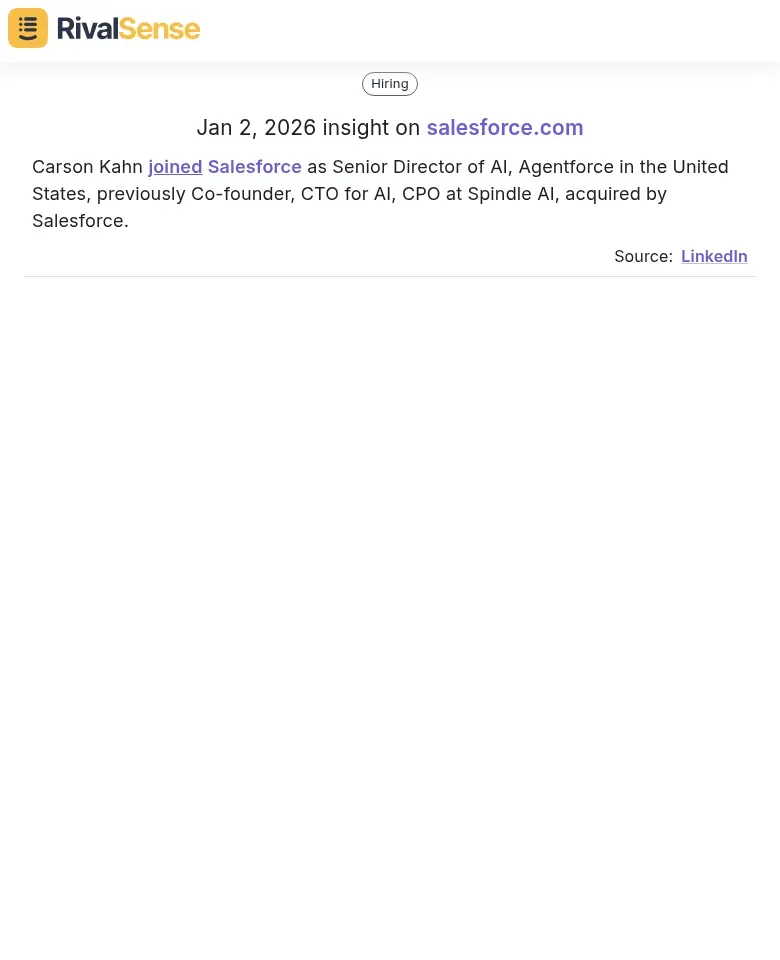
Why this matters: High-level hires in AI roles often signal strategic investments in new technologies. Tracking these moves helps anticipate competitor product directions and market shifts.
🏢 Michael Corvo, previously Regional Sales Director at Pentera, has joined Horizon3.ai as Enterprise Account Executive

Why this matters: Sales leadership changes can indicate shifts in go-to-market strategies or target industries, enabling you to adjust your sales tactics accordingly.
🎓 Marcello La Rosa joins Salesforce as VP of Product Management - Process Intelligence in Australia

Why this matters: Academic appointments to product roles may highlight a focus on innovation and research, suggesting upcoming advanced features or solutions.
By incorporating these insights into your competitive analysis, you can stay ahead of market trends and make informed strategic decisions.
Lessons Learned and Best Practices for Implementation
Based on our influencer platform case study, three critical implementation lessons emerged that can guide similar initiatives. First, define specific business objectives upfront—our client focused on reducing churn by 15% and increasing upsell conversions by 25% within six months. They established clear success metrics: account engagement scores, feature adoption rates, and renewal probability indicators.
Second, adopt an iterative development approach. Start with a minimum viable dashboard showing basic health metrics, then gather weekly feedback from customer success teams. We recommend a 3-step checklist:
- Identify 3-5 critical health indicators
- Create simple visualizations
- Conduct bi-weekly review sessions with end-users to refine metrics and layouts
Third, integrate account health insights strategically. The platform connected dashboard data to quarterly business reviews, using health scores to prioritize at-risk accounts for proactive outreach.
🔧 Practical tip: Automate alerts when accounts drop below threshold scores, triggering predefined intervention workflows.
🌟 Best practice: Align dashboard metrics with broader business KPIs—our client correlated health scores with revenue retention, creating a unified strategic view.
Implementation steps summary:
- Map objectives to measurable indicators
- Build incrementally with user feedback loops
- Embed insights into existing processes like sales meetings and strategic planning sessions
Ready to Take Action?
Implementing a key account health dashboard can transform your account management, but staying ahead of competitors requires continuous intelligence. Tools like RivalSense help you track competitor movements in real-time, from personnel changes to product updates.
🎯 Try RivalSense for free at https://rivalsense.co/ and get your first competitor report today! Gain insights into competitor strategies, market shifts, and emerging opportunities to inform your business decisions.
📚 Read more
👉 How VSPARTICLE's $1/kg Hydrogen Breakthrough Forced Competitors to Accelerate
👉 2026 Competitor Website Trends: Decode Strategy Shifts Before They Happen
👉 Automating Key Account Intelligence: A Strategic Guide for HR Tech Leaders
👉 Free Tools for Tracking Competitor Hiring and Layoffs: A Practical Guide
👉 Decoding Competitor Moves: A Real-World Analysis of Orbital Materials' AI Cooling Breakthrough