
IT Asset Management Competitor Benefits Cheat Sheet: Turn Insights into Advantage
IT asset management (ITAM) has evolved from simple inventory tracking to a strategic differentiator in today's competitive landscape. Competitor analysis transforms ITAM from reactive maintenance to proactive advantage by revealing how industry leaders optimize their technology investments. When you understand competitors' ITAM capabilities—from automated discovery tools to lifecycle management strategies—you gain insights that help you anticipate market shifts and allocate resources more effectively.
Ignoring competitor capabilities carries hidden costs: you might overspend on redundant software licenses, miss opportunities to consolidate overlapping tools, or fail to adopt emerging technologies that competitors are already leveraging. These blind spots can cost millions in unnecessary expenditures and lost productivity.
Practical competitive intelligence helps you benchmark your ITAM maturity against industry leaders. Start by analyzing competitors' technology stacks, vendor relationships, and asset utilization patterns. Create a checklist:
✅ Identify top 3-5 competitors in your sector
✅ Research their ITAM tools and processes
✅ Compare license optimization strategies
✅ Evaluate their hardware refresh cycles
✅ Assess their cloud migration approaches
This analysis reveals where you're ahead, where you're lagging, and where strategic investments can deliver the greatest ROI. By turning competitor insights into actionable ITAM strategies, you transform technology management from a cost center to a competitive weapon that drives efficiency, reduces risk, and accelerates innovation.
Competitor Feature Analysis: Decoding What Really Matters in ITAM Tools 📊
Analyzing competitor ITAM platforms requires a focused approach on features that drive real value. Understanding their tool capabilities helps you identify gaps in your own solutions and prioritize enhancements. When evaluating competitors, focus on three critical dimensions that reveal true competitive advantages.
First, assess automation depth by tracking how competitors handle complex workflows like software license reconciliation, hardware lifecycle management, and compliance reporting. Look beyond basic automation claims—measure actual time savings through case studies or customer testimonials.
Second, evaluate integration capabilities systematically. Create a checklist of essential integrations: CMDB systems (ServiceNow, BMC), cloud platforms (AWS, Azure), and security tools. Note which competitors offer pre-built connectors versus custom API approaches. This reveals scalability limitations and implementation complexity.
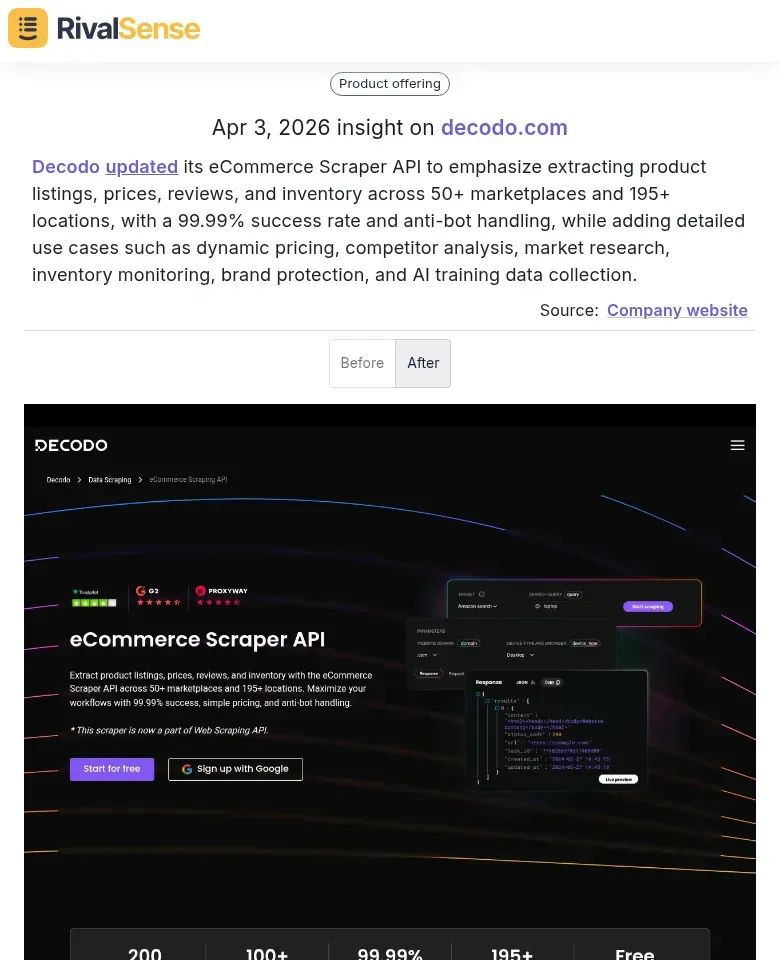
For example, tracking product updates can provide strategic insights. RivalSense recently monitored how Decodo updated its eCommerce Scraper API to emphasize extracting product listings, prices, reviews, and inventory across 50+ marketplaces and 195+ locations. This type of insight is valuable because it shows how competitors enhance their tools to meet market demands, helping you anticipate trends in ITAM solutions and integration needs.
Third, analyze reporting sophistication by comparing dashboard customization, real-time data access, and predictive analytics features. Track how competitors present IT asset ROI metrics to stakeholders.
For pricing analysis, map competitors' models against value delivered. Document tier structures, hidden costs (implementation fees, training), and enterprise discount patterns. This reveals market positioning and helps optimize your own pricing strategy.
Finally, study user experience through adoption patterns. Monitor competitor customer reviews for implementation pain points, training requirements, and feature utilization rates. Identify which interfaces drive higher adoption—this informs your own UX improvements and implementation best practices.
Market Positioning Benefits: How Competitor Intelligence Shapes Your ITAM Strategy 🎯
Competitor intelligence transforms ITAM strategy from reactive to proactive by uncovering market dynamics. By mapping competitors' offerings and activities, you can identify strategic opportunities and threats. Start by mapping competitors' ITAM offerings across enterprise segments (SMB, mid-market, enterprise) to identify underserved gaps.
For instance, if competitors focus on large enterprises, there may be opportunities in mid-market automation or SMB compliance solutions. Monitoring competitor involvement in events can also reveal positioning strategies. RivalSense tracked Oxylabs.io returning as a Silver sponsor for BSides Vilnius 2026, supporting the local infosec community for the second consecutive year. This insight is valuable because it indicates competitors' commitment to community engagement and can signal their focus areas, helping you align your marketing and partnership efforts.
Benchmark your capabilities against 3-5 key competitors using a scoring matrix across:
- Discovery accuracy
- Compliance reporting
- Cloud cost optimization
- Integration ecosystem
Prioritize investments where you score 2+ points below competitors. Leverage competitor weaknesses strategically. If competitors have poor SaaS visibility, emphasize your comprehensive SaaS management. If their reporting is complex, highlight your intuitive dashboards. Create a "weakness-to-strength" map showing how each competitor limitation strengthens your value proposition.
Practical checklist:
• Analyze 3 competitors' pricing pages for feature gaps
• Monitor customer reviews for pain points competitors aren't solving
• Track competitor product updates for strategic direction
• Identify segments where competitors have <20% market penetration
• Benchmark response times for support and implementation
Tip: Use competitive intelligence to position your ITAM solution as the "better alternative" rather than just "different." Focus messaging on specific underserved needs you uniquely address.
Operational Efficiency Gains: Competitor Insights That Streamline ITAM Processes ⚙️
Operational efficiency in ITAM is crucial for reducing costs and improving productivity. Competitor analysis reveals best practices that can streamline your processes and eliminate bottlenecks. Study how competitors automate asset discovery using agent-based vs. agentless tools, and benchmark their tracking accuracy through reconciliation rates.
Analyze lifecycle management strategies—like automated decommissioning workflows—to reduce manual workload and errors. Practical steps:
- Map competitor automation: Document tools for patching, license compliance, and reporting.
- Benchmark metrics: Compare incident resolution times (MTTR) and change success rates from public case studies.
- Adopt proven workflows: Implement automated alerts for expiring warranties or unused software.
Tip: Use competitor insights to prioritize automation in high-error areas, such as manual inventory updates, cutting ITAM process time by up to 30%.
Financial Optimization Benefits: How Competitor Analysis Drives ITAM Cost Savings 💰
Financial optimization through competitor analysis delivers tangible ITAM cost savings by revealing hidden opportunities. Learning from competitors' financial strategies helps you optimize licenses, cloud spending, and vendor negotiations. Start by benchmarking competitor license optimization approaches: track how top performers use AI-driven usage analytics to identify 20-30% redundant licenses, then implement a quarterly review cadence.
For cloud cost management, analyze how competitors leverage multi-cloud visibility tools like Flexera or CloudHealth to eliminate shadow IT spending. Create a checklist:
✅ Map all cloud environments
✅ Tag resources by department
✅ Set automated alerts for cost anomalies
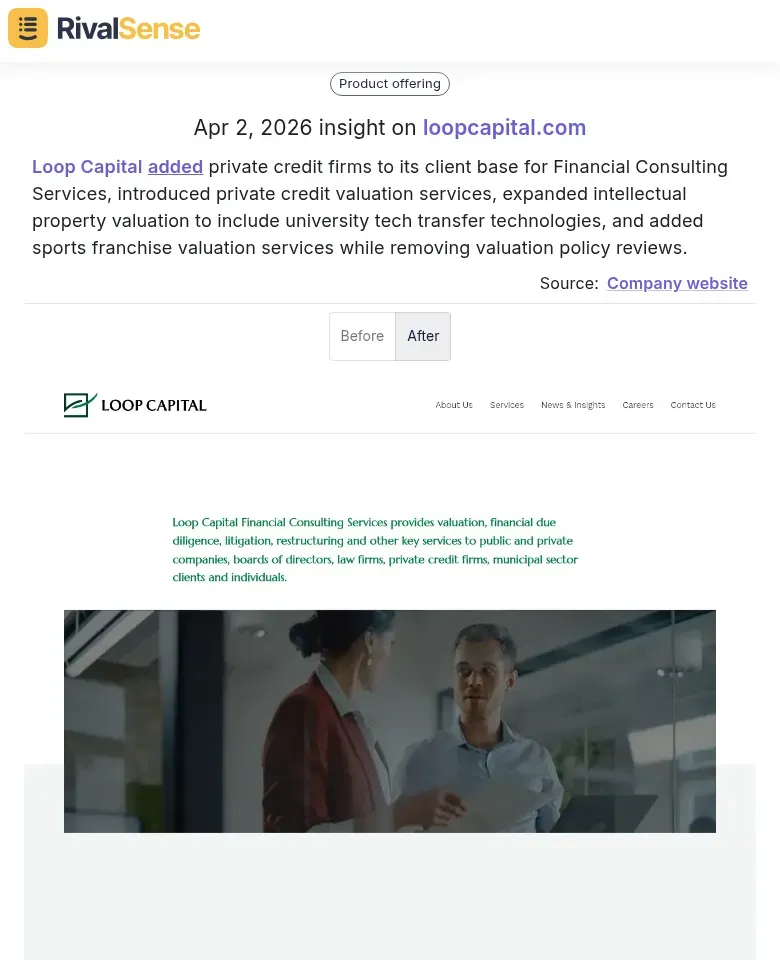
Tracking service expansions can also inform your financial strategies. RivalSense observed Loop Capital adding private credit firms to its client base for Financial Consulting Services, introduced private credit valuation services, and expanded intellectual property valuation. This insight is valuable because it reveals how competitors diversify offerings to capture new revenue streams, prompting you to explore similar opportunities or adjust your cost structures in ITAM.
Learn from competitor vendor negotiation tactics by studying their contract renewal patterns; successful teams negotiate 15-25% discounts by bundling purchases and timing renewals during vendor quarter-ends. Practical tip: Create a vendor scorecard tracking SLA compliance, support responsiveness, and pricing trends to strengthen your negotiation position. Remember, the most effective ITAM cost savings come from combining competitor insights with your unique usage data—start with a 90-day pilot focusing on your highest-spend software categories.
Security and Compliance Advantages: Competitor Intelligence for Risk Mitigation 🔒
Security and compliance are critical in ITAM, and competitor intelligence provides a benchmark for enhancing your risk mitigation strategies. By studying how competitors handle vulnerabilities and regulatory requirements, you can adopt proven practices to safeguard your assets. Benchmarking competitor security posture management reveals critical insights.
Track their vulnerability response times—top performers patch critical vulnerabilities within 7-10 days versus industry averages of 30+ days. Create a checklist:
- Monitor competitor disclosure-to-patch timelines
- Analyze their security incident response workflows
- Compare their asset discovery frequency (daily vs. weekly)
Analyzing competitor compliance frameworks provides audit preparation advantages. Leading companies automate control mapping across NIST, ISO, and CMMC frameworks simultaneously. Practical tip: Study how competitors maintain continuous evidence collection and policy versioning. Implement their audit-ready dashboard approach with automated reporting that reduces manual preparation by 60%.
Learning from competitor shadow IT discovery approaches prevents unauthorized software risks. Top performers use three detection methods:
- Network monitoring for unknown cloud connections
- Cloud Access Security Brokers (CASBs) for access logging
- Expense report analysis for unauthorized subscriptions
Actionable step: Implement automated SaaS discovery tools that competitors use to reduce shadow IT exposure by 80% within 90 days. Monitor how leading companies balance security with employee productivity through approved software catalogs rather than blanket prohibitions.
Ready to Transform Your ITAM Strategy? 🚀
Competitor analysis in ITAM is a continuous process that requires reliable insights. Tools like RivalSense can automate tracking of competitor product launches, pricing updates, event participations, partnerships, and more, delivering weekly reports directly to your inbox. By leveraging such intelligence, you can stay ahead of market trends and make data-driven decisions.
Try RivalSense for free at https://rivalsense.co/ and get your first competitor report today! Uncover hidden opportunities, optimize costs, and mitigate risks with actionable insights tailored to your business needs.
📚 Read more
👉 How Proactive Competitive Intelligence Counters Rivals' Market Moves
👉 Instagram Competitor Insights Cheat Sheet: Track Like Backlinks
👉 2026 Web Data Gathering Industry Awards: Competitive Intelligence Trends
👉 Quick Market Entry Hacks: Competitor Insights for Startup Key Accounts
👉 How to Leverage Competitor Insights: A Real-World Example from n8n