
Internet Intelligence Workflow: Uncovering Why Competitors Succeed
In today's hyper-competitive digital landscape, internet intelligence transforms reactive competitor monitoring into a proactive strategic advantage. Rather than simply tracking what competitors are doing, systematic intelligence workflows reveal why they succeed—uncovering the underlying strategies, financial health indicators, and market positioning that drive their performance. Every company leaves digital footprints that tell their story: website changes signal strategic pivots, pricing adjustments reveal market positioning, and social media engagement patterns expose customer acquisition strategies.
For example, when a competitor suddenly modifies their homepage messaging or restructures pricing pages, these aren't random updates—they're deliberate moves that provide actionable insights into their business direction. Practical intelligence workflow starts with three key steps:
- 🎯 Identify core competitors and analyze their complete digital footprint across websites, social platforms, and industry publications
- 📊 Establish systematic monitoring for pricing changes, feature updates, and marketing campaigns using automated tools
- ⚖️ Benchmark your performance against competitors' traffic patterns, engagement metrics, and market share movements
Real-world intelligence reveals patterns: a competitor gaining 80% YoY traffic growth while others stagnate indicates successful strategy execution. By analyzing these digital footprints systematically, you move from simply knowing what competitors do to understanding why they succeed—and how to outperform them.
Building Your Internet Intelligence Framework: The Core Workflow
Building an effective internet intelligence framework requires a systematic workflow that transforms scattered digital data into actionable competitive insights. Start by establishing structured data collection from diverse sources: monitor competitor news and press releases for strategic announcements, analyze quarterly financial reports for performance indicators, track social media for brand sentiment and customer engagement, and scrutinize job postings for organizational growth signals and skill priorities.
Implement automated monitoring systems using tools like RivalSense to continuously track competitor activities across digital channels. Set up custom alerts for key triggers such as product launches, pricing changes, leadership appointments, or funding rounds. This ensures you're always informed about market movements without manual daily checks. Develop analysis frameworks to convert raw data into strategic intelligence by creating standardized templates for competitor profiling, market positioning analysis, and trend identification.
Practical Checklist for Your Framework:
- 🔍 Identify 5-7 key data sources per competitor (e.g., website, LinkedIn, industry news)
- ⏰ Set up automated alerts for critical events (e.g., pricing updates, product launches)
- 📅 Schedule weekly intelligence briefings with your team
- 💾 Maintain a centralized intelligence repository (e.g., shared drive or tool)
- 🚨 Establish clear escalation protocols for high-impact discoveries
Use SWOT analysis to assess competitor strengths and weaknesses, and apply predictive modeling to anticipate future moves based on historical patterns. Regularly review insights with cross-functional teams to validate findings and develop responsive strategies.
Decoding Financial Signals: What Capital Movements Reveal About Competitor Strategy
Capital movements offer a transparent window into competitor strategy, providing early indicators of market confidence and future focus areas. By analyzing profit distribution patterns, you can gauge how competitors assess market opportunities and their strategic outlook. For instance, when a rival consistently reinvests profits into R&D rather than dividends, they're signaling aggressive growth ambitions in emerging segments.
Asset management changes reveal strategic pivots. When competitors shift assets from mature product lines to new ventures, it indicates market saturation signals and future focus areas. Track these movements quarterly to spot early warning signs of strategic redirection. Financial announcements provide forward-looking intelligence—scrutinize earnings calls and investor presentations for clues about resource allocation priorities.
Example from RivalSense:
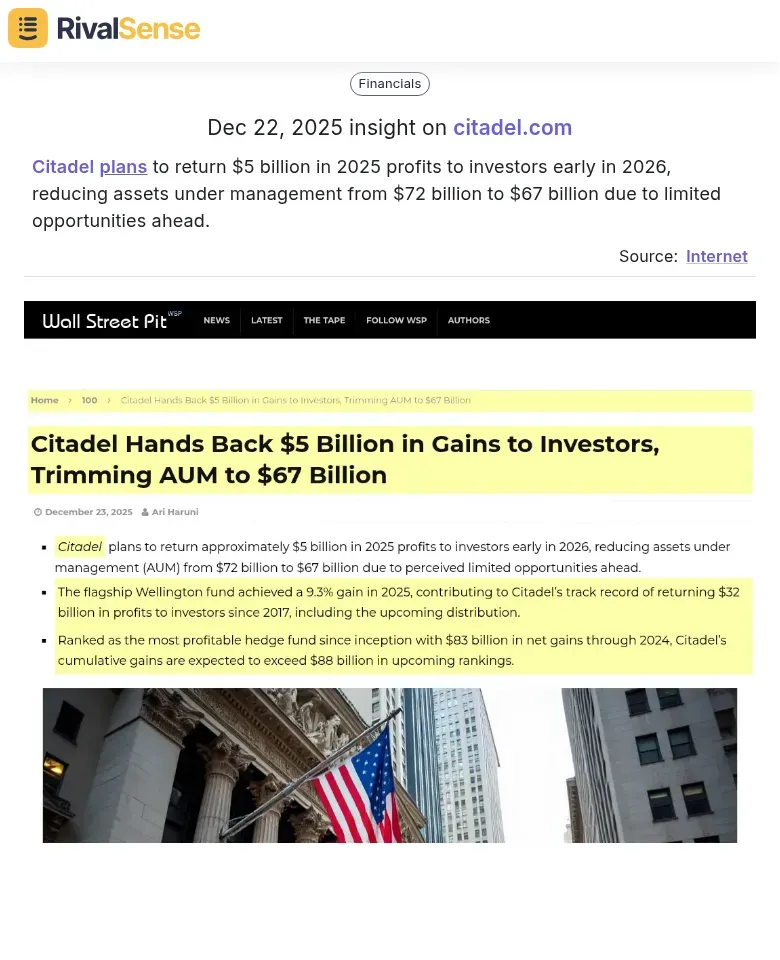
Insights like Citadel's profit distribution plan are valuable because they reveal how competitors perceive future market opportunities, allowing you to adjust your own investment strategies accordingly. When a major player reduces assets under management, it might signal caution in certain sectors, prompting you to reassess your risk exposure or identify underserved niches.
Practical Steps to Decode Financial Signals:
- 📈 Monitor quarterly earnings reports for profit allocation patterns
- 💼 Track asset reallocation in balance sheets across business units
- 🗣️ Analyze investor presentations for capital expenditure guidance
- 📊 Compare dividend policies against industry benchmarks
- 🔄 Watch for debt restructuring as indicators of strategic flexibility
Key insight: Financial signals often precede operational changes by 6-12 months, giving you valuable lead time to adjust your own strategy.
Tracking Technological Evolution: How AI and Automation Shape Competitive Landscapes
Technological advancements, especially in AI and automation, are reshaping competitive landscapes at an unprecedented pace. To track this evolution effectively, implement a systematic monitoring framework that catalogs competitors' machine learning features, natural language processing capabilities, and predictive analytics tools. For example, monitor how SaaS companies integrate AI chatbots for customer support or use recommendation engines to personalize user experiences.
Analyze automation initiatives by examining workflow automation, robotic process automation (RPA), and infrastructure automation. Look for patterns in how competitors automate customer onboarding, billing processes, or data synchronization. Track metrics like operational cost reductions or productivity improvements—some companies achieve 30-40% efficiency gains through strategic automation.
Example from RivalSense:
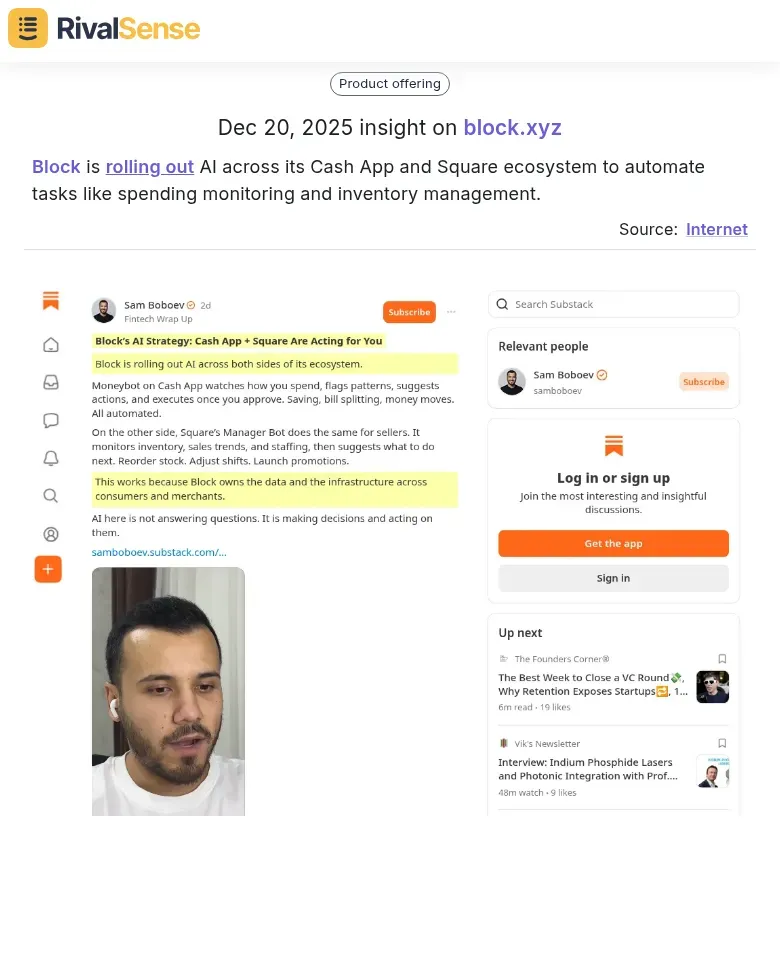
Insights into AI rollouts, like Block's ecosystem automation, are valuable because they highlight how competitors are leveraging technology to enhance customer experience and operational efficiency, signaling areas where you might need to innovate or partner to stay competitive. This type of intelligence helps you anticipate disruptions before they reshape your market.
Practical Checklist for Technology Tracking:
- 🤖 Use web scraping tools to monitor AI feature announcements
- 👨💻 Analyze job postings for automation engineering roles
- 📄 Review technical documentation for integration APIs
- ⚖️ Track patent filings for emerging technologies
- 📊 Benchmark implementation timelines against market performance data
Evaluate technology integration patterns across competitors' ecosystems to identify emerging trends like edge computing integration or unified data platforms that could signal future competitive advantages.
Strategic Acquisitions and Partnerships: Uncovering Growth Trajectories
Strategic acquisitions and partnerships reveal competitors' growth trajectories and market priorities, offering clues about where they see future opportunities. When analyzing acquisitions, track not just the companies being acquired, but their core technologies, customer bases, and market positions. This exposes expansion priorities—like when a competitor acquires a niche AI startup, signaling their push into intelligent automation.
Technology acquisitions accelerate innovation cycles dramatically. Instead of building capabilities from scratch, competitors can leapfrog development by acquiring proven solutions. Monitor patent filings and technology stacks of acquired companies to understand how these integrations enhance competitive positioning. Partnership strategies reveal ecosystem development approaches—map partnership networks to identify market penetration strategies.
Example from RivalSense:

Acquisition insights, such as Grab's move into AI robotics, are valuable because they uncover competitors' strategic bets on emerging technologies or markets, enabling you to assess potential threats or opportunities for collaboration. By understanding why a competitor makes a specific acquisition, you can refine your own M&A strategy or innovation focus.
Practical Steps to Analyze Acquisitions and Partnerships:
| Step | Action | Purpose |
|---|---|---|
| 1 | Create an acquisition tracking matrix | Document target company, technology/assets, and strategic rationale |
| 2 | Analyze integration timelines | Assess how quickly acquired technologies are deployed |
| 3 | Map partnership ecosystems | Identify key partners and their roles in value chains |
| 4 | Monitor executive statements | Glean insights into strategic priorities post-acquisition |
| 5 | Track customer migration patterns | Understand how acquisitions affect market dynamics |
Tip: Focus on smaller, strategic acquisitions that reveal emerging market opportunities rather than just large, obvious deals. These often indicate where competitors see future growth potential before it becomes mainstream.
From Intelligence to Action: Implementing Insights for Competitive Advantage
Transforming competitor intelligence into decisive action requires structured frameworks that prevent analysis paralysis. Start by creating a strategic response matrix that categorizes competitor moves by threat level and response urgency, ensuring strategic resource allocation. For example, when a competitor launches a new feature, assess whether it's a differentiator or parity feature, your development timeline, and the customer impact.
Establish an early warning system with automated alerts for key triggers: pricing changes, leadership hires, funding rounds, patent filings, and technology stack updates. Monitor review sites for emerging customer pain points competitors are solving, and conduct monthly competitor health checks tracking their website traffic, job postings, and social engagement trends.
Implement a Continuous Improvement Cycle:
- Quarterly Review: Analyze competitor successes to identify features driving adoption or messaging that resonates.
- Gap Identification: Pinpoint vulnerabilities or overlooked customer segments in competitors' strategies.
- Initiative Prioritization: Update your product roadmap and marketing strategy based on impact vs. effort assessments.
- Outcome Measurement: Track how implemented changes affect your competitive position using key metrics.
Pro tip: Create a 'competitive playbook' documenting common scenarios and pre-approved responses to accelerate decision-making when opportunities or threats emerge. This empowers your team to act swiftly without bureaucratic delays.
Leverage Internet Intelligence to Stay Ahead
Internet intelligence isn't just about collecting data—it's about translating insights into actionable strategies that drive growth. By systematically decoding financial signals, tracking technological evolution, and analyzing acquisitions, you can anticipate competitor moves and adapt your business accordingly. Remember, the goal is to move from reactive monitoring to proactive strategy formulation.
To streamline this process, consider using automated tools like RivalSense, which tracks competitor product launches, pricing updates, event participations, partnerships, regulatory aspects, management changes, and media mentions across websites, social media, and registries. All insights are delivered in a weekly email report, saving you time and ensuring you never miss a critical update.
👉 Try RivalSense for free today at https://rivalsense.co/ and get your first competitor report to start uncovering why your competitors succeed—and how to outperform them.
📚 Read more
👉 Best Practices for Mobility Trade Show Strategy to Outpace Competitors
👉 Quick Tips: Monitor Competitor Hiring & Layoffs via Regulatory Filings
👉 How to Respond to Competitor Pricing Changes: A Case Study on Vivigo
👉 Key Account Management Tools Comparison 2025: The Ultimate Guide for Business Leaders
👉 Actionable Strategies to Track Key Account Milestones for Insurance Brokers