
Instagram Competitor Insights Cheat Sheet: Track Like Backlinks
In the B2B world, Instagram is no longer just a branding playground—it's a strategic intelligence goldmine. While most companies track vanity metrics like follower counts, savvy founders and CEOs are using competitor analysis on Instagram to uncover actionable insights that drive real growth. Think of it like tracking backlinks in SEO: you're not just counting links, you're understanding your competitive landscape, identifying partnership opportunities, and spotting emerging trends before they become mainstream.
Instagram competitor tracking provides three critical advantages: First, it reveals content strategies that actually work in your niche—what formats, topics, and posting times generate engagement. Second, it exposes partnership opportunities by showing who's collaborating with whom. Third, it helps you identify gaps in your own strategy by benchmarking against industry leaders.
📊 Practical tip: Start by identifying 3-5 key competitors and track their Instagram Stories, Reels, and feed posts weekly. Look beyond likes—analyze their engagement patterns, hashtag strategies, and audience interactions. Create a simple spreadsheet to document what works for them, then test those approaches in your own content calendar. This systematic approach transforms Instagram from a social media channel into a strategic intelligence tool for business growth.
Event & Partnership Tracking: Learning from Fanatics' Road to Games Strategy
Tracking events and partnerships on Instagram provides a direct line into a competitor's expansion and community-building tactics. These moves often signal new markets, target audiences, or revenue streams before they're formally announced. By analyzing these activities, you can anticipate strategic shifts and identify potential collaboration opportunities for your own brand.
Fanatics' 'Road to Games' event is a prime example of using partnerships to create a multi-city experiential marketing funnel. This type of insight is invaluable because it reveals how brands leverage physical events to drive digital engagement and national brand reach.
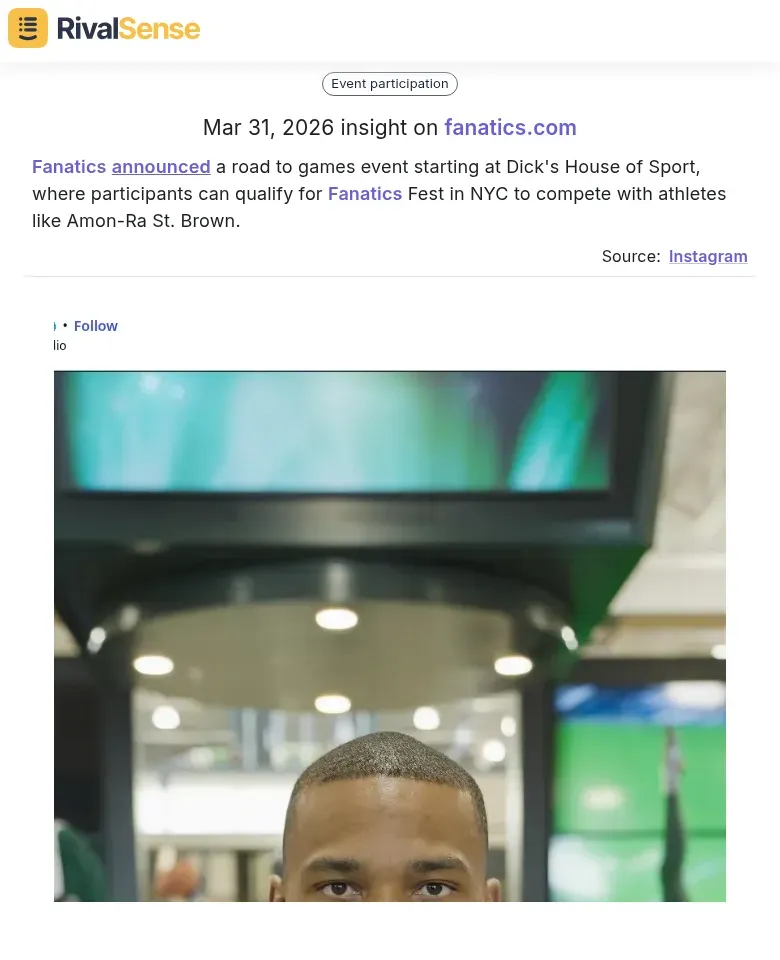
Fanatics announced a road to games event starting at Dick's House of Sport, where participants can qualify for Fanatics Fest in NYC to compete with athletes like Amon-Ra St. Brown. (Source: RivalSense)
Practical Tracking Checklist:
- ✅ Monitor competitor event hashtags (#FanaticsGames) for partnership announcements
- ✅ Track athlete/influencer collaborations for audience expansion patterns
- ✅ Analyze how physical events drive digital engagement through Instagram Reels and Stories
- ✅ Note partnership duration and exclusivity terms in event descriptions
- ✅ Document fan-generated content volume and engagement metrics
Key Insight: Successful brands like Fanatics leverage partnerships not just for promotion, but to create authentic, multi-layered narratives that resonate across different audience segments. This transforms one-off events into year-round engagement platforms.
Feature & Product Launch Analysis: NordVPN's 'Secure My Connection' Case Study
Product and feature launches on social media are rich with strategic clues about a competitor's direction and user pain points they're aiming to solve. Monitoring these announcements helps you benchmark your own development pipeline and identify market expectations your product needs to meet. It's about understanding the 'why' behind the 'what' they build.
When tracking feature announcements, focus on how competitors simplify complex offerings through UX improvements. For instance, NordVPN's update transformed technical VPN concepts into a one-click solution, demonstrating how to make security accessible.
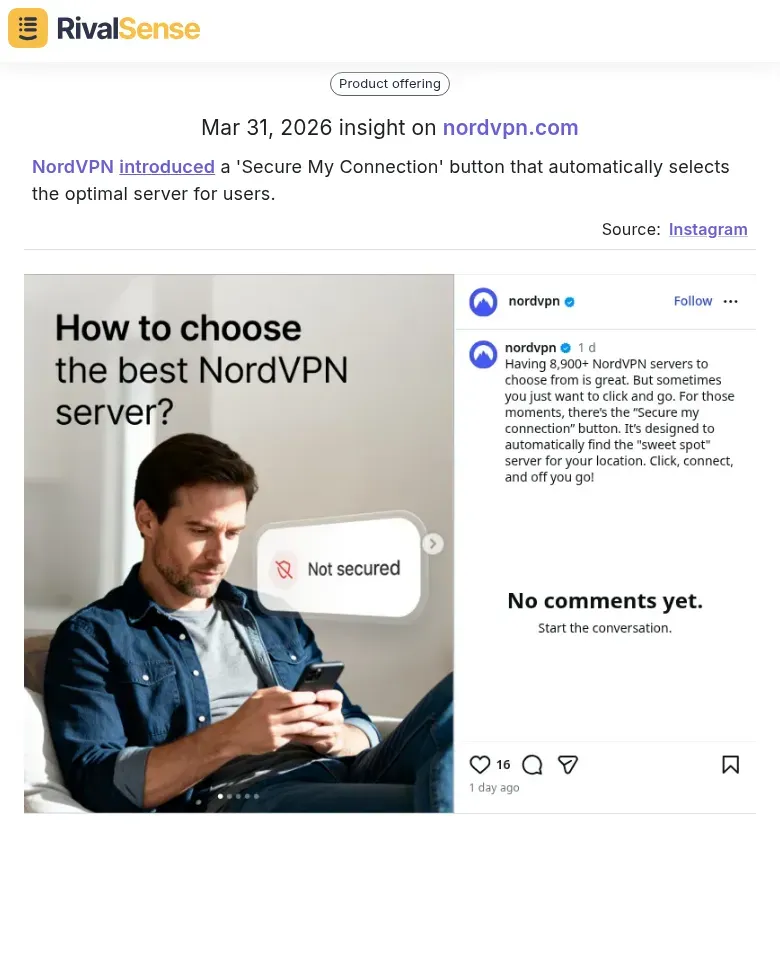
NordVPN introduced a 'Secure My Connection' button that automatically selects the optimal server for users. (Source: RivalSense)
Why this insight matters: It highlights a trend towards automation and simplification in technical products. Spotting this early allows you to evaluate similar opportunities in your own UX to reduce customer friction.
Key Insights for Your Product Development:
- Identify automation opportunities in your own technical processes
- Study how competitors package multiple features into single, intuitive solutions
- Note which pain points competitors address through simplification
- Benchmark your UX against their most successful feature launches
Design & Personalization Insights: Revolut's Virtual Card Designs Example
Design updates are often a leading indicator of brand evolution and shifting customer engagement strategies. Tracking these changes helps you understand how competitors use aesthetics and personalization to drive loyalty, create urgency, and tap into cultural moments. It's a window into their brand's emotional connection with users.
Revolut's frequent virtual card design refreshes are a masterclass in using personalization as a retention tool. Their limited-edition designs create FOMO (fear of missing out) and reward user interaction, turning a functional product into a collectible item.
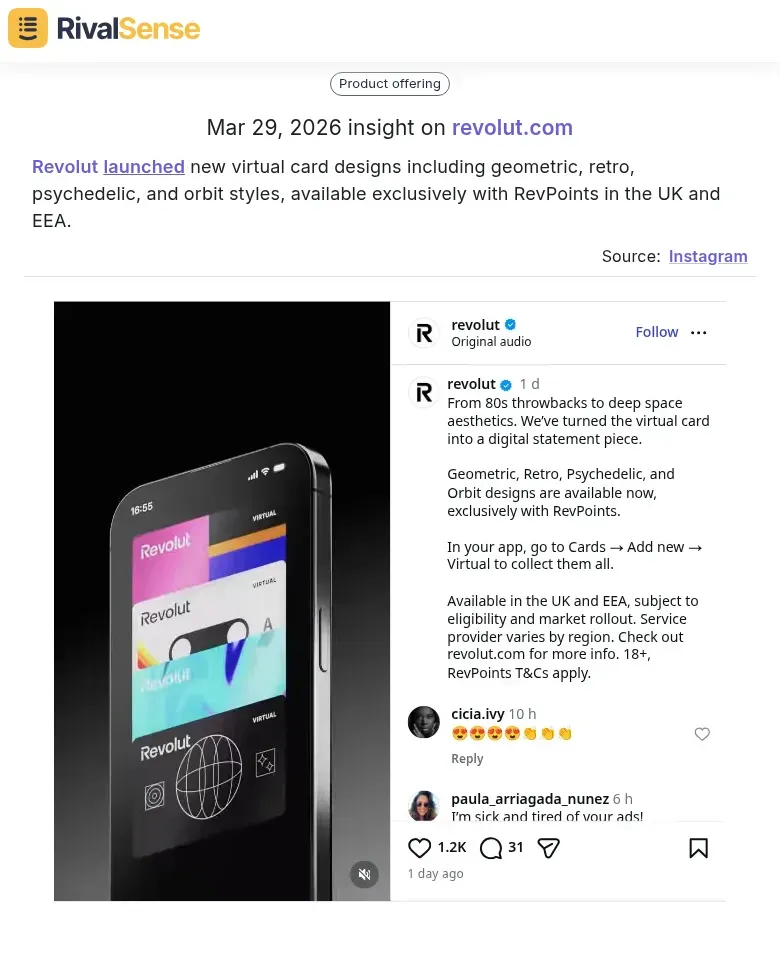
Revolut launched new virtual card designs including geometric, retro, psychedelic, and orbit styles, available exclusively with RevPoints in the UK and EEA. (Source: RivalSense)
Why tracking design matters: This insight reveals how competitors innovate on reward systems and user experience beyond core functionality. It can inspire new ways to increase engagement and perceived value in your own offerings.
Practical steps for monitoring design evolution:
- Capture screenshots of competitor product interfaces or assets monthly.
- Create a timeline of design changes to identify directional shifts.
- Analyze color palette and thematic consistency.
- Note seasonal, cultural, or partnership tie-ins in new designs.
The Instagram Competitor Tracking Framework: Your Cheat Sheet Methodology
Consistency is key to effective competitive intelligence. Here’s a systematic framework to ensure your Instagram tracking delivers actionable insights, not just data overload. This methodology turns sporadic observations into a structured strategic asset for your business.
Step 1: Identify & Categorize Competitors
- Direct competitors (same niche/products)
- Indirect competitors (similar audience, different offerings)
- Aspirational brands (industry leaders to benchmark against)
Step 2: Track Key Metrics Weekly
| Metric Category | What to Track | Why It Matters |
|---|---|---|
| Engagement Patterns | Engagement rate, best posting times, top content types | Reveals what resonates with your shared audience |
| Content Strategy | Hashtag usage, Reels vs. Posts ratio, Story engagement | Shows effective formats and messaging tactics |
| Audience Growth | Follower growth rate, new follower sources | Indicates marketing channel effectiveness |
Step 3: Automate Data Collection
- Use competitive intelligence tools to monitor posts, engagement, and growth automatically.
- Set up alerts for competitor announcements, launches, or viral content.
- Track hashtag performance across competitors to identify trending topics.
📋 Quick Weekly Checklist:
- ✓ Review competitor Stories (they disappear in 24 hours!)
- ✓ Note top-performing feed posts and Reels
- ✓ Monitor comment sentiment on key posts
- ✓ Track any new collaborations or influencer partnerships
- ✓ Update your competitor dashboard with weekly metrics
Turning Insights into Action: Competitive Intelligence Implementation
Gathering insights is only the first step. The real value comes from translating observations into improved performance for your own brand. This requires a disciplined process of adaptation and testing, not just copying what you see. The goal is to learn the underlying principles of what works in your market.
1. Benchmark Your Performance:
- Create a scorecard comparing key metrics (engagement rate, follower growth) against your top 3 competitors.
- Identify clear gaps (e.g., "Our Reels engagement is 40% lower than Competitor A").
- Set SMART goals based on these benchmarks.
2. Adapt Successful Tactics:
- Don’t copy—adapt. If a competitor's user-generated content campaign works, create your unique version.
- Test competitor-proven content formats (carousels, polls, interactive Stories) with your brand voice.
- Analyze their posting schedule and test optimal timing for your own audience.
3. Create a Continuous Improvement Loop:
- Implement weekly 30-minute competitor check-ins.
- Use a simple test log: Date | Tactic Observed | Our Adaptation | Test Results
- Set quarterly reviews to adjust your overall social strategy based on competitive movements.
Pro Tip: Start with one competitor tactic at a time. Test for 2-3 weeks, measure results, then iterate. Successful competitive intelligence is about learning what works in your market and making it uniquely yours.
Ready to Track Your Competitors with Precision?
Manually tracking events, product launches, design updates, and partnerships across multiple competitors and platforms is time-consuming and prone to missed details. The insights highlighted in this post—like Fanatics' event strategy, NordVPN's feature launch, and Revolut's design updates—are exactly the type of intelligence that can inform your next strategic move.
RivalSense automates this entire process. It tracks your competitors' product launches, pricing changes, event participations, partnerships, media mentions, and more—delivering a concise weekly report straight to your inbox. This allows you to focus on implementing insights, not hunting for them.
👉 Get your first competitor intelligence report today. Try RivalSense for free and start turning competitive noise into your strategic advantage.
📚 Read more
👉 2026 Web Data Gathering Industry Awards: Competitive Intelligence Trends
👉 Quick Market Entry Hacks: Competitor Insights for Startup Key Accounts
👉 How to Leverage Competitor Insights: A Real-World Example from n8n
👉 The Ultimate Guide to Key Account Tracking APIs: Automate Competitive Intelligence in 2026
👉 Mastering Competitor Tracking in Pharma Logistics: A Strategic Guide to Promotional Offers