
Instagram Competitor Insights: Actionable Strategies for Key Account Growth
In today's crowded B2B landscape, Instagram competitor analysis isn't just about monitoring rivals—it's about strategic market positioning. While many focus on follower counts and likes, true competitive intelligence reveals how competitors engage high-value accounts, what content resonates with decision-makers, and where market gaps exist.
Practical Tip: Start by identifying 3-5 key competitors in your niche. Track their Instagram Stories for real-time engagement tactics with enterprise clients. Notice patterns in their content strategy—are they using case studies, thought leadership, or product demos to attract key accounts?
Instagram insights go beyond vanity metrics to reveal untapped opportunities. Analyze competitor hashtag strategies to discover niche communities your target accounts participate in. Monitor competitor comments and direct engagement with enterprise clients to understand pain points and buying signals.
Actionable Checklist:
- Map competitor content themes and posting frequency
- Track engagement patterns with enterprise accounts
- Identify gaps in competitor offerings through customer conversations
- Monitor competitor partnerships and collaborations
- Analyze visual storytelling approaches for complex B2B solutions
By moving beyond surface-level metrics, you'll uncover strategic insights that inform your content calendar, partnership opportunities, and account-based marketing strategies—turning competitive intelligence into tangible growth opportunities.
Event-Based Competitor Intelligence: Learning from In-Person Engagement Strategies
Analyzing competitor event calendars reveals market expansion patterns and community engagement priorities. Tracking where competitors host webinars, conferences, and trade shows quarterly can signal their strategic focus and regional targeting. For example, if a competitor suddenly appears at multiple international events, they're likely exploring new markets or strengthening existing ones.
Practical tip: Use LinkedIn event tracking to monitor competitor employee attendance at regional events. Extract content themes from event topics for social media planning. Analyze competitor event agendas and speaker topics to reveal their messaging priorities.
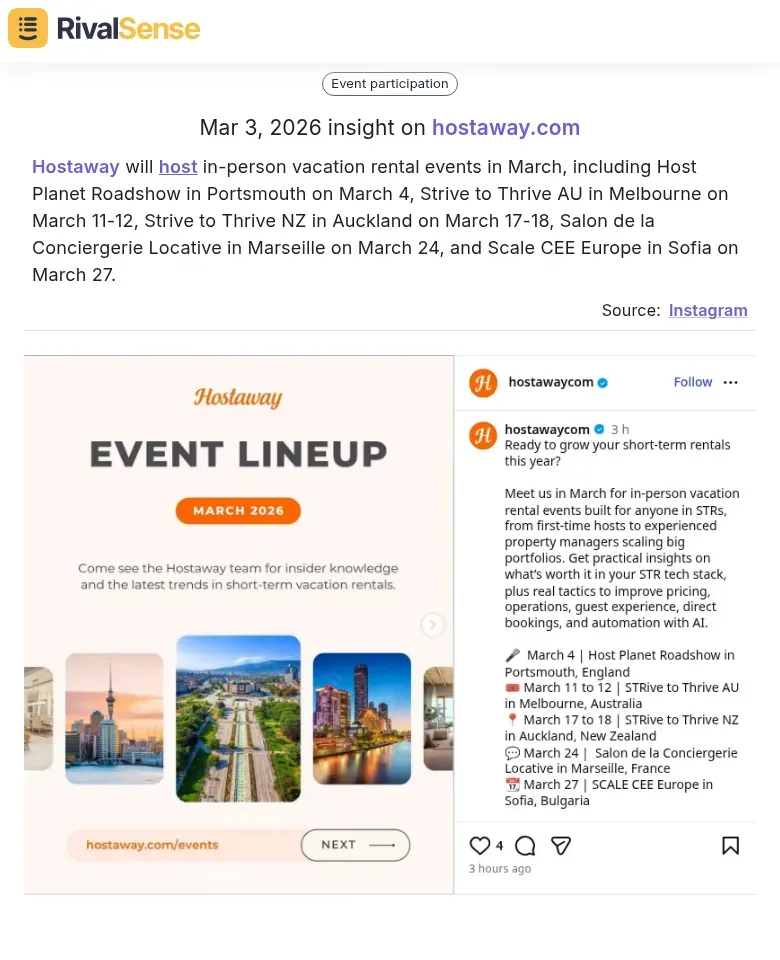
Example from RivalSense: Hostaway will host in-person vacation rental events in March, including Host Planet Roadshow in Portsmouth on March 4, Strive to Thrive AU in Melbourne on March 11-12, Strive to Thrive NZ in Auckland on March 17-18, Salon de la Conciergerie Locative in Marseille on March 24, and Scale CEE Europe in Sofia on March 27. This insight is valuable because it shows where a competitor is investing in community engagement and regional market penetration, helping you anticipate their moves and identify opportunities for your own strategy.
Create a checklist to leverage event insights:
- Record all competitor event topics and locations
- Identify recurring themes and regional clusters
- Map these to your content calendar gaps
- Develop counter-messaging content around industry buzz
For Instagram specifically, capture event booth photos, speaker quotes, and attendee testimonials from competitor events. Monitor event hashtags to understand audience engagement patterns and schedule your content to capitalize on industry trends.
Community Building Insights: Decoding Audience Engagement Tactics
Community building on Instagram requires more than just posting content—it demands strategic engagement tactics that convert followers into loyal customers. Analyzing competitors' community strategies can reveal effective methods for fostering audience loyalty and driving conversions. Here's how to decode their approaches for actionable insights:
1. Decode Competitor Events & Gatherings
Track competitors' Instagram Stories, Reels, and event hashtags to identify specialized gatherings like webinars, workshops, or pop-ups. Note attendance metrics, engagement rates, and post-event content to understand what resonates with their audience.
Example from RivalSense: Bezrindas.lv organizes the Ancient & Divine Dzimumballe event on March 19, 2026, at Rock Cafe in Riga, featuring performances by DJ PM2AM, Linli and Yam, Athodi Brīnumzeme, and Kolūri, with tickets available on their website. This type of insight is valuable because it highlights how competitors use unique, culturally relevant events to engage specific communities, offering ideas for your own targeted gatherings.

2. Analyze Performance Partnerships
Monitor competitors' collaborations with influencers, brands, or entertainers. Use tools to track partnership performance—look for spikes in engagement, follower growth, or lead generation. For example, a B2B SaaS company partnering with industry experts for live Q&As can reveal effective collaboration models.
3. Leverage Ticket-Based Engagement Models
Study competitors using ticketed events (e.g., paid webinars, exclusive workshops) for lead generation. Analyze pricing, audience size, and post-event nurturing to gauge what works for premium offerings.
Actionable Takeaway: Build a community engagement dashboard to track these metrics weekly. Focus on qualitative insights—like emotional triggers used by competitors—to refine your own strategy for key account growth.
Social Responsibility and Market Positioning: Strategic Response Analysis
Social responsibility has become a critical differentiator in today's market, influencing brand perception and customer loyalty. To leverage this for key account growth, systematically monitor how competitors respond to social and political developments, as their actions can reveal alignment with target audiences and potential gaps in the market.
Track competitors' public statements, campaign pivots, and community engagement during significant events. This analysis helps you understand their brand values and identify opportunities for authentic positioning. For instance, targeted promotions during social movements can show how competitors cater to specific demographics or regions.
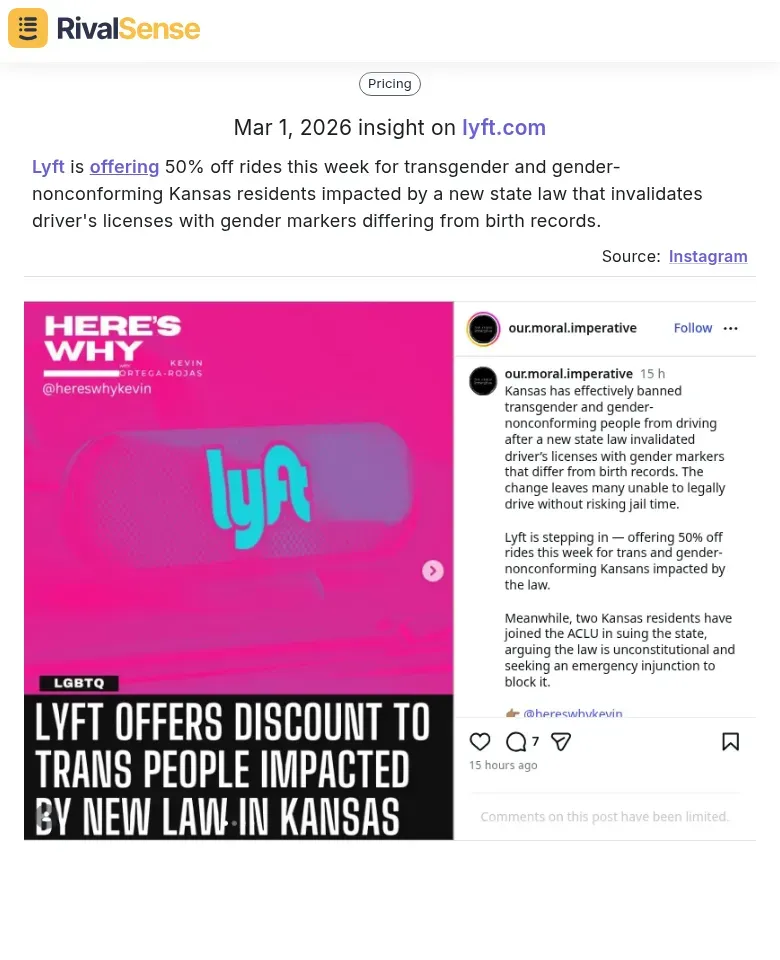
Example from RivalSense: Lyft is offering 50% off rides this week for transgender and gender-nonconforming Kansas residents impacted by a new state law that invalidates driver's licenses with gender markers differing from birth records. This insight is valuable because it demonstrates how competitors can quickly respond to regulatory changes with supportive initiatives, enhancing their market positioning and community trust.
Practical steps to analyze social responsibility:
- Create a tracking spreadsheet for competitor initiatives
- Monitor hashtag usage and engagement during social movements
- Analyze demographic targeting through ad libraries and audience insights
- Document crisis response timelines and community feedback
- Identify gaps where your brand can authentically contribute
Key insight: Authentic, consistent social positioning builds deeper connections than opportunistic campaigns. Use competitor analysis to identify underserved communities and causes aligned with your brand values for genuine impact.
Actionable Framework: Turning Competitor Insights into Growth Strategies
Transforming competitor insights into tangible growth requires a structured approach that moves beyond imitation to strategic innovation. By systematically analyzing competitors' strengths and weaknesses, you can develop differentiated strategies that capture market attention and drive key account acquisition. Here's a 3-step framework to guide your efforts.
First, implement systematic tracking: categorize competitors into tiers (direct, adjacent, audience distractors) and monitor weekly using tools or spreadsheets. Track content themes, format performance, posting frequency, and engagement quality—not just vanity metrics like follower counts.
Second, build content calendars based on competitor patterns: identify when competitors post high-performing content, spot seasonal trends, and schedule your posts to fill gaps in their activity. For example, if competitors dominate Reels on weekdays, test carousel educational content on weekends to capture attention during lulls.
Third, implement differentiated strategies by analyzing competitor weaknesses: if they overuse certain hashtags, experiment with branded tags; if their engagement skews toward likes but lacks saves, create save-worthy tutorials that provide lasting value.
Monthly Audit Checklist:
- Review competitor top-performing posts
- Map content gaps in themes and formats
- Test 2-3 new strategies based on insights
- Measure performance against competitor benchmarks
This approach ensures you're not copying but strategically outmaneuvering competitors for sustainable account growth.
Implementation Roadmap: Tools and Metrics for Continuous Monitoring
To maintain a competitive edge, continuous monitoring of Instagram competitors is essential, requiring the right tools and clear metrics. Establishing a routine for data collection and analysis helps you stay agile and responsive to market shifts. Start by selecting tools that align with your budget and needs, such as RivalSense, which tracks engagement rates, follower growth, content themes, and hashtag performance across competitors in real-time.
For smaller budgets, combine Instagram Insights with manual tracking using spreadsheets to log key data points. Look for tools that offer alerts for competitor announcements, product launches, or viral content, enabling proactive strategy adjustments.
Establish these KPIs for benchmarking:
- Engagement rate: (likes + comments) ÷ followers
- Follower growth velocity: percentage change over time
- Content mix analysis: performance of Reels vs. posts vs. Stories
- Hashtag effectiveness: reach and engagement per hashtag
- Audience sentiment: qualitative analysis of comments
Track these KPIs weekly to spot trends and anomalies. Create a reporting cycle:
- Daily: check alerts for competitor moves
- Weekly: update KPI dashboards
- Monthly: analyze content themes and audience shifts
- Quarterly: conduct deep-dive competitive analysis
Use findings to refine your content calendar, adjust posting times, and test new formats. Pro tip: Set up Google Alerts for competitor mentions outside Instagram to capture broader market intelligence and context.
Conclusion: Leverage Competitor Insights for Accelerated Growth
Mastering Instagram competitor analysis equips you with the insights needed to outmaneuver rivals and capture key accounts in the B2B space. By focusing on events, community building, social responsibility, and systematic tracking, you can transform competitive intelligence into actionable growth strategies. To streamline this process, consider using specialized tools that automate monitoring and deliver actionable insights.
Ready to put these strategies into practice? Try out RivalSense for free at https://rivalsense.co/ to get your first competitor report today. RivalSense tracks competitor product launches, pricing updates, event participations, partnerships, regulatory aspects, management changes, and media mentions across websites, social media, and registries—delivering all in a weekly email report to help you stay ahead effortlessly.
📚 Read more
👉 Predictive Cybersecurity Analysis: Key Account Tracking for Competitive Edge
👉 Step-by-Step Guide: Track Competitor Partnerships, Clients, and Executive Moves
👉 How to Analyze Competitor Innovations: A Case Study on IXI's Autofocus Eyewear
👉 The Ultimate Guide to Key Account Management Forums: Practical Strategies for 2026
👉 Analyzing Competitor Loyalty Programs to Boost Warehouse Productivity