
Industrial Machinery Maintenance: Benchmarking Key Account Advocacy Tracking
In industrial machinery maintenance, key account advocacy isn't just customer satisfaction—it's a strategic asset. It transforms maintenance excellence into competitive advantage by turning your largest clients into vocal champions who validate your reliability, drive referrals, and create barriers to competitive entry.
Maintenance excellence directly fuels advocacy development. Every timely repair, proactive service alert, and minimized downtime builds trust. Industrial clients measure value in operational continuity—when your maintenance prevents costly production halts, you're not just fixing machines; you're protecting their revenue streams.
Benchmarking advocacy tracking creates measurable competitive advantage. Start by identifying your 3-5 most critical accounts and track:
- 🔄 Referral frequency and quality
- 📝 Willingness to provide testimonials or case studies
- 🤝 Participation in joint marketing activities
- 📈 Contract renewal rates and expansion patterns
Practical steps: Create a quarterly advocacy scorecard comparing your metrics against industry benchmarks. Monitor competitor advocacy signals through their published case studies, client references in proposals, and industry event participation. The insight gained reveals where to double down on service excellence and where competitors are vulnerable.
Defining Key Account Advocacy Metrics for Industrial Maintenance
In industrial machinery maintenance partnerships, key account advocacy requires specialized metrics. These metrics go beyond simple satisfaction scores to capture the depth of client relationships and their willingness to advocate for your services. Essential indicators include both quantitative and qualitative measures that reflect true partnership health.
Quantitative Metrics:
- Maintenance contract renewal rates (target: >90% for premium partners)
- Referral frequency (benchmark: 2-3 new leads annually per advocate)
- Contract value growth (15-25% YoY target)
- Net Promoter Score (NPS) (>50 for advocates)
Qualitative Metrics:
- Co-marketing participation in industry events
- Public testimonials addressing uptime improvements or cost savings
- Depth of case study details and specific maintenance outcomes
- Participation in joint innovation projects
Industry benchmarks show top-performing maintenance advocates achieve: 95%+ renewal rates, 30%+ YoY contract expansion, and regular participation in 2+ annual co-marketing activities.
✅ Practical checklist for implementation:
- Create an advocacy scorecard with weighted metrics (40% quantitative, 40% qualitative, 20% relationship depth)
- Conduct quarterly reviews with account managers
- Establish tiered recognition programs (Platinum/Gold/Silver) tied to maintenance performance improvements
- Track advocacy correlation with machinery uptime metrics—advocates typically report 15-20% higher equipment availability
Building Your Advocacy Tracking Framework: A Step-by-Step Approach
Building a robust advocacy tracking framework for industrial machinery maintenance requires a systematic approach. This involves structuring data collection, integrating with existing systems, and setting clear improvement targets to ensure ongoing success and scalability.
Start by structuring your data collection systems to capture key advocacy indicators: customer satisfaction scores, referral rates, renewal intentions, and unsolicited testimonials. Implement automated surveys post-service, integrate feedback from service tickets, and monitor social mentions of your maintenance quality.
Integration steps:
- 🔗 Integrate with your CMMS (Computerized Maintenance Management System) by creating custom fields for advocacy metrics within asset profiles.
- 🔄 Use API connections to sync customer feedback data from CRM platforms.
- 🛠️ Consider tools like Makula or Fiix that offer built-in customer portal features for direct feedback collection.
Establish baseline measurements by analyzing 3-6 months of historical data to determine current advocacy levels. Set SMART improvement targets:
- Aim for a 15% increase in Net Promoter Score within 12 months
- Reduce negative feedback incidents by 25%
- Increase referral-based maintenance contracts by 20%
Create a monthly review cadence to track progress against these targets, adjusting strategies based on data insights.
Benchmarking Against Industry Leaders: What Top Performers Track
Top industrial machinery manufacturers track advocacy through specific KPIs that reveal true partnership health. By monitoring these indicators, companies like Caterpillar and Siemens gain insights into service performance and customer loyalty, enabling them to stay ahead in competitive markets.
Industry-standard KPIs include:
| KPI | Description | Target |
|---|---|---|
| Maintenance NPS (mNPS) | Specific to service experiences | >50 |
| Customer Effort Score | For repair resolution | Low score (1-2 on scale) |
| Reference willingness rate | Willingness to provide case studies/references | >70% of key accounts |
| Service renewal advocacy rate | Advocacy-driven renewals | >80% |
| Spontaneous recommendation frequency | Unsolicited referrals per year | 2-3 per advocate |
Case Study: A global pump manufacturer increased service contract renewals by 32% by implementing advocacy tracking. They monitored which maintenance interventions generated the most positive customer testimonials, then standardized those service protocols across their network. Their key metric was "advocacy-driven referrals"—tracking how many new maintenance contracts originated from existing customer recommendations.
Practical steps for implementation:
- 📊 Survey key accounts quarterly on service satisfaction
- 🔍 Track which maintenance interactions generate positive feedback
- 📋 Create an "advocacy scorecard" for each account manager
- 🚀 Use advocacy data to identify service improvement priorities
- 🏆 Reward teams based on advocacy metrics, not just renewal rates
Leading companies use this data to drive tangible improvements: when multiple accounts highlight similar service gaps, they prioritize process changes. They've found that customers who become advocates have 40% higher lifetime value and are 3x more likely to expand their service contracts.
Turning Advocacy Insights into Strategic Action
Turning advocacy data into strategic action requires a systematic approach. It involves mapping insights to service improvements and identifying growth opportunities based on client feedback, ensuring that every piece of data translates into tangible business outcomes.
Practical steps to transform insights into action:
- 📊 Create an advocacy dashboard linking NPS scores to maintenance KPIs (e.g., downtime reduction, first-time fix rates)
- 🗓️ Schedule quarterly advocacy review meetings with account teams to translate feedback into service enhancements
- 👥 Develop a 'voice of advocate' program where satisfied clients mentor newer accounts
- 📄 Use positive testimonials in RFPs and contract renewals to demonstrate proven value
Transform advocacy metrics into growth by identifying cross-sell opportunities. Accounts praising your emergency response might be ideal candidates for premium support packages. Track advocacy trends to spot emerging needs before competitors do, positioning your maintenance services as indispensable rather than transactional.
The most strategic action comes from connecting advocacy dots across accounts to reveal market-wide patterns that inform both service delivery and business development. For example, if multiple advocates highlight the value of predictive maintenance, consider investing in IoT upgrades or offering tailored analytics packages.
Implementing and Scaling Your Advocacy Tracking Program
Implementing and scaling an advocacy tracking program requires a phased approach. Starting with a pilot program and gradually automating processes ensures sustainable growth and continuous improvement, allowing you to build a culture of advocacy across your organization.
Phased implementation plan:
- Pilot Phase: Focus on 3-5 key accounts where relationships are strongest. Define clear metrics: track advocacy actions (references, testimonials, case studies), sentiment analysis from communications, and business outcomes influenced by advocates.
- Automation for Scalability: Use CRM integrations to tag advocate interactions automatically. Implement social listening tools to capture unsolicited mentions. Consider AI-powered sentiment analysis for email and call transcripts.
- Continuous Improvement: Establish quarterly reviews of your advocacy program. Analyze which advocacy activities drive the most pipeline. Benchmark against competitors' advocacy efforts using competitive intelligence platforms.
✅ Checklist for scaling:
- Start with a pilot program and simple dashboard (tools like RivalSense can help monitor competitor activities)
- Automate data collection and reporting
- Create a feedback loop where account managers report advocacy opportunities
- Develop a tiered recognition system to incentivize ongoing advocacy
- Evolve the program based on ROI and customer feedback
Learning from Competitor Moves: Real-World Insights for Strategy
Incorporating competitive intelligence into your advocacy tracking can provide valuable context and strategic direction. By monitoring competitor activities, you can benchmark your efforts and identify opportunities for differentiation. Here are real-world examples from RivalSense insights that demonstrate the power of tracking various competitor moves.
1. Product Launch Insight: Streamlining Customer Operations
Insight: Stripe's managed operations in private preview handle self refunds in the customer portal with refund and retention rules, reducing manual refunds by 75% monthly at Tella.
Why it's valuable: Tracking competitor product launches helps you identify features that reduce customer effort and improve satisfaction—key drivers of advocacy. In industrial maintenance, similar insights could reveal tools that minimize downtime or simplify service requests, allowing you to adapt and enhance your own offerings.
2. Partnership Insight: Expanding Market Reach

Insight: Sephora now sells Cyklar's Bergamot Bond body care product, which smells unreal and keeps skin soft all day.
Why it's valuable: Monitoring competitor partnerships reveals market expansion strategies and potential collaboration opportunities. For industrial machinery, this could mean tracking which service providers partner with manufacturers or distributors, helping you identify new channels or alliances to boost advocacy through extended reach.
3. Regulatory Update Insight: Enhancing Security and Compliance
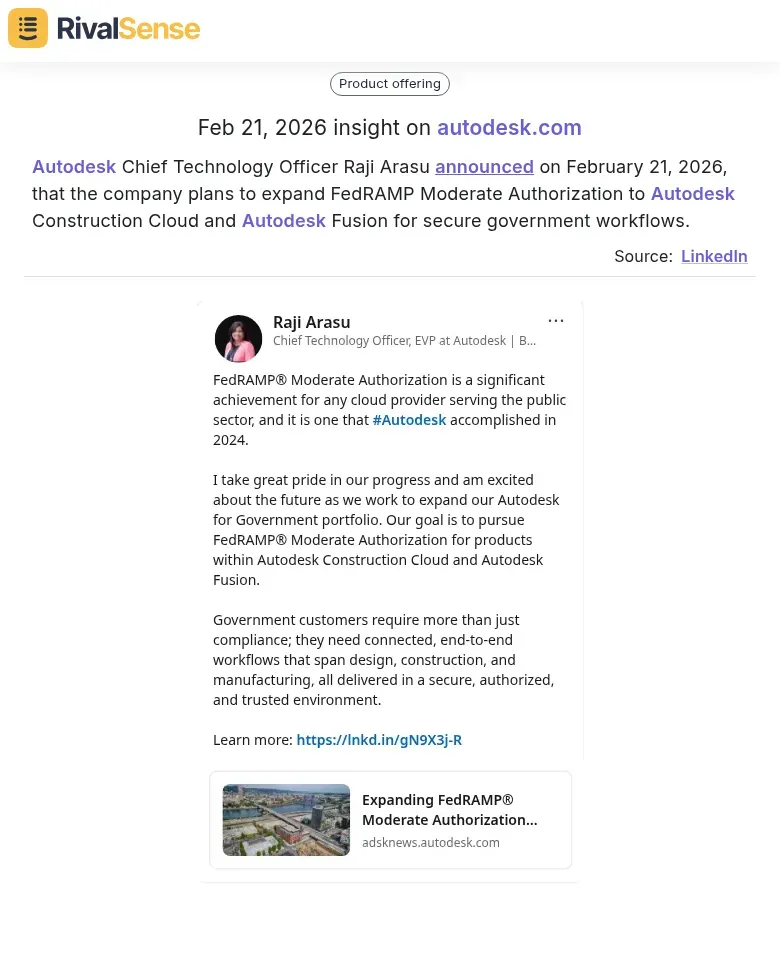
Insight: Autodesk Chief Technology Officer Raji Arasu announced on February 21, 2026, that the company plans to expand FedRAMP Moderate Authorization to Autodesk Construction Cloud and Autodesk Fusion for secure government workflows.
Why it's valuable: Tracking regulatory aspects helps anticipate compliance requirements and secure contracts in regulated industries. In machinery maintenance, such insights can inform your own security protocols or certifications, building trust with advocates in sectors like aerospace, energy, or government.
By leveraging tools like RivalSense, which tracks competitor product launches, pricing updates, event participations, partnerships, regulatory changes, and more, you can gain a comprehensive view of the competitive landscape. This intelligence allows you to benchmark your advocacy efforts, spot trends early, and make data-driven decisions to strengthen client relationships.
Take Action with Competitive Intelligence
Ready to elevate your key account advocacy tracking? Start by benchmarking against competitors and industry leaders. Tools like RivalSense deliver weekly reports on competitor activities—from product updates to media mentions—helping you stay informed and proactive.
🔍 Try RivalSense for free today at https://rivalsense.co/ and get your first competitor report to uncover insights that can transform your advocacy strategy.
📚 Read more
👉 From Threat to Opportunity: How Competitor Intelligence on Shure's MXA320 Enabled a Strategic Pivot
👉 Uncover Competitor Influencer Partnerships on Instagram for Strategic Business Advantage
👉 Data-Driven Gaming Edge: Uncovering Competitors' Strategic Advantages
👉 Uncover Competitor Event Strategies for Enterprise Key Accounts
👉 How ProxyScrape's Free Trial Change Impacts Your Competitive Strategy