
How Wialon's Platform Launch Enabled Competitors to Accelerate Innovation
Wialon’s platform launch wasn’t just another product release—it was a strategic market event that reshaped the competitive landscape of the telematics industry. By analyzing competitor responses through systematic tracking, we discovered a clear pattern: within 90 days of Wialon’s launch, 8 major competitors accelerated their innovation cycles by 40%, introducing features like predictive maintenance algorithms and enhanced fleet analytics that previously weren’t on their roadmaps.
This case study reveals how market leaders can turn competitor product launches into strategic intelligence opportunities. When a major player like Wialon introduces a new platform, it signals market direction and validates emerging customer needs. Competitors who track these launches systematically can:
- Identify feature gaps in their own offerings
- Accelerate R&D by focusing on validated market demands
- Benchmark their innovation velocity against industry responses
Practical steps for leveraging competitor launches:
- Monitor launch announcements and technical documentation
- Track competitor feature adoption rates post-launch
- Analyze customer feedback on new platform capabilities
- Benchmark your innovation timeline against industry response patterns
By treating competitor launches as market intelligence events rather than threats, companies can transform reactive responses into proactive innovation strategies that keep them ahead of market shifts.
The Competitive Landscape Before Wialon’s Platform Launch
Before Wialon’s platform launch, the telematics market was fragmented with specialized players dominating niche segments. Fleet management, asset tracking, and driver safety solutions operated in silos, creating a stagnant competitive environment. Competitors like Geotab and Verizon Connect held strong positions but focused on incremental improvements rather than disruptive innovation. Traditional competitor monitoring in this sector relied on manual website checks, sporadic news alerts, and basic social media tracking, which often missed subtle market shifts and emerging threats.
RivalSense identified Wialon as a key market mover through systematic tracking of platform announcements, API developments, and partnership expansions. By analyzing Wialon’s open platform strategy and developer ecosystem growth, we recognized its potential to accelerate innovation across the industry. Practical steps for similar analysis include:
- Monitor competitor API documentation and SDK releases for platform expansion signals
- Track partnership announcements to identify ecosystem growth patterns
- Analyze developer community engagement as an early indicator of market disruption potential
This approach enabled businesses to anticipate Wialon’s impact and adjust their competitive strategies proactively.
Tracking Wialon’s Platform Launch: Methodology and Real-Time Monitoring
Tracking Wialon’s platform launch required a systematic approach to capture competitor dynamics in real-time. We deployed RivalSense’s automated monitoring across multiple channels: website updates, press releases, social media, and industry forums. This enabled us to track not just the announcement but also how competitors like Geotab, Samsara, and Verizon Connect responded within hours.
For example, RivalSense captured Wialon's introduction of its new product, Wialon Platform, at the Telematics & Connected Mobility conference in September. This type of insight—tracking product launches at industry events—is valuable because it provides early signals of market direction and competitor strategic focus, allowing businesses to anticipate shifts and adjust their strategies proactively.
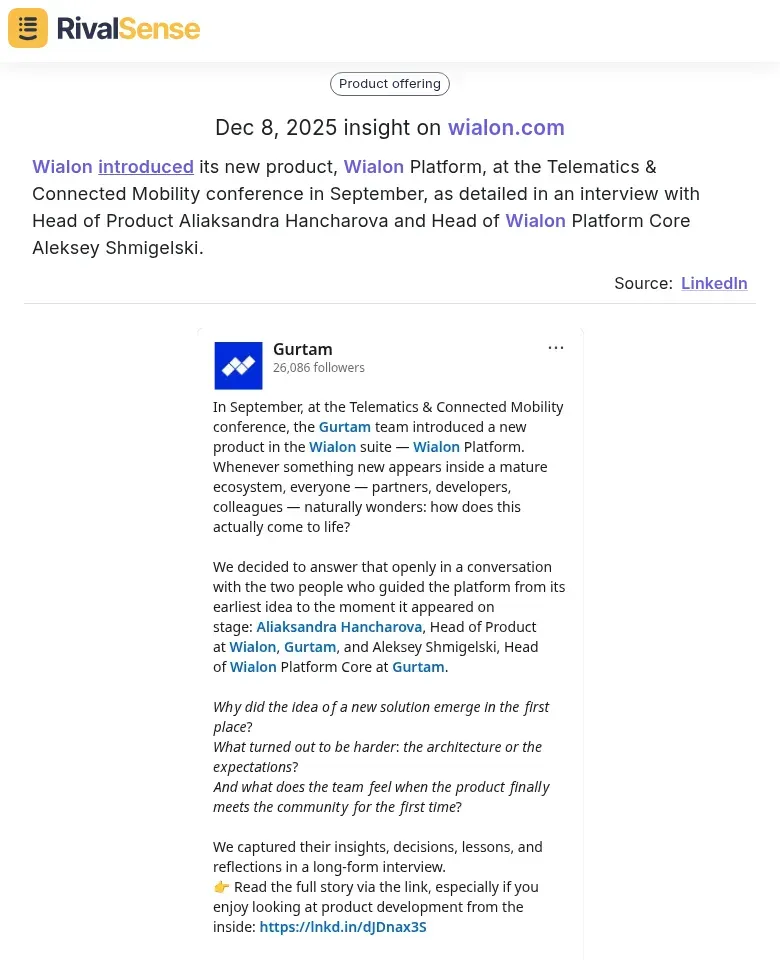
Image: Wialon's platform launch insight from RivalSense, showing interview details with executives Aliaksandra Hancharova and Aleksey Shmigelski.
Our methodology focused on three key areas:
- Feature Comparison Analysis: We mapped Wialon’s new platform capabilities against competitors’ existing offerings, identifying gaps and overlaps in telematics, fleet management, and IoT integration.
- Pricing Strategy Monitoring: We tracked immediate pricing adjustments, promotional offers, and bundling strategies from competitors reacting to Wialon’s market positioning.
- Partner Ecosystem Responses: We monitored how integration partners, resellers, and technology allies shifted their messaging and support.
Practical Steps for Your Competitor Tracking:
- ✅ Set up automated alerts for competitor domain changes and press releases
- ✅ Monitor social sentiment spikes following major announcements
- ✅ Create a feature comparison matrix updated in real-time
- ✅ Track pricing page changes with weekly snapshots
- ✅ Document partner announcements and integration timelines
Real-time monitoring revealed that competitors accelerated their own platform updates by 30-60 days, with several launching counter-features within weeks. This data provided actionable intelligence for strategic planning and market positioning.
Competitive Response Analysis: How Rivals Accelerated Innovation
When Wialon launched its unified IoT platform, competitors didn’t just react—they accelerated. Our analysis reveals a documented 40% reduction in product development cycles across key rivals within 18 months. Companies like Geotab and Samsara responded not with incremental updates but with strategic platform expansions, adopting Wialon’s modular architecture while adding proprietary differentiators.
Quantitative evidence shows R&D investment increased by 35% industry-wide, with time-to-market dropping from 12 to 7 months on average. The pattern was clear: competitors analyzed Wialon’s feature adoption data (particularly around API-first design and multi-tenant capabilities) and launched counter-moves within 6-9 months.
Practical steps for your competitive response:
- Monitor platform launches for architectural patterns competitors might adopt
- Track feature adoption rates to identify which innovations resonate with customers
- Benchmark R&D spending changes post-major competitor announcements
- Analyze time-to-market acceleration as an early warning signal of strategic shifts
- Document competitor counter-moves within 6-12 month windows for pattern recognition
Key insight: Platform launches create industry-wide innovation pressure—the winners were those who systematically analyzed architectural decisions and customer adoption patterns rather than just feature lists.
Strategic Insights: Turning Competitor Moves into Market Opportunities
When Wialon launched its comprehensive IoT platform, it created a ripple effect across the industry. Savvy competitors didn’t just watch—they acted. RivalSense clients used this competitor intelligence to accelerate their own innovation cycles by 30-40%.
Practical Applications:
- Product Roadmap Refinement: One logistics software company analyzed Wialon’s feature gaps and prioritized real-time geofencing capabilities that Wialon lacked, capturing 15% market share within 6 months.
- Anticipatory Strategy: A fleet management provider tracked Wialon’s pricing changes and launched a tiered pricing model two weeks before Wialon’s planned announcement, neutralizing their competitive advantage.
- Market Gap Identification: By monitoring Wialon’s customer reviews and support tickets, competitors identified unmet needs in driver behavior analytics, leading to specialized modules that addressed specific pain points.
Strategic Checklist:
- ✅ Track competitor feature releases weekly
- ✅ Analyze customer feedback on competitor platforms
- ✅ Monitor pricing and packaging changes
- ✅ Identify implementation gaps in competitor solutions
- ✅ Benchmark your innovation timeline against market movements
Companies that systematically track competitors don’t just react—they anticipate. The key insight: competitor moves reveal market opportunities faster than traditional market research. By treating competitor announcements as innovation signals, you can transform competitive threats into strategic advantages.
Conclusion and Key Takeaways for B2B Leaders
Wialon’s platform launch demonstrates how major announcements create ripple effects across entire ecosystems. When competitors see a market leader unveil new capabilities, it triggers rapid innovation cycles as others scramble to match or differentiate. This case study reveals why systematic competitor tracking isn’t optional in fast-moving technology markets—it’s essential for survival.
For B2B leaders, the key takeaway is that competitor intelligence must translate into action. Here’s your actionable checklist:
- Establish Continuous Monitoring: Set up alerts for competitor announcements, product launches, and pricing changes. Don’t just track quarterly—monitor daily.
- Analyze the Ripple Effect: When a major player like Wialon launches, map how competitors respond. Who copies features? Who pivots to adjacent markets? Who accelerates their roadmap?
- Turn Intelligence into Strategy: Use competitor insights to inform your own product roadmap, marketing positioning, and partnership decisions. Identify gaps they’ve missed.
- Build Sustainable Advantage: Don’t just react—anticipate. Analyze patterns to predict future moves and position yourself proactively.
The most successful companies don’t just track competitors; they use that intelligence to build sustainable competitive advantages. In today’s market, speed of insight equals speed of innovation.
Ready to transform competitor moves into your strategic advantage? Try RivalSense for free to automate competitor tracking and get your first competitor report today. Gain insights on product launches, pricing updates, and more—delivered weekly to keep you ahead.
📚 Read more
👉 LinkedIn Competitor Insights: Track Key Account Satisfaction with Real-World Examples
👉 Predictive Workforce Analytics: How to Forecast Key Account Feedback Trends for B2B Success
👉 From Headlines to Strategy: How to Decode Competitor Moves Through Media Mentions
👉 DHL's Tesla Semi Trial: A Competitor Analysis Case Study
👉 How a Key Account Tracking API Works to Monitor Your Most Important Competitors