
How Top Brands Use Twitter to Analyze Competitor Customer Support
Twitter has emerged as the ultimate real-time competitor intelligence platform, offering unprecedented visibility into how competitors handle customer support. Unlike quarterly reports or delayed market analyses, Twitter provides immediate insights into customer complaints, response times, and service quality—often revealing patterns 10-15x faster than traditional sources. Top brands leverage this by monitoring competitor mentions, tracking response patterns, and identifying recurring pain points that customers experience with rival services.
Practical Tip: Set up automated Twitter monitoring for 3-5 key competitors using social listening tools. Create a simple checklist:
✅ Track competitor support handles and brand mentions
✅ Monitor response times and sentiment patterns
✅ Identify recurring customer complaints
✅ Analyze how competitors handle escalations
✅ Document service gaps and opportunities
This shift from reactive to proactive analysis allows businesses to anticipate market needs, improve their own support processes, and identify competitive advantages before formal announcements. By watching how competitors handle support issues in real-time, you can spot weaknesses to exploit and strengths to emulate, transforming social listening into strategic advantage.
Monitoring Product Adoption and Usage Patterns
Tracking how competitors' products are adopted and used in the market is essential for refining your own offerings. Twitter serves as a rich source of real-time customer feedback, revealing transaction trends and usage patterns that traditional analytics might miss. By analyzing mentions of purchases, upgrades, and renewals, you can identify which features drive adoption and where competitors gain traction.
Example: RivalSense tracked that Stripe's stablecoin payment transaction volumes on Polygon grew from less than $1 million per month in late 2024 to peaks of $8-9 million in 2025. Insights into transaction volume trends like this are valuable for business strategy as they highlight competitor growth and market acceptance, enabling you to adjust your product roadmaps and marketing efforts accordingly.

Practical Steps:
- Set up Twitter lists for competitor customer support accounts and product handles
- Use advanced search operators: "just bought [competitor product]" OR "switched to [competitor]"
- Track frequency of purchase mentions weekly to identify growth spikes
- Monitor sentiment around specific features to gauge satisfaction levels
Analyze usage patterns by examining how customers describe their experience. Complaints about complexity indicate adoption barriers, while praise for specific workflows reveals successful implementations. When multiple users mention similar usage scenarios, it uncovers emerging market opportunities your competitors are capturing.
Checklist for Usage Pattern Analysis:
- Document recurring customer pain points mentioned in support interactions
- Track feature-specific mentions to identify most-used capabilities
- Note integration discussions to understand ecosystem adoption
- Monitor hashtag adoption for new product versions or updates
💡 Tip: Use social listening tools to automate tracking of competitor product mentions and set alerts for spikes in transaction-related conversations. Compare adoption timelines with your own product releases to identify strategic gaps.
Analyzing Strategic Partnerships and Ecosystem Development
Strategic partnerships are a clear indicator of where competitors are focusing their efforts and expanding their ecosystems. Monitoring these collaborations on Twitter can reveal market positioning and future directions. When competitors announce partnerships, it often signals entry into new segments or enhancement of existing offerings.
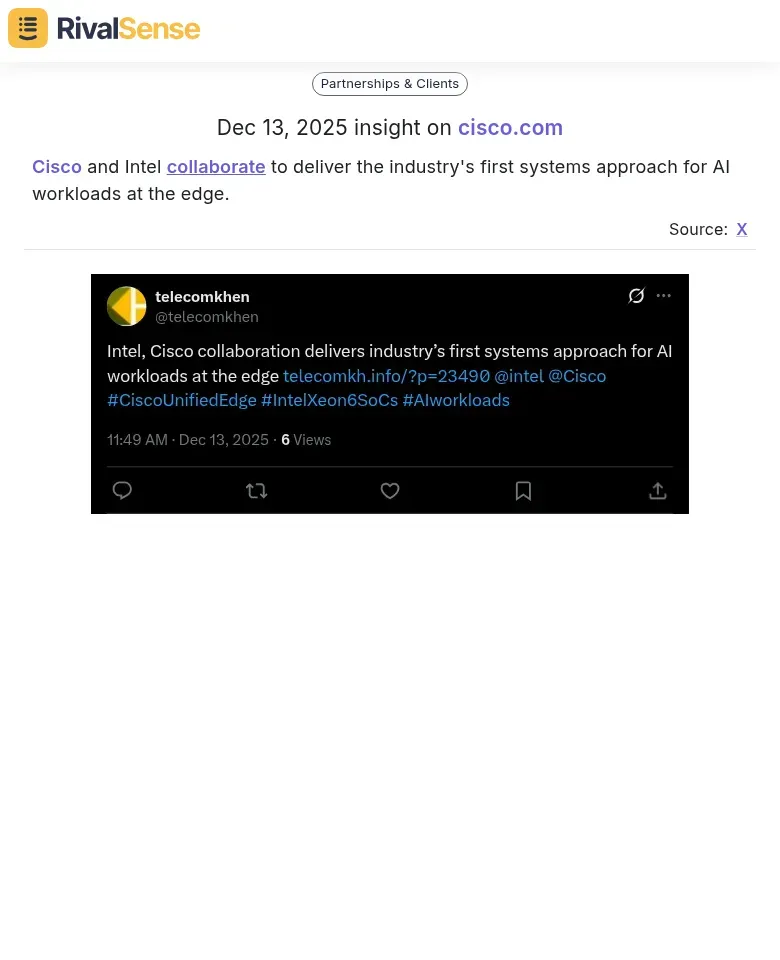
Example: RivalSense identified that Cisco and Intel collaborated to deliver the industry's first systems approach for AI workloads at the edge. Tracking such partnerships is valuable for business strategy as it helps anticipate competitor moves into emerging markets, allowing you to prepare counter-strategies or explore similar collaborations.
Practical steps:
- Create Twitter lists for competitor executives and partnership accounts
- Set up alerts for "partner," "collaboration," and "integration" keywords
- Map partnership frequency by industry vertical quarterly
- Analyze joint solution announcements to identify market gaps
Monitor how partnerships trigger feature releases and pricing changes. Use tools like RivalSense to automate tracking of ecosystem developments and anticipate competitive offerings before launch.
Tracking Product Launches and Limited Edition Releases
Product launches and limited edition releases are critical moments that reveal competitor innovation and marketing tactics. Twitter provides immediate feedback on these events, from customer excitement to complaints. By analyzing launch strategies, you can glean insights into timing, messaging, and demand.
Example: RivalSense reported that Xbox launched a Game of the Year-inspired controller for Clair Obscur: Expedition 33 through Xbox Design Lab on December 12. Monitoring such launches is valuable for business strategy as it helps you understand competitor product cycles, marketing effectiveness, and customer reception, informing your own launch planning.

Practical steps:
- Set up Twitter Lists for competitor accounts and monitor daily
- Track launch hashtags and engagement metrics (retweets, replies, likes)
- Analyze customer responses: Identify recurring complaints or praise patterns
- Note timing windows between announcement and availability
- Monitor limited edition sell-out times to gauge demand
Key insights: Fast sell-outs indicate strong demand, while negative feedback reveals product weaknesses. Compare launch strategies across competitors to identify industry trends. Use Twitter's advanced search to filter by date ranges and engagement levels for deeper analysis.
Practical Framework for Twitter Competitor Support Monitoring
Implementing a systematic approach to Twitter monitoring ensures you capture actionable insights consistently. Start by defining clear objectives and setting up the right tools to streamline data collection. A structured framework helps in organizing information and deriving meaningful patterns from competitor interactions.
To begin, set up automated alerts using tools like TweetDeck or specialized monitoring platforms. Create dedicated columns for each competitor's support handles, customer complaints, and brand mentions. Use Boolean operators (e.g., "@competitor AND (help OR issue OR support)") for precise tracking.
Second, build specialized Twitter lists:
- Competitor Support Accounts (official handles)
- Competitor Customer Conversations (users discussing the brand)
- Industry Influencers who comment on customer service
Combine with keyword tracking for product names, common support terms, and competitor-specific hashtags.
Third, implement sentiment analysis by categorizing tweets into: Positive (praise, resolutions), Negative (complaints, frustrations), and Neutral (questions, feature requests). Look for patterns: Are certain issues recurring? What's the response time? How do competitors handle escalations?
Practical checklist:
• Set daily/weekly review cadences
• Track response times and resolution rates
• Document common pain points and competitor solutions
• Monitor competitor support announcements and policy changes
• Benchmark against your own support performance
Turning Twitter Insights into Competitive Customer Support Advantages
Transforming raw Twitter data into strategic advantages requires deliberate action and integration into your business processes. By systematically analyzing competitor support interactions, you can identify best practices and avoid common pitfalls, enhancing your own customer service.
1. Develop Response Playbooks from Competitor Patterns
Analyze how competitors handle common issues on Twitter. Track their response times, tone, and resolution methods. Create your own playbooks that incorporate their best practices while avoiding their mistakes. For example, if competitors consistently move sensitive conversations to DMs within 30 minutes, set a 20-minute benchmark for your team. Document successful competitor scripts for handling complaints, returns, and technical issues.
2. Identify Service Gaps Through Competitor Feedback Analysis
Monitor competitor mentions for recurring complaints and unresolved issues. Use social listening tools to categorize feedback by theme (shipping delays, product defects, billing problems). Look for patterns where multiple customers mention the same problem without resolution. These gaps represent opportunities to differentiate your support. Create a quarterly report highlighting 3-5 key competitor weaknesses you can address.
3. Integrate Twitter Intelligence into Support Strategy
Train your team using real competitor examples. Conduct weekly reviews of competitor support interactions, discussing what worked and what didn't. Implement a competitive intelligence dashboard showing key metrics: competitor response times, resolution rates, and customer satisfaction indicators. Adjust your SLAs based on industry benchmarks you discover. Establish a feedback loop where support agents report competitor insights to product and marketing teams.
Practical Checklist:
- Monitor 3-5 key competitors daily using Twitter lists
- Track response times and resolution patterns weekly
- Document competitor scripts for common scenarios
- Identify recurring complaints in competitor mentions
- Share insights in weekly team meetings
- Update playbooks quarterly based on new patterns
- Benchmark your performance against competitor metrics
- Train new hires using competitor case studies
Take Action with Competitor Intelligence
Leveraging Twitter for competitor analysis is powerful, but it can be time-consuming to monitor multiple sources manually. To streamline this process and gain comprehensive insights, consider using automated tools like RivalSense. RivalSense tracks competitor product launches, pricing updates, event participations, partnerships, regulatory changes, management shifts, and media mentions across websites, social media, and registries, delivering a consolidated weekly email report.
Why not try it for free? Visit https://rivalsense.co/ to get your first competitor report today and start turning insights into competitive advantages for your B2B business.
📚 Read more
👉 Airbnb vs Hotels: Real-World Content Marketing Advantages Revealed
👉 Competitor Product Benchmarking: Actionable Insights for Key Account Management
👉 Decoding Competitor Pricing Moves: A Real-World Example from EmpMonitor
👉 Optimizing Key Account Management for Investment & Wealth Management Firms