
How to Turn Competitor Insights into Key Account Wins
In today's hyper-competitive B2B landscape, key account acquisition is no longer about guesswork or generic outreach. It's about strategic precision powered by competitor intelligence. When you understand your competitors' weaknesses, gaps, and blind spots, you transform market entry from risky speculation into calculated advantage.
Competitor analysis directly fuels key account wins by revealing where rivals are vulnerable. For example, if a competitor struggles with enterprise-level support, that's your opening to target their dissatisfied enterprise clients. When you identify gaps in their product roadmap, you can position your solution as the future-proof alternative.
Practical steps to start:
- Map competitor key accounts and identify pain points they're not addressing
- Analyze competitor reviews and customer complaints for recurring themes
- Monitor competitor pricing changes and feature limitations
- Track competitor executive movements and strategic shifts
Real-world example: A SaaS company discovered through competitor tracking that a rival was sunsetting a critical integration. They immediately targeted those affected accounts, offering a seamless migration path and won 15 enterprise clients in one quarter.
By turning competitor insights into actionable intelligence, you don't just compete—you strategically outmaneuver. The gap in their armor becomes your key account opportunity.
Learning from Competitor Market Moves: Timing, Location, and Expansion Patterns
Competitor expansion announcements reveal more than just new locations—they signal market validation and optimal entry windows. Understanding when and where competitors expand provides critical intelligence for your own market entry strategies. By analyzing their moves, you can identify optimal timing and locations for targeting key accounts.
When a competitor announces expansion into a region, analyze the timing: are they entering during peak seasons or economic upswings? This validates market readiness. For example, if a SaaS competitor expands to Europe in Q1, consider Q3 entry to capitalize on established demand while avoiding initial competition.
Map competitor store openings or service launches geographically using tools like RivalSense. Look for clusters in urban centers versus gaps in suburban or rural areas. These underserved zones represent low-hanging opportunities for key account targeting. Create a heatmap overlay to visualize density and identify white spaces.
Monitor competitor financial reporting cycles for strategic shifts. Tracking financial results, like earnings calls, is valuable because it reveals resource allocation and segment performance, helping you pivot your account targeting. For instance, RivalSense captured this insight on Purple's upcoming financial report:

Purple will report its fourth quarter and full year 2025 financial results on March 25, 2026.
If a competitor reports declining enterprise sales but increased SMB focus, pivot your account targeting toward larger enterprises they're neglecting. Set calendar alerts for earnings dates and review transcripts for clues on resource allocation.
Practical checklist:
- 📍 Track expansion announcements via news alerts and social media
- 🗺️ Plot locations on a map to identify geographic patterns
- ⏰ Note timing relative to market cycles and seasons
- 📊 Review financial reports for segment performance changes
- 🎯 Adjust account targeting based on competitor resource shifts
Timing your moves between competitor expansions allows you to ride validated demand waves while targeting accounts in overlooked areas they've deprioritized.
Decoding Competitor Product and Service Strategies for Account Differentiation
To decode competitor product and service strategies, start by analyzing their product launches and feature updates. This intelligence helps you identify gaps where your solution can excel, enabling precise differentiation for key accounts. By understanding their offerings, you can craft compelling value propositions that address unmet needs.
Create a competitive feature matrix comparing your offerings against theirs, identifying service gaps where you can excel. For example, if a competitor launches AI-powered analytics but lacks real-time reporting, position your solution as the comprehensive alternative.
Study competitor localization strategies by examining how they adapt content, pricing, and features for different markets. Look at their cultural adaptation approaches—do they translate content literally or adapt messaging for local nuances? Learn from their successes and failures to develop more effective market-specific strategies.
Analyze competitor pricing models and bundling strategies systematically. Tracking product expansions is valuable because it reveals new market segments and service enhancements you can counter or emulate. RivalSense identified this move by BoursoBank:
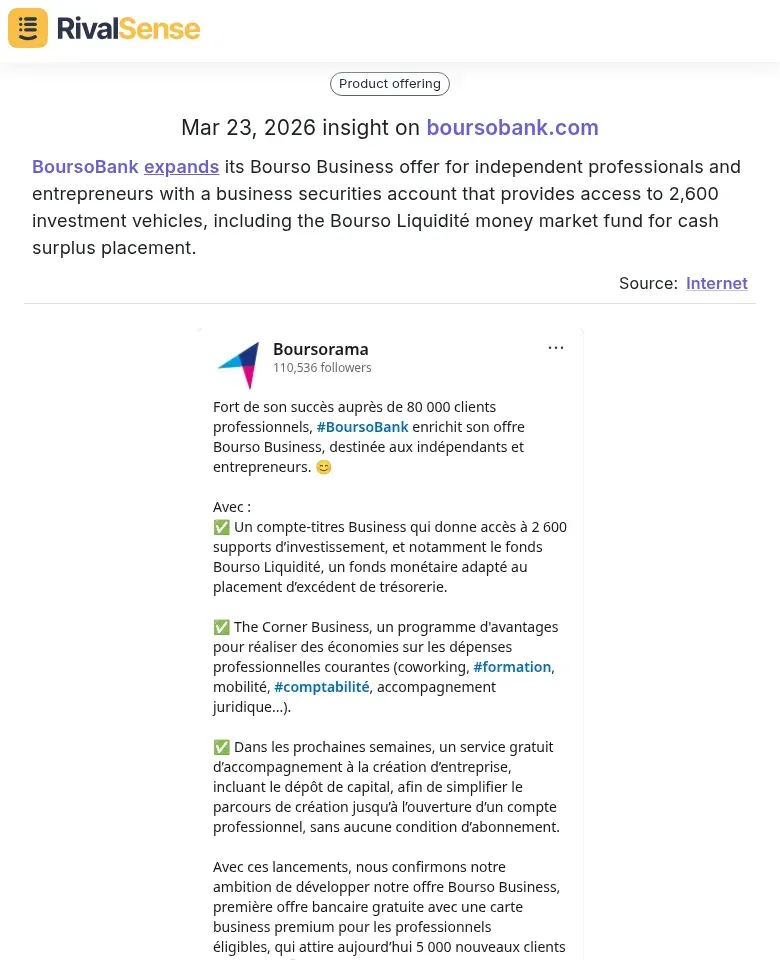
BoursoBank expands its Bourso Business offer for independent professionals and entrepreneurs with a business securities account that provides access to 2,600 investment vehicles, including the Bourso Liquidité money market fund for cash surplus placement.
Track their pricing changes, discount patterns, and how they package services. Create a pricing intelligence dashboard that monitors competitor moves in real-time. Look for opportunities where their bundling creates gaps—perhaps they bundle too many features at a premium price, leaving room for a more focused, affordable alternative.
Practical checklist:
- 🔍 Monitor competitor product announcements and release notes weekly
- 📝 Create a feature gap analysis spreadsheet with weighted scoring
- 💰 Analyze competitor pricing across different customer segments
- 🌍 Study localization patterns in at least 3 key markets
- 📦 Test competitor bundles to understand value perception
- ❌ Identify underserved customer needs in their service approach
Pro tip: Use AI-powered competitor tracking tools to automate monitoring and receive alerts when competitors make strategic moves, allowing you to respond proactively rather than reactively.
Leveraging Competitor Thought Leadership and Industry Engagement
Competitor thought leadership and industry engagement reveal where market conversations are happening and how to position yourself. Tracking these activities is valuable because it shows which accounts and topics competitors are targeting, allowing you to preempt their messaging. By observing their participation, you can identify trending pain points and credibility-building tactics.
Monitor competitor speaking engagements at key industry events to identify trending topics and pain points they're addressing. For example, RivalSense captured this insight on Robeauté's upcoming engagement:
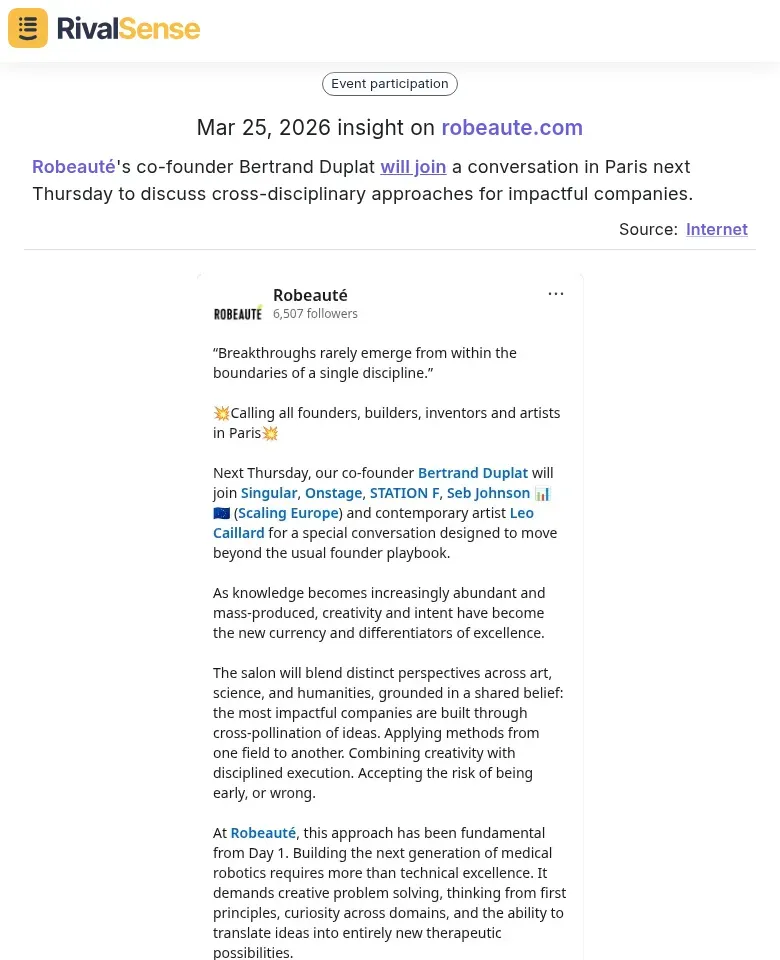
Robeauté's co-founder Bertrand Duplat will join a conversation in Paris next Thursday to discuss cross-disciplinary approaches for impactful companies.
Monitor their participation in industry forums, LinkedIn groups, and professional associations to understand how they build credibility with your target accounts. Learn from competitor cross-disciplinary approaches by observing how they combine expertise across departments (sales, marketing, product) in their thought leadership.
Practical steps:
- 📊 Create a tracking spreadsheet with columns for competitor name, event/forum, topic, audience, and key messaging
- 🔔 Set up Google Alerts for competitor names + "speaking at" or "panel discussion"
- 👥 Follow competitor executives on LinkedIn to see their industry engagement
- 📈 Analyze how competitors use case studies and success stories in their presentations
- 🤝 Note which industry influencers they partner with for co-branded content
Key insight: Competitors who consistently appear at the same industry events are signaling which accounts they're targeting. Use this intelligence to preempt their messaging with your own thought leadership on those same platforms.
Turning Competitor Weaknesses into Key Account Value Propositions
To turn competitor weaknesses into key account wins, start by systematically analyzing customer reviews and support forums. This approach uncovers recurring pain points that you can address directly in your value propositions. By focusing on these gaps, you position your solution as the remedy to frustrations that key accounts experience with current vendors.
Look for recurring complaints about competitor service gaps, implementation delays, or feature limitations. Create a spreadsheet tracking these pain points by competitor and frequency. This data-driven method ensures your messaging is targeted and evidence-based.
Next, transform these insights into differentiated value propositions. For example, if competitors struggle with onboarding, emphasize your streamlined implementation process. If they lack specific integrations, highlight your platform's comprehensive connectivity. Frame your solution as the direct answer to their frustrations.
Develop targeted account acquisition playbooks using this intelligence. Create competitor-specific battle cards that outline their weaknesses and your corresponding strengths. For each key account, identify which competitor they're using and tailor your outreach to address their specific pain points.
Checklist for sales teams:
✅ Research target's current vendor
✅ Identify 2-3 specific pain points
✅ Craft messaging that positions your solution as the remedy
✅ Prepare case studies showing how you've solved similar issues for others
Practical tip: Monitor competitor review sites quarterly and update your battle cards. Use tools like RivalSense to track competitor mentions and identify emerging weaknesses before they become widespread knowledge.
Implementation Framework: Building a Systematic Competitor-to-Account Strategy
Transform competitor insights into systematic account growth with this three-step implementation framework. A structured approach ensures that intelligence is consistently gathered, analyzed, and acted upon across your organization. By automating and coordinating efforts, you can respond swiftly to competitor moves and secure key accounts.
-
Automated Monitoring Systems: Set up real-time alerts for competitor campaigns, content strategies, and engagement metrics. Use tools like RivalSense to track competitor targeting, ad spend fluctuations, and audience reactions. Create a dashboard showing competitor share-of-voice, engagement rates, and campaign frequency. 💡 Pro tip: Set alerts for competitor product launches or pricing changes that could impact your key accounts.
-
Data-Driven Response Playbooks: Develop pre-approved response templates for common scenarios: price change responses (include value reinforcement messaging and ROI calculators), product launch counters (create feature comparison matrices), and market move strategies (build territory defense playbooks). Create a 3-tier response system with immediate action templates, strategic frameworks, and proactive positioning guides.
-
Cross-Functional Collaboration: Establish weekly syncs between sales, marketing, and account teams. Marketing provides intelligence on competitor campaigns, sales reports competitive objections, and account management shares client feedback. Create a shared competitive intelligence repository with clear protocols for updating and acting on new information.
Practical Checklist:
✓ Map competitor triggers to specific account segments
✓ Create escalation protocols with approval thresholds
✓ Develop measurement dashboards tracking response effectiveness
✓ Establish monthly playbook review cadences
✓ Train teams on template usage and customization
Track impact through 3 key metrics: account retention rate post-response, expansion revenue in defended accounts, and competitive win rate improvement.
Ready to turn competitor insights into key account wins? Try out RivalSense for free to automate competitor tracking across product launches, pricing updates, events, and more. Get your first competitor report today and start outmaneuvering your rivals with actionable intelligence delivered weekly to your inbox.
📚 Read more
👉 Streamline Education Stakeholder Management with Key Account Dashboards
👉 Competitor Financial Analysis Templates: Fundraising & M&A Insights Framework
👉 Decoding Competitor Pricing Moves: A Real-World Analysis from Credifiel México
👉 The Strategic Advantage: 7 Key Benefits of a Dedicated Key Account Manager
👉 Beginner's Guide: Competitive Intelligence Software Benefits for IT Asset Management