
HOW TO TRACK KEY ACCOUNT RENEWAL DATES: A STRATEGIC GUIDE FOR 2026
Missing a key account renewal deadline isn't just a financial mistake—it's a strategic failure that can cost you your most valuable customer relationships. For a $500,000/year enterprise account with a 90-day notice period, missing the window by even a week means committing to another full year of potentially suboptimal terms before anyone realizes what happened.
This happens because renewal dates and notice periods are buried in complex contract language that's rarely revisited after signing. As your portfolio of key accounts grows, so does the risk—and the strategic exposure.
This guide covers what information you need to track, practical approaches teams use, and smarter alternatives to manual tracking. If you're looking for comprehensive competitive intelligence to protect your key accounts, see how RivalSense helps businesses track competitor movements that could impact your renewal negotiations.
WHY KEY ACCOUNT RENEWAL DEADLINES GET MISSED
Proactively managing renewals requires understanding why deadlines are missed in the first place. Several strategic factors contribute to these oversights, often compounding as your account portfolio expands. Here are the key reasons why renewal deadlines slip through the cracks:
- Complex Contract Structures ⚖️: Enterprise agreements often have tiered renewal clauses, volume commitments, and performance metrics that create multiple decision points.
- Varying Notice Periods 📅: Some require 30 days, others 90, and enterprise contracts may have different notice requirements for different service lines.
- Spreadsheet Breakdown 📊: Manual tracking becomes unreliable as accounts grow and contract amendments accumulate.
- Stakeholder Changes 👥: The person who set calendar reminders may change roles, leaving critical dates unmonitored.
- Competitive Blind Spots 🕵️: Without tracking competitor movements, you may miss signals that your key account is being courted by alternatives.
The result is the same: a renewal date passes, notice isn't given, and your business is locked into another term—often while competitors are actively targeting your most valuable relationships.
WHAT INFORMATION YOU NEED TO TRACK FOR KEY ACCOUNTS
To build a reliable tracking system, you must first identify the essential data points for each key account. Without this foundation, any method you use will be prone to errors and omissions. Capture these critical fields to ensure nothing falls through the cracks:
| Data Point | Description | Why It Matters |
|---|---|---|
| Contract Start Date | When the agreement took effect | Determines the baseline for calculating renewal dates |
| Contract Term Length | Duration of initial or current term | Defines when the contract is up for renewal or expiration |
| Renewal Date | When the contract is due to renew (or expire) | Critical deadline for taking action |
| Notice Period | Advance notice required to opt out or renegotiate | Sets the internal deadline for strategic decisions |
| Stakeholder Contacts | All decision-makers and influencers with roles and influence levels | Ensures you engage the right people at the right time |
| Usage Analytics | Product adoption rates and feature utilization patterns | Provides data to demonstrate value during renewal discussions |
| Competitive Context | Recent competitor activities that could impact renewal decisions | Helps anticipate threats and position your offering effectively |
| Reminder Dates | Internal deadlines to ensure strategic action before notice windows close | Keeps your team proactive and prepared |
Without these fields documented and visible, you're relying on memory—which doesn't scale across a portfolio of strategic accounts.
PRACTICAL CHECKLIST: KEY ACCOUNT RENEWAL TRACKING SYSTEM
Implementing a structured tracking system requires consistent activities at different frequencies. By breaking down tasks into weekly, monthly, and quarterly cycles, you can maintain control and adapt to changes proactively.
✅ WEEKLY TRACKING ACTIVITIES
Dedicate time each week to prevent small issues from becoming major problems. These routine checks keep you ahead of renewals and competitive threats:
- Review upcoming renewal dates for the next 90 days 📅
- Monitor competitor activity alerts (product launches, pricing changes, executive movements) 🚨
- Check customer engagement metrics and response rates 📈
- Update account health scores based on recent interactions 💚
- Scan for regulatory developments affecting key accounts ⚖️
✅ MONTHLY REVIEW TASKS
Monthly reviews provide a broader perspective on account performance and market dynamics. Use this time to analyze trends and adjust strategies accordingly:
- Analyze Customer Lifetime Value (CLV) trends and identify growth opportunities 💰
- Review competitive positioning across all key accounts 🥊
- Assess customer satisfaction scores and identify improvement areas 😊
- Evaluate market share movements and competitive threats 📊
- Track partnership announcements and event participations 🤝
✅ QUARTERLY STRATEGIC ANALYSIS
Quarterly analyses are crucial for long-term strategic alignment. This is when you step back and ensure your approach is driving desired outcomes:
- Conduct comprehensive account portfolio review 🗂️
- Update competitive intelligence and market positioning 🧠
- Review and adjust account strategies based on KPI trends 📉
- Identify accounts at risk and develop mitigation plans 🛡️
- Benchmark performance against industry standards 🏆
SIMPLE WAYS TO TRACK KEY ACCOUNT RENEWALS
Various methods exist for tracking renewals, each with its pros and cons. Choosing the right one depends on the size of your account portfolio and the level of strategic risk involved. Here are common approaches businesses use:
- Spreadsheets 📊 — flexible and familiar, but require manual upkeep and become stale quickly.
- Calendar Reminders 📅 — useful for a handful of accounts, but difficult to maintain across a growing portfolio.
- CRM Systems 💼 — better than spreadsheets but often lack competitive context.
- Dedicated Tracking Tools 🛠️ — purpose-built software that centralizes renewal dates, notice periods, and competitive intelligence.
The right approach balances simplicity with scalability, ensuring you don't miss critical deadlines.
THE COMPETITIVE INTELLIGENCE ADVANTAGE IN RENEWAL TRACKING
In today's competitive landscape, tracking renewals isn't just about dates—it's about understanding the market dynamics. Competitors are constantly evolving, and their moves can directly impact your key account relationships. Effective renewal tracking must include monitoring competitive movements that could sway your customers' decisions.
Real-World Competitive Insights from RivalSense
Integrating real-time competitor insights into your renewal strategy can provide a significant edge. Here are examples of how different types of intelligence can inform your approach:
Insight 1: Product Innovation Tracking
Wordsmith now automatically checks inbound contracts against company playbooks, flags risks, and drafts redlines before review, focusing on changes in revised versions.
Why this matters: Tracking product launches like this helps you understand if competitors are offering features that could appeal to your key accounts. If a competitor introduces advanced contract automation, it might become a selling point for clients in legal or procurement sectors, prompting you to highlight your own strengths or develop counter-features during renewal discussions.
Insight 2: Strategic Partnerships and Events
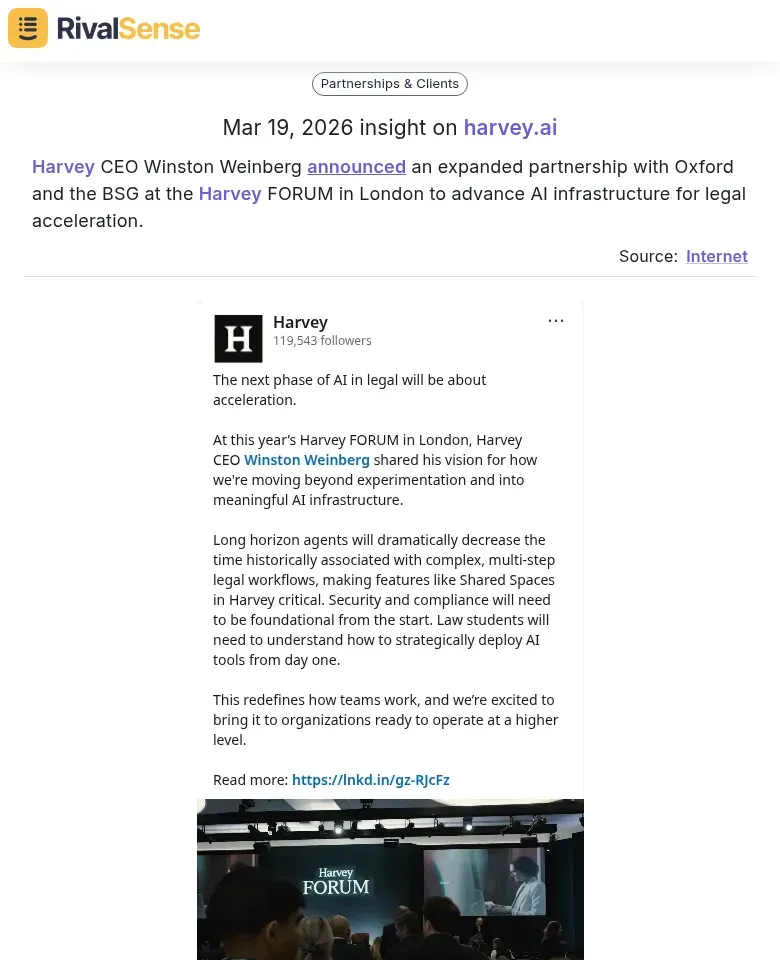
Harvey CEO Winston Weinberg announced an expanded partnership with Oxford and the BSG at the Harvey FORUM in London to advance AI infrastructure for legal acceleration.
Why this matters: Monitoring partnerships and event participations signals a competitor's strategic direction and market expansion. For instance, such alliances can enhance credibility and attract key accounts in research-intensive industries, allowing you to anticipate competitive moves and strengthen your own partnerships before renewals.
Insight 3: New Product Launches
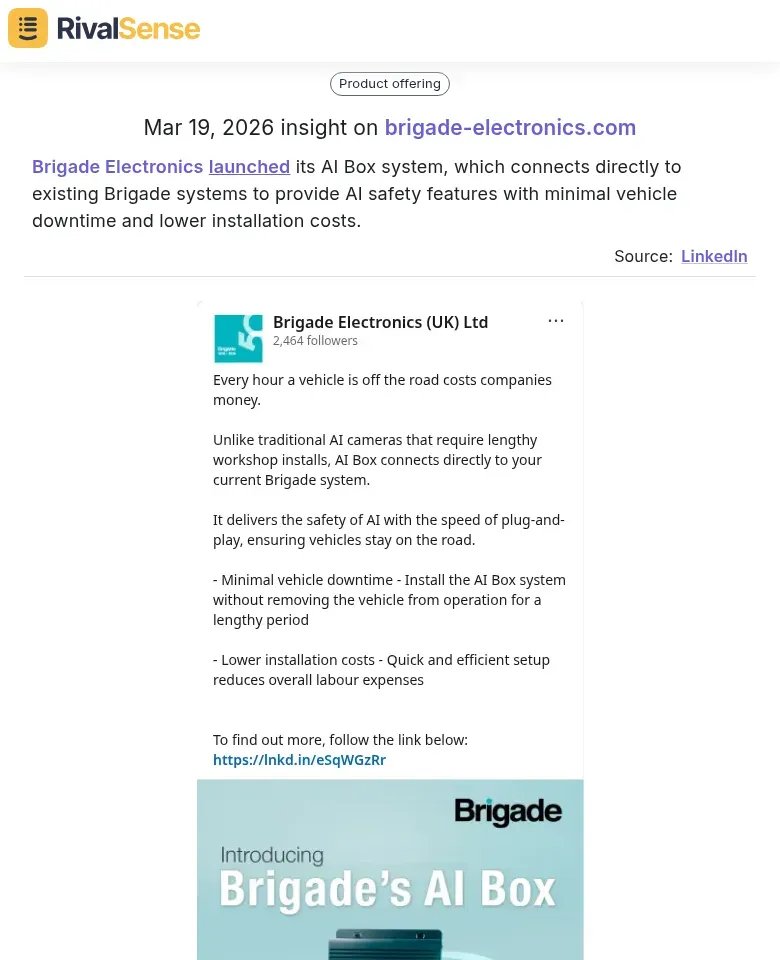
Brigade Electronics launched its AI Box system, which connects directly to existing Brigade systems to provide AI safety features with minimal vehicle downtime and lower installation costs.
Why this matters: Product launches, especially those that integrate with existing systems, can disrupt your competitive position. If a competitor introduces a cost-effective AI solution, it might appeal to your key accounts in manufacturing or logistics, urging you to reassess your product roadmap or value proposition during renewals.
Competitive Intelligence Checklist for Your Renewal Reports:
✅ Product Innovation Tracking: Monitor competitor launches of features or products that appeal to your accounts' industries.
✅ Strategic Moves Monitoring: Track acquisitions, partnerships, or executive changes that signal strategy shifts.
✅ Pricing and Service Updates: Watch for competitor pricing adjustments or service term changes.
✅ Market Expansion Signals: Monitor geographic expansion and new market entries.
✅ Regulatory Changes: Follow industry regulations that impact your competitive landscape.
WHAT A MISSED KEY ACCOUNT RENEWAL ACTUALLY COSTS
Understanding the true cost of missed renewals highlights the importance of proactive tracking. It's not just about lost revenue—it's about lost opportunities and strategic setbacks. Consider this enterprise scenario: A business signs a $500,000/year enterprise contract with a 24-month term and a 90-day notice period. The team intends to renegotiate better terms at renewal but misses the notice window by two weeks. The contract auto-renews for another full term at the same rate—$500,000 committed before anyone realizes.
Now multiply that across 10, 20, or 50 key accounts. The financial exposure grows exponentially, and in most cases, the terms were ones the business wanted to revisit. The cost isn't just financial—it's the lost opportunity to:
- Renegotiate better terms based on usage and value delivered 💰
- Consolidate vendors and streamline operations 🔄
- Exit relationships that no longer serve strategic objectives 🚪
- Preempt competitive threats before they gain traction 🛡️
DO YOU NEED A FULL CLM TO TRACK KEY ACCOUNT RENEWALS?
Contract Lifecycle Management (CLM) systems are comprehensive tools, but they may be overkill for renewal tracking alone. CLMs are designed to handle the full contract lifecycle—drafting, negotiation, approvals, e-signatures, and storage. They're powerful for legal teams managing high-volume contracting workflows.
However, if contracts are already signed and your primary need is tracking what they require going forward—renewal dates, notice periods, and competitive context—a CLM is often more system than most account teams need. The implementation effort, cost, and complexity frequently don't match the strategic problem.
Post-signature tracking with competitive intelligence focuses specifically on this narrower scope: surfacing the dates, requirements, and competitive threats that matter after contracts are executed, without the overhead of a full lifecycle platform.
THE RIVALSENSE ADVANTAGE IN KEY ACCOUNT PROTECTION
Unlike basic monitoring tools, RivalSense provides comprehensive competitor intelligence across 80+ sources including company websites, social media, regulatory filings, industry registries, and media mentions. All delivered in a consolidated weekly report, saving account managers hours of manual research while providing actionable insights into:
- Competitor product launches and updates that could appeal to your key accounts 🚀
- Pricing changes and service term adjustments 💵
- Executive movements and organizational changes 👔
- Partnership announcements and strategic alliances 🤝
- Regulatory developments that impact your competitive landscape ⚖️
- Event participations and market expansion signals 📅
This intelligence helps you anticipate competitive threats during renewal negotiations and position your offerings more effectively.
USE A RENEWAL NOTICE CALCULATOR FOR SINGLE CONTRACTS
For one-off calculations, a renewal notice calculator can be a handy tool. If you only need to estimate the deadline for a single key account contract, you can enter the contract start date, term length, and notice period, and the tool will calculate the last date you can give notice before the contract automatically renews.
It's a simple, free tool—no account required—but remember it doesn't provide the competitive context needed for strategic renewals. Use it for quick checks, but rely on more comprehensive systems for ongoing management.
TRACKING RENEWALS ACROSS MANY KEY ACCOUNTS
Manual tracking becomes difficult—and strategically risky—when you manage dozens or hundreds of key accounts. Spreadsheets break down, calendar reminders get lost, and no single person can reliably hold all the details plus the competitive context. A comprehensive approach combines contract tracking with competitive intelligence to give you:
- Centralized renewal dates and notice periods across all key accounts 📂
- Automated alerts for upcoming deadlines 🔔
- Competitive context showing what alternatives your accounts are considering 🥊
- Stakeholder tracking of all decision-makers and influencers 👥
- Usage analytics to demonstrate value during renewal discussions 📈
This integrated view ensures you're prepared for every renewal, not just reacting to deadlines.
STOP RELYING ON MEMORY FOR KEY ACCOUNT RENEWAL DATES
Transform your key account management from reactive to proactive by implementing a systematic tracking approach. Start with these practical steps to build a robust system:
- Audit your current key account portfolio and identify all renewal dates 🔍
- Implement a centralized tracking system that includes competitive intelligence 🛠️
- Set up automated alerts for upcoming renewals and competitor movements 🚨
- Create strategic review processes that combine contract data with market intelligence 📊
- Train your team on using competitive insights during renewal negotiations 🧠
PRACTICAL IMPLEMENTATION ROADMAP
Rolling out a new tracking system requires a phased approach to ensure adoption and effectiveness. Follow this roadmap to gradually build and optimize your process.
PHASE 1: FOUNDATION (WEEKS 1-4)
- Select 5-10 most important accounts to start 🎯
- Set up basic tracking and health scoring 📝
- Integrate competitive monitoring tools like RivalSense 🔍
- Establish baseline metrics for comparison 📈
PHASE 2: SCALING (MONTHS 2-3)
- Expand tracking to all key accounts 📂
- Integrate data sources (CRM, support, product analytics) 🔗
- Implement comprehensive competitive monitoring 🕵️
- Refine reporting based on initial feedback 📋
PHASE 3: OPTIMIZATION (MONTHS 4-6)
- Add predictive capabilities for renewal risk 🔮
- Enhance automation to reduce manual work ⚙️
- Conduct regular strategic reviews 📅
- Scale best practices across the organization 🌐
ESSENTIAL FEATURES CHECKLIST FOR MODERN TRACKING TOOLS
Choosing the right tools is critical for success. Look for these features to ensure your tracking system is comprehensive and efficient:
✅ Real-time competitor monitoring across multiple sources 🕵️
✅ Automated alerts for critical account developments 🔔
✅ Cross-platform integration with existing CRM systems 🔗
✅ Predictive analytics for trend identification 📊
✅ Comprehensive reporting with customizable dashboards 📈
✅ Weekly consolidated reports from 80+ sources 📬
✅ Tracking of product launches, pricing updates, and executive movements 🚀
✅ Monitoring of partnerships, events, and regulatory developments 🤝
THE ROI OF COMPREHENSIVE KEY ACCOUNT RENEWAL TRACKING
Investing in robust tracking with competitive intelligence yields significant returns. Companies that implement full-spectrum tracking typically see tangible benefits that justify the effort and cost. Here are common outcomes:
- 15-25% improvement in key account retention 📈
- 20-30% faster identification of growth opportunities 🚀
- 40-50% reduction in competitive surprise incidents 🛡️
- Significant time savings on manual research and contract review ⏱️
- Better negotiation outcomes during renewal discussions 💰
CONCLUSION: TRANSFORMING KEY ACCOUNT RENEWALS IN 2026
In 2026, key account renewal success isn't just about remembering dates—it's about understanding the complete strategic context. The most successful account managers leverage comprehensive tracking that combines contract data, relationship health indicators, and competitive intelligence.
By implementing the practical steps outlined above and leveraging modern tools that include competitive context, you can transform your renewal process from administrative task to strategic advantage. Start by implementing one new practice from this guide each week, and consider how competitive intelligence could enhance your next key account renewal negotiation.
Ready to protect your key accounts with comprehensive competitive intelligence? Try RivalSense for free at https://rivalsense.co/ and get your first competitor report today to assist with the challenges described in this post.
📚 Read more
👉 Marine Port Services Key Account Risk Tracking Checklist 2026
👉 How ScraperAPI's New Tech Hire Revealed Competitor Expansion Plans
👉 Twitter Competitor Intelligence Framework: Key Account Health Dashboard Template
👉 How to Build a Key Account Management Playbook for AML Compliance
👉 Regulatory Compliance Checklist: Uncover Competitor Market Positioning Insights