
How to Track Competitor Pricing Changes: The Complete 2026 Playbook for B2B Leaders
Written by Bas de Goei
17 min read
As we move into 2026, competitor pricing intelligence has evolved from a nice-to-have to a non-negotiable strategic capability. The companies winning today aren't just monitoring prices—they're building systematic processes that turn pricing data into competitive advantage.
Consider this: A recent study found that businesses with systematic competitor price tracking achieve 5-20% higher margins within their first year of implementation. Yet most companies still rely on ad-hoc manual checks or outdated spreadsheets, missing critical market signals that could reshape their entire pricing strategy.
Why Competitor Price Tracking Matters More Than Ever in 2026
In today's hyper-competitive B2B landscape, pricing changes aren't just about numbers—they're strategic signals. Without systematic tracking, you're flying blind in a market where pricing intelligence directly impacts revenue, market share, and customer perception.
A competitor's price drop might indicate:
- New market entry strategies
- Inventory clearance before product launches
- Response to your own pricing moves
- Testing new pricing models
- Financial pressures or strategic pivots
The 7-Step Framework for Tracking Competitor Pricing Changes
Step 1: Build Your Competitor Intelligence Matrix
Before you track anything, you need clarity on who to track and what to monitor. This foundational step ensures your efforts are targeted and efficient. Create a simple matrix:
| Competitor | Core Products | Pricing Pages | Frequency | Priority |
|---|---|---|---|---|
| Competitor A | Product X, Y | pricing.com | Daily | High |
| Competitor B | Product Z | plans.com | Weekly | Medium |
| Competitor C | All products | enterprise.com | Monthly | Low |
Pro Tip: Don't just track direct competitors. Include alternative solutions, emerging players, and adjacent market entrants who could disrupt your space.
Step 2: Choose Your Monitoring Method
Selecting the right monitoring method is crucial for accuracy and efficiency. You have three primary options to consider, each with its pros and cons.
-
Manual Monitoring (Not Recommended)
- Visiting competitor websites daily
- Checking pricing pages and documentation
- Time-consuming and prone to human error
- Misses real-time changes
-
Basic Web Monitoring Tools
- Tools like Visualping that track page changes
- Good for specific pricing pages
- Limited to website changes only
- Misses social media, registries, and other sources
-
Comprehensive Competitive Intelligence Platforms
- Tools like RivalSense that monitor 80+ sources
- Track pricing across websites, social media, registries
- Provide context beyond just price numbers
- Deliver weekly consolidated reports
Checklist for Choosing Your Method:
- [ ] Can it track pricing changes in real-time?
- [ ] Does it monitor multiple sources (not just websites)?
- [ ] Can it handle anti-scraping measures?
- [ ] Does it provide historical data for trend analysis?
- [ ] Is it scalable as your competitor list grows?
Step 3: Set Up Your Tracking System
Implementation varies based on your chosen method. Proper setup ensures you capture relevant data without overwhelm.
For Basic Tools:
- Identify exact pricing page URLs
- Set monitoring frequency (daily minimum)
- Configure alerts for price changes
- Create a central dashboard for tracking
For Comprehensive Platforms like RivalSense:
- Define your competitor list
- Specify key products and pricing tiers to monitor
- Set alert thresholds (e.g., notify for >5% changes)
- Configure weekly report preferences
- Integrate with your CRM or pricing systems
Step 4: Establish Alert Priorities
Not all price changes are created equal. Creating a triage system helps you focus on what matters most and avoid unnecessary reactions.
High Priority (Immediate Response Needed):
- Price drops >10% on core competitive products
- New pricing model launches
- Major discount campaigns
- Changes affecting >50% of their product line
Medium Priority (Weekly Review):
- Price changes 5-10%
- Minor tier adjustments
- Promotional pricing for specific segments
- Regional price variations
Low Priority (Monthly Analysis):
- Price changes <5%
- Add-on pricing adjustments
- Minor packaging changes
- Temporary promotions
Step 5: Analyze Context, Not Just Numbers
This is where most companies fail. A price change without context is just a number. Deep analysis uncovers the strategic drivers behind shifts.
Ask these key questions to gain insights:
-
Why did they change prices?
- New funding round?
- Product launch coming?
- Market share pressure?
- Cost structure changes?
-
What else changed simultaneously?
- Product features?
- Packaging?
- Target market messaging?
- Sales team compensation?
-
How does this fit their overall strategy?
- Market penetration play?
- Premium positioning?
- Customer segmentation?
- Geographic expansion?
Practical Example: When a SaaS competitor drops prices by 15%, check if they simultaneously:
- Launched new features (value increase)
- Changed their target customer segment
- Announced new funding (ability to sustain lower margins)
- Updated their sales commission structure
Step 6: Implement Your Response Framework
Create a decision matrix for how to respond. This structured approach prevents knee-jerk reactions and aligns responses with your strategy.
| Change Type | Your Position | Recommended Response |
|---|---|---|
| Major price drop | Market leader | Maintain price, emphasize value |
| Major price drop | Challenger | Consider selective matching |
| New pricing model | Any | Analyze impact, consider testing |
| Minor adjustment | Any | Monitor, no immediate action |
| Temporary promo | Any | Consider counter-promotion |
Key Principle: Don't automatically match prices. Consider:
- Value-based response (enhance your offering)
- Communication strategy (explain your value)
- Selective matching (only on key competitive products)
- No response (if change doesn't affect your target market)
Step 7: Build Continuous Improvement Loops
Regular reviews turn data into actionable strategy. Establish cycles to refine your approach and stay ahead of market trends.
- Weekly Review: Analyze all pricing changes from the past week
- Monthly Deep Dive: Identify patterns and trends
- Quarterly Strategy Session: Adjust your pricing strategy based on insights
- Annual Competitive Audit: Complete review of all competitor pricing strategies
Common Pitfalls to Avoid
Pitfall 1: Chasing Every Price Change
Solution: Set minimum thresholds for response. Not every 2% price drop requires action.
Pitfall 2: Ignoring Non-Price Factors
Solution: Use comprehensive tools like RivalSense that track product launches, partnerships, and management changes alongside pricing.
Pitfall 3: Manual Spreadsheet Overload
Solution: Automate data collection. One founder we spoke with spent 15 hours weekly on manual tracking before switching to automated solutions.
Pitfall 4: Lack of Historical Context
Solution: Ensure your tracking system maintains historical data. Price changes are more meaningful when you can see patterns over time.
The RivalSense Advantage: Beyond Basic Price Tracking
While many tools focus solely on website price scraping, RivalSense takes a comprehensive approach to competitive intelligence. Here's how it transforms price tracking:
1. 80+ Source Monitoring
Unlike basic tools that only track websites, RivalSense monitors:
- Company websites and pricing pages
- Social media platforms for pricing announcements
- Regulatory filings and registries
- Partnership announcements
- Product launch information
- Management changes that might signal strategy shifts
2. Context-Rich Intelligence
When a competitor changes prices, RivalSense helps you understand:
- What else changed simultaneously (product updates, partnerships)
- The strategic context behind the change
- Historical patterns and trends
- Market-wide implications
3. Weekly Consolidated Reports
Instead of drowning in daily alerts, get a comprehensive weekly report that includes:
- All pricing changes across your competitor landscape
- Product launch and update intelligence
- Partnership and event participation news
- Regulatory and compliance updates
- Media mentions and market sentiment
4. Real-World Examples of Competitive Intelligence
Here are recent insights tracked by RivalSense that demonstrate how broader intelligence informs pricing strategy:
-
Product Launch Insight: Tomas Sudnius, CEO for Africa and Asia at Eleving Group, shares insights on the company's smartphone financing launch in Africa.

Why it matters: Tracking product launches in new markets can reveal competitor expansion strategies that may involve introductory pricing or localized pricing models, helping you prepare competitive responses. -
Seasonal Promotion Insight: FRED introduced new jewelry pieces from its FORCE 10 and CHANCE INFINIE collections, featuring red rubies and infinity-inspired designs, in a Chinese New Year celebration.

Why it matters: Monitoring seasonal campaigns and new collections can alert you to temporary price promotions or premium pricing strategies, enabling you to time your own promotions effectively. -
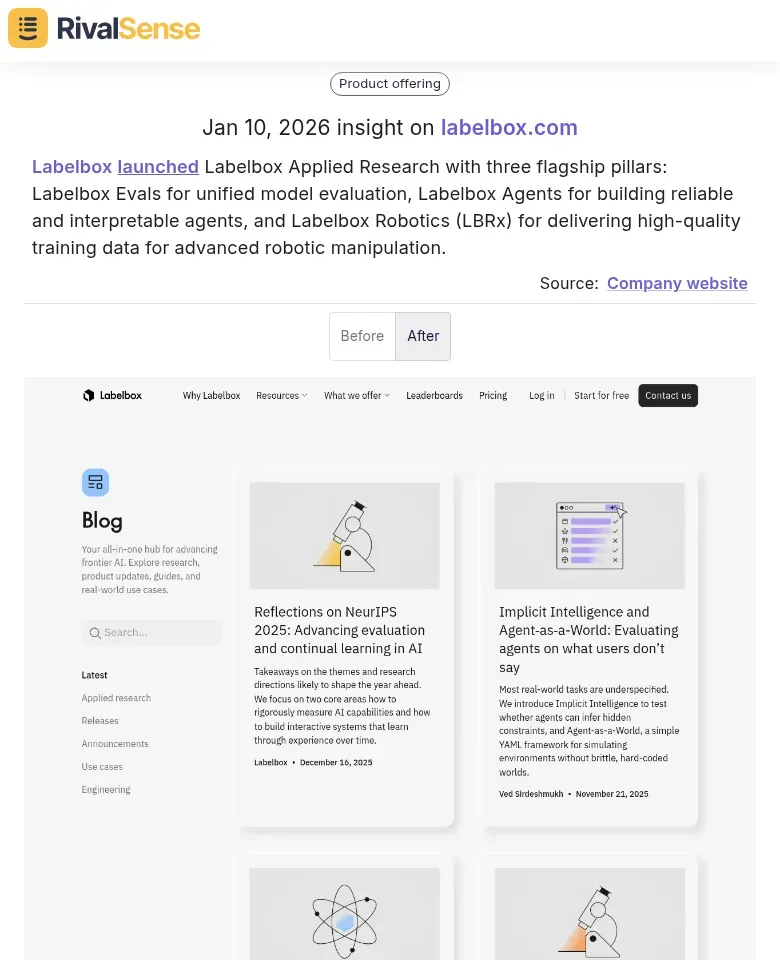
Product Update Insight: Labelbox launched Labelbox Applied Research with three flagship pillars: Labelbox Evals for unified model evaluation, Labelbox Agents for building reliable and interpretable agents, and Labelbox Robotics (LBRx) for delivering high-quality training data for advanced robotic manipulation.
Why it matters: Major product updates often accompany pricing changes or new tier structures. By tracking these, you can anticipate how competitors are enhancing value and adjust your pricing accordingly.
5. Practical Implementation
One B2B SaaS company using RivalSense reported:
- 40% reduction in time spent on competitor research
- 15% improvement in pricing response time
- Better understanding of competitor strategy beyond just prices
- More confident pricing decisions with complete market context
Your Competitor Price Tracking Checklist
Setup Phase
- [ ] Identify all relevant competitors (direct, indirect, emerging)
- [ ] Map their core products and pricing pages
- [ ] Choose monitoring method (manual, basic tools, comprehensive platform)
- [ ] Set up tracking systems and alerts
- [ ] Define response thresholds and priorities
Execution Phase
- [ ] Monitor pricing changes daily/weekly
- [ ] Analyze context behind each change
- [ ] Document changes and patterns
- [ ] Review with team weekly
- [ ] Make strategic decisions based on insights
Optimization Phase
- [ ] Refine competitor list quarterly
- [ ] Adjust monitoring frequency based on market dynamics
- [ ] Update response frameworks based on results
- [ ] Integrate insights into pricing strategy
- [ ] Measure ROI of tracking efforts
Advanced Tactics for 2026
1. Predictive Price Tracking
Look for signals that precede price changes. Proactive monitoring can give you a head start on competitor moves.
- Hiring patterns (new pricing analysts)
- Funding announcements
- Technology stack changes
- Leadership team adjustments
2. Competitor Psychology Analysis
Understand your competitors' decision-making. This insight helps anticipate their reactions and strategies.
- Are they reactive or proactive with pricing?
- Do they follow market leaders or set trends?
- How do they respond to your moves?
- What's their risk tolerance?
3. Cross-Channel Intelligence
Price changes often correlate with other business activities. Connecting dots across channels reveals holistic strategies.
- Marketing campaign launches
- Sales team restructuring
- Partnership announcements
- Product roadmap updates
The Bottom Line
Tracking competitor pricing changes in 2026 isn't about building complex spreadsheets or manually checking websites. It's about creating a systematic, automated process that delivers actionable intelligence.
The most successful B2B companies we work with at RivalSense have moved beyond basic price monitoring to comprehensive competitive intelligence. They understand that a price change is just one piece of the puzzle—the real value comes from understanding the strategic context behind those changes.
Ready to transform your competitor price tracking? Start with our free checklist above, and consider how comprehensive tools like RivalSense can help you move from reactive price matching to proactive market leadership.
Remember: In today's market, the companies that win aren't those with the lowest prices—they're the ones with the best intelligence about why prices are changing and what to do about it.
Want to see how comprehensive competitor intelligence can transform your pricing strategy? Try RivalSense for free today at https://rivalsense.co/ and get your first competitor report delivered to your inbox.
📚 Read more
👉 Aviation Fuel System Construction: Best Practices for Competitor Partnership Ecosystems
👉 How Tracking Meta's CTO Departure Gave Competitors an AR/VR Edge
👉 Mastering Facebook Competitor Analysis: A Strategic Guide for B2B Leaders
👉 2026 Sports Retail Trends: Automating Key Account Intelligence for Competitive Edge
👉 Regulatory Intelligence Workflow: Uncover Competitor Technology Stack Advantages