
How to Track Competitor Podcast Appearances: The Complete Strategic Guide
Last updated: December 26, 2025
RivalSense Competitive Intelligence Team
8 min read
CONTENTS
- Why Competitor Podcast Appearances Matter for B2B Strategy
- Step 1: Identify Which Competitors Are Active on Podcasts
- Step 2: Build Your Competitor Podcast Tracking System
- Step 3: Extract Strategic Intelligence from Guest Appearances
- Step 4: Analyze Positioning and Messaging Patterns
- Step 5: Turn Insights into Competitive Advantages
- Beyond Podcasts: Holistic Competitor Tracking with RivalSense
- Actionable Checklist for Immediate Implementation
1. Why Competitor Podcast Appearances Matter for B2B Strategy
In today's crowded B2B landscape, podcast guest appearances have become a powerful channel for thought leadership, market positioning, and lead generation. When your competitors appear on industry podcasts, they're not just sharing content—they're revealing strategic priorities, testing new messaging, and building relationships with potential customers.
Key Strategic Insights You Can Gain:
- Market Positioning: How competitors position themselves against industry trends
- Product Roadmaps: Early signals about upcoming features or services
- Target Audience: Which customer segments they're focusing on
- Partnership Signals: Who they're collaborating with and why
- Weakness Indicators: What challenges they're openly discussing
Real-World Example: In the SaaS industry, when a competitor appears on "The SaaS Revolution Show" discussing their new AI features, they're not just promoting their product—they're signaling a strategic shift toward AI capabilities that you need to track.
2. Step 1: Identify Which Competitors Are Active on Podcasts
Before diving into tracking, you need to know which competitors are actively using podcasts. This step involves both manual and automated methods to compile a comprehensive list of their appearances across various shows.
Manual Discovery Methods:
A. Google Search Operators:
"[Competitor Name] podcast guest"
"[Competitor CEO Name] interview podcast"
site:apple.com/podcast "[Competitor Name]"
"[Industry Keyword] podcast guest [Competitor Name]"
B. Podcast Platform Searches:
- Apple Podcasts search for competitor names
- Spotify podcast search with competitor keywords
- Google Podcasts search operators
- Industry-specific podcast directories
C. Social Media Monitoring:
- LinkedIn posts mentioning podcast appearances
- Twitter/X threads about industry podcasts
- YouTube channels that host podcast interviews
Automated Discovery Tools:
- Podcast databases like Rephonic or Podchaser
- Social listening tools that track mentions
- Media monitoring platforms with podcast coverage
Pro Tip: Create a master spreadsheet with columns for:
- Competitor Name
- Podcast Name
- Episode Title
- Guest Name/Title
- Publication Date
- Key Topics Discussed
- Strategic Insights
3. Step 2: Build Your Competitor Podcast Tracking System
Once you've identified active competitors, building a systematic tracking system is crucial. A structured approach ensures you capture all relevant appearances without missing key insights that could inform your strategy.
The 4-Pillar Tracking Framework:
1. Content Capture System:
- Set up RSS feed alerts for competitor mentions
- Use transcription services to convert audio to searchable text
- Create a centralized repository (Google Drive, Notion, etc.)
2. Regular Review Cadence:
- Weekly: Quick scan of new appearances
- Monthly: Deep dive analysis of patterns
- Quarterly: Strategic assessment and reporting
3. Team Collaboration:
- Assign specific competitors to team members
- Create shared annotation systems
- Schedule regular intelligence sharing sessions
4. Technology Stack:
- Podcast player with bookmarking capabilities
- Note-taking apps with tagging systems
- Spreadsheet or database for structured data
Practical Checklist for Setup:
- [ ] Identify top 5-10 competitor podcasts to monitor
- [ ] Set up Google Alerts for competitor + "podcast"
- [ ] Create shared folder structure for episode storage
- [ ] Establish weekly review time in calendar
- [ ] Train team on intelligence extraction techniques
4. Step 3: Extract Strategic Intelligence from Guest Appearances
Listening to podcast episodes is just the first step; extracting strategic intelligence requires focused attention. Pay attention to specific areas where competitors reveal their plans, priorities, and vulnerabilities during interviews.
What to Listen For:
A. Product & Service Intelligence:
- Mentions of new features or upcoming releases
- Pricing strategy discussions
- Customer success stories and use cases
- Integration partnerships announced
B. Market & Competitive Positioning:
- How they differentiate from other solutions
- Industry trends they're capitalizing on
- Target customer profiles discussed
- Geographic expansion plans
C. Organizational Insights:
- Team growth and hiring plans
- Funding or financial updates
- Leadership changes or promotions
- Cultural values and operating principles
D. Customer & Market Intelligence:
- Pain points they're solving for customers
- Market gaps they've identified
- Competitive weaknesses they admit
- Future market predictions
Intelligence Extraction Template:
Episode: [Podcast Name] - [Episode Title]
Date: [MM/DD/YYYY]
Guest: [Name, Title]

Key Strategic Points:
1. [Strategic insight 1]
2. [Strategic insight 2]
3. [Strategic insight 3]

Action Items for Our Team:
- [ ] [Specific action]
- [ ] [Specific action]
- [ ] [Specific action]

Competitive Implications:
[Analysis of how this affects our positioning]
5. Step 4: Analyze Positioning and Messaging Patterns
Over time, competitor podcast appearances can reveal patterns in messaging and positioning. Analyzing these patterns helps you anticipate their next moves, understand their strategic shifts, and adjust your own approach accordingly.
Pattern Recognition Framework:
A. Messaging Evolution:
Track how competitor messaging changes over time:
- Are they emphasizing different value propositions?
- How are they responding to market changes?
- What new terminology are they introducing?
B. Guest Strategy Analysis:
- Which team members are appearing most frequently?
- Are they sending technical vs. business leaders?
- What seniority levels are they deploying?
C. Podcast Selection Patterns:
- Are they targeting niche industry podcasts or broad business shows?
- What audience sizes are they pursuing?
- Which geographic markets are they focusing on?
D. Content Themes Over Time:
- Create a timeline of topics discussed
- Identify seasonal or cyclical patterns
- Spot emerging themes before they become mainstream
Analysis Spreadsheet Structure:
| Date | Podcast | Guest | Key Message | Target Audience | Strategic Shift |
|---|---|---|---|---|---|
| [Date] | [Name] | [Name] | [Message] | [Audience] | [Yes/No + Details] |
6. Step 5: Turn Insights into Competitive Advantages
The ultimate goal of tracking is to turn insights into actionable advantages. This framework helps you translate intelligence into concrete steps for your business, from messaging adjustments to product development.
Immediate Action Framework:
1. Counter-Messaging Development:
- If competitors emphasize "speed," develop messaging around "accuracy" or "reliability"
- If they focus on "innovation," highlight your "proven track record"
- Create response content that addresses their claims directly
2. Product Strategy Adjustments:
- Identify feature gaps they're not addressing
- Accelerate development of competing capabilities
- Adjust pricing based on their disclosed strategies
3. Marketing Campaign Optimization:
- Target the same podcasts with stronger value propositions
- Create content that addresses weaknesses they've revealed
- Adjust SEO strategy based on their keyword usage
4. Sales Enablement:
- Equip sales team with competitive intelligence
- Develop counter-arguments to their claims
- Create comparison materials highlighting your advantages
Implementation Timeline:
- Week 1-2: Intelligence gathering and analysis
- Week 3-4: Strategy development and content creation
- Month 2: Campaign execution and monitoring
- Ongoing: Continuous optimization based on results
7. Beyond Podcasts: Holistic Competitor Tracking with RivalSense
While podcast appearances provide valuable audio intelligence, they represent just one piece of the competitive puzzle. To build a comprehensive competitive intelligence program, you need to monitor multiple data sources simultaneously, from product updates to partnership announcements.
How RivalSense Complements Your Podcast Tracking:
A. Automated Multi-Source Monitoring:
RivalSense tracks 80+ sources including:
- Company website updates and product launches
- Social media announcements and engagement
- Event participations and speaking engagements
- Partnership announcements and collaborations
- Regulatory filings and compliance changes
- Management changes and organizational updates
- Media mentions across the internet
B. Weekly Intelligence Delivery:
Instead of manually searching across dozens of sources, RivalSense delivers a consolidated weekly email report with:
- Key competitor developments
- Strategic signals and patterns
- Actionable insights and recommendations
- Market trend analysis
C. Real-World RivalSense Insights:
Example 1: Product Update Intelligence
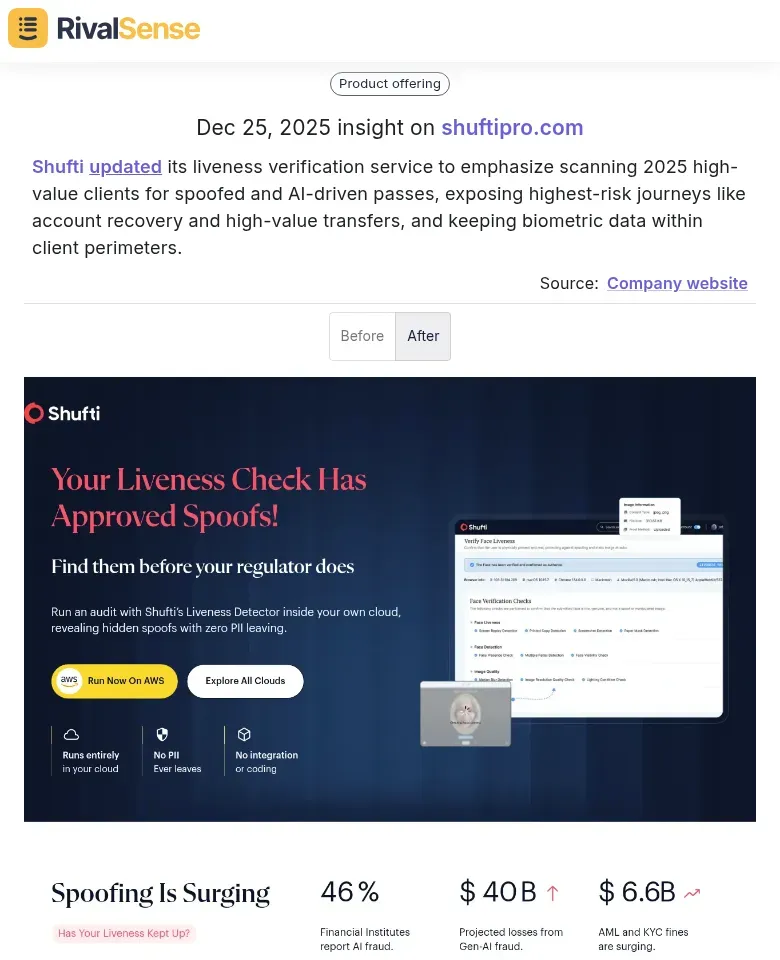
"RivalSense insight: Shufti updated its liveness verification service to emphasize scanning 2025 high-value clients for spoofed and AI-driven passes, exposing highest-risk journeys like account recovery and high-value transfers, and keeping biometric data within client perimeters."
Why it's valuable: Tracking product updates helps you understand competitor innovations and market focus, allowing you to identify gaps in your own offerings or anticipate industry trends.
Example 2: Partnership and Content Intelligence

"RivalSense insight: Afdhal Syamdiwita Setiawan, a Senior Visual Content Specialist, produced a video for the launch of the Garuda Indonesia x Pokémon special livery in February 2024."
Why it's valuable: Monitoring partnerships and content production reveals collaborative strategies and marketing initiatives, helping you spot alliance opportunities or competitive threats.
Example 3: Operational Expansion Intelligence

"RivalSense insight: Air India will start flying four times weekly non-stop between Delhi and Rome from March 25, 2026."
Why it's valuable: Tracking operational expansions provides insights into market entry strategies and growth plans, enabling you to assess competitive moves in new geographies or segments.
D. Integration with Your Existing Workflow:
- Export intelligence to your CRM or project management tools
- Set up custom alerts for specific competitor activities
- Share reports across teams with customizable permissions
- Historical data access for trend analysis
Why This Matters:
When you combine podcast intelligence with comprehensive tracking from RivalSense, you get a 360-degree view of your competitive landscape. You can see not just what competitors are saying on podcasts, but what they're actually doing across their entire business, from product launches to executive moves.
8. Actionable Checklist for Immediate Implementation
Phase 1: Setup (Week 1)
- [ ] Identify your top 5 competitor podcasts to monitor
- [ ] Create tracking spreadsheet with standardized columns
- [ ] Set up Google Alerts for competitor + podcast keywords
- [ ] Bookmark key industry podcast directories
- [ ] Schedule weekly 30-minute review sessions
Phase 2: Intelligence Gathering (Week 2-4)
- [ ] Listen to 2-3 competitor podcast episodes weekly
- [ ] Document key strategic points using the template above
- [ ] Identify messaging patterns and positioning shifts
- [ ] Share insights with relevant team members
- [ ] Begin building competitive response library
Phase 3: Analysis & Strategy (Month 2)
- [ ] Analyze collected data for patterns and trends
- [ ] Develop counter-messaging and positioning strategies
- [ ] Create competitive intelligence report for leadership
- [ ] Identify gaps in your own podcast guest strategy
- [ ] Plan targeted podcast outreach based on competitor success
Phase 4: Advanced Tracking (Ongoing)
- [ ] Consider tools like RivalSense for automated multi-source tracking
- [ ] Expand monitoring to include indirect competitors
- [ ] Track podcast appearance ROI for your own team
- [ ] Build predictive models based on competitor patterns
- [ ] Integrate podcast intelligence with other competitive data sources
RivalSense Integration Steps:
- [ ] Sign up for RivalSense free trial at https://rivalsense.co/
- [ ] Configure competitor tracking for your key rivals
- [ ] Set up custom alerts for podcast mentions
- [ ] Integrate weekly reports into team workflows
- [ ] Use insights to inform quarterly strategic planning
Key Takeaways
Tracking competitor podcast appearances isn't just about monitoring what they're saying—it's about understanding their strategic direction, identifying market opportunities, and positioning your business for success. By implementing a systematic approach to podcast intelligence, you can:
- Anticipate market moves before they happen
- Develop effective counter-strategies based on real intelligence
- Optimize your own podcast guest strategy by learning from competitors
- Build a comprehensive competitive intelligence program that drives business decisions
Remember: The most successful companies don't just track competitors—they use that intelligence to make better decisions faster. Whether you start with manual tracking or leverage tools like RivalSense for comprehensive monitoring, the key is consistency and action.
Ready to take your competitor tracking to the next level? Start with our actionable checklist above, and to streamline your efforts, try RivalSense for free at https://rivalsense.co/ to assist with the challenges described in this post—get your first competitor report today.
About RivalSense: RivalSense transforms web data into actionable competitive intelligence. Our platform tracks competitor product launches, pricing updates, event participations, partnerships, regulatory changes, management updates, and media mentions across 80+ sources, delivering consolidated weekly reports to help B2B companies make smarter strategic decisions.
📚 Read more
👉 How Systems Software Leaders Win with Competitor Feature Gap Analysis
👉 How Early Regulatory Alerts Enabled VPN Competitors to Capture Market Share
👉 Competitor Website Changes: A Strategic Guide for Key Account Planning
👉 AI Platform Competitive Intelligence: Decoding Advertising Strategies for Strategic Advantage
👉 Predictive Regulatory Intelligence: Anticipate Competitor Moves for Key Account Wins