
How to Track Competitor Email Campaigns: From Manual Methods to Automated Intelligence
As the Reddit discussion in our sample content reveals, tracking competitor email campaigns is a universal challenge for marketers. Whether you're manually subscribing with burner emails, taking screenshots, or building custom Excel trackers, the consensus is clear: manual tracking becomes unsustainable once you're monitoring more than 10-15 competitors.
One Reddit user perfectly captured the pain point: "It works… until it doesn't. Once you're tracking more than ~10–15 competitors, it becomes noisy, inconsistent, and time-consuming. The biggest issue for me wasn't collecting emails — it was making sense of patterns over time."
📈 Why Competitor Email Tracking Matters More Than Ever
With email marketing delivering an average ROI of $36 for every $1 spent, understanding what your competitors are doing isn't just interesting—it's essential for staying competitive. In today's fast-paced digital landscape, staying informed about competitor strategies can directly impact your marketing effectiveness and revenue growth. As legendary copywriter David Ogilvy advised: "I have a confession to make. I collect ads. If they're good enough to get my attention, they're worth saving. You never know when they'll come in handy."
🛠️ Practical Steps: How to Track Competitor Email Campaigns
Tracking competitor email campaigns can be approached methodically to yield actionable insights. Here, we outline both manual and automated methods to suit different scales of operation.
Manual Tracking Method (For Beginners or Small-Scale Monitoring)
Step-by-Step Checklist:
- Create Burner Email Accounts - Use separate email addresses for each competitor or category
- Subscribe Strategically - Sign up for newsletters, lead magnets, and automated sequences
- Organize with Labels/Folders - Create a dedicated competitor tracking system in your email client
- Trigger Automations - Add items to cart, abandon checkouts, and make purchases to test their sequences
- Document Everything - Use Notion, Sheets, or Airtable to track:
- Subject line patterns
- Send times and frequency
- Design elements and templates
- CTA placement and copy
- Promotional offers and timing
Pro Tip: As one Reddit user noted, "The biggest win is just consistency and knowing what you're looking for (hooks, cadence, CTAs), not tracking everything."
What to Analyze in Competitor Emails (The 8-Point Framework)
- Email Content & Copy - Are they using proven frameworks like PAS or AIDA?
- Subject Lines - What hooks work? Curiosity, storytelling, or direct promises?
- Design Elements - Template consistency, mobile optimization, branding
- Calls-to-Action - Placement, copy, button vs. hyperlink strategies
- Sending Frequency & Timing - Daily, weekly, or event-driven cadences
- Automation Sequences - Welcome series, abandoned cart, post-purchase flows
- List Growth Tactics - Lead magnets, pop-ups, referral programs
- Monetization Strategies - Sponsored ads, affiliate links, premium offerings
⚙️ The Automation Evolution: When Manual Methods Fail
As your competitor tracking needs grow, manual methods become what one Reddit user called "a weekly time sink." This is where specialized tools come in—and why so many marketers are building their own solutions.
Popular Email Tracking Tools Compared
Based on recent market analysis, here's how the landscape looks:
| Tool | Best For | Key Features |
|---|---|---|
| Milled | Browsing e-commerce emails | 39M+ emails from 98K+ brands |
| Mailcharts | Journey analysis and benchmarks | Industry comparisons |
| Owletter | Automated capture | Keyword alerts |
| SendView | Technical focus | Spam scores, ESP tracking |
| Panoramata | All-in-one platform | Emails, ads, website changes |
However, most of these tools focus primarily on email marketing specifically. For comprehensive competitive intelligence that includes email campaigns alongside other critical business signals, you need a broader solution.
🚀 Introducing RivalSense: Beyond Email Tracking to Complete Competitive Intelligence
While email tracking is crucial, it's just one piece of the competitive intelligence puzzle. This is where RivalSense offers a distinct advantage for B2B founders and business leaders.
Why RivalSense Is Different
Unlike tools that only track emails, RivalSense monitors 80+ sources to give you a complete picture of your competitive landscape:
Weekly Email Reports Include:
- Product Launches & Updates - Never miss a feature release
- Pricing Changes - Stay ahead of market positioning shifts
- Event Participations - Know where competitors are showing up
- Partnership Announcements - Track strategic alliances
- Regulatory Developments - Monitor compliance and legal changes
- Management Changes - Follow leadership movements
- Media Mentions - Track brand visibility across channels
- AND Email Campaign Insights - Integrated with broader business context
Real-World Insights from RivalSense
Here are examples of the types of insights RivalSense provides, demonstrating how broader competitive intelligence can inform your strategy:
-
Management Changes
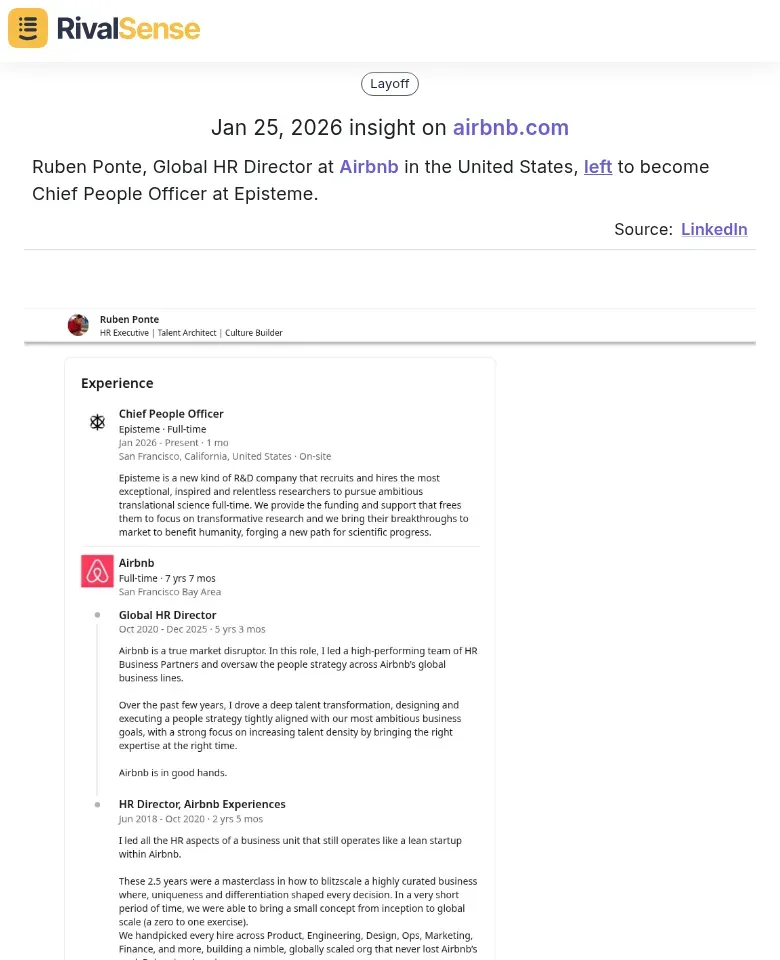
Example: Ruben Ponte, Global HR Director at Airbnb in the United States, left to become Chief People Officer at Episteme.
Why it matters: Tracking management changes can reveal talent movements, strategic shifts, and potential vulnerabilities in competitors' organizations. This insight helps you anticipate changes in company culture or strategy. -
Regulatory Actions
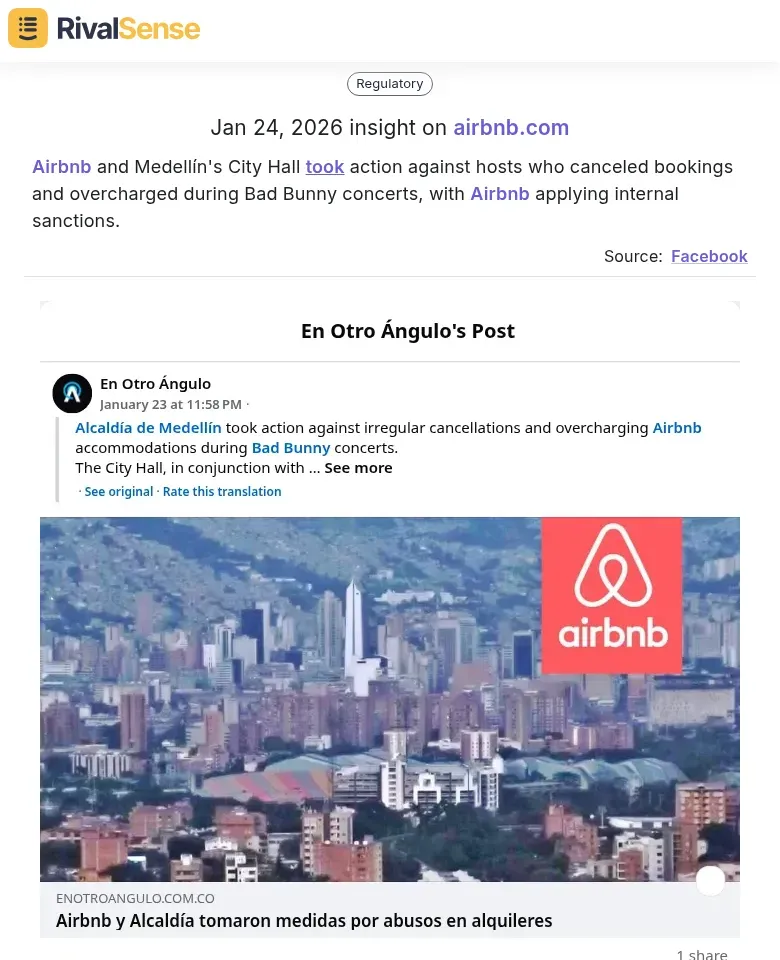
Example: Airbnb and Medellín's City Hall took action against hosts who canceled bookings and overcharged during Bad Bunny concerts, with Airbnb applying internal sanctions.
Why it matters: Monitoring regulatory developments helps you understand compliance risks and industry standards. This can inform your own policies and prevent similar issues. -
Product Launches
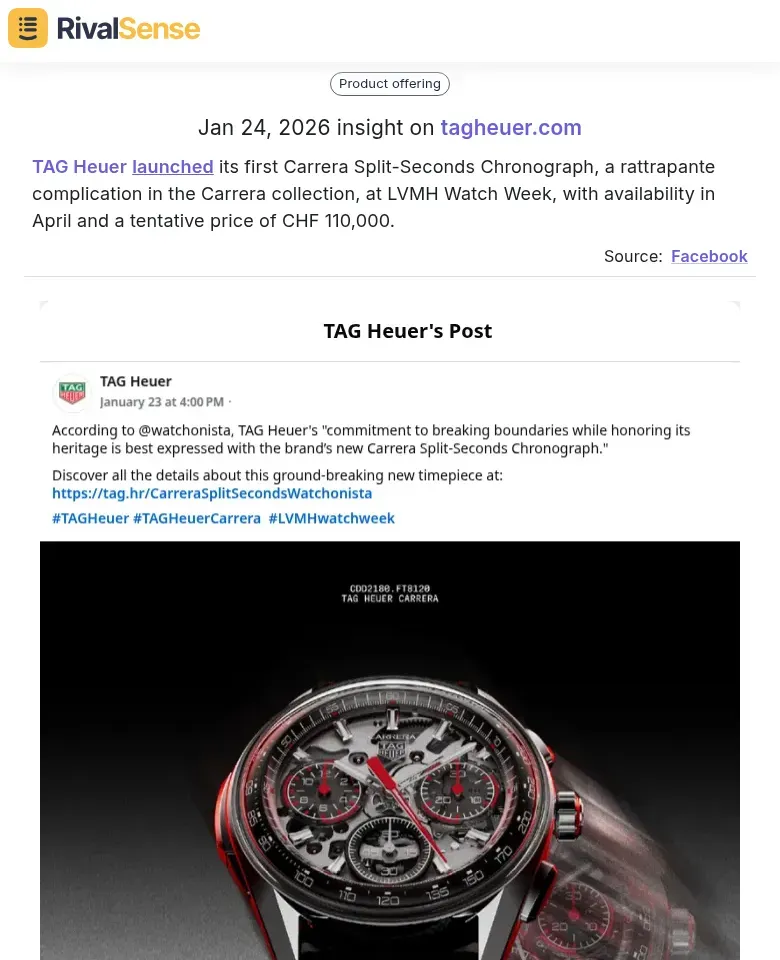
Example: TAG Heuer launched its first Carrera Split-Seconds Chronograph, a rattrapante complication in the Carrera collection, at LVMH Watch Week, with availability in April and a tentative price of CHF 110,000.
Why it matters: Product launches signal market positioning and innovation efforts. By tracking these, you can benchmark your offerings and identify gaps or opportunities in the market.
These insights, when combined with email campaign tracking, provide a holistic view of your competitive landscape.
The RivalSense Advantage for B2B Leaders
- Context-Rich Intelligence - See email campaigns alongside product launches, pricing changes, and leadership moves
- Time Efficiency - Replace hours of manual research with automated weekly reports
- Strategic Insights - Connect email marketing patterns to broader business strategies
- Scalable Monitoring - Track dozens of competitors without the manual overhead
- Actionable Intelligence - Get insights you can immediately apply to your strategy
📋 Implementation Checklist: Building Your Competitor Tracking System
Phase 1: Foundation (Weeks 1-2)
- [ ] Identify 5-10 key competitors
- [ ] Set up burner email accounts
- [ ] Subscribe to all relevant lists
- [ ] Create tracking spreadsheet/database
- [ ] Document baseline metrics
Phase 2: Analysis (Weeks 3-4)
- [ ] Analyze subject line patterns
- [ ] Map automation sequences
- [ ] Track promotional cadence
- [ ] Document design templates
- [ ] Identify content themes
Phase 3: Automation (Month 2+)
- [ ] Evaluate tracking tools based on needs
- [ ] Consider comprehensive solutions like RivalSense for broader intelligence
- [ ] Set up automated reporting
- [ ] Establish regular review cadence
- [ ] Integrate insights into strategy meetings
🎯 Key Takeaways for Business Leaders
-
Start Simple, Scale Smart - Begin with manual tracking for immediate insights, but plan for automation as your needs grow
-
Look Beyond Email - Email campaigns don't exist in isolation. Connect them to product launches, pricing changes, and leadership moves for true strategic intelligence
-
Focus on Patterns, Not Individual Emails - As one Reddit user emphasized, the real value is in "making sense of patterns over time"
-
Consider Comprehensive Solutions - For B2B companies, tools like RivalSense that track multiple business dimensions provide more valuable context than email-only trackers
-
Make It Actionable - The goal isn't just to collect data, but to derive insights that inform your product roadmap, pricing strategy, and marketing approach
🔮 The Future of Competitor Intelligence
As the Reddit discussion shows, the market is recognizing that manual tracking isn't sustainable. Whether you choose specialized email tools or comprehensive platforms like RivalSense, the key is finding a solution that scales with your needs while providing the strategic context B2B leaders require.
Remember: Tracking competitor emails isn't about copying—it's about learning, adapting, and finding opportunities to deliver more value to your audience. With the right approach and tools, you can transform competitive intelligence from a time-consuming chore into a strategic advantage.
Ready to move beyond manual tracking? Try RivalSense for free at https://rivalsense.co/ and get your first competitor report today to start gaining comprehensive competitive intelligence that includes email campaigns and more.
📚 Read more
👉 5 Actionable Hacks to Master Key Account Feedback in Cybersecurity
👉 From Monitoring to Action: How Real-Time Competitor Intelligence Drives Strategic Wins
👉 From Tracking to Winning: How Competitor Insights Unlock Key Account Opportunities
👉 Predictive Analytics for Key Account Monitoring: A Web Scraping Guide for B2B Leaders
👉 Data-Driven Insights: How Competitor Partnerships & Client Wins Reveal Hiring Strategies