
How to Conduct a Regulatory Competitor SWOT Analysis for Strategic Insights
In today’s complex business landscape, regulatory compliance is no longer just a cost center—it’s a powerful competitive differentiator. Regulatory Competitor SWOT Analysis transforms compliance from a defensive necessity into an offensive strategic tool. By systematically evaluating competitors’ Strengths, Weaknesses, Opportunities, and Threats through a regulatory lens, you gain unprecedented insights into market positioning.
Practical Tip: Start by mapping your top 3 competitors’ regulatory certifications, compliance gaps, and enforcement history. This reveals who’s using compliance as a market barrier and who’s vulnerable to regulatory scrutiny.
Why this matters strategically:
- Compliance Advantage: Companies with superior regulatory positioning can enter markets faster, secure better partnerships, and command premium pricing.
- Gap Identification: Spotting competitors’ compliance weaknesses creates opportunities for targeted market entry or acquisition.
- Market Anticipation: Regulatory changes often signal market shifts—analyzing competitors’ responses helps you anticipate industry trends.
Checklist: Track competitors’ regulatory filings, enforcement actions, certification updates, and public compliance statements monthly. This proactive monitoring helps you identify strategic opportunities before they become obvious to the entire market.
Framework Fundamentals: The Regulatory SWOT Analysis Structure
A regulatory SWOT analysis transforms compliance from a cost center into a strategic advantage. Here’s how to structure it effectively:
Mapping Regulatory Strengths:
- Compliance Expertise: Track competitors’ regulatory team size, certifications (GDPR, HIPAA, SOC2), and compliance officer backgrounds.
- Certification Portfolio: Document all industry-specific certifications and audit results.
- Regulatory Relationships: Note participation in industry working groups, advisory boards, and government consultations.
Identifying Regulatory Weaknesses:
- Compliance Gaps: Monitor regulatory filings for deficiencies, warning letters, and corrective action plans.
- Enforcement Actions: Track fines, consent decrees, and settlement amounts across jurisdictions.
- Legal Vulnerabilities: Document ongoing litigation, regulatory investigations, and whistleblower cases.
Analyzing Regulatory Opportunities:
- Emerging Regulations: Subscribe to regulatory updates in key markets (EU AI Act, US privacy laws).
- Policy Changes: Monitor proposed legislation that could create market openings.
- Market Openings: Identify regulatory sandboxes, pilot programs, and compliance-free zones.
Practical Checklist:
- Create a regulatory intelligence dashboard.
- Set up alerts for competitor regulatory filings.
- Map compliance requirements by jurisdiction.
- Track regulatory enforcement trends.
- Document competitor’s regulatory incident history.
Pro Tip: Regulatory strengths often become weaknesses when regulations change. Monitor not just current compliance, but adaptability to future requirements.
Data Collection: Monitoring Regulatory Signals and Competitor Actions
Effective data collection for regulatory competitor SWOT analysis requires systematic monitoring of both regulatory signals and competitor actions. Start by tracking regulatory enforcement actions and legal challenges against competitors through public databases like SEC’s EDGAR, court filings, and regulatory agency websites. Set up automated alerts for new cases, consent decrees, or penalties that reveal competitor vulnerabilities.
Monitor competitor responses to regulatory changes by analyzing their public statements, press releases, and investor communications. Look for patterns in how they adapt compliance programs, modify products, or adjust market strategies.
Checklist for Data Collection:
- Review quarterly earnings calls for compliance mentions.
- Track website updates for new compliance sections.
- Monitor social media for regulatory discussions.
- Use automated tools to streamline monitoring efforts.
Analyze public statements, legal filings, and regulatory submissions for strategic insights. Focus on 10-K risk factor disclosures, comment letter responses, and regulatory submission patterns.
Practical Tip: Use tools like RivalSense to automate tracking of competitor website changes and regulatory announcements. Look for early signals like new compliance officer hires, updated privacy policies, or shifts in product positioning that indicate strategic responses to regulatory pressures.
Real-World Example: Waymo's autonomous vehicle incident on March 13, 2026, where the vehicle ignored safety barriers and drove into a house fire scene, leading to a citation. This type of insight is valuable for business strategy as it highlights compliance gaps and regulatory risks in real-time. Monitoring such events helps you anticipate increased scrutiny on autonomous vehicle safety standards and adjust your own compliance strategies accordingly.
This data reveals both threats (enforcement actions against competitors) and opportunities (market gaps created by regulatory constraints).
Strategic Analysis: Turning Regulatory Intelligence into Actionable Insights
Regulatory intelligence becomes strategic when you translate it into actionable insights. Start by identifying regulatory threats that could disrupt competitors’ business models. For example, track upcoming legislation in their core markets, analyze how new data privacy laws might impact their SaaS platform, or monitor environmental regulations affecting their manufacturing processes. Create a regulatory threat matrix scoring each competitor’s vulnerability to specific regulatory changes.
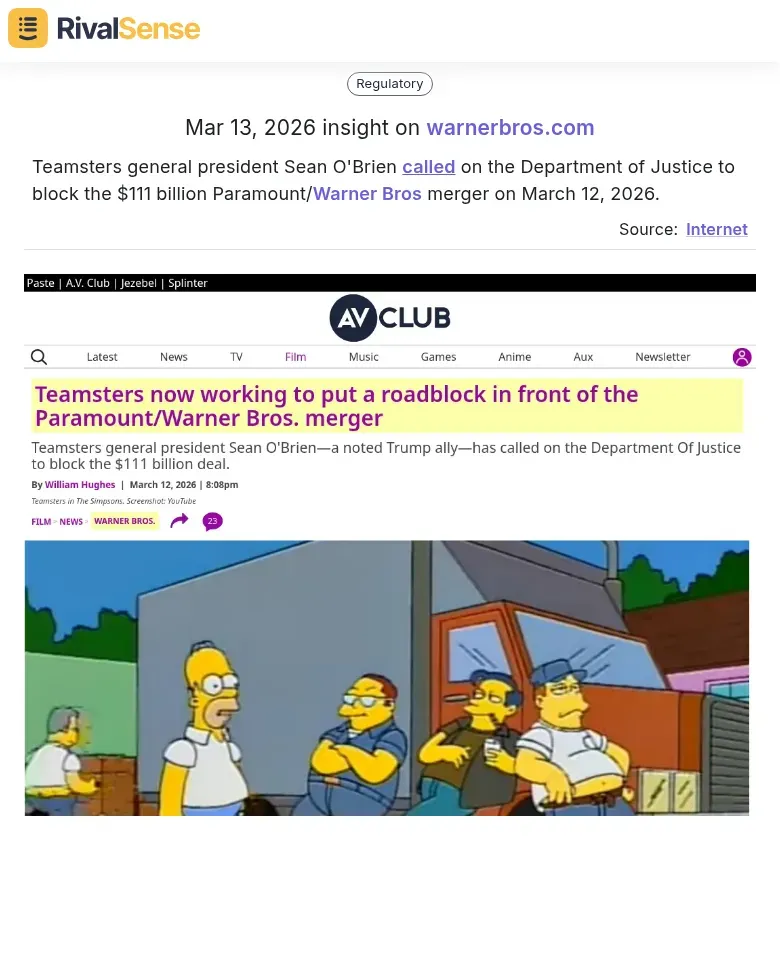
Real-World Example: On March 12, 2026, Teamsters general president Sean O'Brien called on the Department of Justice to block the $111 billion Paramount/Warner Bros merger. This insight is crucial for business strategy as it shows how regulatory interventions can impact major mergers and acquisitions. By tracking such calls, you can assess the regulatory climate for consolidation in your industry and plan your M&A strategies accordingly.
Next, assess how competitors’ legal strategies reveal their market positioning. Examine their patent filings, litigation history, and lobbying activities. A competitor aggressively patenting AI algorithms signals a focus on technological dominance, while heavy lobbying for favorable trade policies suggests expansion plans. This legal footprint often reveals unstated strategic priorities.
Finally, evaluate regulatory compliance as a barrier to entry or competitive moat. Map the compliance landscape in your industry—licensing requirements, safety certifications, data sovereignty laws. Identify where competitors have built substantial compliance infrastructure that creates defensible advantages. For instance, a fintech company’s extensive KYC/AML systems might deter new entrants.
Practical Steps:
- Create a regulatory monitoring dashboard tracking key agencies and legislation.
- Conduct quarterly SWOT analyses focused on regulatory factors.
- Benchmark competitors’ compliance investments against industry standards.
- Identify regulatory gaps where you can build competitive moats.
- Develop contingency plans for high-impact regulatory scenarios.
Regulatory analysis isn’t just about risk avoidance—it’s about uncovering strategic opportunities hidden in the legal landscape.
Implementation: Integrating Regulatory SWOT Findings into Business Strategy
Once you’ve identified regulatory vulnerabilities and strengths through competitor SWOT analysis, the real value comes from strategic implementation. Here’s how to integrate these findings into actionable business strategy:
-
Develop Proactive Regulatory Strategies: Use competitor weaknesses to anticipate regulatory changes. For example, if a competitor struggles with data privacy compliance, proactively enhance your own GDPR framework and position it as a market differentiator. Create a regulatory roadmap that addresses gaps before they become compliance issues.
-
Create Compliance Differentiation: Turn regulatory strengths into competitive advantages. If your analysis reveals competitors have outdated compliance systems, invest in automated compliance tools and market this as a key benefit. Develop compliance certifications or badges that customers value, creating barriers to entry for less-prepared competitors.
-
Establish Continuous Monitoring: Implement a systematic approach to track regulatory changes and competitor responses. Set up alerts for regulatory updates in your industry, monitor competitor compliance announcements, and track enforcement actions against industry players. Use tools like RivalSense to automate competitor tracking and regulatory intelligence gathering.
Practical Checklist:
- Map competitor regulatory vulnerabilities to your strategic opportunities.
- Develop compliance-based marketing messaging.
- Create quarterly regulatory impact assessments.
- Establish cross-functional regulatory response teams.
- Implement automated monitoring for regulatory changes and competitor actions.
By transforming regulatory intelligence into strategic action, you can navigate compliance requirements while gaining competitive ground in regulated markets.
Case Studies and Best Practices: Learning from Real-World Regulatory Dynamics
Regulatory scrutiny often reveals competitor weaknesses that create market opportunities. For example, when a major fintech company faced SEC investigations in 2025 for inadequate customer data protection, competitors identified gaps in their own compliance frameworks and strengthened data governance protocols. This created opportunities for more secure alternatives to gain market share.
Legal challenges expose operational vulnerabilities and strategic gaps. Consider the 2024 case where a healthcare SaaS provider faced FTC penalties for misleading claims about AI capabilities. Competitors analyzed this failure to identify their own marketing compliance risks and implemented stricter review processes for technical claims.
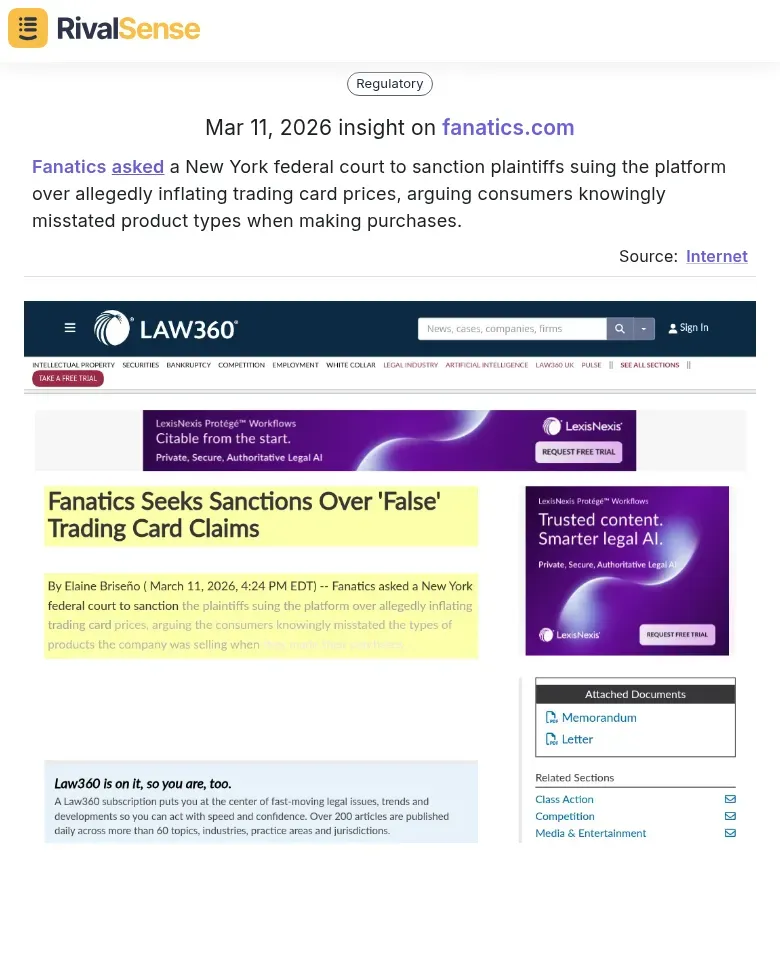
Real-World Example: On March 13, 2026, Fanatics asked a New York federal court to sanction plaintiffs suing the platform over allegedly inflating trading card prices. This insight is valuable for business strategy as it demonstrates how companies use legal tactics to manage regulatory and litigation risks. By monitoring such moves, you can understand competitors' legal strategies and prepare your own responses to potential disputes.
Practical Steps for Learning from Competitors’ Regulatory Missteps:
- Create a regulatory intelligence dashboard tracking competitors’ enforcement actions, fines, and consent decrees.
- Conduct quarterly analysis of competitor regulatory filings and public enforcement documents.
- Map competitor compliance failures to your own operations using a risk matrix.
- Develop "lessons learned" workshops after major competitor regulatory incidents.
- Implement a checklist: Review competitor consent decrees, analyze root causes, assess your similar vulnerabilities, update compliance controls.
Best Practice Tip: When a competitor faces regulatory action, immediately convene a cross-functional team (legal, compliance, operations) to conduct a gap analysis comparing their failure points to your current practices. This proactive approach transforms competitor missteps into your compliance advantages.
Conclusion: Leverage Regulatory Insights for Competitive Edge
Conducting a regulatory competitor SWOT analysis is a continuous process that requires diligent monitoring and strategic integration. By systematically tracking regulatory signals, analyzing competitor actions, and translating insights into actionable strategies, you can turn compliance into a competitive advantage.
To streamline this process and gain real-time insights into competitor regulatory moves, consider using automated tools like RivalSense. RivalSense tracks competitor product launches, pricing updates, event participations, partnerships, regulatory aspects, management changes, and media mentions across company websites, social media, and various registries, delivering all in a weekly email report.
Try RivalSense for free today at https://rivalsense.co/ and get your first competitor report to start uncovering strategic opportunities hidden in regulatory dynamics.
📚 Read more
👉 Decoding Competitor Moves: Lessons from Sennheiser's Audio Update
👉 The Ultimate Guide to Tracking Key Client Activity: Software Solutions & Strategic Insights for 2026
👉 Advanced Tactics: Track Competitor Sales for Supply Chain Optimization
👉 How LinkedIn's Product Shift Revealed a $2B Market Gap for Competitors
👉 Data-Driven Competitor Intelligence: Key Account Success Strategies