
How to Build a Key Account Management Playbook for AML Compliance
In today's evolving regulatory landscape, AML compliance has transformed from a reactive box-ticking exercise to a strategic business imperative. Financial institutions face increasing pressure to balance regulatory demands with client relationship management. Key Account Management (KAM) represents this fundamental shift—moving beyond transactional monitoring to building proactive, intelligence-driven relationships with high-value clients. By adopting a tiered approach that mirrors risk-based compliance frameworks, organizations can allocate resources efficiently, focusing enhanced due diligence on accounts with the highest risk profiles.
Practical steps to integrate compliance intelligence into your KAM workflows:
- Risk-tier your accounts using transaction patterns, geographic exposure, and business activities
- Establish clear escalation protocols for suspicious activity detection
- Embed compliance metrics into account performance reviews
- Create standardized documentation for enhanced due diligence procedures
This integration delivers tangible business value: reduced false positives, stronger client relationships through transparent communication, and the ability to identify legitimate growth opportunities within compliance boundaries. The modern KAM playbook transforms compliance from a cost center to a competitive advantage, enabling organizations to navigate complex regulatory requirements while driving sustainable business growth.
Foundations: Structuring Your AML Key Account Management Framework
Structuring your AML key account management framework requires a methodical approach. By segmenting accounts based on risk, you can allocate resources efficiently and focus on high-priority clients. Building an effective framework starts with intelligent account segmentation. Create a tiered system based on risk profiles: Tier 1 for high-risk accounts (PEPs, high-value transactions, complex ownership structures), Tier 2 for medium-risk, and Tier 3 for low-risk. Use risk scoring criteria like transaction volume, geographic exposure, and business activities.
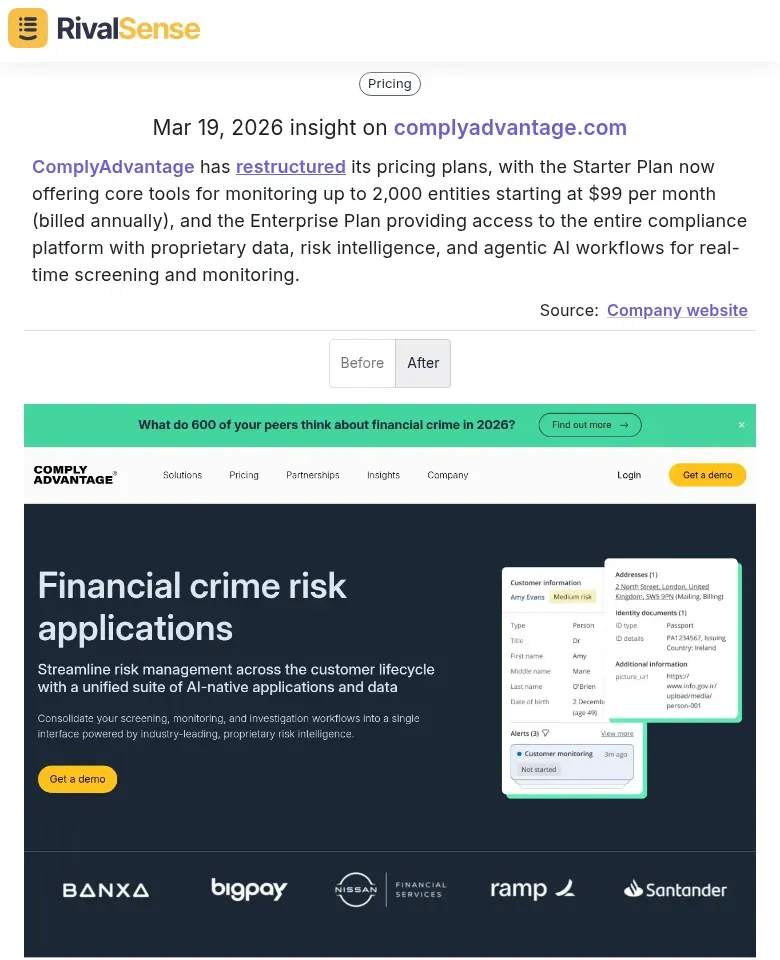
Monitoring competitor pricing strategies can inform your own value proposition and business strategy. For example, RivalSense tracked that ComplyAdvantage has restructured its pricing plans, with the Starter Plan now offering core tools for monitoring up to 2,000 entities starting at $99 per month (billed annually), and the Enterprise Plan providing access to the entire compliance platform with proprietary data, risk intelligence, and agentic AI workflows for real-time screening and monitoring. This insight helps you benchmark pricing against competitors and understand market trends to optimize your offerings.
Establish clear escalation protocols with defined triggers: unusual transaction patterns, adverse media hits, or regulatory changes. Create a communication matrix specifying who to notify (compliance officer, senior management, regulators) and within what timeframe. Implement regular review cycles—monthly for Tier 1, quarterly for Tier 2.
Integrate compliance monitoring tools directly with your CRM or account management platform. Use APIs to sync customer data, transaction alerts, and risk scores automatically. Set up real-time dashboards showing account risk status, pending reviews, and compliance metrics. Practical tip: Start with a pilot program focusing on your 20 highest-risk accounts before scaling to your entire portfolio.
Technology Integration: Leveraging AI and Automation for Enhanced Monitoring
Technology integration transforms AML compliance from reactive monitoring to proactive risk management. Here's how to leverage AI and automation effectively to stay competitive and efficient.
Agentic AI Workflows: Implement autonomous AI agents that continuously screen transactions against evolving risk patterns. For example, configure workflows where AI agents automatically flag suspicious patterns, escalate high-risk cases, and document decisions—reducing manual review by 40-60%.
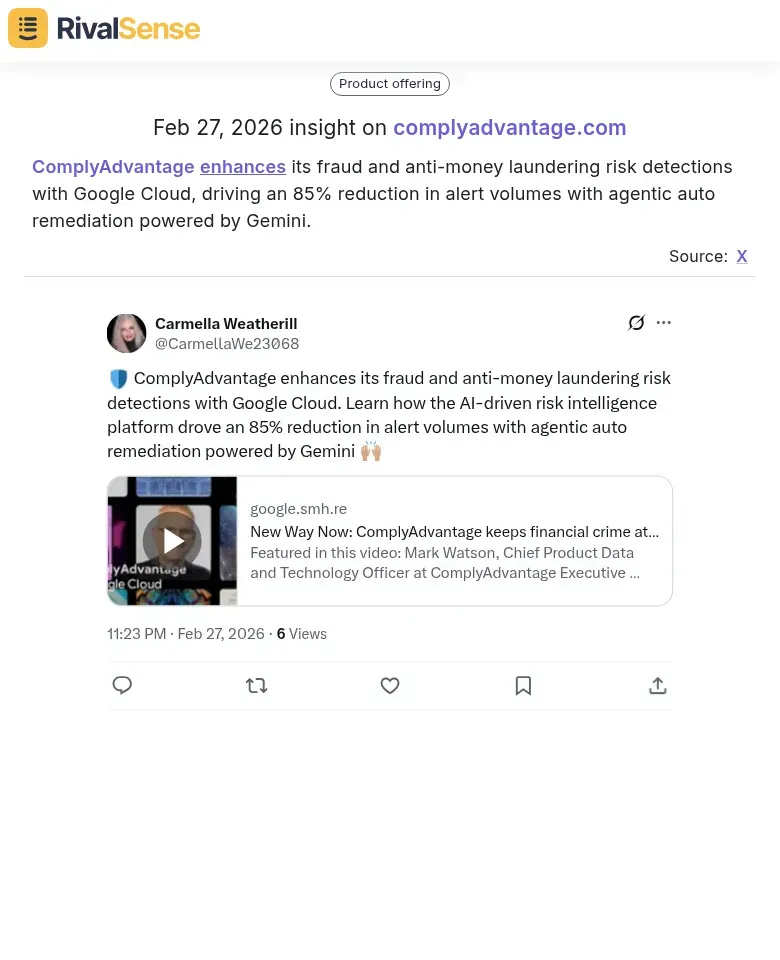
Tracking competitor product updates and partnerships is valuable for assessing technological advancements and strategic direction. RivalSense observed that ComplyAdvantage enhances its fraud and anti-money laundering risk detections with Google Cloud, driving an 85% reduction in alert volumes with agentic auto remediation powered by Gemini. Such insights help you evaluate similar integrations and AI tools to enhance your own monitoring capabilities.
Cloud-Based Platforms: Migrate to cloud-native solutions that use machine learning to reduce false positives. Platforms like AWS AML or Azure Compliance Services can cut alert volumes by 70% while maintaining regulatory effectiveness through adaptive algorithms.
Data Integration: Combine proprietary transaction data with external risk intelligence feeds. Create a unified risk dashboard that scores accounts using both internal behavior patterns and global threat intelligence.
Practical Checklist:
✅ Start with pilot AI agents for specific high-risk transaction types
✅ Choose cloud platforms with built-in compliance certifications (SOC 2, ISO 27001)
✅ Integrate at least 3 external risk data sources (sanctions lists, PEP databases, adverse media)
✅ Implement automated reporting workflows for audit trails
✅ Conduct quarterly model validation to ensure AI accuracy
Pro Tip: Use explainable AI models that provide audit trails for regulatory scrutiny—avoid black-box solutions that can't justify decisions to examiners.
Risk Intelligence: Building Proactive Detection and Response Capabilities
Building proactive detection and response capabilities requires a dynamic risk intelligence framework. This involves continuously updating risk models and integrating external data sources to stay ahead of threats. Start by developing proprietary risk scoring models tailored to key account profiles—incorporate factors like transaction patterns, geographic risk, PEP status, and industry exposure. For example, a corporate account in high-risk jurisdictions might trigger enhanced monitoring thresholds.
Implement real-time monitoring systems that adapt to evolving financial crime patterns. Use machine learning algorithms to detect anomalies in transaction behaviors, such as sudden volume spikes or unusual counterparties. Integrate external data feeds (sanctions lists, adverse media) for comprehensive risk assessment. Set up automated alerts for suspicious activities, ensuring systems learn from false positives to reduce noise.
Create automated remediation workflows with human oversight for critical decisions. Design tiered response protocols: Level 1 for low-risk alerts (auto-close with documentation), Level 2 for medium-risk (escalate to analysts), and Level 3 for high-risk (immediate human review and potential account freeze). Maintain audit trails for all actions. Regularly update playbooks based on regulatory changes and internal incident reviews to stay ahead of emerging threats.
Stakeholder Engagement: Communicating Value and Building Strategic Partnerships
Effective stakeholder engagement transforms AML compliance from a cost center to a strategic partnership. Here's how to build these critical relationships through communication and collaboration.
Thought Leadership Events: Host quarterly roundtables with key accounts to share compliance insights. Knowing competitor events can reveal industry trends and help you plan your own strategic gatherings. For instance, RivalSense reported that ComplyAdvantage hosted an AML Unplugged event at the Gherkin in London to launch its sixth annual State of Financial Crime 2026 report, featuring insights from Iain Armstrong, Executive Director of FCC Strategy at ComplyAdvantage. This type of insight is valuable for understanding how competitors position themselves and inspire your event strategies.

Practical tip: Invite regulators as guest speakers to demonstrate your commitment to industry standards. Create a checklist:
- Identify 3-5 pressing compliance topics
- Secure industry experts
- Develop actionable takeaways
- Follow up with implementation guides
Executive-Level Reporting: Develop monthly dashboards that quantify compliance ROI using this formula: (Fines Avoided + Reputational Damage Prevented) - Compliance Costs. Include visual metrics showing reduced false positives, faster investigation times, and regulatory alignment. Pro tip: Translate technical compliance metrics into business outcomes like customer retention and market expansion opportunities.
Collaborative Frameworks: Establish joint working groups where compliance teams and account managers co-create risk mitigation strategies. Implement a 4-step process:
- Monthly alignment meetings
- Shared risk assessment templates
- Co-developed escalation protocols
- Quarterly strategic reviews
This partnership approach ensures compliance becomes embedded in account growth strategies rather than being a transactional requirement. Key success factor: Measure partnership effectiveness through stakeholder satisfaction surveys and track how collaborative initiatives reduce compliance-related friction in account relationships.
Implementation Roadmap: From Strategy to Operational Excellence
Implementing your KAM playbook requires a phased approach to ensure operational excellence. Start with foundational elements and gradually integrate advanced capabilities while fostering a culture of continuous improvement. Here's a roadmap to guide your journey.
Phase 1: Foundation Building (Months 1-3)
Start with core monitoring tools: Implement transaction monitoring systems, customer due diligence platforms, and basic alert management. Checklist:
✓ Select AML screening software
✓ Establish risk scoring models
✓ Create initial customer risk profiles
✓ Set up basic reporting dashboards
Phase 2: Integration & Training (Months 4-6)
Expand to enterprise platforms that integrate with CRM and account management systems. Launch cross-functional training programs:
- AML fundamentals for account managers
- Relationship management skills for compliance staff
- Joint workshops on high-risk client scenarios
Tip: Use real case studies from your industry to make training practical.
Phase 3: Continuous Improvement (Ongoing)
Establish feedback loops between compliance and account teams. Monthly review meetings should analyze:
✓ Regulatory intelligence updates
✓ Industry benchmarking data
✓ Client feedback on compliance processes
✓ Emerging risk patterns
Implement quarterly playbook updates based on insights.
Practical Steps:
- Assign dual-role champions who understand both compliance and account management
- Create shared metrics that track both relationship health and compliance effectiveness
- Develop escalation protocols for high-risk accounts that balance relationship preservation with regulatory requirements
- Use competitor intelligence to benchmark your approach against industry leaders
Key Success Factor: Build a culture where compliance enhances rather than hinders account management, turning regulatory requirements into competitive advantages in client relationships.
Take Action with Competitive Insights
To stay updated on competitor moves like pricing changes, product enhancements, and events—all critical for refining your AML key account management strategy—try out RivalSense for free at https://rivalsense.co/. Get your first competitor report today and gain strategic insights to enhance your compliance and client relationship efforts.
📚 Read more
👉 Regulatory Compliance Checklist: Uncover Competitor Market Positioning Insights
👉 Analyzing Fanatics' Bundesliga Collection Launch: A Competitor Insight
👉 The Strategic Benefits of Tracking Emerging Competitors: Your Early Warning System
👉 How to Conduct Fleet Management Competitor Analysis for Strategic Advantage
👉 How RivalSense Alerted Competitors to BoursoBank’s Rate Hike for Strategic Response