
How to Analyze Competitor Websites in 2026: A Practical Guide with Actionable Steps
By the RivalSense Team | Updated February 23, 2026
Why Competitor Website Analysis Matters More Than Ever
In today's hyper-competitive B2B landscape, your competitors' websites are more than just digital brochures—they're real-time strategic dashboards. Every homepage redesign, pricing update, feature launch, and blog post reveals critical insights about market positioning, growth strategies, and emerging threats.
According to recent market research, companies that systematically analyze competitor websites are 47% more likely to identify market opportunities before their competitors do. Yet most teams still rely on sporadic manual checks that miss 80% of meaningful changes.
This guide provides a practical, step-by-step framework for analyzing competitor websites that goes beyond surface-level observations to deliver actionable competitive intelligence.
The 5-Step Competitor Website Analysis Framework
Implementing a structured approach ensures you don't miss critical signals. This framework breaks down the process into manageable steps that deliver actionable insights.
Step 1: Identify Your Strategic Monitoring Targets
Practical Checklist:
- Direct Competitors (3-5): Companies selling similar solutions to your target customers
- Indirect Competitors: Companies solving the same problem with different approaches
- Aspirational Competitors: Market leaders whose strategies inform your direction
- Emerging Threats: Startups gaining traction in your space
Pro Tip: Use SEO tools like SEMrush or Ahrefs to discover competitors you might be missing. Look for websites ranking for your core keywords that you don't encounter in sales deals. 🎯
Step 2: Map High-Signal Pages for Each Competitor
Priority Monitoring Checklist:
- Homepage - Strategic positioning and messaging shifts
- Product/Feature Pages - Roadmap signals and feature evolution
- Pricing Pages - Pricing strategy and tier restructuring
- Blog/Newsroom - Content strategy and announcement patterns
- Careers/Jobs Pages - Hiring signals and investment areas
- Case Studies/Testimonials - Customer success and vertical focus
- Partnership Pages - Ecosystem expansion and integration strategy
Real Example: When Slack restructured its free plan in 2022, competitors who monitored their pricing page caught the change immediately and created migration guides within days, capturing displaced users.
Step 3: Set Up Automated Monitoring Systems
Manual website checks are unreliable and don't scale. The most effective teams use automated monitoring tools that track changes across multiple competitors simultaneously.
Key Monitoring Capabilities to Look For:
- Real-time change detection across 80+ sources (websites, social media, registries)
- AI-powered change summaries that highlight what actually changed
- Visual diffs showing before-and-after screenshots
- Keyword filtering to focus on relevant changes
- Team collaboration features for routing alerts to the right departments
RivalSense Advantage: Unlike basic website monitors, RivalSense tracks competitor product launches, pricing updates, event participations, partnerships, regulatory changes, management shifts, and media mentions across company websites, social media, and various registries—delivering comprehensive weekly email reports that consolidate everything in one place.
Step 4: Establish Your Analysis Framework
The 7-Layer Analysis Model (Adapted from Seeto's Research):
- Traffic Distribution Analysis: What demand clusters do they dominate?
- Traffic Composition: Are they brand-led (high direct traffic) or SEO-dependent?
- Messaging Clarity: How quickly do they communicate value? (Nielsen Norman research shows users form impressions in seconds)
- Pricing Philosophy: Outcome-based vs. feature-based pricing reveals margin strategy
- Content Depth: Long-form authority content vs. rapid-fire posts shows strategic horizon
- Conversion Friction: Minimal onboarding vs. qualification forms reveals segmentation strategy
- Rate of Change: How quickly are they evolving? (The most important metric)
Practical Analysis Template:
Competitor: [Name]
Date Analyzed: [Date]

Key Changes This Month:
1. [Change 1] - Strategic Implication: [Your analysis]
2. [Change 2] - Strategic Implication: [Your analysis]

Patterns Emerging:
- [Pattern 1]
- [Pattern 2]

Action Items for Our Team:
1. [Immediate action]
2. [Quarterly adjustment]
Step 5: Build Your Review and Action Process
Department-Specific Playbooks:
For Marketing Teams:
- When homepage messaging changes, compare to your positioning
- Update battlecards within 24 hours of significant competitor moves
- Bring insights to weekly standups with one question: "Does this affect how we tell our story?"
For Sales Teams:
- Get immediate alerts on pricing changes
- Update talk tracks within hours (not days)
- Use competitor weaknesses identified in their testimonials as talking points
For Product Teams:
- Log new features in your competitive matrix
- Flag integration announcements that affect your product comparisons
- Identify sunset features that create migration opportunities
For Leadership:
- Review monthly competitive intelligence briefs
- Spot category-wide trends before they impact your business
- Make strategic decisions based on market momentum, not just internal metrics
Common Mistakes to Avoid
Even with the best intentions, analysis can go awry. Avoiding these common pitfalls will keep your efforts focused and effective.
- Monitoring Too Many Competitors: Start with 3-5 direct competitors. Expand only when your review process is solid.
- Tracking Low-Signal Pages: Focus on pages where changes correlate with strategic decisions.
- Collecting Without Reviewing: Alerts nobody read are worse than no alerts at all.
- Reacting to Every Change: Develop criteria for what triggers action vs. what's just context.
- Relying on Manual Checks: Even disciplined teams miss critical changes. ⚠️
The RivalSense Difference: Beyond Basic Website Monitoring
While many tools track website changes, RivalSense provides comprehensive competitive intelligence by monitoring multiple dimensions. Here are real examples of insights we track and why they matter for your business strategy:
Product Intelligence:
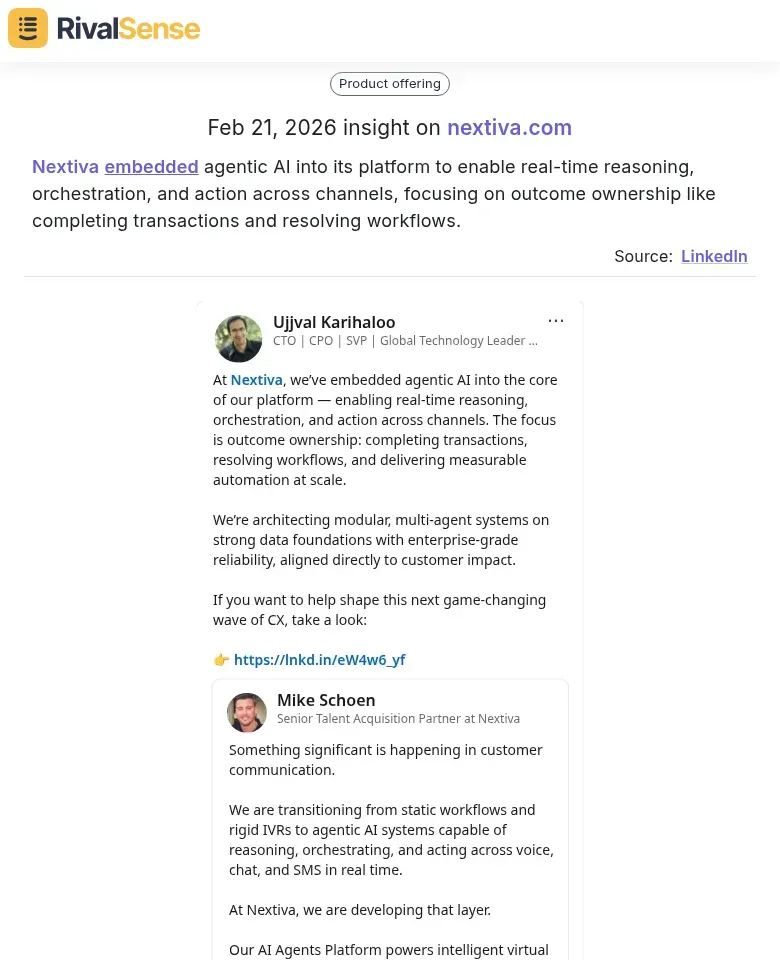
- Feature launches and updates: For instance, when Nextiva embedded agentic AI into its platform to enable real-time reasoning, orchestration, and action across channels, it signaled a shift towards outcome-driven automation. Tracking such product updates helps you anticipate market trends and adjust your own roadmap.
Commercial Intelligence:
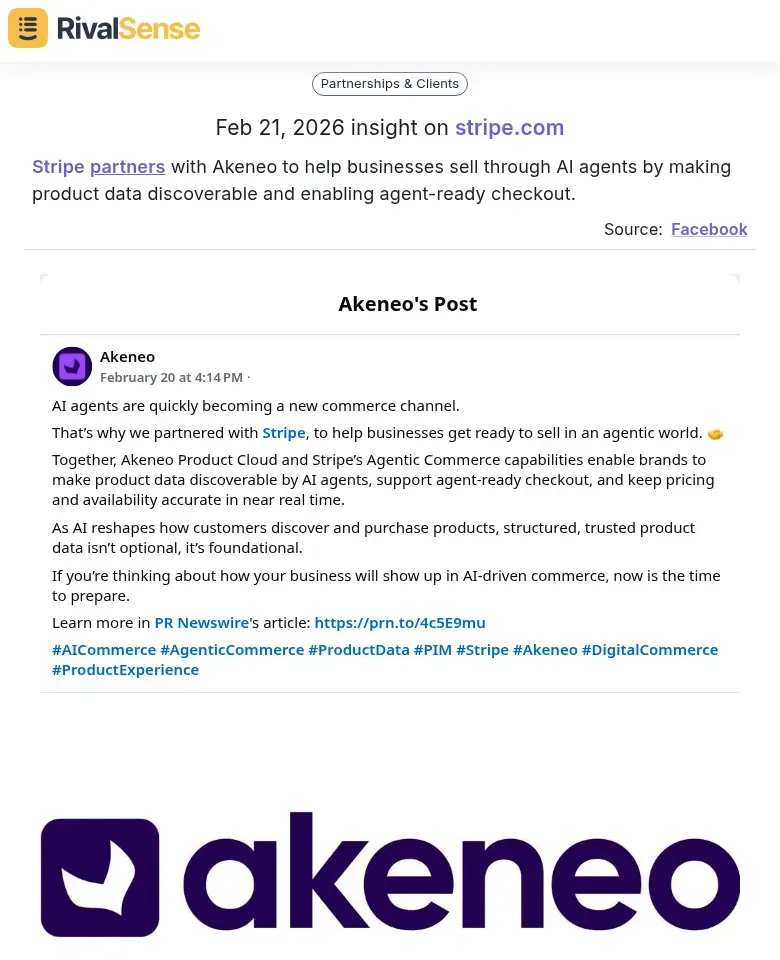
- Partnership announcements: For example, Stripe's partnership with Akeneo to help businesses sell through AI agents by making product data discoverable reveals strategic moves to capture the AI commerce space. Monitoring partnerships can uncover new market opportunities and competitive threats.
Organizational Intelligence:
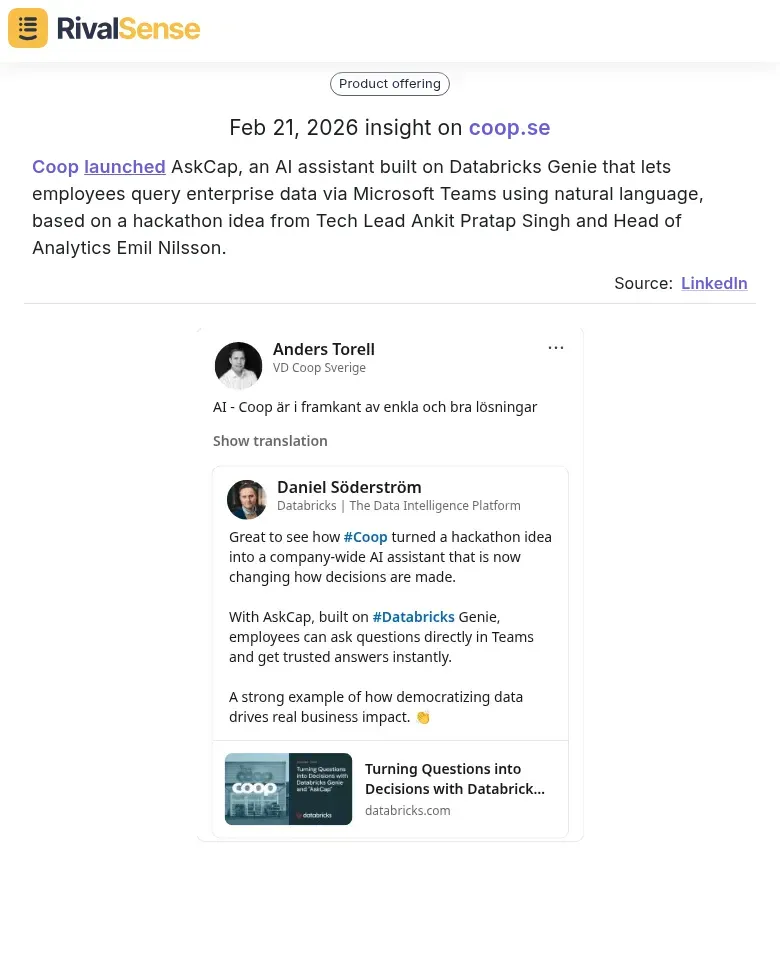
- Innovation from internal initiatives: Coop launched AskCap, an AI assistant built on Databricks Genie that lets employees query enterprise data via Microsoft Teams. This insight, based on a hackathon idea, shows how tracking product launches from various sources can reveal a competitor's innovation pipeline and internal capabilities.
All these insights are consolidated into weekly email reports that save you hours of manual research.
Getting Started: Your 15-Minute Setup
Getting started doesn't have to be complicated. With a simple setup, you can begin gaining insights immediately.
- Identify your top 3 competitors
- Select their homepage, pricing page, and main product page (3 URLs each)
- Set up automated monitoring with keyword filters for your product categories
- Establish a weekly 30-minute review meeting
- Create a simple shared document to log insights and actions
Quick Win: Monitor one competitor's pricing page for two weeks. The first time you catch a change your sales team didn't know about, you'll see the immediate value. 🚀
Advanced Analysis Techniques
To deepen your insights, combine website analysis with other data sources. These techniques help you spot patterns and make predictive decisions.
Pattern Recognition Across Multiple Competitors:
When three competitors simultaneously shift messaging from "growth" to "efficiency," that's not coincidence—it's capital pressure making itself visible. Tools that aggregate changes across multiple competitors help you spot these category-wide shifts.
Historical Analysis:
Track how competitors' positioning has evolved over 6-12 months. This reveals long-term strategic direction, not just tactical adjustments.
Cross-Reference with Other Data:
Combine website analysis with:
- Funding announcements (Crunchbase)
- Employee growth (LinkedIn)
- Customer reviews (G2, Capterra)
- SEO performance (Ahrefs, SEMrush)
FAQ: Competitor Website Analysis
Here are answers to common questions about competitor website analysis. These clarifications will help you implement best practices.
Q: How often should I check competitor websites?
A: Pricing and product pages in fast-moving markets need daily monitoring. Blog content and careers pages can be checked weekly. Automated tools eliminate manual checking by alerting you only when meaningful changes occur.
Q: Is it legal to monitor competitor websites?
A: Yes. Monitoring publicly available information is standard business practice. Tools access only public pages, the same way you would by visiting the site.
Q: What types of changes reveal the most about strategy?
A: Pricing changes, new feature pages, homepage messaging rewrites, and job posting patterns carry the strongest signals. The most valuable insights come from tracking these over time to spot patterns.
Q: Can I monitor without competitors knowing?
A: Yes. Monitoring tools access public pages using standard web requests, just like search engine crawlers. Competitors have no way of knowing you're monitoring specific pages.
Conclusion: From Reactive to Predictive
The most successful companies don't just react to competitor moves—they anticipate them. By implementing a systematic competitor website analysis process, you transform raw change data into predictive intelligence.
Remember: In fast-moving markets, interpretation speed becomes competitive advantage. The teams that understand competitor signals fastest win not because they build faster, but because they interpret faster.
Ready to transform your competitor analysis? Try RivalSense for free at https://rivalsense.co/ and get your first competitor report today. Track product launches, pricing updates, partnerships, and media mentions across 80+ sources—all delivered in your weekly email report.
RivalSense helps B2B companies track competitor product launches, pricing updates, event participations, partnerships, regulatory aspects, management changes, and media mentions across company websites, social media, and various registries—delivering comprehensive competitive intelligence in weekly email reports.
📚 Read more
👉 Industrial Machinery Maintenance: Benchmarking Key Account Advocacy Tracking
👉 From Threat to Opportunity: How Competitor Intelligence on Shure's MXA320 Enabled a Strategic Pivot
👉 Uncover Competitor Influencer Partnerships on Instagram for Strategic Business Advantage
👉 Data-Driven Gaming Edge: Uncovering Competitors' Strategic Advantages
👉 Uncover Competitor Event Strategies for Enterprise Key Accounts