
How to Analyze Competitor Innovations: A Case Study on IXI's Autofocus Eyewear
Competitor analysis is essential for understanding market dynamics and positioning your business effectively. By tracking competitors' activities, you can uncover opportunities and threats that inform strategic decisions. A recent example from RivalSense highlights how insights from competitor communications can reveal significant industry shifts.
IXI's Chief Design Officer Timo Yliluoma and CEO Niko Eiden discussed autofocus eyewear with Monocle, emphasizing its complex engineering and potential to dynamically change vision correction. This insight not only showcases IXI's innovation but also signals a broader impact on the eyewear and healthcare sectors. Analyzing such details helps you anticipate trends and adjust your product roadmap accordingly.
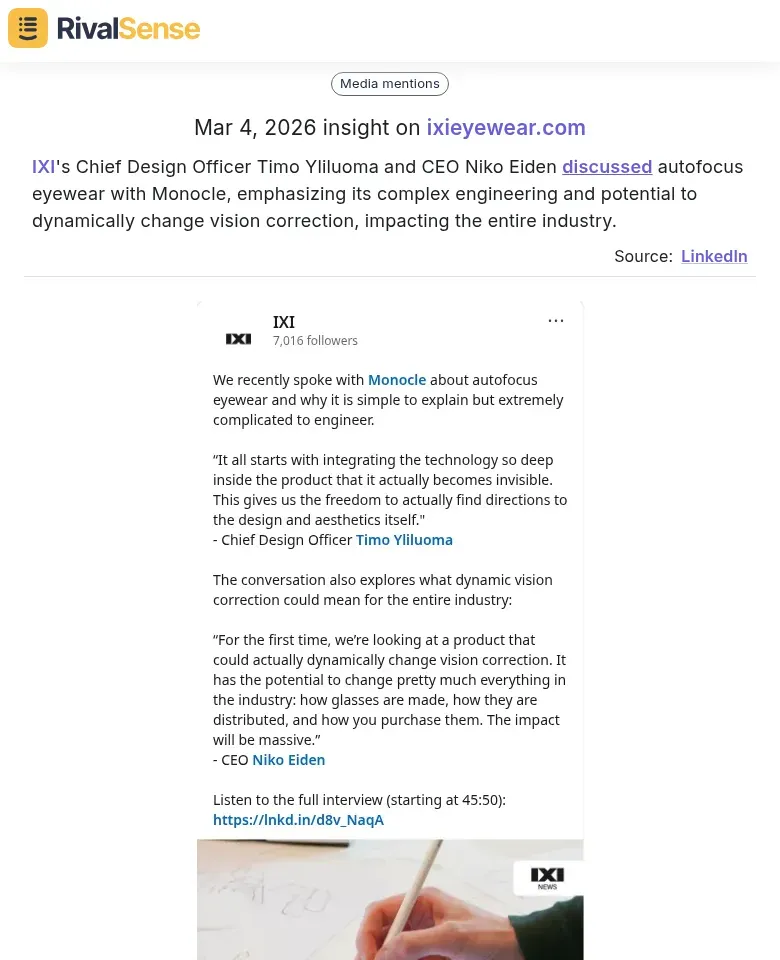
To turn competitor insights into actionable strategies, follow these practical steps. Start by systematically monitoring key sources and interpreting the data for your business context. Here’s a breakdown of effective competitor analysis techniques with examples from the IXI case.
1. Track Executive Communications and Media Appearances
Executive interviews often provide early warnings about strategic shifts or new product launches. In the IXI example, the discussion with Monocle revealed focus on autofocus technology, hinting at R&D priorities. Set up alerts for competitors' leaders on news platforms and social media to catch such insights early.
- Tip: Use tools that aggregate media mentions and executive profiles to save time.
- Checklist for monitoring:
- [ ] Identify key executives and their communication channels
- [ ] Subscribe to industry publications where interviews appear
- [ ] Analyze tone and keywords for hidden agendas
2. Evaluate Product Innovations and Engineering Complexity
When competitors highlight new technologies, assess their feasibility and market readiness. IXI's autofocus eyewear involves complex engineering, which may indicate high barriers to entry or potential delays. Break down the innovation into components to understand its strengths and weaknesses.
- Hint: Compare with your own R&D efforts to identify gaps or advantages.
- Table for analysis:
Aspect Question to Ask Example from IXI Technology Is it proprietary or open-source? Likely proprietary due to complexity Market Fit Who is the target audience? Individuals needing dynamic vision correction Competitive Edge How does it differ from existing solutions? Autofocus vs. static lenses
3. Assess Industry Impact and Strategic Responses
Determine how a competitor's move might reshape the industry landscape. For autofocus eyewear, it could disrupt traditional optometry and retail models. Use scenarios to plan your response, whether through innovation, partnerships, or marketing adjustments.
- Tip: Conduct regular SWOT analyses (Strengths, Weaknesses, Opportunities, Threats) based on competitor insights.
- Actionable steps:
- Map out potential regulatory changes or partnership opportunities.
- Engage with key accounts to gauge their interest in such innovations.
- Update your business development strategies to counter or collaborate.
Incorporating competitor insights into your routine can transform how you navigate market challenges. Tools like RivalSense automate this by tracking product launches, pricing updates, event participations, and more across various sources. To enhance your competitor analysis, try out RivalSense for free at https://rivalsense.co/ and get your first report today!
📚 Read more
👉 The Ultimate Guide to Key Account Management Forums: Practical Strategies for 2026
👉 Analyzing Competitor Loyalty Programs to Boost Warehouse Productivity
👉 How LinkedIn's AI Hiring Insight Helped Competitors Accelerate Recruitment Innovation
👉 Uncover Competitor Secrets: A Step-by-Step Guide to Twitter Content Marketing Intelligence
👉 Mastering Key Account KPIs for Enterprise AI Platform Success