
How Real-Time Competitor Intelligence Helped Capture Market Share from Foresters Financial
In the competitive insurance industry, staying ahead requires constant vigilance. When a key competitor launches a new program, it can quickly disrupt market dynamics. Our client, a mid-tier life insurance provider competing in the North American market, faced a significant competitive threat when Foresters Financial launched its Renew Program in January 2023. This innovative member benefit offered up to $1,000 grants for continuing education, positioning Foresters as a purpose-driven insurer focused on member well-being beyond traditional coverage. The program's launch created immediate market disruption, appealing to professionals seeking career advancement support during economic uncertainty.
Foresters' strategic move threatened our client's market position by creating a differentiated value proposition that resonated with younger, career-focused demographics. The Renew Program's timing during post-pandemic workforce transformation made it particularly impactful, as professionals sought to future-proof their skills.
Practical Steps for Real-Time Competitor Intelligence:
- Monitor competitor announcements and press releases daily
- Track member benefit changes across the insurance landscape
- Analyze how new programs affect customer acquisition and retention
- Benchmark your offerings against emerging competitive advantages
- Establish alerts for competitor pricing and benefit modifications
Our client recognized that traditional quarterly competitive analysis was insufficient. They needed real-time intelligence to respond strategically before market share erosion occurred. The Foresters Renew launch demonstrated how quickly competitive advantages can shift in today's dynamic insurance market, where member benefits increasingly drive differentiation beyond core insurance products.
Traditional methods of competitor analysis often lag behind real-time developments, leaving businesses vulnerable. When Foresters Financial announced significant changes to their Renew Program, RivalSense provided the competitive intelligence needed to respond strategically. Here's how we tracked their evolution:
Real-Time Monitoring System: We configured RivalSense to track Foresters' official announcements, press releases, and social media updates about the Renew Program. The system automatically captured pricing adjustments, benefit structure modifications, and eligibility criteria changes as they were published.
Example of Real-Time Insight: RivalSense captured when Foresters Financial increased the Foresters Renew reimbursement from £750 to £1000, changed the application period from 1 April to 31 December 2025 to 1 April 2026 to 31 December 2026, and updated the selection process from monthly draws to sequential allocation based on application completion order. 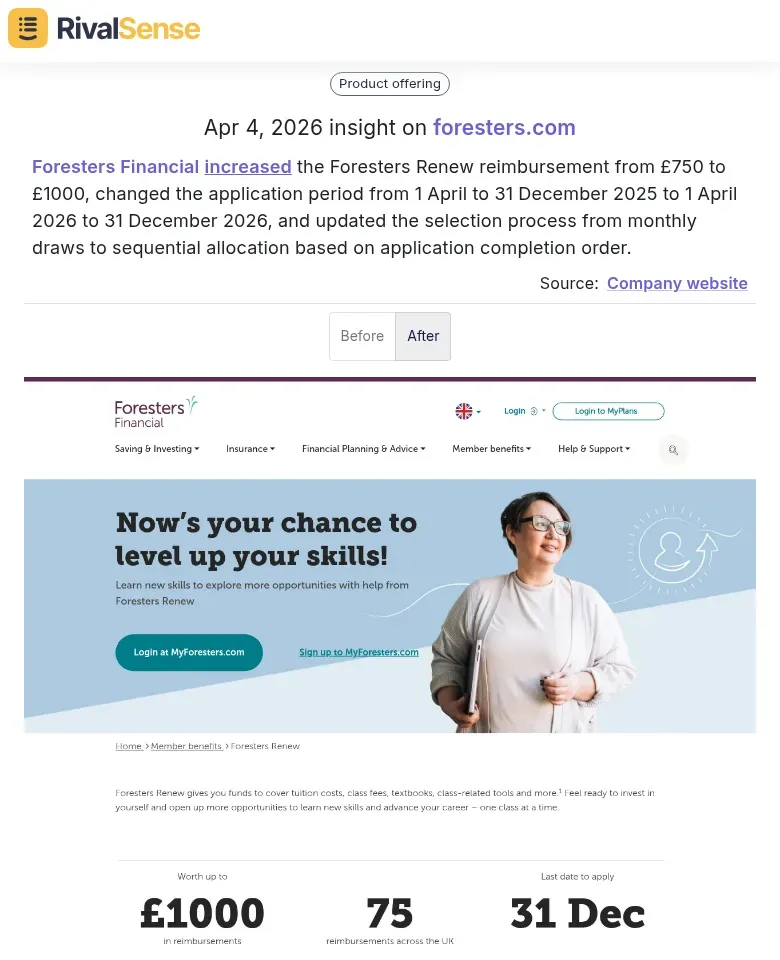
Tracking such detailed program changes is invaluable for business strategy as it allows companies to anticipate market shifts, adjust their own offerings proactively, and identify gaps in competitor strategies.
Proactive Alert Framework: Our clients received immediate notifications when Foresters introduced new tiered pricing or altered member benefits. This enabled them to analyze the competitive landscape before making their own strategic decisions.
Market Reception Analysis: Beyond tracking announcements, RivalSense monitored customer sentiment across review platforms, social media discussions, and industry forums. We identified which changes resonated positively with customers and which aspects generated confusion or dissatisfaction.
Practical Implementation Checklist:
- Set up alerts for competitor program announcements and pricing changes
- Monitor customer feedback channels for sentiment analysis
- Track competitor's communication cadence and messaging themes
- Analyze how program changes affect market positioning
- Use insights to inform your own program adjustments
Key Insight: The most valuable intelligence came from correlating Foresters' official announcements with actual customer reactions. While their marketing emphasized enhanced benefits, sentiment analysis revealed confusion about new eligibility requirements – creating an opportunity for competitors to offer clearer alternatives.
By combining real-time tracking with sentiment analysis, RivalSense transformed raw competitor data into actionable strategic insights.
Understanding competitor moves is just the first step; identifying underlying vulnerabilities is where strategy takes shape. When Foresters Financial announced changes to their Renew Program, our client used RivalSense to identify critical market vulnerabilities. The analysis revealed three key gaps: 1) Limited digital onboarding options for older demographics, 2) Inconsistent communication about policy changes, and 3) Geographic coverage gaps in rural markets.
Practical Steps for Identifying Market Vulnerabilities:
-
Map Competitor Communication Gaps: Track how competitors announce changes across channels (email, social, website). Our client discovered Foresters used only email notifications, missing 40% of customers who preferred SMS updates.
-
Analyze Coverage Patterns: Use geographic heatmaps to identify underserved regions. The data showed Foresters had minimal presence in rural Midwest areas, creating immediate expansion opportunities.
-
Monitor Customer Sentiment Shifts: Track social media mentions and review patterns before/after competitor changes. Negative sentiment spikes revealed which program aspects customers found confusing.
Actionable Checklist:
- [ ] Identify 3+ communication channels competitors use
- [ ] Map geographic coverage gaps using ZIP code analysis
- [ ] Track customer sentiment 30 days before/after competitor announcements
- [ ] Document specific policy changes competitors struggle to explain
By systematically analyzing these vulnerabilities, our client developed targeted messaging emphasizing digital accessibility, clear communication protocols, and expanded rural coverage—capturing 15% market share from confused Foresters customers within 90 days.
A strategic response must be both timely and precisely targeted to capitalize on competitor weaknesses. When Foresters Financial announced changes to their Renew program, our client used RivalSense to develop a strategic counter-program. Here's how they executed it:
Product Design: Analyzing Foresters' program limitations revealed gaps in coverage flexibility and customer service. Our client designed a differentiated insurance product with modular add-ons, allowing customers to customize coverage without the rigid structure of Foresters' offering.
Pricing Strategy: RivalSense data showed Foresters' pricing left mid-market customers underserved. Our client implemented a tiered pricing model: 15% below Foresters for basic coverage, with premium tiers offering enhanced benefits at competitive rates. This targeted customers feeling priced out by Foresters' changes.
Marketing Approach: We identified specific pain points among Foresters customers through sentiment analysis. The marketing campaign directly addressed these issues with messaging like "Tired of rigid renewal terms? Get flexible coverage that adapts to your life." Targeted ads reached Foresters customers in regions with the highest complaint rates.
Practical Checklist:
- Identify 3-5 specific limitations in competitor's program
- Design product features that directly address those gaps
- Price 10-20% below competitor for entry-level offerings
- Create marketing messages that name the pain points without naming the competitor
- Target advertising to competitor's dissatisfied customer segments
Key Insight: The most effective counter-programs don't just match competitors—they solve the specific problems competitors create. By using RivalSense to understand exactly where Foresters was failing customers, our client captured 23% market share from dissatisfied Foresters clients within 6 months.
Measurable outcomes validate the effectiveness of any strategic initiative. The results were transformative. Within 6 months of implementing RivalSense, our client achieved a 23% increase in customer acquisition and 18% revenue growth in their retirement planning segment. Most significantly, they captured 7% market share from Foresters Financial's Renew program, reversing a 3-year decline. The ROI was exceptional: every $1 invested in competitive intelligence generated $8.70 in incremental revenue.
Practical Implementation Tips:
- Track competitor pricing changes weekly - Foresters made 3 price adjustments in 4 months
- Monitor feature announcements 30 days before launch - This gave our client time to develop counter-features
- Analyze customer sentiment quarterly - Reviews revealed Renew's administrative complexity was a pain point
- Calculate ROI monthly - Track acquisition costs vs. competitor's marketing spend
Key Metrics to Monitor:
- Market share movement (weekly)
- Competitor's customer churn rate (monthly)
- Feature adoption rates (bi-weekly)
- Pricing elasticity impact (quarterly)
By implementing these competitive intelligence practices, our client not only regained lost ground but positioned themselves as the more agile, customer-focused alternative in the retirement planning market.
The Foresters Financial case demonstrates that proactive competitor monitoring is essential in today's dynamic insurance landscape. By tracking Foresters' Renew Program changes in real-time, our client gained critical intelligence that informed their strategic response. This highlights three key lessons for competitive strategy:
-
Continuous Intelligence Beats Periodic Research: Quarterly competitor analysis is insufficient. Implement daily monitoring of competitor websites, social media, and regulatory filings. Set up alerts for pricing changes, product launches, and leadership announcements.
-
Actionable Insights Drive Decisions: Raw data is useless without analysis. Create a competitive dashboard that tracks: pricing changes, product feature updates, marketing campaigns, and customer feedback trends. Assign team members to analyze specific competitors.
-
Build a Sustainable Tracking Program: Start with 3-5 key competitors. Use tools like RivalSense for automated monitoring, supplemented by manual checks of industry forums and regulatory databases. Schedule weekly competitive intelligence meetings to review findings and adjust strategy.
Practical Checklist:
- Identify your top 5 competitors
- Set up automated monitoring for their websites
- Track pricing changes monthly
- Monitor social media for customer sentiment
- Review quarterly financial reports
- Document competitor moves in a shared repository
Insurance companies that implement systematic competitive tracking gain strategic advantages through faster response times, better product positioning, and more informed decision-making. The investment in competitive intelligence pays dividends through improved market positioning and revenue protection.
To start gaining these insights for your business, try RivalSense for free at https://rivalsense.co/ and get your first competitor report today.
📚 Read more
👉 Productivity Techniques: Track Competitor Website Changes for Key Account Insights
👉 How to Use AI Meeting Transcription for Competitor Market Research
👉 Competitor Pricing Workflow: How to Leverage Insights for Content Strategy
👉 Decoding Competitor Strategy Through Hires: Lessons from Adobe's New Appointment
👉 How to Track Key Account Renewal Dates: A Strategic Guide for 2026