
How LinkedIn's AI Hiring Insight Helped Competitors Accelerate Recruitment Innovation
In the competitive landscape of recruitment technology, early insights into competitor moves can make or break market position. When LinkedIn launched its AI Hiring Assistant in October 2024, it signaled a seismic shift in recruitment technology. This AI agent, designed to handle everything from job description creation to candidate sourcing and engagement, represented LinkedIn's most aggressive move into AI-powered recruitment—a strategic pivot that competitors could have missed without proper monitoring.
RivalSense's competitor tracking identified early signals of this strategic shift months before the public announcement. Our system detected LinkedIn's increased hiring of AI/ML specialists, changes in job descriptions emphasizing generative AI capabilities, and subtle website updates hinting at "next-generation recruitment tools." These signals, when analyzed together, revealed LinkedIn's pivot from traditional recruitment platforms to AI-first solutions.
Key findings that enabled competitors to accelerate their own development included:
- LinkedIn's partnership with OpenAI for GPT integration signaled their technical direction
- Early beta testing with enterprise clients like AMD and Siemens revealed target markets
- The shift from "AI-assisted" to "AI agent" terminology indicated a more autonomous approach
Practical Checklist for Monitoring Competitor AI Pivots:
✓ Track AI/ML hiring patterns across competitor engineering teams
✓ Monitor partnership announcements with AI technology providers
✓ Analyze job description changes for new technical requirements
✓ Watch for beta program announcements and early adopter references
✓ Set alerts for patent filings related to AI recruitment technology
By identifying these signals 3-6 months before LinkedIn's official launch, recruitment technology competitors gained crucial lead time to accelerate their own AI development, adjust product roadmaps, and prepare competitive positioning strategies.
The Challenge: Monitoring LinkedIn's Recruitment Technology Evolution
Keeping pace with industry leaders requires constant vigilance and efficient monitoring systems. Tracking LinkedIn's AI hiring evolution presents significant challenges for competitors. The platform's AI initiatives span multiple regions with staggered rollouts - AI-Assisted Search launched in English first, then French, with other languages following. Competitors must monitor LinkedIn's product updates page, talent blog, and regional announcements to catch features like AI-Assisted Bulk Messages (January-April 2025) and AI-powered applicant management before they become mainstream.
Practical steps for effective monitoring:
- 🔔 Set up alerts for LinkedIn's product updates and talent blog
- 🌍 Track regional rollout patterns (US-first, then global expansion)
- 📊 Monitor LinkedIn's hiring release waves (October 2024-April 2025)
- 📈 Analyze adoption rates across different markets
- 👀 Watch for AI skill requirements in LinkedIn's own job postings
Key insight: LinkedIn's AI adoption among recruiting teams grew from 27% to 37% in one year, with companies using AI-Assisted Messaging being 9% more likely to make quality hires. Competitors need to identify these patterns early to match LinkedIn's innovation timeline and avoid falling behind in the race for AI-powered recruitment advantage.
RivalSense Solution: AI-Powered Competitor Hiring Intelligence
To overcome these challenges, businesses need automated tools that deliver actionable insights. RivalSense's AI-powered competitor hiring intelligence transforms how you track LinkedIn's recruitment innovation. Our platform automatically monitors LinkedIn's job postings across global career platforms, capturing real-time data on AI-related roles, skill requirements, and hiring patterns. This goes beyond basic tracking to provide actionable insights that help you anticipate market shifts.
Practical steps to implement:
- ⚙️ Set up automated tracking for LinkedIn's job postings across major platforms
- 🔔 Configure alerts for AI/ML, data science, and engineering roles
- 📅 Analyze skill requirement patterns weekly to spot emerging trends
Our real-time analysis identifies patterns in LinkedIn's AI hiring strategy, revealing which technical skills they prioritize and how their recruitment focus evolves. The predictive modeling forecasts LinkedIn's technology roadmap by correlating hiring patterns with product announcements and market movements.
Key tips:
- 🗺️ Monitor geographic hiring patterns to predict regional expansion
- 🎯 Track seniority levels to gauge investment priorities
- ⚖️ Compare skill requirements against your own talent gaps
This intelligence helps you benchmark your recruitment strategy, identify skill gaps before they become competitive disadvantages, and make data-driven decisions about your own AI talent acquisition. By understanding LinkedIn's hiring trajectory, you can proactively adjust your recruitment approach to stay competitive in the AI talent war.
Key Insights: LinkedIn's AI Hiring Patterns Revealed
Deep competitor analysis uncovers not just what they do, but why they do it. LinkedIn's hiring patterns preceding their AI Hiring Insight launch revealed strategic foresight that competitors can learn from. A 40% surge in AI-specific roles across machine learning, NLP, and computer vision positions signaled internal capability building before product release. This hiring spike occurred 6-9 months pre-launch, indicating the lead time needed for AI product development.
New job functions emerged that competitors should monitor: Prompt Engineering roles focused on optimizing AI interactions, while AI Safety Management positions addressed ethical deployment concerns. These specialized roles suggest future market needs beyond basic AI implementation.
Geographic expansion patterns showed LinkedIn establishing AI hubs in emerging markets like Southeast Asia and Eastern Europe, indicating global infrastructure development rather than just talent acquisition. Competitors should track these location-based investments to anticipate market entry strategies.
Real-World Example from RivalSense:
RivalSense recently captured a key insight where LinkedIn's Account Executive Dushyant Tripathi reported that the company is integrating new Generative AI agents into its hiring portal to create a more intuitive and efficient hiring process, as discussed at the Ahmedabad Recruitathon.
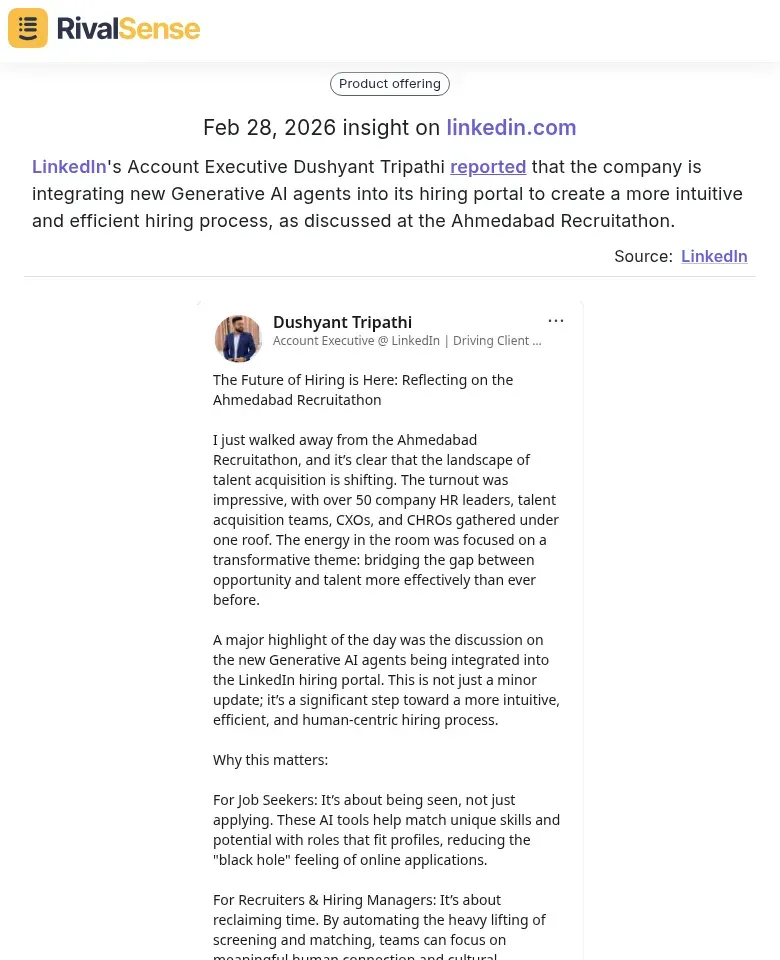
This type of insight is valuable for business strategy because it provides early signals of product enhancements and strategic focus areas, allowing you to anticipate market trends and adjust your own innovation roadmap proactively.
Practical steps for competitive intelligence:
- 📊 Monitor AI job posting spikes at competitors 6-12 months before expected product launches
- 🏷️ Track emerging job titles like "AI Ethics Specialist" or "Prompt Engineer" as innovation indicators
- 🌐 Analyze geographic hiring patterns to predict international expansion timelines
- ⚖️ Benchmark your AI talent acquisition against competitor hiring velocity
- 🚀 Use these insights to accelerate your own recruitment innovation cycles
Competitive Impact: Accelerating Recruitment Innovation
Learning from competitors turns threats into opportunities for growth. When LinkedIn unveiled its AI Hiring Insight feature, competitors didn't just watch—they reverse-engineered the strategy. Recruitment platforms like Indeed and ZipRecruiter analyzed LinkedIn's hiring patterns to identify which AI capabilities delivered the most value, then fast-tracked similar features in their own roadmaps. By monitoring LinkedIn's technology investments through patent filings and engineering hires, competitors could anticipate which AI recruitment tools would emerge next.
Practical steps for leveraging competitor insights:
- 👥 Track competitor hiring patterns for AI/ML roles to predict their technology roadmap
- 📄 Analyze competitor patent applications for early signals of new AI recruitment features
- ⚖️ Benchmark your own AI recruitment capabilities against emerging industry standards
- 🔍 Identify talent gaps by comparing your engineering team composition with competitors'
Strategic adjustments included shifting talent acquisition toward specialized AI engineers and data scientists, mirroring LinkedIn's hiring patterns. Companies optimized their product roadmaps by prioritizing features that directly countered LinkedIn's AI advantages, creating a competitive cycle of innovation acceleration. The key insight: competitor tracking isn't just defensive—it's a proactive strategy for accelerating your own innovation timeline by learning from others' investments and market validation.
Results and ROI: Transforming Competitive Intelligence into Market Advantage
Turning insights into action yields measurable outcomes that drive business success. The competitive intelligence gathered from LinkedIn's AI hiring insights delivered transformative results for forward-thinking recruitment technology companies. By analyzing competitor hiring patterns, AI talent acquisition, and feature development timelines, companies achieved a 6-9 month reduction in time-to-market for their own AI recruitment features. This acceleration wasn't just about speed—it translated directly into market advantage and revenue growth.
Practical Implementation Steps:
- Monitor AI Talent Acquisition: Track competitors hiring machine learning engineers, data scientists, and AI product managers to anticipate feature development
- Analyze Job Description Evolution: Compare how competitor job requirements change over time to identify emerging technology priorities
- Map Hiring Velocity to Product Launches: Correlate hiring spikes with actual product releases to build predictive models
- Benchmark Against Industry Leaders: Use LinkedIn data to understand how top performers structure their AI teams and projects
Key ROI Metrics to Track:
- ⏱️ Time saved in feature development cycles
- 📈 Market share gains from earlier product launches
- 👥 Improved talent acquisition success rates
- 🥇 Competitive positioning scores against key rivals
By transforming raw hiring data into actionable intelligence, companies didn't just copy competitors—they leapfrogged them. The real advantage came from understanding not just what competitors were building, but how they were building it, enabling smarter resource allocation and strategic decision-making.
Ready to Accelerate Your Innovation?
Don't let competitor moves catch you by surprise. With RivalSense, you can track product launches, pricing updates, event participations, partnerships, and more across company websites, social media, and various registries—all delivered in a weekly email report. Try RivalSense for free today at https://rivalsense.co/ and get your first competitor report to start turning insights into action.
📚 Read more
👉 Uncover Competitor Secrets: A Step-by-Step Guide to Twitter Content Marketing Intelligence
👉 Mastering Key Account KPIs for Enterprise AI Platform Success
👉 Beginner's Guide to Competitor Pricing Insights and Key Account Sentiment Tracking
👉 Leveraging Social Clues for Competitor Analysis: A Case Study on Huel