
How Intel Countered NVIDIA's Visteon Deal with Edge AI Partnerships
Executive Summary: The Automotive Edge AI Battlefield
In the high-stakes race for automotive innovation, edge AI has emerged as a key differentiator. The automotive edge AI battlefield is heating up as NVIDIA and Intel deploy contrasting strategies to dominate the $2.1B edge AI accelerators market. NVIDIA's Visteon partnership represents a classic platform play—creating an integrated edge-to-cloud AI solution that locks in automakers through seamless data pipelines and proprietary software. This vertical integration approach aims to establish NVIDIA as the default AI infrastructure provider across the automotive value chain.
Intel's counter-strategy focuses on a whole-vehicle approach, targeting specific OEM partnerships that emphasize flexibility and customization. Rather than pushing a one-size-fits-all platform, Intel is positioning its edge AI solutions as modular components that can be integrated into diverse vehicle architectures. This horizontal strategy allows automakers to mix-and-match components while maintaining control over their AI stack.
Practical implications for business leaders:
- 🔍 Assess whether your competitive strategy favors vertical integration (like NVIDIA) or horizontal partnerships (like Intel)
- 🗺️ Map your partner ecosystem to identify gaps in edge-to-cloud capabilities
- ⚖️ Evaluate whether your AI solutions create lock-in effects or enable customer flexibility
- 📡 Monitor how platform strategies evolve in adjacent markets for early warning signals
Key takeaway: In emerging technology markets, the battle often shifts from product features to ecosystem control—understanding which approach aligns with your market position is critical for sustainable competitive advantage.
Competitive Threat Analysis: NVIDIA's Visteon Deal
Keeping track of competitor partnerships is essential for anticipating market shifts. NVIDIA's Visteon deal represents a sophisticated competitive threat that extends beyond hardware to complete AI infrastructure. For instance, RivalSense tracked NVIDIA's partnership with Visteon Corporation to use NVIDIA DRIVE AGX Orin and DriveOS for AI-powered in-cabin compute platforms, integrating Nemotron open models at the edge.
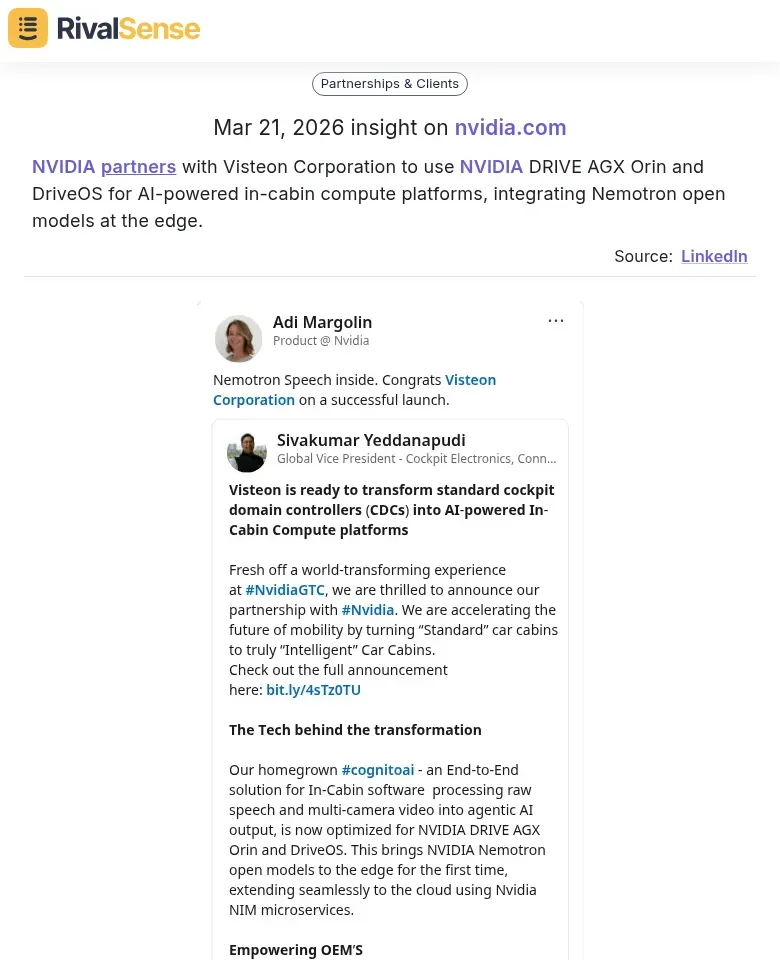
Why this insight matters: Monitoring partnerships like this is valuable for business strategy as it reveals how competitors are expanding their ecosystems, creating lock-in effects, and addressing regulatory requirements such as data sovereignty.
The edge-to-cloud AI arbitration architecture powered by NVIDIA DRIVE AGX Orin enables dynamic workload distribution between vehicle edge and cloud, optimizing for latency, privacy, and connectivity. This positions NVIDIA as a full-stack provider in software-defined vehicles through production-ready, regionally governed deployment that addresses data sovereignty and compliance requirements globally.
Competitive Threat Analysis Checklist:
- Infrastructure Lock-in: NVIDIA's integrated AIOS stack creates vendor dependency across the entire AI pipeline
- Market Expansion: Production-ready deployment accelerates NVIDIA's automotive AI adoption beyond autonomous driving
- Data Control: Regional governance capabilities address automaker concerns about data residency and compliance
- Scalability Advantage: Edge-to-cloud architecture enables fleet-wide AI model evolution and continuous learning
Practical Monitoring Tips:
- 📊 Track NVIDIA's automotive partnership announcements for pattern recognition
- 🚗 Monitor Visteon's customer wins to gauge market adoption rates
- 🔬 Analyze NVIDIA's AI Factory principles implementation across automotive verticals
- 👀 Watch for similar edge-to-cloud architectures emerging from competitors
This deal demonstrates NVIDIA's strategic pivot from chip supplier to complete AI infrastructure provider, creating significant barriers to entry for competitors lacking full-stack capabilities.
Intel's Counter-Strategy: Whole-Vehicle Edge AI Platform
Facing integrated threats requires a cohesive and innovative response. Intel's counter-strategy centered on a comprehensive whole-vehicle edge AI platform that directly addressed NVIDIA's strengths while leveraging Intel's system-level advantages. At CES 2025, Intel unveiled three key components:
Adaptive Control Unit (ACU) Technology: The ACU U310 represents a breakthrough for EV powertrains and zonal controllers, consolidating multiple real-time, safety-critical functions into a single chip. This "dual-brain" approach offloads control algorithms from CPU cores, enabling 3-5% efficiency gains and up to 40% energy loss reclamation. Practical tip: When evaluating edge AI solutions, prioritize platforms that offer hardware-level workload consolidation to reduce BOM costs while maintaining safety certifications.
Second-Generation Intel Arc B-series Graphics: Set for production by end of 2025, this solution provides scalable AI compute for advanced in-vehicle workloads, next-generation HMI engines, and immersive experiences. Checklist item: Ensure your AI platform supports both current and future workload requirements through modular, scalable GPU architectures that can be upgraded without complete system redesigns.
Intel Automotive Virtual Development Environment: Co-developed with AWS, this cloud-to-car solution ensures true hardware/software parity, eliminating expensive ECU simulators. Key insight: Partner with cloud providers who offer virtual development environments that mirror physical hardware, enabling 30-50% faster development cycles while reducing R&D costs.
Strategic recommendation: When countering dominant competitors, build comprehensive ecosystems rather than point solutions. Intel's approach demonstrates how combining hardware innovation (ACU), AI acceleration (Arc Graphics), and cloud development tools creates defensible market positions that address multiple customer pain points simultaneously.
Partnership Execution: Securing Key Automotive OEMs
Turning strategy into success hinges on effective alliance building. Intel's partnership execution strategy secured key automotive OEMs through targeted collaborations. The Stellantis Motorsports partnership for next-generation inverter control in Formula E racing demonstrates edge AI's real-world performance benefits, with Intel's Adaptive Control Unit U310 delivering efficiency gains in competitive environments. Karma Automotive's bilateral collaboration for software-defined vehicle architecture represents a comprehensive system-level transformation, integrating Intel's AI-enabled SoC for intelligent workload management across Karma's ultra-luxury vehicle platform.
Practical Checklist for Securing OEM Partnerships:
- Identify High-Impact Use Cases: Target applications with clear ROI, like Formula E's inverter efficiency gains
- Offer System-Level Solutions: Move beyond components to comprehensive architectures (SDVA)
- Demonstrate Production Readiness: Show working implementations, not just prototypes
- Create Industry Blueprints: Develop solutions that can scale across multiple OEMs
- Focus on Open Standards: Enable broader industry adoption through interoperable frameworks
These strategic OEM wins validate Intel's production-ready edge AI solutions, proving that real-time AI processing at the edge delivers tangible performance improvements while establishing scalable frameworks for the entire automotive industry.
Competitive Differentiation: Intel's Edge AI Value Proposition
In crowded markets, clear value propositions win deals. Intel's Edge AI value proposition counters NVIDIA's Visteon partnership with three compelling advantages for automakers. First, workload consolidation reduces costs by 15-25% through simplified vehicle BOM—consolidating multiple ECUs onto Intel's software-defined zonal controllers. Practical tip: Map your current ECU architecture and identify redundant functions that can migrate to centralized compute.
Second, energy efficiency gains of 3-5% with up to 40% powertrain energy loss recovery. Intel's intelligent power management dynamically shifts workloads between high-performance central compute and low-power zonal controllers. Checklist:
- Implement SAE J3311 power management standard
- Enable workload migration during vehicle idle states
- Integrate environmental-aware power policies
Third, faster time-to-market through Intel's cloud-to-car development environment with AWS. This virtual development environment provides hardware and software parity, enabling developers to test applications in the cloud before vehicle integration. Key steps:
- Adopt Intel Automotive VDE on AWS
- Establish CI/CD pipelines with performance parity testing
- Leverage x86 architecture consistency from cloud to vehicle
Intel's whole-vehicle approach delivers system-level benefits that individual component optimization cannot match, offering automakers a comprehensive alternative to NVIDIA's edge-to-cloud platform.
Strategic Outcomes and Market Implications
Learning from competitive dynamics can inform future strategic moves. Intel's strategic response to NVIDIA's Visteon acquisition demonstrates how to protect market share against vertical integration threats. By forging partnerships with automakers like BMW and suppliers like Aptiv, Intel established itself as a comprehensive software-defined vehicle platform provider rather than just a chip supplier. This created a more open ecosystem alternative to NVIDIA's integrated approach.
Key outcomes include:
- 🏆 Securing design wins in next-gen vehicles through platform-level solutions
- 🔗 Expanding from compute to full software stack with middleware and development tools
- 🤝 Positioning Intel as a neutral partner versus NVIDIA's captive ecosystem
Practical advice for B2B leaders facing similar competitive threats:
- Assess integration risks: When competitors acquire key partners, evaluate how this affects your ecosystem access
- Build alliance networks: Counter vertical integration with horizontal partnerships across the value chain
- Elevate value proposition: Move from component supplier to platform provider with comprehensive solutions
- Differentiate on openness: Position your approach as more flexible versus closed ecosystems
- Secure anchor customers: Land flagship partnerships that validate your alternative approach
Future implications suggest automotive AI competition will increasingly center on ecosystem strategies rather than just hardware specs. Companies must choose between integrated control (NVIDIA's path) or partnership networks (Intel's approach), with significant implications for market access, innovation speed, and customer lock-in.
Leverage Competitive Insights for Your Strategy
Staying ahead in fast-moving industries requires constant vigilance over competitor moves. As seen in the NVIDIA-Intel battle, partnership announcements, product launches, and ecosystem expansions can signal major strategic shifts. Tools like RivalSense can automate this monitoring by tracking competitor activities across websites, social media, and registries, delivering actionable insights in weekly reports.
To assist with the challenges described in this post, try out RivalSense for free at https://rivalsense.co/. Get your first competitor report today and gain clarity on your competitive landscape.
📚 Read more
👉 Best Practices: Analyzing Competitor Brand Perception on Facebook
👉 Advanced Tactics: Tracking Video Conferencing Leaders for Strategic Edge
👉 How Competitor Insights Solve Market Entry Challenges for Key Account Success
👉 Competitor Analysis in Action: Learning from Keatech's Partnership with EG
👉 HOW TO TRACK KEY ACCOUNT RENEWAL DATES: A STRATEGIC GUIDE FOR 2026