
How Competitor Insights Solve Market Entry Challenges for Key Account Success
Entering new markets without competitor intelligence is like navigating a maze blindfolded—you're bound to hit walls. Market entry transforms from risky guesswork to strategic planning when you leverage competitor insights. These insights reveal where rivals are vulnerable, what key accounts truly value, and how to position your offering for maximum impact.
Competitor analysis directly fuels key account acquisition success by identifying decision-makers' pain points that competitors overlook. For example, a SaaS company entering the European market used competitor tracking to discover that local players lacked robust API integrations—a critical need for their target enterprise accounts. By highlighting this gap in sales conversations, they secured three major accounts within 90 days.
Practical steps to start:
- Map competitor pricing, features, and customer reviews before market entry
- Identify 2-3 key accounts that competitors serve poorly
- Monitor competitor announcements for expansion signals
- Use tools like RivalSense to automate tracking of competitor moves
Real-world example: A fintech firm analyzed competitor partnerships and discovered a gap in SME banking solutions. They tailored their market entry around this underserved segment, capturing 15% market share in their first year. Competitor intelligence turns market barriers into strategic opportunities for key account success.
📍 Learning from Market Entry Patterns: Timing and Location Strategy
Timing and location are everything in market entry. By analyzing competitor expansion patterns, you can identify optimal windows when markets are receptive but not oversaturated. Track when competitors enter new regions—do they follow seasonal trends, economic cycles, or specific industry events? For example, if three major players all launched in Q2 2023 in a specific region, that signals market readiness you might have missed.
Location strategy reveals opportunity zones. Map competitor store openings to identify underserved areas versus saturated markets. Look for clusters—are competitors avoiding certain neighborhoods or demographics? These gaps represent prime entry points. Use heat maps to visualize density patterns and identify white spaces.
For instance, RivalSense tracked that Sephora opened its first store in Stuttgart on March 21:

Why this insight is valuable: Monitoring competitor store openings helps you understand geographic expansion trends and identify potential market gaps. This type of intelligence allows you to time your entry strategically and avoid oversaturated areas.
Practical steps:
- Create a timeline of competitor expansions over the past 2-3 years
- Map physical locations to identify geographic gaps
- Analyze opening dates relative to local economic indicators
- Track foot traffic data around competitor locations
- Monitor social media sentiment before/after openings
Key insight: Competitor openings serve as market validation. If multiple players are expanding in a region, it's a strong signal of consumer demand. However, beware of oversaturation—sometimes the best opportunity is in adjacent markets competitors have overlooked.
🌍 Localization Insights: Adapting to Cultural and Regional Nuances
When entering new markets, studying how competitors localize provides invaluable shortcuts to success. Analyze their cultural adaptation strategies to avoid costly pitfalls. For example, examine how multinational fast-food chains adjust menus for local tastes—like introducing seafood dishes in Japan where seafood is culturally significant.
Take Amazon's recent product launch as an example: RivalSense captured that Amazon's Panos Panay announced on March 19 that Alexa+ Early Access is rolling out in the UK, built by teams in Cambridge to feel authentically British.
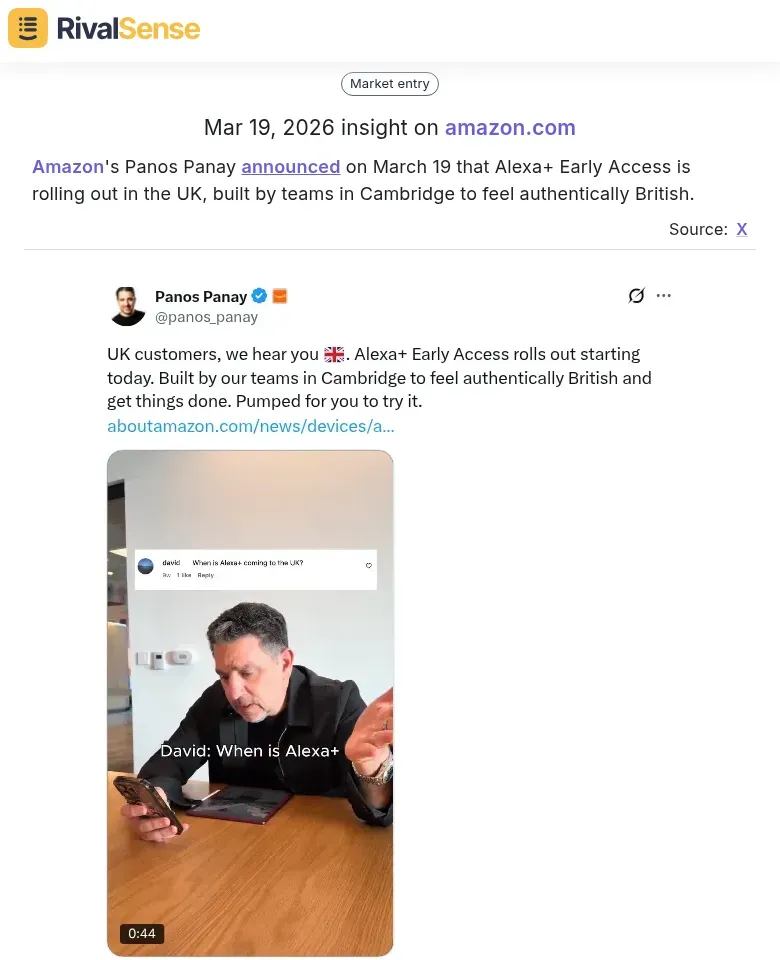
Why this insight is valuable: Tracking product launches and updates like this reveals how competitors adapt offerings to cultural nuances. This helps you learn from their localization efforts and avoid missteps in your own market entry.
Practical Checklist for Competitor Localization Analysis:
✅ Product Adaptation: Track feature changes, packaging modifications, and service adjustments
✅ Cultural Messaging: Analyze marketing campaigns for local cultural references and symbolism
✅ Pricing Strategies: Study how competitors adjust pricing for regional economic conditions
✅ Team Composition: Observe if competitors hire local leadership and culturally-aware staff
✅ Community Engagement: Monitor participation in local events, partnerships, and social initiatives
Key Insight: Successful localization goes beyond translation—it requires authentic cultural understanding. Study how competitors build local presence through hiring regional teams and engaging with community organizations. This creates trust that pure translation cannot achieve.
Actionable Tip: Create a competitor localization matrix tracking 3-5 key competitors across different cultural dimensions. Document their successes and failures to inform your own market entry strategy while avoiding their missteps.
🚀 Competitor Launch Strategies: Learning from Market Entry Execution
When competitors enter new markets, their launch events reveal critical positioning insights. Analyze their celebration formats—are they hosting exclusive VIP gatherings or public community festivals? This signals whether they're targeting enterprise clients or mass-market adoption.
Consider Hemköp's recent store openings: RivalSense reported that Hemköp opened two new stores, Hemköp Strandängen in Jönköping led by store manager Nathalie Nero and Hemköp Matbörsen in Huddinge led by store manager Lennart Ström, with celebrations including fika and activities.
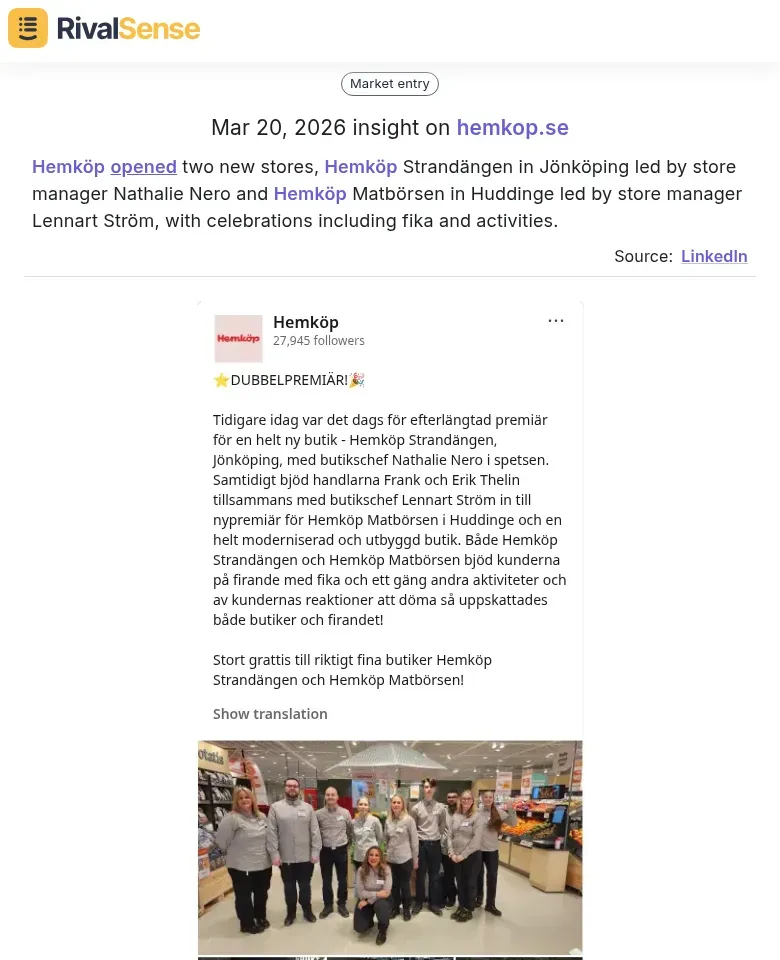
Why this insight is valuable: Monitoring competitor launch events and community engagements provides insights into how they build local presence and credibility. This helps you understand their market entry execution and refine your own launch strategies.
Practical Checklist for Analyzing Competitor Launches:
- Monitor competitor event announcements and guest lists
- Analyze media coverage and social media engagement patterns
- Track post-launch messaging shifts and positioning adjustments
Local leadership appointments provide credibility signals. When competitors hire respected industry veterans or former government officials, they're signaling long-term commitment and regulatory savvy. Study their management team announcements—are they emphasizing local hires or parachuting in expatriates?
Key Questions to Ask:
- How are competitors structuring their local leadership teams?
- What community partnerships are they announcing during launch phases?
- Which local influencers are they engaging for credibility building?
Community engagement tactics during market entry reveal strategic priorities. Competitors who invest in local sponsorships, educational programs, or industry partnerships are building sustainable presence rather than quick market grabs. Track their first 90-day community initiatives—these indicate whether they're pursuing transactional relationships or genuine ecosystem integration.
Pro Tip: Create a competitor launch timeline tracking these three elements simultaneously to identify patterns in their market entry playbook.
🔄 Product and Service Adaptation: Learning from Competitor Innovation
When entering new markets, studying how competitors adapt their offerings provides invaluable insights for key account success. Analyze how successful players modify existing products to meet local regulations, cultural preferences, and market requirements. For example, McDonald's creates region-specific menu items like Chicken McArabia in the Middle East, demonstrating authentic local adaptation.
Practical Checklist for Competitor Product Analysis:
- Map competitor feature development timelines for each region
- Identify which core features get modified vs. which remain standardized
- Study packaging, sizing, and pricing adaptations for local purchasing power
- Analyze how competitors incorporate local payment methods and support services
- Track how they build products with authentic local characteristics (language, imagery, cultural references)
Key Insight: Look beyond surface-level changes. GE Healthcare's portable ECG machine for India (reduced from £10k to £500) shows how competitors sometimes completely reimagine products for specific markets while creating innovations that benefit global operations.
Pro Tip: Use competitor tracking tools to monitor feature releases, pricing changes, and customer feedback across different regions. This reveals patterns in how successful companies balance standardization with localization for maximum market penetration.
🏆 Strategic Application: Turning Competitor Insights into Key Account Wins
Transform competitor intelligence from passive data into active account acquisition strategies with this practical framework:
-
Account Prioritization Matrix: Create a scoring system that evaluates potential key accounts based on competitor presence, contract renewal dates, and service gaps. Focus on accounts where competitors are vulnerable due to recent negative reviews, pricing changes, or service disruptions.
-
Differentiated Value Proposition Development: Analyze competitor weaknesses systematically:
- Map their service gaps from customer reviews and support forums
- Identify pricing pain points through win/loss analysis
- Document implementation challenges from case studies
Build your value proposition around these specific pain points with concrete solutions.
-
Targeted Account Acquisition Playbook:
- Timing Strategy: Track competitor contract renewal cycles and major account announcements
- Stakeholder Mapping: Identify dissatisfied decision-makers within target accounts
- Proof Points: Prepare case studies showing how you've solved competitor weaknesses for similar clients
- Risk Mitigation: Develop migration plans addressing switching costs and implementation concerns
Practical Checklist:
- [ ] Conduct quarterly competitor SWOT analysis focusing on key account vulnerabilities
- [ ] Create competitor battle cards highlighting specific weaknesses for sales teams
- [ ] Set up alerts for competitor account announcements and contract renewals
- [ ] Develop 3-5 competitor-specific value propositions with supporting evidence
- [ ] Establish a win/loss analysis process to continuously refine competitive positioning
Pro Tip: Use competitor intelligence to identify "low-hanging fruit" accounts where competitors are overextended or underperforming, then deploy targeted resources for maximum impact.
🚀 Ready to Accelerate Your Market Entry?
Competitor insights are powerful, but manually tracking them is time-consuming. Imagine having a tool that automates this process, delivering weekly reports on competitor product launches, pricing updates, event participations, and more.
Try RivalSense for free at https://rivalsense.co/ and get your first competitor report today! With RivalSense, you can track competitor moves across company websites, social media, and various registries, turning market entry challenges into key account opportunities.
📚 Read more
👉 Competitor Analysis in Action: Learning from Keatech's Partnership with EG
👉 HOW TO TRACK KEY ACCOUNT RENEWAL DATES: A STRATEGIC GUIDE FOR 2026
👉 Marine Port Services Key Account Risk Tracking Checklist 2026
👉 How ScraperAPI's New Tech Hire Revealed Competitor Expansion Plans
👉 Twitter Competitor Intelligence Framework: Key Account Health Dashboard Template